
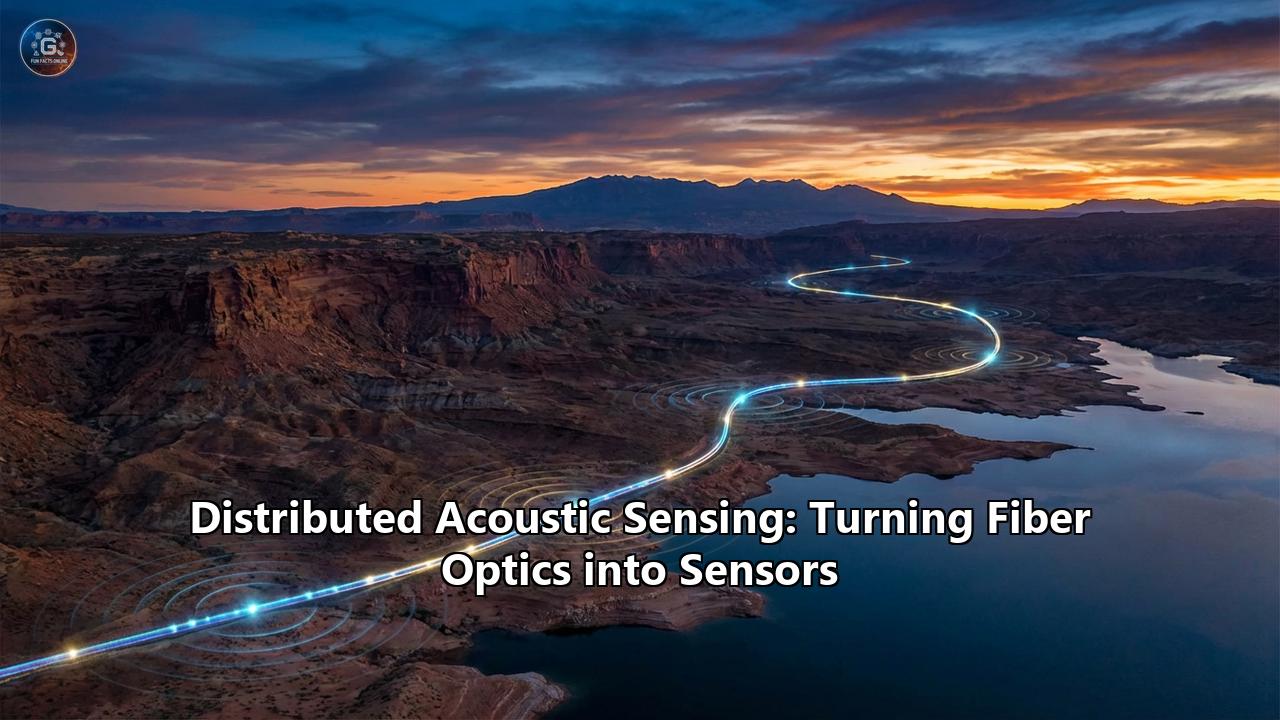
In the quiet hum of the modern world, buried beneath our feet and stringing across our oceans, lies a vast, dormant nervous system. For decades, fiber optic cables have been the silent workhorses of the information age, transmitting pulses of light that carry the internet, telephone calls, and financial transactions across the globe at the speed of light. We have long viewed these glass strands merely as passive pipes—conduits for data. But a revolutionary shift in photonics is reimagining these passive cables as active, feeling sensors. This technology is called Distributed Acoustic Sensing (DAS), and it is turning millions of kilometers of fiber optic infrastructure into the world’s largest, most sensitive microphone.
Imagine a sensor that is not a discrete point device, but a continuous line stretching for 50, 80, or even 100 kilometers. Imagine a system that can detect the footsteps of a trespasser on a remote border, the minute hiss of a leaking pipeline buried deep underground, the strain of a train wheel flattening on a track, and the rumble of a distant earthquake—all simultaneously, and all without a single electronic component in the field. This is the promise of DAS. By listening to the light, engineers and scientists are unlocking a new dimension of awareness, transforming the passive glass threads of our telecommunications networks into a listening ear that spans continents.
The Physics of Listening to Light
To understand how a glass cable can "hear," we must journey into the quantum scale of the fiber itself. Optical fibers are designed to be near-perfect guides for light. A core of pure silica glass, thinner than a human hair, is surrounded by a cladding with a slightly lower refractive index, trapping light inside through total internal reflection. When a laser pulse is sent down this fiber for telecommunications, the goal is for as much light as possible to reach the other end. However, no glass is perfectly pure.
At the microscopic level, the silica lattice contains tiny imperfections—frozen variations in density and refractive index that occurred when the glass was manufactured. These imperfections act like microscopic obstacles in a hallway. When the photons from a laser pulse encounter these impurities, a tiny fraction of the light is scattered in all directions. Some of this light is scattered backward, returning towards the source. This phenomenon is known as Rayleigh backscattering.
In traditional fiber diagnostics, such as Optical Time Domain Reflectometry (OTDR), this backscatter is used to find breaks in the cable. If the fiber is cut, the backscatter signal drops to zero. But DAS takes this a step further using a technique called Coherent Optical Time Domain Reflectometry (C-OTDR).
A DAS interrogator unit, usually sitting in a server room or a control station, shoots highly coherent laser pulses down the fiber thousands of times per second. As the light travels, it continuously scatters back from those microscopic imperfections. The interrogator captures this returning light. Because the speed of light in glass is constant and known, the time it takes for the backscatter to return corresponds exactly to a specific distance along the fiber.
Here lies the magic: sound is vibration. When an acoustic wave—whether from a person walking, a digging excavator, or a seismic shift—hits the ground, it physically vibrates the soil. These vibrations transfer to the buried fiber optic cable. Even though the fiber is glass, it is slightly elastic. The acoustic pressure causes the fiber to stretch or compress by an infinitesimally small amount—often on the scale of nanometers.
This microscopic deformation changes the distance between the scattering impurities in the glass. When the laser pulse hits these now-shifted impurities, the path length of the backscattered light changes, resulting in a phase shift in the returning light wave. By comparing the phase of the light from one pulse to the next, the DAS interrogator can detect these minute changes.
Essentially, the system analyzes the interference pattern of the backscattered light. If the pattern changes at a specific point (say, 15.4 kilometers down the line), it means the fiber was disturbed at that location. By processing these phase changes at high speeds, the system reconstructs the acoustic signal that caused the disturbance. The result is a system that treats every meter of the fiber as a separate, high-fidelity virtual microphone. A 50-kilometer cable thus becomes an array of 50,000 sensing points, listening in real-time.
The Anatomy of a DAS System
The beauty of Distributed Acoustic Sensing lies in its simplicity of deployment relative to its capability. A typical system consists of three main components: the Interrogator Unit (IU), the optical fiber, and the processing software.
The Interrogator Unit is the brain of the operation. It houses the laser source, the optical receiver, and the initial signal processing hardware. Modern interrogators are marvels of optoelectronics, capable of firing laser pulses with extreme frequency stability and detecting phase shifts with sub-radian precision. They must process gigabytes of raw optical data every second to extract the acoustic signature.
The Optical Fiber is the sensor itself. One of the most compelling aspects of DAS is that it often requires no special cabling. Standard single-mode fibers—the same kind used by internet service providers—work perfectly well. This allows operators to utilize "dark fiber," which refers to unused strands within existing telecom cables. For more specialized applications, such as high-temperature oil wells, engineered fibers with enhanced scattering profiles or ruggedized coatings may be used to improve sensitivity and survivability.
The Processing Software is where the raw data becomes actionable intelligence. The interrogator outputs a "waterfall" of acoustic data—time on one axis, distance on the other, and intensity represented by color. To a human eye, this raw data looks like static noise. Advanced algorithms, increasingly powered by Artificial Intelligence (AI) and Machine Learning (ML), are required to sift through this noise. They distinguish between the rhythmic thud of a compressor, the chaotic frequency of a leak, and the transient impact of footsteps, filtering out environmental background noise like wind or rain.
Revolutionizing the Oil and Gas Industry
The earliest and most robust adopter of DAS technology has been the oil and gas sector. The industry deals with assets that are vast, buried, and hazardous—a perfect fit for a sensor that can survive high pressures and temperatures without needing onboard electronics.
Pipeline Integrity and Security: Pipelines stretch for thousands of kilometers, often through uninhabited and hostile terrain. They are vulnerable to two main threats: leaks and third-party interference (TPI). A small pinhole leak in a high-pressure gas pipeline generates a specific high-frequency hiss as the gas escapes into the surrounding soil. This sound causes a vibration that DAS can detect almost instantly, pinpointing the leak to within a few meters. Traditional methods, such as mass balance calculations, might take hours or days to notice a small drop in pressure. DAS hears the leak the moment it starts.Furthermore, oil theft and accidental damage by construction crews are major concerns. DAS acts as a continuous security perimeter. The system can detect the heavy thrum of an excavator engine or the rhythmic digging of a shovel long before the bucket hits the pipe. Algorithms can classify these sounds and alert the control center, allowing operators to shut down the line or dispatch security before a breach occurs.
Downhole Monitoring: In the upstream sector, DAS is transforming how engineers see inside the Earth. Fiber cables are strapped to the outside of well casings or lowered inside via wireline. Once in place, they provide a full vertical acoustic profile of the well. This is widely used for Vertical Seismic Profiling (VSP), where a seismic source on the surface sends waves into the ground. The fiber picks up these waves at every depth, allowing geophysicists to create detailed images of the rock formations and reservoirs.During hydraulic fracturing (fracking), DAS listens to the rock cracking. It allows engineers to hear exactly where the fractures are opening and how effectively the treatment is stimulating the reservoir. It can also detect "cross-well communication," where a fracture from one well accidentally hits another, preventing costly operational failures.
The Nervous System of Smart Cities and Transport
As DAS technology matures, it is moving out of the oil fields and into the urban jungle. Our cities and transport networks are becoming "smart," and DAS is providing the sensory input they need.
Railways: Trains are heavy, noisy, and run on fixed tracks—an ideal environment for acoustic sensing. By connecting a DAS unit to a fiber buried alongside the tracks, railway operators gain a comprehensive view of the entire network.- Train Tracking: DAS can track the exact position and speed of a train continuously, without the need for discrete signaling blocks or GPS, which can fail in tunnels.
- Asset Health: When a train wheel develops a flat spot, it hammers the track with every rotation. This rhythmic impact stands out clearly in the DAS data. Similarly, a broken rail or a loose sleeper has a distinct acoustic signature. Identifying these issues early prevents derailments and reduces maintenance costs by allowing for predictive, rather than reactive, repairs.
- Safety: DAS can detect people walking on the tracks, rockfalls blocking the line, or cable thieves trying to cut copper signaling wires.
Perimeter Security: The Invisible Wall
Border control agencies and critical infrastructure facilities (like nuclear power plants and airports) are turning to DAS to create invisible, unbreachable perimeters. Traditional fences can be cut or climbed. Cameras have blind spots. But a fiber optic cable buried a meter underground is impossible to evade.
A DAS system creates a sensing zone that can detect an intruder approaching the perimeter before they even touch the fence. The algorithms are sophisticated enough to differentiate between a human walking, a human crawling, a deer, or a vehicle. In border security applications, a single system can monitor up to 100 kilometers of border line, drastically reducing the manpower needed for patrols. Because the sensor is buried, it is covert; intruders do not know they are being watched until authorities arrive.
Earth Sciences: The Dark Fiber Revolution
Perhaps the most scientifically exciting application of DAS is in seismology. Traditional seismometers are expensive and difficult to deploy. They are typically spaced tens of kilometers apart, leaving massive gaps in our data coverage.
Scientists have realized that the world is already wrapped in a dense web of "dark fiber"—unused telecommunications cables. By hooking a DAS interrogator to the end of a dark fiber running under a city or across the ocean floor, researchers can instantly turn that cable into a massive seismic array.
This was famously demonstrated in California, where researchers used dark fiber to detect aftershocks from earthquakes with unprecedented resolution. They could map the subsurface faults beneath urban areas in detail that was previously impossible. In volcanology, fibers laid on the slopes of active volcanoes listen to the internal rumblings of magma and gas, providing early warning signs of eruptions without putting scientists in harm's way.
The technology is also making waves in oceanography. Subsea cables are being used to detect underwater earthquakes and even track the songs of whales. The sheer scale of data from these "ocean bottom" DAS arrays is helping scientists understand the complex interactions between the solid earth and the oceans.
The Data Challenge and the Role of AI
If there is an Achilles' heel to Distributed Acoustic Sensing, it is the sheer volume of data it produces. A single interrogator sampling 50 kilometers of fiber at 10 kilohertz can generate terabytes of data per day. Transmitting this amount of raw data to the cloud is often impossible, especially from remote oil rigs or border posts.
This has necessitated a shift toward "Edge Computing." Modern DAS units process the data locally, on the device itself. They don't send the raw acoustic files; they send the answers. For example, instead of streaming the sound of a pipeline for 24 hours, the system simply sends a message: "Excavator detected at kilometer 12.5, confidence 98%."
This is where Artificial Intelligence becomes the critical enabler. The acoustic environment of the real world is messy. Rain pounding on the ground creates noise. A tractor plowing a field near a pipeline creates vibrations that look similar to malicious digging. Machine Learning models are trained on vast libraries of sounds to distinguish these events. Neural networks analyze the spectral content, the temporal pattern, and the energy distribution of the signal to classify it. As these models ingest more data, they become smarter, reducing false alarms—the bane of any security system.
Advantages Over Traditional Sensing
The rise of DAS is driven by its distinct advantages over conventional sensor networks:
- Continuity: Traditional sensors (like geophones or cameras) are point sensors. If an event happens between two sensors, it might be missed. DAS provides continuous coverage with no blind spots.
- Range: A single unit can monitor up to 100 kilometers of fiber (50km in each direction from the source). Using optical amplifiers, this range can be extended further.
- Passive Nature: The fiber in the field requires no power. There are no batteries to change, no electronics to fail in the rain, and no sparks that could ignite gas in a hazardous environment.
- Durability: Fiber optic cables are immune to electromagnetic interference (EMI), corrosion, and extreme temperatures. They can last for decades with zero maintenance.
- Cost-Effectiveness: In many cases, the fiber is already there. Utilizing existing telecom infrastructure (retrofitting) dramatically lowers the cost of deployment compared to installing thousands of new discrete sensors.
The Future Horizon
The future of Distributed Acoustic Sensing is one of convergence and ubiquity. We are seeing the emergence of "multi-sensing" platforms. By combining DAS with Distributed Temperature Sensing (DTS) and Distributed Strain Sensing (DSS), a single fiber can measure sound, heat, and physical stretch simultaneously. This provides a holistic view of asset health—for example, detecting a power cable that is overheating (DTS) and vibrating due to wind (DAS) before it snaps.
As the cost of interrogator units falls (driven by the commoditization of photonic components), DAS will likely become a standard feature in all new infrastructure projects. Smart buildings will use fiber in their walls to detect structural stress and occupancy. Smart grids will use it to monitor the health of every meter of power line.
In the grand tapestry of technological evolution, Distributed Acoustic Sensing represents a shift from observing the world in discrete pixels to sensing it as a continuous wave. It is a technology that gives the planet a voice, allowing us to listen to the heartbeat of our infrastructure and the Earth itself. As we continue to refine the algorithms and expand the networks, we are effectively building a planetary-scale nervous system, one that promises to make our world safer, more efficient, and more deeply understood.
Reference:
- https://www.fjinno.net/das-dts-fiber-optic-what-is-the-difference-and-which-is-better-for-pipeline-monitoring/
- https://www.apsensing.com/en/technology-and-products/distributed-acoustic-sensing
- https://terra15.com.au/what-is-distributed-acoustic-sensing-das/
- https://silixa.com/resources/what-is-distributed-sensing/
- https://www.spiedigitallibrary.org/conference-proceedings-of-spie/13639/1363904/Distributed-acoustic-sensing-DAS-a-real-world-perspective-requirements-applications/10.1117/12.3062464.full
- https://www.bandweaver.com/fiber_optic_sensing_technology/
- https://en.wikipedia.org/wiki/Distributed_acoustic_sensing
- https://pubs.geoscienceworld.org/seg/geophysics/article/88/6/WC1/624227/Applications-and-limitations-of-distributed
- https://www.skyquestt.com/report/distributed-acoustic-sensing-market
- https://www.networkintegritysystems.com/hubfs/DAS%20in%20the%20Age%20of%20AI.pdf
- https://orbi.umons.ac.be/bitstream/20.500.12907/5823/1/SENSORS_BG_March2022.pdf
- https://www.sensonic.com/en/blog/5-uses-of-distributed-acoustic-sensing-das--3265/
- https://www.sensonic.com/en/blog/what-is-distributed-acoustic-sensing-how-does-it-work--3274/