
When the James Webb Space Telescope (JWST) first opened its golden hexagonal eyes to the cosmos in mid-2022, astronomers expected to see the first galaxies. They anticipated seeing "blue" galaxies—clumps of pristine, hot, young stars forming in the primordial hydrogen fog of the early universe. Standard cosmological models predicted that the further back we looked, the smaller and bluer the galaxies would become, representing the fragile, chaotic infancy of the cosmos.
Instead, JWST found something that shouldn’t have been there.
Scattered across the deep fields—among the faint, ragged smears of early galaxies—were hundreds of tiny, intense points of red light. They were compact, almost indistinguishable from stars, yet their redshift placed them merely 600 million to 1.5 billion years after the Big Bang. They were too red to be standard blue starbursts and too compact to be typical galaxies. To the casual observer, they were mere specks, digital noise in the grand tapestry of the universe. But to the spectroscopic instruments of JWST, they were screaming with energy.
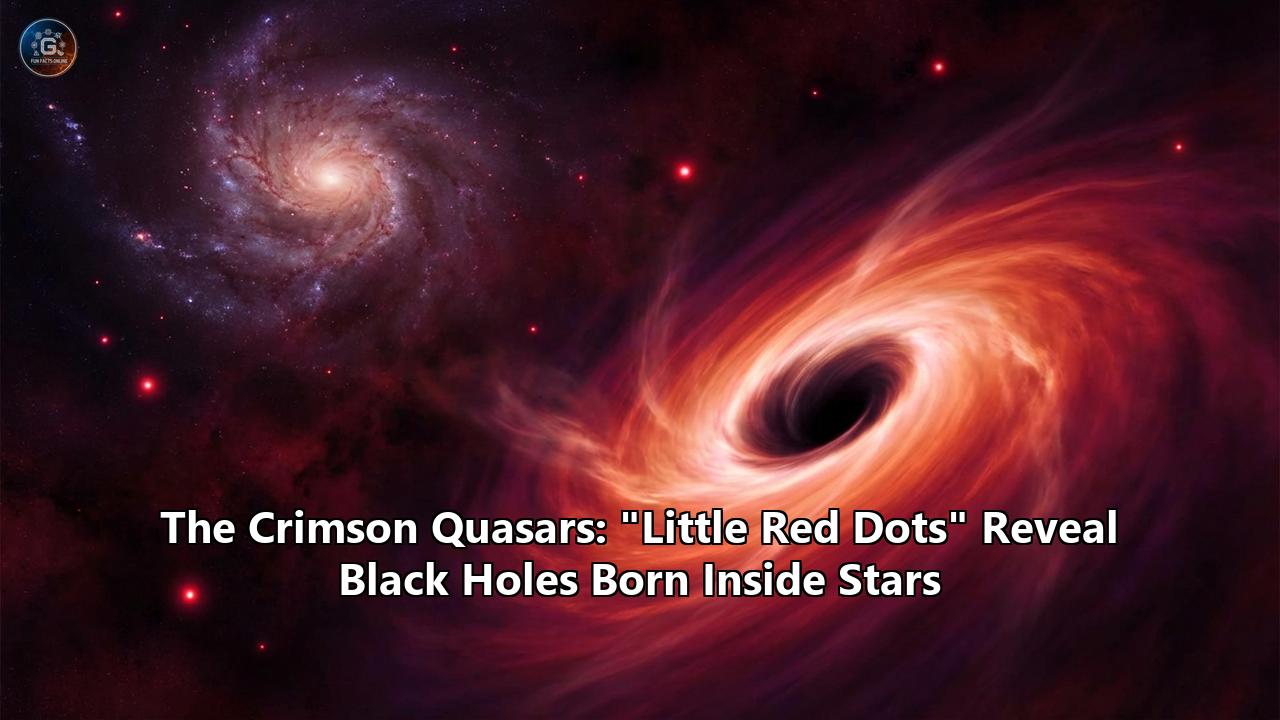
Astronomers colloquially dubbed them "Little Red Dots" (LRDs). But as the data began to be analyzed, a more dramatic picture emerged. These were not merely red galaxies. They were something far more exotic: a missing link in the evolution of the universe, a bridge between the first stars and the monstrous supermassive black holes that anchor galaxies today. Some theories suggest they are "Crimson Quasars"—baby black holes shrouded in thick veils of dust. Others propose an even more radical idea: that we are looking at "Black Hole Stars," or quasi-stars—gigantic celestial objects where a black hole lives inside a massive star, eating it from the inside out.
This discovery has sparked a crisis in cosmology, challenging our understanding of how the universe grew up. It offers a potential solution to the long-standing "impossible early black hole" problem, suggesting that the monsters in the dark didn't grow slowly over eons—they were born heavy, violent, and red.
Part I: The Accidental DiscoveryThe story of the Little Red Dots began not as a targeted hunt, but as a byproduct of broader surveys. The EIGER (Emission-line galaxies and Intergalactic Gas in the Epoch of Reionization) and FRESCO (First Reionization Epoch Spectroscopically Complete Observations) surveys were designed to map the distribution of galaxies and gas in the early universe. The goal was to understand "Reionization," the era when the first lights turned on and burned away the cosmic fog.
Professor Jorryt Matthee, an astrophysicist at the Institute of Science and Technology Austria (ISTA), was among the first to notice the pattern. While analyzing images of the distant universe, his team found that a specific population of objects was systematically being misclassified. In observations by the Hubble Space Telescope, these objects were either invisible or barely detectable faint smudges. But to JWST’s Near-Infrared Camera (NIRCam), they blazed with intensity.
"Without having been developed for this specific purpose, the JWST helped us determine that faint little red dots—found very far away in the Universe's distant past—are small versions of extremely massive black holes," Matthee later stated.
The initial confusion stemmed from their color. In astronomy, "red" usually means one of two things: age or dust. Old stars are cool and red; young stars are hot and blue. However, dust also scatters blue light (much like a sunset), making objects behind it appear redder.
These objects were at high redshifts (z ≈ 4-9), meaning they existed when the universe was less than 1.5 billion years old. There hadn't been enough time for stars to grow "old" and red. Therefore, the redness had to come from dust or a unique physical process. But if they were dusty galaxies, they should have been large, sprawling clouds of star formation. Instead, they were point-sources—compact, unresolved dots with radii often less than 100 parsecs (roughly 300 light-years). For comparison, our Milky Way is 100,000 light-years across.
These LRDs were pouring out the energy of a billion suns from a space smaller than a typical star cluster.
Part II: The "Impossible" MonstersTo understand why the Little Red Dots are so disruptive, one must understand the "Problematic Quasar" dilemma.
For decades, astronomers have detected quasars—supermassive black holes (SMBHs) actively feeding on gas—at very high redshifts. Some of these quasars, like J0313-1806, existed just 670 million years after the Big Bang and already possessed masses billions of times that of our Sun.
This presents a paradox. In the standard model of black hole growth, a black hole starts as a "seed"—the remnant of a massive star, perhaps 10 to 100 times the mass of the Sun. This seed then eats gas (accretion) to grow. But there is a physical speed limit to this feeding, known as the Eddington Limit. If a black hole eats too fast, the radiation pressure from the superheated gas pushes away the food, choking the black hole.
Even if a 100-solar-mass seed ate at the maximum Eddington rate continuously for 670 million years, it could not reach a billion solar masses. It’s like finding a kindergarten child who is seven feet tall and weighs 300 pounds. The math of growth doesn’t add up.
Theorists proposed two solutions:
- Super-Eddington Accretion: The black holes somehow broke the speed limit, force-feeding themselves faster than physics should allow.
- Heavy Seeds: The black holes didn't start as 10-solar-mass stellar remnants. Instead, they started as massive "seeds" of 10,000 to 100,000 solar masses, formed by the direct collapse of giant gas clouds.
The Little Red Dots appear to be the "smoking gun" for one or both of these scenarios.
Spectroscopy of the LRDs revealed broad H-alpha emission lines. In astrophysics, broad lines are a tell-tale sign of gas moving at incredible speeds—thousands of kilometers per second. This happens in the extreme gravity well of a black hole. By measuring the width of these lines, astronomers could estimate the mass of the central object.
The results were shocking. The black holes inside these Little Red Dots were massive—10 million to 100 million solar masses—but they were residing in tiny, low-mass galaxies. In the local universe, a black hole is typically 0.1% of its galaxy's mass. In the LRDs, the black hole could be 10% or even almost all of the mass. These weren't galaxies with black holes; they were black holes wearing galaxies like a thin coat.
Part III: The "Black Hole Star" HypothesisThe most radical and fascinating explanation for the Little Red Dots comes from a team including Anna de Graaff (MPIA) and researchers from Penn State, who analyzed a specific, extreme LRD nicknamed "The Cliff."
"The Cliff" (technically RUBIES-UDS-154183) is a bright red object at redshift z=3.55. Its spectrum was baffling. It showed signs of a supermassive black hole, but it lacked the X-ray emissions that should accompany such a monster. Standard Active Galactic Nuclei (AGN) are bright in X-rays because the inner accretion disk gets hot enough to emit them. The LRDs, however, are often "X-ray quiet."
Furthermore, the shape of the spectrum—the way its light varied across different wavelengths—didn't fit the model of a dusty doughnut (torus) obscuring a black hole. It looked more like a star—a really, really weird red star.
This led to the resurrection of a theoretical object known as a Quasi-Star or Black Hole Star.
What is a Black Hole Star?Imagine a cloud of pristine gas in the early universe, millions of times the mass of the Sun. Under gravity, it collapses. Usually, this cloud would fragment into thousands of normal stars. But if the conditions are right (high temperature, no heavy metals to cool the gas), it collapses into a single, monolithic object.
The core of this cloud becomes so dense it collapses directly into a black hole. But—and this is the key—the outer layers of the gas cloud are so massive that they don't blow away. The black hole is trapped inside the gas cloud.
You end up with a hybrid object: a supermassive black hole at the center, surrounded by a massive envelope of gas. The black hole eats the gas from the inside. This accretion generates tremendous energy. The energy heats the outer gas envelope, causing it to swell and glow.
To an outside observer (like JWST), you don't see the black hole or the accretion disk. You see the glowing outer shell. Because the shell is huge and relatively cool (compared to an accretion disk), it glows red. It looks like a red supergiant star, but one that is millions of times brighter and larger than Betelgeuse.
This "Black Hole Star" hypothesis perfectly fits the LRD data:
- Compact: It looks like a point source, not a galaxy.
- Red: The outer envelope is cool (thousands of degrees, not millions), emitting red and infrared light.
- No X-rays: The thick gas envelope completely absorbs the high-energy X-rays generated by the black hole, reprocessing them into lower-energy heat (infrared light).
- Broad Lines: The gas inside is turbulent and moving fast, creating the spectral signature of a black hole.
If this hypothesis holds, the "Little Red Dots" are snapshots of the universe's most violent gestation period—the moment when the first supermassive black hole seeds were being incubated inside giant cocoons of gas.
Part IV: The "Heavy Seed" NurseriesFabio Pacucci of the Center for Astrophysics | Harvard & Smithsonian, along with collaborators, has proposed a complementary but distinct mechanism detailed in their paper "Little Red Dots Are Nurseries of Massive Black Holes" (2025).
Pacucci’s team tackled the problem of density. If LRDs are composed entirely of stars, the stellar density at their cores would be astronomical—far exceeding that of globular clusters. In such a cramped environment, stars would not orbit peacefully. They would crash into each other.
The Runaway Collision ScenarioIn the dense core of an LRD, the stars are packed so tightly that they undergo "runaway collisions." A massive star collides with another, merging to become bigger. Its increased gravity pulls in more stars. It grows exponentially, becoming a Very Massive Star (VMS) with a mass of 10,000 to 100,000 suns.
This VMS is unstable. It lives fast and dies young, collapsing under its own weight. But unlike a normal star that leaves behind a 10-solar-mass black hole, a VMS collapses directly into a "Heavy Seed" black hole of roughly 10,000 solar masses.
This mechanism provides a natural factory for the heavy seeds required to explain the "Problematic Quasars." The LRDs are essentially "black hole nurseries," where the extreme conditions of the early universe forced stars to merge into monsters.
Pacucci’s modeling shows that this process is fast—taking less than a million years. This fits the narrow time window in which LRDs are observed. Once the black hole forms and eats the remaining gas, it likely blows away the cocoon and reveals itself as a bright, blue quasar—the type we have seen for decades. The LRDs are the "cocoon phase" of quasar evolution.
Part V: Case Studies of the Crimson AnomaliesTo truly appreciate the weirdness of these objects, we must look at specific examples identified by the RUBIES and CAPERS teams.
1. "The Cliff" (RUBIES-UDS-154183)- Redshift: z = 3.55
- The Feature: Named for a dramatic drop in its spectrum (a "Balmer Break"), "The Cliff" is the poster child for the Black Hole Star hypothesis.
- Why it matters: A Balmer Break usually indicates an old population of stars (where the hydrogen has been used up). But at this redshift, the galaxy shouldn't be "old." The Black Hole Star model explains this break not as age, but as the specific atmospheric signature of the dense gas envelope surrounding the black hole. The "atmosphere" of the black hole star mimics the chemistry of an old galaxy, fooling our standard tools.
- Redshift: z = 9.288
- Significance: This object exists just ~500 million years after the Big Bang. It is one of the furthest confirmed black holes.
- The Puzzle: It hosts a "Broad Line AGN," meaning the black hole is already churning gas at high speeds. Its existence so early pushes the "Heavy Seed" theory to the limit. It implies that the process of forming massive black holes began almost immediately after the first stars turned on.
- Redshift: z ≈ 4.5
- The Brightest: This is the most optically luminous LRD found so far.
- The Gas Mystery: ALMA (the Atacama Large Millimeter/submillimeter Array) looked at this object to find the molecular gas that usually fuels star formation (Carbon Monoxide, CO). It found... nothing. Or at least, very little.
- The Implication: This suggests the LRD is not a standard "starburst" galaxy where gas is turning into stars. If it were, ALMA would see the CO. Instead, it detected neutral atomic carbon, hinting at a very different, perhaps harsher environment dominated by the radiation of the central black hole, dissociated from standard molecular clouds.
One of the most engaging aspects of the LRD mystery is how they deceived astronomers for so long. In Hubble images, they looked like boring, faint red blobs. Why?
The V-Shape SpectrumThe spectral energy distribution (SED) of an LRD is often described as "V-shaped."
- The Blue Wing: In the ultraviolet (rest-frame), there is a faint blue glow. This likely comes from the host galaxy—the scattered young stars that manage to shine around the central monster.
- The Dip: There is a dip in the visible light range.
- The Red Wing: In the infrared (rest-frame optical), the brightness rockets up. This is the "red" dominant component.
Standard models tried to fit this as a "Dusty AGN"—a blue quasar hidden behind a red dust screen. But the math failed. To be that red from dust, the dust would have to be so thick it would block all the light.
The "Black Hole Star" or "Dense Gas Shroud" model fixes this. The red light isn't reddened by dust; it is intrinsically red. The object itself is glowing red, like a hot poker. It is a 5,000-degree Kelvin surface of a gas cloud that is light-years wide, powered by a black hole heart. This distinction—between "reddened by dust" and "intrinsically red"—is the pivot point of the entire discovery.
Part VII: The "Missing" X-RaysA major piece of evidence supporting the exotic nature of LRDs is the "X-ray weakness." The Chandra X-ray Observatory, which has been detecting black holes for 25 years, stared at the patches of sky containing LRDs. It should have seen them shining like beacons.
It saw darkness.
If these were standard supermassive black holes, their X-ray luminosity should be proportional to their optical luminosity. The LRDs are under-luminous in X-rays by factors of 100 or more.
This supports the "Cocoon" or "Black Hole Star" theory. X-rays are high-energy photons. They are easily blocked by dense gas (this is why you wear a lead vest at the dentist). If the black hole is buried inside a massive star or a dense nursery, the column density of gas is high enough to completely absorb the X-rays, thermalize them, and re-emit them as the infrared light that JWST sees.
We are not seeing the black hole directly; we are seeing the glowing cage that contains it.
Part VIII: Rewriting Cosmic HistoryThe existence of the Crimson Quasars changes the timeline of the universe.
Old Timeline:- Big Bang.
- Dark Ages.
- Pop III Stars (light seeds) form.
- Stars die, forming 10-100 solar mass black holes.
- Billions of years of slow mergers and eating allow them to become Supermassive Black Holes (SMBHs).
- Big Bang.
- Dark Ages.
- Direct Collapse / Runaway Collisions: Huge gas clouds or dense clusters collapse directly into "Heavy Seeds" (10,000+ solar masses).
- The LRD Phase: These seeds grow rapidly inside gas cocoons (Black Hole Stars), hidden from view (until JWST).
- The Quasar Phase: The black holes get big enough to blow off their cocoons, revealing the "Blue Quasars" we see later.
- Today's SMBHs.
The Little Red Dots are the "teenage years" of black holes—a phase of rapid, messy, obscured growth that we had never seen before because we lacked the infrared vision to pierce the red veil.
Part IX: The Future of the SearchThe discovery of LRDs is just the beginning. The scientific community is currently mobilized to verify the "Black Hole Star" hypothesis.
The Role of ALMAWhile JWST looks at infrared, ALMA looks at millimeter waves (cool dust and gas). Initial observations (like those of A2744-45924) are puzzling because they show less dust than expected. Future campaigns will map the gas dynamics of these objects. If they are truly "Black Hole Stars," ALMA might detect the specific outflow signatures of the gas envelopes expanding or rotating.
Variability StudiesIf LRDs are powered by black holes, they might flicker. Accretion is a chaotic process. By watching these dots over years, astronomers can see if they change in brightness. A steady light points to a star (or Black Hole Star); a flickering light points to a traditional accretion disk. Early results suggest LRDs are remarkably stable, which favors the "Black Hole Star" / stable envelope model over the chaotic "Dusty Quasar" model.
The Next GenerationThe Nancy Grace Roman Space Telescope and future extremely large ground-based telescopes will join the hunt. But for now, JWST remains the only eye sharp enough to resolve these crimson ghosts.
Conclusion: The Universe BreakersThe "Little Red Dots" are more than just a new entry in a catalog. They are "Universe Breakers." They broke our star formation models. They broke our black hole growth models. They broke our expectations of what the early universe looked like.
We used to think the early universe was a place of small, blue, innocent beginnings. The Crimson Quasars reveal a darker, heavier truth: that monsters were born early, born big, and born in the heart of red, dusty cocoons. The "Little Red Dots" are not little at all; they are the titans of the dawn, the heavy seeds from which the structure of our modern cosmos grew.
As we stare at these crimson specks, we are witnessing the primal violence of creation, the very mechanism that allowed the universe to organize itself around the gravitational anchors of black holes. The Golden Eye of Webb has blinked, and in the darkness, it has found a thousand red eyes staring back.
Reference:
- https://www.researchgate.net/publication/389547529_Tentative_detection_of_neutral_gas_in_a_Little_Red_Dot_at_z446
- https://arxiv.org/pdf/2509.02664
- https://arxiv.org/html/2512.15853v2
- https://en.wikipedia.org/wiki/Little_red_dot_(astronomical_object))
- https://www.sciencedaily.com/releases/2025/11/251127102115.htm
- https://news.utexas.edu/2025/07/26/meet-the-universes-earliest-confirmed-black-hole-a-monster-at-the-dawn-of-time/
- https://www.skyatnightmagazine.com/news/capers-lrd-z9
- https://www.mpg.de/25316826/black-hole-stars
- https://www.researchgate.net/publication/397578872_Little_Red_Dots_are_Nurseries_of_Massive_Black_Holes
- https://www.researchgate.net/publication/227646271_Quasi-stars_Accreting_black_holes_inside_massive_envelopes
- https://www.futurity.org/earliest-confirmed-black-hole-capers-lrd-z9-3289962/
- https://arxiv.org/html/2509.02664v1
- https://arxiv.org/html/2509.23490v2
- https://arxiv.org/html/2505.04609v3
- https://arxiv.org/html/2503.00998v1
- https://arxiv.org/pdf/2509.23490