
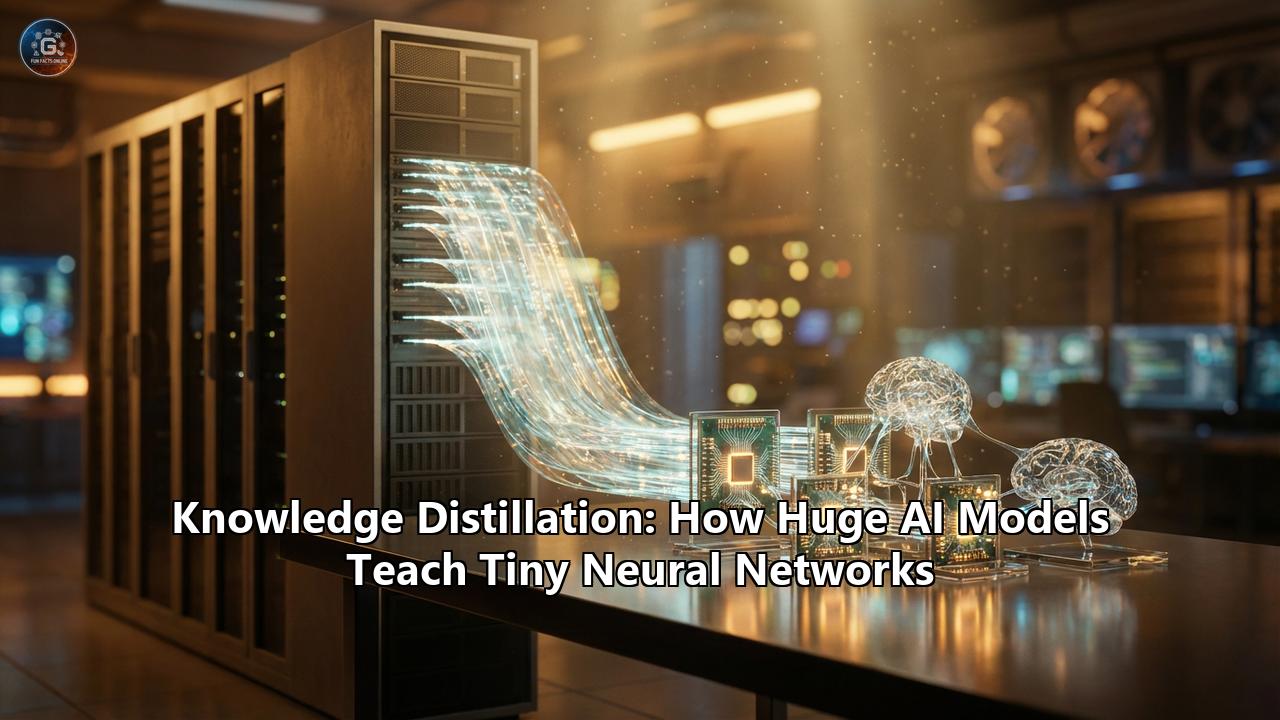
The paradox of modern Artificial Intelligence is a problem of scale. We have cracked the code on intelligence, but the solution is heavy. Models like GPT-4, Claude, and Gemini possess billions, sometimes trillions, of parameters. They are computational leviathans that require warehouse-sized data centers to run. Yet, the world demands intelligence that is light, fast, and local—AI that lives on a smartphone, a robotic arm, or a medical sensor.
This is where Knowledge Distillation (KD) enters the narrative. It is the bridge between the "God-mode" capability of massive supercomputers and the constrained reality of edge devices. It is the pedagogical science of machines teaching machines.
The Genesis: Hunting for "Dark Knowledge"
To understand Knowledge Distillation, we must first understand what a neural network actually learns. When we train a massive Deep Learning model (the Teacher) to classify images, for example, we typically judge it by its top prediction. If it sees a Golden Retriever and says "Golden Retriever," we call it a success.
However, in 2015, Geoffrey Hinton, Oriol Vinyals, and Jeff Dean published a seminal paper titled "Distilling the Knowledge in a Neural Network" that changed everything. They argued that the "correct" answer is the least interesting part of the model's output.
When a massive model analyzes an image of a Golden Retriever, its final output layer (the softmax) might assign a 90% probability to "Dog". But scattered in the remaining 10% are tiny probabilities assigned to other classes: 9% to "Wolf", 0.9% to "Cat", and 0.0001% to "Truck".
In standard training, we ignore these small numbers. We treat them as error. Hinton argued that these small numbers are actually "Dark Knowledge." They reveal how the model thinks. The fact that the model gave "Wolf" a 9% probability and "Truck" a near-zero probability tells us that the model understands the morphology of the animal. It knows a dog looks like a wolf, but not like a truck. This structural understanding—the relationships between incorrect answers—is the essence of intelligence.
Knowledge Distillation is the process of forcing a smaller, compact network (the Student) to learn not just the correct answer, but these subtle, rich probability distributions produced by the Teacher.
The Core Mechanics: Temperature and Soft Targets
How do we transfer this IQ from a 100-layer giant to a 5-layer dwarf? The secret lies in Temperature ($T$).
In a standard softmax function, probabilities are often pushed to extremes (e.g., 0.99 and 0.01) to make a decisive prediction. This sharpness hides the dark knowledge. If the probability of "Wolf" is $10^{-5}$, the student model can't learn from it; the gradient is too small.
Distillation introduces a temperature parameter to the softmax function. By raising $T$, the probability distribution "softens" or flattens. The peak (Dog) lowers, and the valleys (Wolf, Cat) rise. This exposes the hidden relationships.
- The Teacher's Role: The Teacher processes data at high temperature, generating "soft targets" that reveal its reasoning.
- The Student's Role: The Student is trained to minimize two errors simultaneously:
Distillation Loss: The difference between its soft predictions and the Teacher's soft predictions (mimicking the thought process).
Student Loss: The difference between its hard predictions and the actual ground truth (getting the right answer).
This dual-objective training creates a Student that is significantly smarter than if it were trained alone. It effectively "downloads" the generalization capabilities of the Teacher, bypassing the need for the massive dataset and compute power the Teacher originally required.
Taxonomy of Distillation: How Knowledge Flows
As the field evolved beyond 2015, researchers realized that simply mimicking the final output (Response-based KD) wasn't enough for complex tasks. This led to a rich taxonomy of distillation methods.
1. Response-Based Knowledge
This is the classic Hinton approach. The Student mimics the final logit layer of the Teacher. It is simple, efficient, and works remarkably well for classification tasks. However, it treats the Teacher as a "Black Box," ignoring the internal features that led to the decision.
2. Feature-Based Knowledge
If Response-based KD is teaching a student by showing them the answers, Feature-based KD is showing them the workings.
Deep neural networks are hierarchical. Early layers detect edges; middle layers detect textures; deep layers detect semantic objects (eyes, ears, wheels). In Feature-based KD (pioneered by FitNets), the Student is forced to align its intermediate feature maps with the Teacher's.
Since the Student is smaller, its layers are often narrower. Projection layers (1x1 convolutions) are used to resize the Student's feature maps to match the Teacher's dimensions, ensuring the Student "sees" the data the same way the Teacher does at every stage of abstraction.
3. Relation-Based Knowledge
This is the most abstract form. Instead of mimicking specific outputs or features, the Student mimics the relationships between data points.
For example, if the Teacher calculates that Image A is more similar to Image B than Image C, the Student must learn a feature space where that geometric relationship holds true. This preserves the structural topology of the learned manifold, making it highly effective for tasks like face recognition and metric learning.
The Modern Era: Distilling Large Language Models (LLMs)
The explosion of Generative AI (2022–2025) shifted the focus of KD from computer vision to Natural Language Processing. Distilling LLMs presents unique challenges. You cannot simply match "probabilities" when the output is an open-ended sequence of text.
The "White-Box" vs. "Black-Box" Dilemma
In traditional KD, you have access to the Teacher's weights (White-Box). But today, the best Teachers (like GPT-4 or Claude 3.5) are often behind APIs (Black-Box). We cannot see their logits or hidden states.
This has given rise to Data Distillation or Synthetic Transfer:
- Step 1: You take a massive, unlabeled dataset.
- Step 2: You feed it to the Teacher (e.g., GPT-4) and ask it to generate labels, explanations, or "Chain-of-Thought" (CoT) reasoning.
- Step 3: You train a tiny model (e.g., Llama-3-8B or TinyLlama) on this synthetic, high-quality data.
Training Regimes: Offline, Online, and Self-Distillation
- Offline Distillation: The standard approach. A Teacher is pre-trained and frozen. The Student is trained later. This is resource-intensive (you need a big Teacher) but reliable.
- Online Distillation: The Teacher and Student are trained simultaneously. This sounds counter-intuitive—how can an untrained Teacher teach? It turns out that in a "Deep Mutual Learning" setup, two small peer networks teaching each other often outperform one large network. They push each other out of local minima.
- Self-Distillation: The strangest phenomenon of all. A model acts as its own teacher. You train a model, freeze it, and then use it to retrain a fresh version of itself (or deeper layers teaching shallower layers). Empirical evidence suggests this acts as a powerful form of regularization, denoising the dataset and smoothing the decision boundary.
Applications: Where the Rubber Meets the Road
Knowledge Distillation is the unsung hero behind almost every "real-time" AI application today.
- Mobile Vision: FaceID systems and smartphone cameras use distilled models to process images in milliseconds without draining the battery.
- Autonomous Driving: Cars cannot tolerate the latency of sending video to the cloud. Distilled models running on edge hardware (like NVIDIA Jetson) detect pedestrians and lane markers locally.
- IoT and TinyML: Distillation enables "Keyword Spotting" (like "Hey Siri") to run on chips with kilobits of RAM, always listening but consuming micro-watts of power.
- Real-Time Translation: Distilled Transformers allow for on-device language translation, essential for privacy and offline functionality.
Challenges and the Future (2025 Trends)
Despite its success, KD is not magic. The Capacity Gap is a real limit; if the Student is too small, it simply lacks the neural circuitry to comprehend the Teacher's complex patterns, leading to a collapse in performance.
Current research in 2025 is focusing on:
- Quantization-Aware Distillation: Combining KD with 4-bit or 8-bit quantization to create models that are both structurally simple and numerically compressed.
- Cross-Modal Distillation: Using a Teacher trained on rich data (e.g., video + audio) to teach a Student that only sees one modality (e.g., audio only). The Student learns to "hallucinate" the missing visual context, improving performance in blind environments.
- Adversarial Distillation: Using Generative Adversarial Networks (GANs) to generate difficult synthetic examples that probe the Student's weaknesses, forcing it to align more perfectly with the Teacher.
Conclusion
Knowledge Distillation challenges the notion that "bigger is better." It proves that intelligence is not just about the number of neurons, but about the density of information. By compressing the dark knowledge of digital giants into compact, efficient forms, we are democratizing AI—moving it from the server farm to the palm of our hands. As models continue to grow, the art of making them small will become just as important as the science of making them smart.
Reference:
- https://pub.towardsai.net/a-gentle-introduction-to-knowledge-distillation-6240bf8eb8ea
- https://medium.com/@bravekjh/distilling-large-language-models-a-practical-deep-dive-with-code-f9e46cb76e05
- https://www.youtube.com/watch?v=DEsfW7G4UGY
- https://medium.com/@nikitaparate9/understanding-knowledge-distillation-in-simple-terms-01c247ee8a72
- https://medium.com/@asimadnan/understanding-knowledge-distillation-from-hintons-paper-to-openai-s-mini-models-e5a761b0dc47
- https://blog.roboflow.com/what-is-knowledge-distillation/
- https://www.preprints.org/manuscript/202503.0903/v1
- https://en.wikipedia.org/wiki/Knowledge_distillation
- https://htec.com/insights/ai-model-distillation-evolution-and-strategic-imperatives-in-2025/
- https://thesequence.substack.com/p/the-sequence-knowledge-463-wrapping
- https://medium.com/mlworks/distillation-algorithms-for-knowledge-distillation-df80b1e9ad7a
- https://neptune.ai/blog/knowledge-distillation