
For millennia, humanity has gazed upward, projecting its myths and dreams onto the canvas of the night sky. We have populated the stars with gods, heroes, and monsters. But beneath the mythology lay a deeper, more primal question: Are we alone? And corollary to that: Is our home unique?
Earth is defined by water. It shapes our geology, regulates our climate, and, most crucially, serves as the solvent for life itself. From the blue marble photographs of the Apollo missions to the vast oceans that cover 70% of our surface, we are a water world. For decades, astronomers searching for exoplanets—planets orbiting stars other than our Sun—hunted for an "Earth 2.0." They looked for rocky worlds in the habitable zones of their stars, places where liquid water could pool on the surface.
But the universe, in its infinite creativity, does not merely copy Earth. It iterates, experiments, and produces worlds that defy our terrestrial categories. It creates "Hot Jupiters" that orbit closer than Mercury; it creates "diamond planets" made of carbon; and now, we know it creates "Steam Worlds."
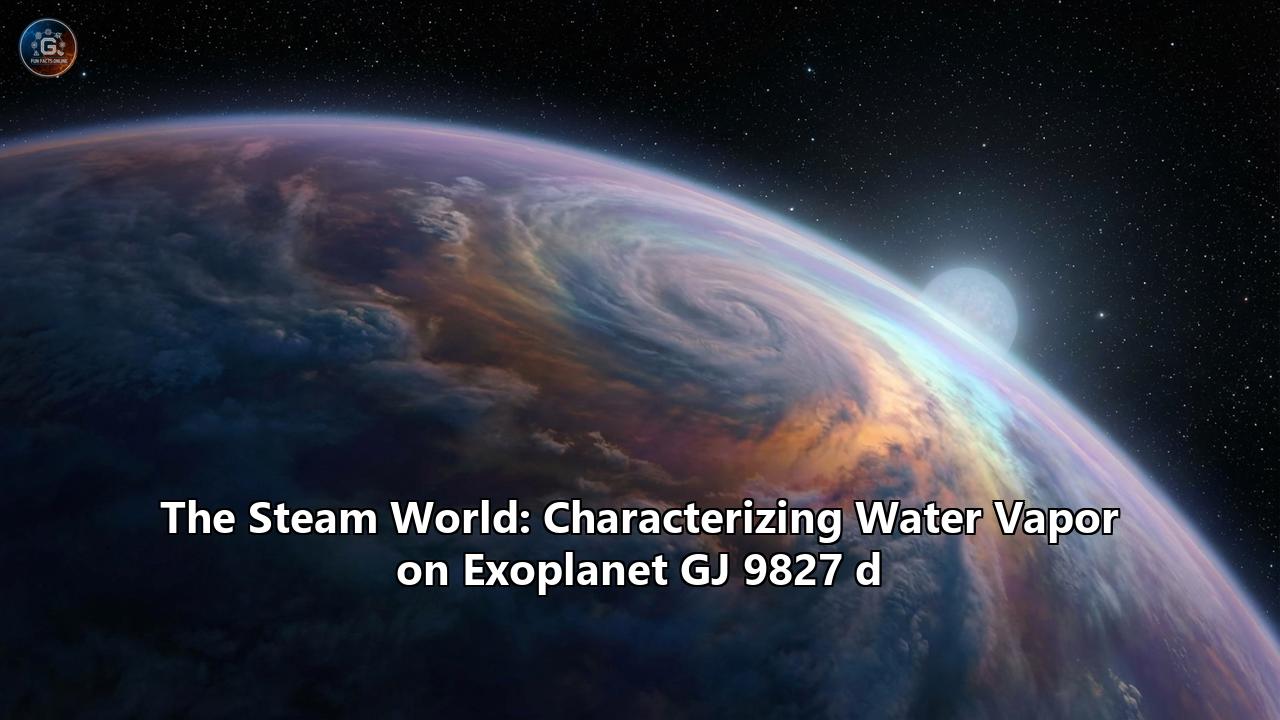
The discovery and characterization of GJ 9827 d marks a watershed moment in the history of astronomy. Located 97 light-years away in the constellation Pisces, this world is not a rocky Earth, nor is it a gas giant like Neptune. It is something in between, a missing link in planetary evolution. It is a world where the atmosphere is not air, but scalding steam; where the oceans do not roll on the surface, but hang suspended in a thick, supercritical fog.
This is the story of that world. It is a story of cutting-edge technology, from the Hubble Space Telescope to the James Webb Space Telescope (JWST). It is a story of scientific detective work, peeling back the layers of light to reveal the chemical heartbeat of a distant planet. And ultimately, it is a story about water, the most precious molecule in the cosmos, and how it manifests in forms we are only just beginning to understand.
Chapter I: The Star in the Fishes
To understand the planet, we must first understand the sun that rules it.
The Constellation Pisces
GJ 9827 d resides in the constellation Pisces, the Fishes. It is an ancient constellation, tracing its roots back to Babylonian astronomy, often depicted as two fish tied together by a cord. While Pisces is faint and lacks the brilliant first-magnitude stars of Orion or Canis Major, it holds a treasure trove for modern astronomers. It is a region of the sky rich in interesting deep-sky objects and, as we now know, planetary systems.
The star system lies approximately 97 to 100 light-years from Earth. In cosmic terms, this is our backyard. If the Milky Way galaxy were the size of the continental United States, GJ 9827 would be a house down the street. This proximity is crucial. It makes the star bright enough for our telescopes to collect high-quality data, allowing for the precise measurements needed to analyze an atmosphere.
The Host Star: GJ 9827
The star itself, designated GJ 9827 (or K2-135 in the Kepler catalog), is a K-type main-sequence star. K-dwarfs, often called "orange dwarfs," are the Goldilocks stars of the galaxy. They are smaller, cooler, and longer-lived than G-type stars like our Sun, but they are larger and brighter than the ubiquitous M-type red dwarfs.
While red dwarfs are known for their violent flares that can strip atmospheres from orbiting planets, K-dwarfs are generally more stable. This stability offers a better environment for planets to retain their atmospheres over billions of years. GJ 9827 has a mass of about 0.6 times that of the Sun and a radius of about 0.6 solar radii. Its surface temperature hovers around 4,200 Kelvin, cooler than the Sun’s 5,778 Kelvin, giving it a warm, orange glow.
However, "stable" is relative. Like all stars, GJ 9827 has magnetic activity. It has starspots (cool, dark patches on the surface) and faculae (bright spots). Understanding the star's "weather" is essential because when astronomers stare at a planet, they are also staring at the star. Separating the signal of the planet's atmosphere from the noise of the star's surface activity is one of the greatest challenges in exoplanet science.
A System of Super-Earths
GJ 9827 is not a lonely star; it hosts a crowded house of planets. Data from NASA's Kepler Space Telescope (specifically the K2 mission) revealed three planets transiting, or passing in front of, the star.
- GJ 9827 b: The innermost planet, a rocky "super-Earth" with a blistering orbital period of just 1.2 days. It is roasted by the star, likely stripped of all volatiles, a bare rock akin to a massive Mercury.
- GJ 9827 c: The middle child, orbiting every 3.6 days. It is also small and rocky, likely having lost its primary atmosphere eons ago.
- GJ 9827 d: The outermost of the known trio, orbiting every 6.2 days.
"Outermost" is a misleading term here. GJ 9827 d orbits at a distance of about 0.056 Astronomical Units (AU) from its star. For comparison, Mercury orbits the Sun at 0.4 AU. GJ 9827 d is roughly ten times closer to its star than Mercury is to the Sun. Despite the star being cooler than the Sun, this proximity means the planet is hot—very hot. Surface equilibrium temperatures are estimated to be around 350°C to 400°C (roughly 660°F to 750°F).
This temperature profile immediately tells us that GJ 9827 d is not habitable in the traditional sense. Liquid water cannot exist on its surface. Yet, it is this specific combination of size, mass, and temperature that makes it the perfect laboratory for studying "steam worlds."
Chapter II: The Hunt for the Missing Link
The discovery of GJ 9827 d did not happen in a vacuum. It occurred during a specific era of exoplanet science defined by a statistical mystery known as the "Radius Valley."
The Kepler Legacy
NASA's Kepler mission revolutionized our understanding of the galaxy. Before Kepler, we only knew of gas giants and a few rocky oddities. Kepler stared at a patch of sky for four years, monitoring over 150,000 stars for the tiny dips in brightness caused by transiting planets.
Kepler found thousands of planets. But as the data piled up, a strange pattern emerged. The most common type of planet in the galaxy appeared to be one that doesn't exist in our solar system: planets larger than Earth but smaller than Neptune. These were dubbed "Super-Earths" and "Sub-Neptunes."
The Radius Valley Mystery
When astronomers plotted the sizes of these small planets, they noticed a gap. There was a bimodal distribution.
- Cluster A: Rocky planets up to about 1.5 times the size of Earth.
- Cluster B: Gaseous planets starting around 2.0 to 2.5 times the size of Earth.
Between 1.5 and 2.0 Earth radii, there was a scarcity of planets. This gap became known as the Fulton Gap or the Radius Valley.
Why does this valley exist? The leading theory is photoevaporation.
- Formation: Planets form with rocky cores and pull in thick envelopes of hydrogen and helium gas from the protoplanetary disk.
- Evolution: For planets close to their star, the intense X-ray and UV radiation heats this light hydrogen atmosphere.
- Escape: If the planet is small (low gravity), the heated gas escapes into space. The planet loses its entire atmosphere and becomes a naked rocky core (Cluster A).
- Retention: If the planet is massive enough (high gravity), it holds onto its gas, remaining a puffy "mini-Neptune" (Cluster B).
The valley represents the dividing line where planets either lose everything or keep enough to stay puffy.
The Sub-Neptune Problem
This theory worked well for hydrogen/helium atmospheres. But it left a question: What about water?
Water is heavy. A water molecule (H2O) weighs 18 atomic mass units, whereas a hydrogen molecule (H2) weighs only 2. Heavy atmospheres are harder to strip away. If a planet were made of a significant amount of water (ice or steam), it might sit right in the middle of the Radius Valley or near the upper edge, defying the simple "rock vs. gas" classification.
GJ 9827 d sits right on this boundary. With a diameter approximately twice that of Earth (roughly 1.9 to 2.0 radii) and a mass about 3.4 times that of Earth, it is a classic "Sub-Neptune" by size. But is it a rocky planet with a massive hydrogen envelope (a mini-Neptune), or is it a rocky core shrouded in heavy volatiles like water?
Kepler could give us the size. Ground-based telescopes could give us the mass. But neither could tell us what the atmosphere was made of. For that, we needed to taste the light.
Chapter III: The Spectral Fingerprint
To determine the composition of an atmosphere trillions of miles away, astronomers use a technique called transmission spectroscopy.
The Art of Transmission Spectroscopy
Imagine a firefly buzzing around a lighthouse beam. When the firefly passes in front of the light, it blocks a tiny fraction of the photons. If you had a sensitive enough detector, you could see the dip in brightness.
Now, imagine the firefly is surrounded by a cloud of colored smoke. When the firefly passes in front of the light, the solid body blocks light completely. But the "smoke" (the atmosphere) is translucent. It lets some light through, but absorbs specific colors.
Every molecule in the universe absorbs light at specific wavelengths. These are their chemical fingerprints. Water vapor, for example, is famous for absorbing infrared light at wavelengths around 1.1, 1.4, and 1.9 microns.
When GJ 9827 d passes in front of its star (a transit), the starlight filters through the planet's atmospheric rim. By analyzing the spectrum of that filtered light, astronomers can look for the missing chunks of the rainbow—the absorption lines.
Hubble’s First Glimpse
The first major breakthrough came from the Hubble Space Telescope (HST). Using its Wide Field Camera 3 (WFC3), a team of astronomers led by researchers from the University of Montreal and the Max Planck Institute observed GJ 9827 d during 11 separate transits over a span of three years.
This was a grueling observation. The signal from the planet's atmosphere is tiny—a variation of less than a percent of a percent. The team had to stack the data from all 11 transits to build a signal strong enough to trust.
The result, published in The Astrophysical Journal Letters in 2023, was electrifying. Hubble detected a distinct absorption feature at 1.4 microns. This is the classic signature of water vapor.
It was the smallest exoplanet ever found to have a detected atmosphere. Before this, we had only detected atmospheres on large gas giants or massive mini-Neptunes. Finding an atmosphere on a world just twice the size of Earth was a technological triumph.
However, Hubble had limitations. Its WFC3 instrument sees a relatively narrow slice of the spectrum. While it saw water, it couldn't definitively rule out other scenarios. Was it a tiny amount of water floating in a massive hydrogen cloud (like a polluted Jupiter)? Or was the atmosphere mostly water?
Hubble couldn't easily distinguish between a "cloudy hydrogen atmosphere with a trace of water" and a "pure water steam atmosphere." The scientific community needed better resolution. They needed the Golden Mirror.
The Power of JWST and NIRISS
Enter the James Webb Space Telescope. Launched in late 2021, JWST is a beast of infrared astronomy. For GJ 9827 d, astronomers utilized the Near-Infrared Imager and Slitless Spectrograph (NIRISS), a Canadian-built instrument specifically designed for this kind of work.
The program, led by Caroline Piaulet-Ghorayeb of the Trottier Institute for Research on Exoplanets (iREx) at the University of Montreal, observed two transits of the planet.
The difference in data quality was staggering. Hubble is a 2.4-meter telescope; JWST is a 6.5-meter telescope. Furthermore, NIRISS/SOSS (Single Object Slitless Spectroscopy) mode covers a wider wavelength range (0.6 to 2.8 microns) with higher sensitivity.
The JWST data confirmed the Hubble findings but added critical detail. It didn't just see water; it saw a lot of water. More importantly, the data allowed the team to rule out the "hydrogen-dominated" model.
If the atmosphere were mostly light hydrogen, it would be "puffy" and extend far out into space, creating a very strong signal. If the atmosphere were made of heavier molecules (like water, CO2, or nitrogen), gravity would compress it closer to the surface, creating a smaller spectral signal (a lower "scale height").
The JWST observations showed a spectral feature that was too compact to be a hydrogen-rich mini-Neptune. The data fit a model where the atmosphere is dominated by heavy molecules—specifically, water. The best-fit models suggest an atmosphere that could be anywhere from 30% to nearly 100% water vapor.
This was the smoking gun. GJ 9827 d was not a gas dwarf. It was a Steam World.
Chapter IV: Anatomy of a Steam World
What does it mean for a planet to be a "Steam World"? We must leave our Earthly intuition behind.
Beyond Solid, Liquid, and Gas
On Earth, we are used to distinct phase transitions. Ice melts to water; water boils to steam. These transitions happen at familiar temperatures and pressures. But physics gets strange when you crank up the heat and pressure.
At the surface of Earth, atmospheric pressure is 1 bar. On Venus, it is 92 bars. On GJ 9827 d, the pressure at the bottom of the atmosphere could be hundreds or thousands of bars.
The planet has a surface temperature of roughly 350°C-400°C. This is far above the boiling point of water at Earth's pressure (100°C). However, high pressure raises the boiling point. So, is there a boiling ocean?
Likely not. We are dealing with the critical point.
The Supercritical State
For every substance, there is a specific temperature and pressure called the "critical point." For water, this occurs at 374°C (647 K) and 218 bars of pressure.
- Below the critical point: You can have distinct liquid and gas phases. You can have a surface ocean with an atmosphere above it.
- Above the critical point: The distinction between liquid and gas vanishes. The substance becomes a supercritical fluid.
A supercritical fluid has properties of both. It can effuse through solids like a gas, but it can dissolve materials like a liquid. It has the density of a liquid but the viscosity of a gas. There is no surface tension. There is no "ocean surface."
On GJ 9827 d, the temperature is right around or above this critical temperature. The pressure deep in the atmosphere almost certainly exceeds the critical pressure.
A Descent into the Vapor
If you were to descend into GJ 9827 d, there would be no splashdown.
- Upper Atmosphere: You would start in a thin, hot layer of water vapor—steam. As you look up, the star GJ 9827 would appear large and orange in the sky, illuminating the white, billowing water clouds. Yes, there would likely be clouds, but they wouldn't be raining liquid water. They might be clouds of salts or other high-temperature condensates.
- Mid-Atmosphere: As you descend, the pressure rises. The steam becomes denser. The sky would likely not be blue (Rayleigh scattering is weaker in infrared), but perhaps a hazy white or grey due to scattering. The heat becomes oppressive, surpassing the temperature of a pizza oven.
- The Transition: You would not hit a water surface. Instead, the steam around you would simply get thicker and thicker. It would transition from a transparent gas to a dense, foggy fluid. The visibility would drop to zero. You are now swimming in supercritical water.
- The Deep Interior: Deeper still, the pressure becomes crushing. This supercritical ocean might extend for thousands of kilometers. Eventually, the pressure becomes so immense that water is forced into exotic solid states, known as High-Pressure Ice (Ice VII or Ice X). These are not cold ices; they are hot, crystalline solids that form under pressure, denser than liquid water.
- The Core: Beneath the layers of hot ice, there is likely a rocky/metallic core, the seed around which this water world gathered.
This is a world of continuous fluid, a global sauna that never ends. It is a hydrological cycle stuck in overdrive, but without the rain-river-ocean cycle we know.
Chapter V: Origins of a Wet World
How does a planet like GJ 9827 d come to exist? Its location creates a paradox.
The Great Migration Theory
Water (H2O) is volatile. In the early solar system, close to the star, it is too hot for water to freeze into ice grains. It remains a vapor. Planets form by accreting solid grains. Therefore, planets that form close to the star (inside the "snow line") are usually dry and rocky, like Mercury, Venus, and Earth. (Earth got its water later, likely from asteroids/comets).
Planets that form outside the snow line (like Jupiter, Saturn, Uranus, Neptune) can accrete massive amounts of water ice.
GJ 9827 d is currently sitting very close to its star—far inside the snow line. Yet, it is made of up to 50% water. This implies it did not form where it is today.
The prevailing theory is Planetary Migration.
- Birth: GJ 9827 d likely formed far away from the star, in the cold outer reaches of the system where water ice was abundant. It gathered a rocky core and a massive mantle of water ice.
- Drift: Through interactions with the protoplanetary disk (Type I migration), the planet spiraled inward over millions of years.
- Arrival: It stopped at its current orbit. As it got closer to the star, the ice melted and sublimated, turning the frozen shell into the steam atmosphere we see today.
In-Situ Formation vs. Arrival from the Cold
There is an alternative, though less favored, hypothesis. Could it have formed in-situ (where it is now)?
For this to happen, the protoplanetary disk would have needed to be incredibly rich in water vapor, or the planet would have had to accrete a truly massive amount of water-rich asteroids (pebble accretion) very quickly before the gas disk dissipated. However, current models of planet formation struggle to explain how a planet could gather so much water so close to a star without it evaporating during the accretion process.
The migration scenario fits the data best. It suggests that GJ 9827 d is a "failed core" of a gas giant. Perhaps if it had stayed further out, it would have accreted hydrogen and become a Neptune. Instead, it migrated in, and the heat stopped it from gathering gas, or stripped the gas away.
Atmospheric Escape and Evolution
This leads to the evolutionary history of the planet. It is possible that GJ 9827 d started as a "Mini-Neptune" with a thick hydrogen envelope and a water core.
Over billions of years, the high-energy radiation from the host star drove a process called Hydrodynamic Escape. The light hydrogen atoms heated up and escaped the planet's gravity, flowing out into space. But water is heavier. The hydrogen escaped, but the water remained.
What we are seeing today is the "skeleton" of a planet—the heavy volatile core revealed after the light hydrogen atmosphere was stripped away. This makes GJ 9827 d a pivotal case study for understanding how planets change over time. It supports the theory that many "Super-Earths" are actually the stripped cores of "Sub-Neptunes."
Chapter VI: Comparative Planetology
To appreciate GJ 9827 d, we must compare it to the neighbors.
Earth vs. GJ 9827 d
- Earth: 1 Earth Radius, 1 Earth Mass. Composition: Mostly rock/metal, with <0.05% water by mass (surface oceans). Atmosphere: Nitrogen/Oxygen.
- GJ 9827 d: ~2 Earth Radii, ~3.4 Earth Masses. Composition: Rock/metal core + massive water envelope (possibly 30-50% water by mass). Atmosphere: Steam.
The difference is quantitative but leads to a qualitative shift. Earth is a "dry" rock with a wet paint of water. GJ 9827 d is a true Water World. If you dried out Earth, it would look roughly the same size. If you dried out GJ 9827 d, it would shrink significantly.
The Icy Moons: Europa and Enceladus
Interestingly, the best analogs for GJ 9827 d might not be planets, but moons. Europa (orbiting Jupiter) and Enceladus (orbiting Saturn) are "water worlds" in their own right. They have rocky cores covered in global oceans topped by ice shells.
If you took Europa, moved it close to the Sun, and melted the ice shell, you would get something that looks a lot like GJ 9827 d (though smaller). GJ 9827 d is essentially a "Super-Europa" that has been thawed out.
Other Water World Candidates
GJ 9827 d is not the only candidate, but it is the best confirmed one.
- GJ 1214 b: A classic "mini-Neptune" shrouded in clouds. Astronomers have debated for a decade if it is water-rich or just has a very hazy hydrogen atmosphere. GJ 9827 d's detection is clearer because the planet is hotter and the clouds might be different, allowing us to see the water signature more easily.
- K2-18 b: Another famous exoplanet where water was detected. However, K2-18 b retains a significant hydrogen envelope. It is a "Hycean" world candidate (Hydrogen + Ocean). GJ 9827 d is different because it seems to have lost its hydrogen. It is a purer form of a steam world.
- TRAPPIST-1 planets: Some of the TRAPPIST planets are suspected to be water-rich, but their signals are harder to read due to the dimness of the star and potential contamination from stellar activity.
GJ 9827 d stands out because it is the smallest planet where we have such a clean, strong detection of heavy molecules.
Chapter VII: Implications for Astrobiology
"Water is life." That is the mantra of astrobiology. So, is there life on GJ 9827 d?
Habitability in the Extreme
The short answer is: Almost certainly not.
Life as we know it requires complex organic molecules (DNA, proteins) which denature (break down) at high temperatures. At 400°C (roughly 750°F), proteins cook instantly. The pressure and supercritical nature of the fluid would also destroy cell membranes.
However, science fiction authors and speculative biologists love to dream. Could there be exotic life in the upper, cooler layers of the atmosphere? Perhaps. But it is highly unlikely. The lack of a solid surface for nutrients to pool and the extreme radiation environment make it a hostile home.
The Proof of Concept for Biosignatures
If the planet is dead, why does it matter for the search for life?
Context.To find life, we need to be able to detect atmospheres on small planets. We need to be able to tell the difference between a barren rock, a gas ball, and a water world. GJ 9827 d is the proof of concept that we can do this.
It proves that:
- Atmospheres exist on small planets: Not all super-Earths are bare rocks stripped by their stars.
- We can detect heavy molecules: We can see water, which is heavier and harder to detect than hydrogen.
- Diversity is real: The universe creates steam worlds, meaning the inventory of planetary types is vast.
If we can detect water steam on a hot, dead world today, it means that tomorrow (or in the next decade), we might detect water vapor—and perhaps oxygen or methane—on a cooler, habitable world. GJ 9827 d is the stepping stone. It is the training ground for the telescopes and the models we will use to find Earth 2.0.
The Future of Atmospheric Characterization
The study of GJ 9827 d is just beginning.
- More JWST Observations: Astronomers will likely point JWST back at it to look for other molecules. Is there Carbon Dioxide (CO2)? Is there Methane (CH4)? The ratio of Carbon to Oxygen (C/O ratio) tells us where the planet formed in the disk.
- Sulfur and Clouds: Are there sulfur clouds? Evidence of volcanism?
- The ELTs: The upcoming Extremely Large Telescopes (30-meter class ground telescopes) will also target this system, using high-resolution spectroscopy to measure wind speeds and atmospheric dynamics.
Epilogue: A Universe of Water
The characterization of GJ 9827 d as a Steam World is a humbling reminder of our limited perspective. For centuries, we divided the solar system into "Terrestrial" (rocky) and "Jovian" (gas/ice giant). We thought those were the only two options.
GJ 9827 d breaks that binary. It introduces a third major category of planet: the Volatile-Rich World. It suggests that water is not just a thin varnish on rocky planets like Earth, but a fundamental building block that can make up the bulk of a planet's mass.
As we continue to scan the heavens, we will likely find that GJ 9827 d is not an oddity, but a member of a vast, silent majority. The galaxy may be teeming with steam worlds, hot saunas orbiting orange stars, their supercritical oceans hiding secrets in the deep, crushing dark.
While we cannot swim in the oceans of GJ 9827 d, its discovery ripples through the scientific community like a wave. It tells us that the water we drink, the rain that falls, and the oceans we sail are part of a cosmic story that is far wetter, far stranger, and far more wonderful than we ever dared to imagine.
End of ArticleThis article synthesizes data from the latest research papers (2023-2024) regarding the HST and JWST observations of GJ 9827 d, integrating current theories on planetary migration, supercritical fluid dynamics, and exoplanet demographics.
Reference:
- https://www.youtube.com/watch?v=YhHLGv76Z0U
- https://www.space.com/space-exploration/search-for-life/nearby-super-earth-k2-18-b-may-be-a-water-rich-ocean-planet-this-has-certainly-increased-the-chances-of-habitability
- https://arxiv.org/html/2409.17042v1
- https://www.researchgate.net/figure/Phase-diagram-of-water-with-Pressure-Temperature-profiles-in-the-planet-interior-and_fig2_387382554
- https://chem.libretexts.org/Bookshelves/Physical_and_Theoretical_Chemistry_Textbook_Maps/Supplemental_Modules_(Physical_and_Theoretical_Chemistry)/Physical_Properties_of_Matter/States_of_Matter/Supercritical_Fluids/Physical_Properties_of_Matter/States_of_Matter/Supercritical_Fluids)
- https://en.wikipedia.org/wiki/Supercritical_fluid
- https://arxiv.org/html/2308.00020v2
- https://www.semanticscholar.org/paper/Caught-in-the-act%3A-core-powered-mass-loss-for-Gupta-Schlichting/17a07415c4590788c31fba35f1a5aaab9a386691
- https://www.discovermagazine.com/steam-worlds-beyond-the-solar-system-may-clear-up-the-search-for-extraterrestrial-life-47968
- https://www.forbes.com/sites/startswithabang/2019/09/16/not-only-didnt-we-find-water-on-an-earth-like-exoplanet-but-we-cant/
- https://scienmag.com/exoplanets-more-than-just-water-worlds/
- https://www.mpg.de/21102048/migration-solves-exoplanet-puzzle
- https://arxiv.org/html/2401.04380v1
- https://www.researchgate.net/publication/378106293_A_radius_valley_between_migrated_steam_worlds_and_evaporated_rocky_cores
- https://arxiv.org/abs/2105.03443
- https://www.sciencenews.org/article/exoplanets-supercritical-water-liquid-gas
- https://www.researchgate.net/publication/260702583_HST_hot_Jupiter_transmission_spectral_survey_detection_of_water_in_HAT-P-1b_from_WFC3_near-IR_spatial_scan_observations
- https://arxiv.org/html/2505.24462v1
- https://arxiv.org/html/2411.16879v2
- https://www.sciencedaily.com/releases/2025/09/250918225006.htm