
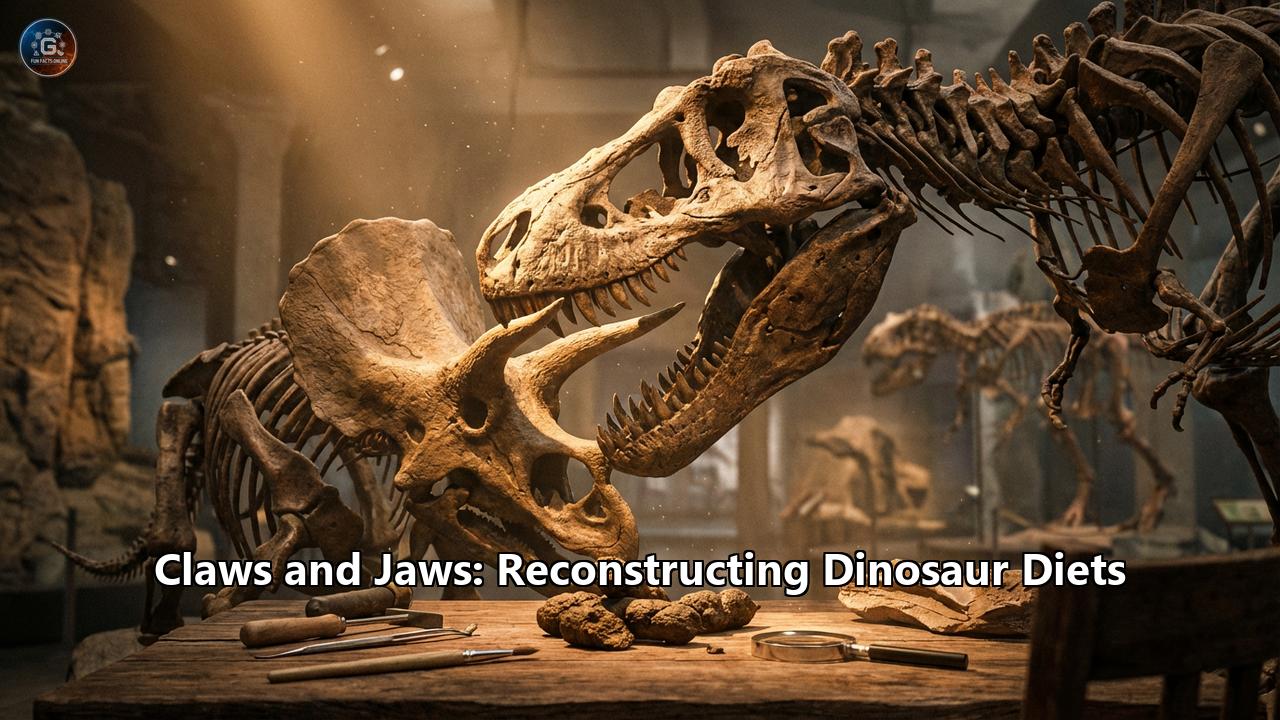
The Mesozoic Era was a world of titans and terrors, a landscape dominated by creatures that have captured the human imagination like no others. For over 160 million years, dinosaurs reigned supreme, filling every ecological niche imaginable. But for centuries, the primary question that plagued paleontologists was a simple, primal one: What did they eat?
To the casual observer, the answer might seem obvious. Sharp teeth meant meat; flat teeth meant plants. But the reality of reconstructing the dietary habits of animals that have been dead for 66 million years is a forensic puzzle of immense complexity. It requires looking beyond the obvious silhouettes of claws and jaws to the microscopic scratches on tooth enamel, the chemical signatures locked inside fossilized bone, and the rare, petrified remains of their last meals.
This is the story of how science is reconstructing the dining tables of the deep past, revealing a world far more complex, dynamic, and surprising than we ever dared to imagine.
Part I: The Silent Witnesses — Teeth and Mechanics
The most direct link to an animal's diet is the machinery it uses to process food. Dinosaur dentition is a study in evolutionary engineering, with each lineage developing specialized tools to exploit their specific corner of the food web.
The Bone-Crushers: Tyrannosaurus rex
For decades, Tyrannosaurus rex was depicted as a sleek, if heavy, hunter. But recent biomechanical studies have transformed our understanding of the "King of the Tyrant Lizards." The secret lies not just in the sharpness of its teeth, but in the architecture of its skull.
Unlike most reptiles, which have kinetic (flexible) skulls to swallow prey whole, T. rex possessed a fused, rigid skull structure capable of handling immense stress. Finite Element Analysis (FEA)—a technology originally designed for engineering bridges and aircraft—has revealed that a T. rex jaw could exert a bite force of over 8,000 pounds (35,000 Newtons). This is equivalent to the weight of three small cars crashing down on a single point.
But force is nothing without the tools to apply it. T. rex teeth were not merely knives; they were "railroad spikes"—thick, banana-shaped, and serrated. This morphology allowed them to withstand the pressure of crushing bone. We know this because of the damage they left behind. Paleontologists have found hadrosaur (duck-billed dinosaur) bones with T. rex teeth embedded in them, healed over time, proving these were active hunts. More gruesome, however, are the shattered bone fragments found in coprolites (fossilized feces) attributed to T. rex. These fragments indicate "extreme osteophagy"—the consumption of bone. By pulverizing the skeletons of their prey, tyrannosaurs accessed nutrient-rich marrow, a food source unavailable to smaller predators with weaker jaws.
The Slicing Machines: Triceratops
On the other end of the spectrum lies Triceratops. Often lazily compared to a rhinoceros, its feeding mechanism was actually far more sophisticated than any modern grazer. While cows and horses grind their food with a side-to-side motion, Triceratops possessed a "vertical shearing" mechanism.
Its jaws were packed with hundreds of teeth stacked in "batteries." As the animal chewed, the teeth slid past each other like giant, self-sharpening scissors. Recent microscopic analysis of these teeth has revealed a complexity of dental tissues—enamel, orthodentine, and vasodentine—that rivals the complexity of mammalian teeth. This multi-tissue structure allowed the teeth to wear down at different rates, creating a "fuller" (a recessed channel) on the blade that reduced friction. This suggests Triceratops was not just grazing on soft grass (which hadn't fully taken over the world yet) but was shearing through incredibly tough, fibrous vegetation like cycads and palm fronds that would have worn down lesser teeth in weeks.
The Grinding Giants: Hadrosaurs
The hadrosaurs, or "duck-billed" dinosaurs, took a different approach. They were the "cows" of the Cretaceous, but with a twist. Their dental batteries were vast, containing up to 1,400 teeth. Unlike the shearing action of ceratopsians, hadrosaurs employed a complex grinding motion.
For years, a debate raged about "pleurokinesis"—the idea that the hadrosaur's upper jaw could flex outwards to accommodate the lower jaw's grinding. Recent 3D modeling suggests that while some flexibility existed, the primary grinding action came from the lower jaw rotating slightly. This effectively turned their mouths into organic millstones, capable of processing huge quantities of abrasive horsetails and conifers.
Part II: The Chemical Fingerprint — Isocapes of the Mesozoic
When physical evidence like teeth and jaws leaves room for doubt, paleontologists turn to chemistry. You are, quite literally, what you eat. The chemical elements that make up an animal's food are incorporated into their bones and teeth, leaving an atomic signature that lasts for millions of years.
Calcium Isotopes and the Niche Partitioning Puzzle
One of the great mysteries of the Morrison Formation (a Jurassic ecosystem in North America) is how so many gigantic sauropods—Diplodocus, Camarasaurus, Brachiosaurus, Apatosaurus—coexisted without eating each other out of house and home.
The answer lies in "niche partitioning," revealed through calcium isotopes. Plants process calcium differently depending on where they grow and what part of the plant is being analyzed. Wood, leaves, and seeds all have distinct ratios of Calcium-44 to Calcium-40.
By analyzing the tooth enamel of these Jurassic giants, scientists found distinct differences. Camarasaurus teeth showed isotopic signatures consistent with a diet of woody material and coarser vegetation, likely browsed from mid-level heights. Diplodocus, with its peg-like teeth and horizontal neck posture, had signatures matching softer, lower-level ferns and horsetails. They weren't competing for the same food; they were effectively eating from different shelves of the same forest.
The Spinosaurus Water Debate
For decades, Spinosaurus was a riddle. Was it a terrestrial predator that simply looked like a crocodile, or was it truly aquatic? The "Oxygen Isotope Story" helped settle the debate.
Oxygen isotopes (Oxygen-16 vs. Oxygen-18) in drinking water and food are incorporated into bone phosphate. Aquatic animals, which live in water and drink constantly, tend to have lower variability in their oxygen isotopes compared to terrestrial animals, who lose water through evaporation and drink sporadically.
When researchers compared the oxygen isotopes of Spinosaurus teeth to those of known terrestrial theropods and aquatic crocodiles from the same formation, the results were clear. Spinosaurus plotted right alongside the crocodiles and turtles. It wasn't just dipping its toes in; it was a semi-aquatic specialist, spending a significant portion of its life in the water, hunting fish—a conclusion bolstered by the recent discovery of its paddle-like tail.
Part III: The "Iron Stomachs" — Gut Contents and Gastroliths
Sometimes, the fossil record grants a miracle: a look inside the stomach itself. These finds are rare, requiring exceptional preservation conditions ("Lagerstätten"), but they offer the only indisputable proof of diet.
The Diamantinasaurus Discovery
In Australia, a recent discovery rocked the paleontological world. A sauropod named Diamantinasaurus was found with a "cololite"—a mass of fossilized gut contents. For the first time, we could see exactly what a titanosaur ate.
The mass contained a mix of conifer branches, ferns, and—crucially—angiosperms (flowering plants). The sheer volume of material, and the fact that the twigs were snapped rather than ground, confirmed that these giants were "bulk browsers." They didn't chew; they stripped branches and swallowed them whole, relying on a massive fermentation vat of a stomach to break down the cellulose. The presence of flowering plants also proved that sauropods were adaptable, readily switching to new food sources as the botanical world evolved around them.
The Gastrolith Myth
For years, it was common knowledge that sauropods swallowed stones ("gastroliths") to grind food in a muscular gizzard, much like modern chickens. It was a neat theory that explained how they processed food without chewing.
However, modern research has largely debunked this "gastric mill" hypothesis for sauropods. When paleontologists compared the mass of stones found in sauropod torsos to those in modern ostriches, the ratios didn't add up. An ostrich's gastroliths make up about 1% of its body mass. In sauropods, the stones found (when they are found at all) account for less than 0.1%. Furthermore, the stones often lack the heavy polish seen in bird gizzard stones.
The current consensus? Sauropods likely swallowed stones accidentally while browsing low to the ground, or perhaps in small numbers for mineral intake, but they did not have a bird-like gizzard. Their digestion was chemical, driven by gut bacteria in a massive cecum, rather than mechanical.
Part IV: The Scoop on Poop — The World of Coprolites
If teeth are the tools and stomach contents are the pantry, then coprolites are the trash can. And as any detective knows, the trash tells the truth.
Karen Chin, a paleontologist at the University of Colorado Boulder, is the world's leading expert on dinosaur dung. Her work has elevated the study of coprolites from bathroom humor to high science.
The "King of Coprolites"
One of the most famous specimens is a massive coprolite attributed to T. rex. It is over 40 centimeters long and filled with pulverized bone. This single specimen provided the smoking gun for the bone-crushing hypothesis. But more importantly, it revealed the speed of digestion. The bone fragments were angular and sharp, not rounded or etched by acid. This suggests that T. rex had a relatively short digestive tract for its size, passing food quickly to maximize protein absorption from the meat while expelling the indigestible bone before it could cause internal damage.
The Wood-Eating Hadrosaurs
Chin's work on hadrosaur coprolites from Montana revealed something even more startling. The dung was packed with rotting wood and crushed invertebrate shells (crustaceans).
Why would a herbivore eat rotting wood? It offers almost no nutritional value on its own. The hypothesis is that these dinosaurs were targeting the fungi and invertebrates living in the rotting wood. This "detritivory" suggests that hadrosaurs were not just munching on fresh leaves; they were flexible foragers who may have supplemented their diet with extra protein (crustaceans) during egg-laying season, much like modern female birds eat snail shells for calcium.
Part V: Behavioral Reconstructions — Cannibalism and Lips
Finally, the study of diet leads us to behavior. How did these animals interact with each other and their own kind?
Cannibalism in the Quarry
The Mygatt-Moore Quarry in Colorado is a mass grave of Jurassic dinosaurs, mostly Allosaurus. But a closer look at the bones revealed something chilling. Hundreds of bones bore the serrated bite marks of theropods.
When researchers measured the spacing of the tooth marks, they found that many matched the size of Allosaurus teeth. But the bones being bitten were also Allosaurus. While predators often fight, these marks were on "low-value" bones like toes and the ends of ribs—parts you only eat if the carcass has already been picked clean.
This wasn't a fight; it was scavenging. In times of drought or environmental stress, Allosaurus turned to the only available food source: each other. It paints a picture of a harsh, unforgiving world where the line between predator and prey could vanish in a season of hunger.
The "Lips" Debate
One of the most heated recent debates concerns the face of the dinosaur. Did they have exposed, crocodile-like teeth, or were they covered by soft tissues—lips?
For a long time, the "exposed tooth" look (popularized by Jurassic Park) was the standard. But recent studies published in Science have challenged this. When teeth are exposed to air, the enamel dries out and becomes brittle. Crocodile teeth are tough enough to withstand this, but theropod enamel was thinner.
Microscopic analysis of Daspletosaurus (a tyrannosaur) teeth showed that the enamel was pristine, lacking the weathering patterns seen in crocodiles. This strongly suggests that even the mighty T. rex had lips—scaly, lizard-like lips that kept their teeth moist and protected. This changes not just the artwork, but our understanding of their feeding. Lips would have helped seal the mouth, perhaps aiding in suction or manipulating food, and certainly protecting the "weapons" that were so vital to their survival.
Part VI: The Vegetarian Wolverine — Therizinosaurus
No discussion of dinosaur diets is complete without the oddballs. Therizinosaurus is the ultimate dietary paradox. It belongs to the theropods—the same lineage as T. rex and Velociraptor—but it abandoned meat.
With a pot-belly designed for fermenting plants, a small head with leaf-shaped teeth, and massive, three-foot-long claws on its hands, it looked like a fantasy monster. But those claws weren't for slashing prey. They were likely used like giant rakes to pull down tree branches (much like a giant ground sloth) or perhaps to strip bark. Therizinosaurus represents the extreme plasticity of the dinosaur diet—proof that with enough time, evolution can turn a lineage of hyper-carnivores into the most bizarre gardeners the world has ever seen.
Conclusion
The question "What did dinosaurs eat?" has moved far beyond simple categorization. It has become a window into the energy flows of the Mesozoic. We now see a world where giant sauropods acted as forest pruners, shaping the canopy; where Triceratops acted as prehistoric hedge-trimmers, clearing the understory; and where T. rex served as the ultimate recycler, crushing the bones of the dead to return nutrients to the soil.
Through the microscopic scratches on a tooth, the atomic weight of a calcium atom, and the petrified remains of a prehistoric lunch, we have reconstructed not just a diet, but an ecosystem. The "Claws and Jaws" of the title were not just weapons of war; they were the tools of life, the cutlery of a dynasty that dined on the earth for 160 million years.
Reference:
- https://www.cnet.com/science/new-study-reveals-more-about-t-rexs-bone-crushing-bites/
- https://www.sciencenews.org/article/tyrannosaurus-rex-pulverized-bones-incredible-amount-force
- https://www.sciencedaily.com/releases/2017/05/170517090520.htm
- https://pmc.ncbi.nlm.nih.gov/articles/PMC4640618/
- https://www.researchgate.net/publication/277721125_Wear_biomechanics_in_the_slicing_dentition_of_the_giant_horned_dinosaur_Triceratops
- https://www.youtube.com/watch?v=_tYT-le9xb0
- https://www.paleonerds.com/podcast/karenchin
- https://royalsocietypublishing.org/rspb/article/285/1876/20180197/78903/Calcium-isotopes-offer-clues-on-resource
- https://www.researchgate.net/publication/222090629_Oxygen_isotope_evidence_for_semi-aquatic_habits_among_spinosaurid_theropods
- https://pmc.ncbi.nlm.nih.gov/articles/PMC2197205/
- https://www.sciencenews.org/article/role-gastroliths-digestion-questioned
- https://www.museumoftheearth.org/daring-to-dig/bio/chin
- https://www.colorado.edu/asmagazine/2023/11/13/oh-poop-what-looks-rock-filled-clues
- https://ocm.auburn.edu/newsroom/news_articles/2023/03/301455-research-suggests-dinosaurs-had-lips.php
- https://thesauropodomorphlair.wordpress.com/2020/09/09/lipped-dinosaurs-and-the-replaceable-teeth-argument/