
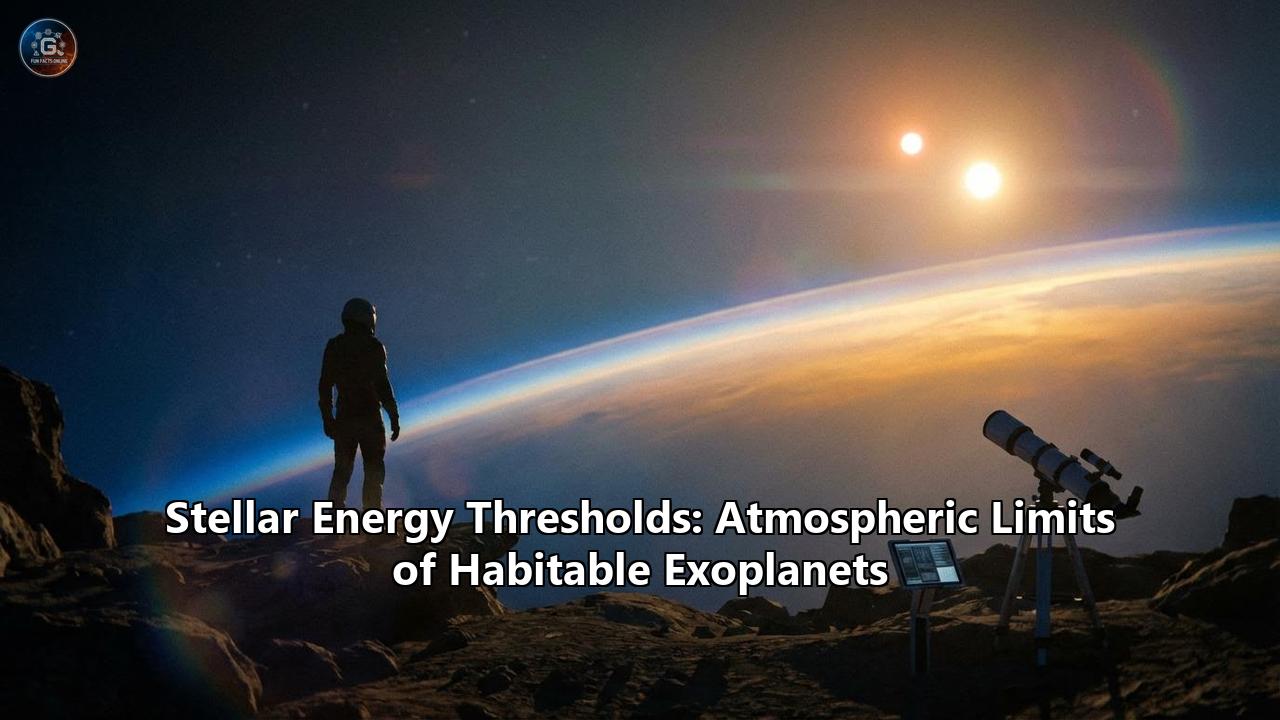
The search for life beyond our solar system is, at its core, a search for balance. Drifting through the vast, freezing expanse of the cosmos, a rocky planet is essentially a thermodynamic engine. Its atmosphere—a fragile, clinging veil of gas—must intercept just enough incoming stellar radiation to maintain liquid water, while successfully radiating excess heat back into the void. This delicate equilibrium is governed by strict, unforgiving physical boundaries known as stellar energy thresholds.
When we speak of the "Habitable Zone" (HZ) or the "Goldilocks Zone," we are not merely drawing arbitrary lines in space. We are defining the extreme atmospheric limits of a world. Cross the inner threshold, and a planet is subjected to a catastrophic runaway greenhouse effect, transforming into a desiccated, superheated hellscape like Venus. Drift beyond the outer threshold, and the atmosphere collapses as vital greenhouse gases freeze out of the sky, leaving a barren, ice-locked tomb like Mars.
Understanding these stellar energy thresholds is arguably the most critical pursuit in modern astrophysics. As next-generation observatories like the James Webb Space Telescope (JWST) and the upcoming PLAnetary Transits and Oscillations of stars (PLATO) mission peer deeper into the atmospheres of alien worlds, scientists are moving beyond simplistic distance-based models. Today, we are uncovering a complex symphony of atmospheric physics, cloud feedbacks, limit cycles, and evolutionary hysteresis that dictate whether a planet becomes an oasis for life or a sterile wasteland.
The Architecture of Planetary Energy Budgets
To comprehend the atmospheric limits of habitable exoplanets, we must first understand the concept of insolation—the total amount of stellar energy reaching a planet's surface. A planet's climate is driven by the tension between Incoming Shortwave Radiation (visible and ultraviolet light from its host star) and Outgoing Longwave Radiation (infrared heat emitted by the planet back into space).
Atmospheres complicate this simple energy exchange. Greenhouse gases—such as carbon dioxide (CO2), water vapor (H2O), methane (CH4), and hydrogen (H2)—are relatively transparent to incoming shortwave radiation but highly opaque to outgoing longwave radiation. They act as a thermal blanket. The carbonate-silicate cycle, a geological process involving volcanism and the weathering of rocks, acts as a planetary thermostat, regulating CO2 levels over millions of years to stabilize this temperature.
However, this thermostat has limits. When stellar insolation reaches certain extreme thresholds, the regulatory mechanisms break down. These breaking points define the inner and outer atmospheric limits of habitability.
The Inner Edge: The Runaway and Moist Greenhouse Limits
The inner edge of the habitable zone is dictated by the point at which a planet receives too much stellar energy, causing its water and greenhouse gas regulatory systems to catastrophically fail. This boundary is not a single line, but a series of dire climatic transitions.
The Moist Greenhouse Transition
As a planet moves closer to its star, the surface temperature rises, increasing the evaporation of liquid oceans. In a temperate climate like Earth's, water vapor is largely confined to the lower atmosphere (the troposphere) because a layer of cold air (the tropopause) acts as a "cold trap," forcing water to condense and rain back down.
However, at a higher stellar energy threshold, this cold trap fails. The atmosphere warms uniformly, allowing massive quantities of water vapor to surge into the upper atmosphere (the stratosphere). This is known as the Moist Greenhouse Limit. In the stratosphere, high-energy ultraviolet (UV) photons from the host star split the H2O molecules via photolysis. The liberated hydrogen, being the lightest element, achieves thermal escape velocity and leaks into space, while the heavier oxygen is left behind to oxidize the planetary crust. Over billions of years, a planet in a moist greenhouse state will slowly, quietly bleed its oceans into the void.
The Runaway Greenhouse Limit
If a planet is pushed even closer to its star, it crosses an even more violent threshold: the Runaway Greenhouse Limit. Water vapor is a potent greenhouse gas. As the star heats the planet, more water evaporates, which in turn traps more heat, causing even more evaporation.
Eventually, the atmosphere becomes completely dominated by thick, opaque water steam. At this critical juncture, the planet's outgoing longwave radiation hits a hard physical cap, known as the Kombayashi-Ingersoll limit. The planet simply cannot radiate heat away as fast as it receives it. The oceans boil entirely, turning the world into a global steam bath. The surface temperature skyrockets enough to melt lead, and the crust may even begin to melt into a magma ocean.
Recent 3D Global Climate Model (GCM) simulations have revealed that this transition may not be gradual. Studies examining the climate dynamics at the inner edge of the habitable zone indicate that planets can exhibit "climate bistability". Driven by complex cloud feedbacks on the planet's dayside and nightside, an Earth-like world could undergo a sudden, irreversible bifurcation, snapping abruptly from a temperate state into a runaway greenhouse state.
The Habitable Zone Inner Edge Discontinuity
Fascinatingly, the runaway greenhouse effect leaves a physical imprint on the size of the planet, which astronomers are now learning to detect. The immense thermal energy of a steam atmosphere causes the planet's gaseous envelope to drastically expand.
Recent demographic models of exoplanets suggest this creates a measurable "radius inflation effect". When surveying a large population of rocky exoplanets, scientists expect to find a "Habitable Zone Inner Edge Discontinuity" in radius-density space. Planets just inside the runaway greenhouse threshold will appear significantly larger and less dense than their temperate counterparts just outside the line, providing an empirical, observational marker for the inner boundary of habitability,.
The Lava Planet Paradox
It is worth noting that the classic runaway greenhouse model is continuously evolving. A groundbreaking 2025 study demonstrated that if a runaway greenhouse effect is severe enough to melt the planet's surface into a magma ocean, the chemistry of the atmosphere fundamentally changes. Volatiles like H2O, CO2, CO, CH4, and N2 dissolve into and outgas from the molten mantle, altering the atmosphere's equilibrium.
In these multi-component atmospheres over magma oceans, the characteristic "thermal radiation limit" of a pure-steam atmosphere disappears. This implies an "evolutionary hysteresis" in exoplanet climates: a planet that starts out as a molten ball and cools down will not follow the same climatic pathways as a solid planet that is heated up by external irradiation. It is a stark reminder that a planet's geological history is intrinsically linked to its atmospheric survival.
The Outer Edge: The Maximum Greenhouse Limit and Atmospheric Collapse
Conversely, what happens when a planet receives too little stellar energy? As insolation drops, the planet's carbonate-silicate cycle attempts to compensate. Lower temperatures slow down the weathering of surface rocks, allowing volcanically emitted CO2 to build up in the atmosphere. The planet aggressively thickens its CO2 blanket to trap whatever meager warmth it can.
The Maximum Greenhouse Limit
Intuitively, one might assume that you could infinitely extend a planet's habitability simply by adding more and more CO2. However, physics dictates a harsh Maximum Greenhouse Limit.
As the CO2 atmosphere becomes incredibly dense (reaching pressures of around 8 bars, compared to Earth's 1 bar atmosphere), the nature of the gas begins to work against the planet. At high densities, CO2 molecules start to efficiently scatter incoming stellar sunlight (Rayleigh scattering) rather than just trapping outgoing heat. Furthermore, as the planet moves further from the star, the ambient temperature drops to the point where CO2 itself begins to condense.
Clouds of dry ice (solid CO2) form in the atmosphere, drastically increasing the planet's albedo (reflectivity) and blocking the stellar light from ever reaching the surface. Eventually, the atmosphere suffers a catastrophic collapse. The CO2 catastrophically freezes out of the sky and falls as dry ice snow, leaving the planet stripped of its thermal blanket. In our solar system, 1D climate models place this maximum greenhouse limit between 1.67 and 1.70 Astronomical Units (AU)—just past the orbit of Mars,.
Limit Cycles and Snowball Oscillations
For decades, scientists believed that planets residing near this outer maximum greenhouse limit would simply maintain a stable, albeit chilly, climate. However, advanced models have revealed a far more chaotic reality: Limit Cycles.
Planets situated near the outer edge of the habitable zone may not be capable of maintaining permanent liquid water. Instead, they become trapped in violent climatic oscillations. When the planet gets too cold, the oceans freeze, creating a highly reflective "Snowball Earth." Because the surface is covered in ice, silicate weathering ceases entirely, but volcanoes continue to pump CO2 into the atmosphere.
Eventually, the CO2 levels become so staggeringly high that the greenhouse effect violently overpowers the ice albedo, resulting in a rapid, global thaw. For a brief geological period, the planet enjoys a warm, temperate climate. But the exposed liquid oceans and rocky continents immediately begin weathering the CO2 out of the atmosphere at an accelerated rate, rapidly depleting the greenhouse blanket and plunging the world back into a deep freeze.
Complex life would struggle immensely to survive on a world experiencing these aggressive limit cycles, oscillating between a frozen wasteland and a brief, sweltering interglacial period.
The Stellar Spectrum Effect: How Star Types Warp Atmospheric Limits
Not all stars are created equal, and the type of host star fundamentally warps the location and behavior of these atmospheric energy thresholds. A planet's atmospheric response is highly sensitive to the spectral distribution of the incoming light—whether the star emits mostly high-energy ultraviolet, visible light, or low-energy infrared.
F-Dwarfs: The UV Threat
F-type main-sequence stars are larger, hotter, and more luminous than our Sun, emitting a vast percentage of their radiation at visible and ultraviolet wavelengths. For planets orbiting F-dwarfs, the inner runaway greenhouse threshold is pushed far outward, as the intense UV radiation rapidly photolyzes water vapor, stripping atmospheres with brutal efficiency.
Furthermore, planets orbiting F-dwarfs are uniquely vulnerable to the outer edge "limit cycles." Because water ice and snow are highly reflective to visible and UV light, the ice-albedo feedback is exceptionally strong. A slight drop in temperature can trigger a rapid glaciation, making F-dwarf planets highly susceptible to becoming permanently locked in Snowball states.
M-Dwarfs: The Red Dwarf Paradox
M-dwarfs (red dwarfs) are the most common stars in the universe. They are small, cool, and emit the vast majority of their light in the near-infrared spectrum. At first glance, they seem to be excellent hosts for life because they can burn steadily for trillions of years. However, their unique physics completely rewrite the rules of atmospheric thresholds.
Because red dwarfs are so cool, their habitable zones are located extremely close to the star. At this proximity, the gravitational tidal forces of the star act heavily upon the planet, forcing it into a state of Tidal Locking,. One side of the planet perpetually faces the star (eternal day), while the other side faces the freezing void of space (eternal night).
This tidal locking creates bizarre atmospheric dynamics. The dayside is bombarded with insolation, pushing it toward the runaway greenhouse limit, while the nightside becomes a "cold trap" where the atmosphere risks freezing out entirely and collapsing onto the dark ice sheet. Habitable conditions might only exist on the "terminator"—the twilight boundary ring dividing day and night. Alternatively, atmospheric circulation could transport heat from the dayside to the nightside, maintaining an "eyeball planet" state: a global ice sheet with a permanent liquid water ocean directly under the sub-stellar point.
Interestingly, red dwarf planets manage to completely avoid the violent "limit cycles" that plague F-dwarfs. Why? Because red dwarfs emit mainly infrared light, and water ice is actually absorptive (dark) in the infrared spectrum. On an M-dwarf planet, an ice sheet does not reflect much stellar energy away, severely weakening the ice-albedo feedback loop and protecting the planet from entering an irreversible snowball state.
Despite this advantage, M-dwarfs are notoriously violent in their youth, emitting massive, frequent stellar flares and intense X-ray/UV radiation. These early flare phases can easily blast a planet's atmosphere into space through non-thermal atmospheric escape, leaving it a barren rock before life ever has a chance to begin.
Extending the Boundaries: Alternative Atmospheres
While the traditional definitions of atmospheric limits rely on Earth-like conditions (CO2 and H2O atmospheres), the universe is highly diverse. The presence of alternative greenhouse gases can drastically stretch the energy thresholds of habitability.
The Hydrogen Extension
A study led by Ramses Ramirez and Lisa Kaltenegger demonstrated that the outer edge of the habitable zone could be massively extended if a planet experiences prodigious volcanic outgassing of Hydrogen (H2). Hydrogen is an incredibly potent greenhouse gas. If a super-Earth or early terrestrial planet has enough gravity or a thick enough envelope to retain a layer of H2, the maximum greenhouse limit is pushed significantly further out. In our Solar System, a highly hydrogen-enriched atmosphere could theoretically push the outer atmospheric survival limit to 2.4 AU—well into the asteroid belt,.
Methane and Subglacial Sanctuaries
Methane (CH4) also plays a fascinating role. In atmospheres around stars hotter than 4500K (like our Sun), adding methane to a CO2 atmosphere warms the planet, extending the outer edge. However, counterintuitively, adding methane to planets orbiting cooler M-dwarfs actually shrinks the habitable zone, as the atmospheric haze created by methane absorbs incoming light high in the stratosphere, creating an anti-greenhouse effect that cools the surface.
Furthermore, liquid water may not be restricted to the surface. Planets residing beyond the maximum greenhouse limit may harbor vast subsurface oceans. By utilizing internal geothermal heating or tidal friction (much like Jupiter's moon Europa), subglacial basal melting can extend habitability far beyond the traditional atmospheric threshold. Some models suggest that for tidally locked exoplanets, subglacial liquid water could exist on the dark night-side, shielded from stellar radiation, provided the night-side ice evaporates at the moist greenhouse limit.
The Gravity of the Situation: The Habitable Zone Atmosphere (HZA) Metric
Insolation is only half the battle; gravity is the other. Even if a planet sits perfectly within the energy thresholds, it must possess the physical mass to hold onto its gases.
Scientists utilize a metric called the Habitable Zone Atmosphere (HZA), which evaluates the mass-radius relationship required for a planet to retain a life-sustaining atmosphere against the forces of thermal escape (Jeans escape). At the top of an exosphere, gas molecules are heated by the star and move at high velocities. If the velocity of a molecule exceeds the planet's escape velocity, it bleeds off into space.
The HZA metric specifically looks at a planet's ability to hold onto atomic Nitrogen (N) and atomic Hydrogen (H). Hydrogen is the most abundant element; if a planet's gravity is too high (like a gas giant), it retains all its hydrogen, resulting in a crushing, high-pressure atmosphere that turns surface water and CO2 into solid or supercritical fluids, destroying surface habitability.
Conversely, the planet must be massive enough to hold onto Nitrogen. Nitrogen is a heavy volatile necessary for all known biology (crucial for DNA, amino acids, and the food chain via nitrogen fixation). More importantly, a thick Nitrogen buffer gas provides the atmospheric pressure necessary to keep water liquid at the surface. Small, hot exoplanets will see their Nitrogen thermally escape, leaving them airless. Therefore, the perfect habitable exoplanet must thread the needle: massive enough to hold onto Nitrogen and heavier volatiles like CO2 and O2, but light enough to let primordial Hydrogen slip away.
The Frontier of Exoplanet Observation
We are no longer relegated to theoretical mathematics to understand these limits. The era of direct observational verification has arrived.
The James Webb Space Telescope (JWST) is currently staring down the atmospheric limits of exoplanetary systems, particularly the famed TRAPPIST-1 system—a cool red dwarf orbited by seven Earth-sized rocky planets. The inner planets of TRAPPIST-1 (planets b and c) receive more insolation than Earth and are prime candidates for testing the runaway greenhouse limits. By utilizing transmission spectroscopy and phase curve observations, JWST is analyzing whether these planets possess thick, inflated steam atmospheres, or if the stellar flares have stripped them bare entirely.
Furthermore, astronomers are utilizing advanced photodynamical models to search for "Planet-Planet Occultations" (PPOs) in compact systems like TRAPPIST-1. When one planet passes in front of another, the tiny dip in reflected and thermal light can help map the atmospheric dynamics and surface temperatures, allowing us to see if thick day-side cloud layers are suppressing outgoing infrared radiation—a key mechanism in delaying the runaway greenhouse effect.
Looking ahead, the European Space Agency's Ariel mission and NASA's proposed Habitable Worlds Observatory will target hundreds of rocky worlds. They will search for the "Habitable Zone Inner Edge Discontinuity", looking for the statistical break in planetary radii that proves exactly where the oceans boil and the runaway greenhouse limit asserts its dominance over exoplanetary demographics.
Conclusion: The Cosmic Tightrope
An atmosphere is not a permanent fixture of a planet; it is a temporary privilege, granted and maintained by a remarkably fragile balance of physics. The atmospheric limits of habitable exoplanets—dictated by the terrifying heat of the runaway greenhouse effect on the inner edge, and the silent, freezing collapse of maximum greenhouse condensation on the outer edge—reveal just how rare true Earth-like habitability might be.
Through the interactions of stellar spectral types, planetary gravity, cloud feedbacks, and limit cycling, the universe offers a narrow, winding path for life to emerge. Every temperate world, our own Earth included, is constantly walking this cosmic tightrope. By mapping these stellar energy thresholds, humanity is not just categorizing distant specks of light; we are charting the ultimate boundaries of life itself.
Reference:
- https://astrobiology.com/2024/08/climate-bistability-at-the-inner-edge-of-the-habitable-zone-due-to-runaway-greenhouse-and-cloud-feedbacks.html
- https://www.hou.usra.edu/meetings/abscicon2017/pdf/3089.pdf
- https://astrobites.org/2013/02/07/finding-the-edges-of-the-habitable-zone/
- https://www.aanda.org/articles/aa/abs/2019/08/aa35585-19/aa35585-19.html
- https://arxiv.org/abs/2309.04518
- https://arxiv.org/abs/2505.11149
- https://en.wikipedia.org/wiki/Habitable_zone
- https://arxiv.org/pdf/2510.00736
- https://www.projectrho.com/public_html/rocket/colonysite.php
- https://luger.dev/planetplanet/PPOs.pdf
- https://www.centauri-dreams.org/2018/09/07/extending-the-habitable-zone/
- https://phl.upr.edu/library/labnotes/habitable-zone-atmosphere-hza-a-habitability-metric-for-exoplanets