
In the grand cathedral of particle physics, the neutrino has always been the ghost in the pews. They are the most abundant matter particles in the universe, outnumbering atoms by a billion to one, yet they pass through our bodies, our planet, and our detectors as if we weren't even there. For decades, physicists have painstakingly built a "Standard Model" to describe the fundamental building blocks of reality. It is a theory of exquisite precision, arguably the most successful scientific theory ever devised. But for the last thirty years, a persistent whisper has echoed from the basement of experimental physics, suggesting that the Standard Model is incomplete.
This whisper came in the form of an "anomaly"—a set of data from experiments in the 1990s and 2000s that didn't make sense. The data hinted at the existence of a fourth type of neutrino, a "sterile" neutrino, that would be even ghostlier than its known cousins. If it existed, this particle would break the Standard Model. It promised to be the key to understanding dark matter, the asymmetry of the universe, and perhaps the origin of mass itself.
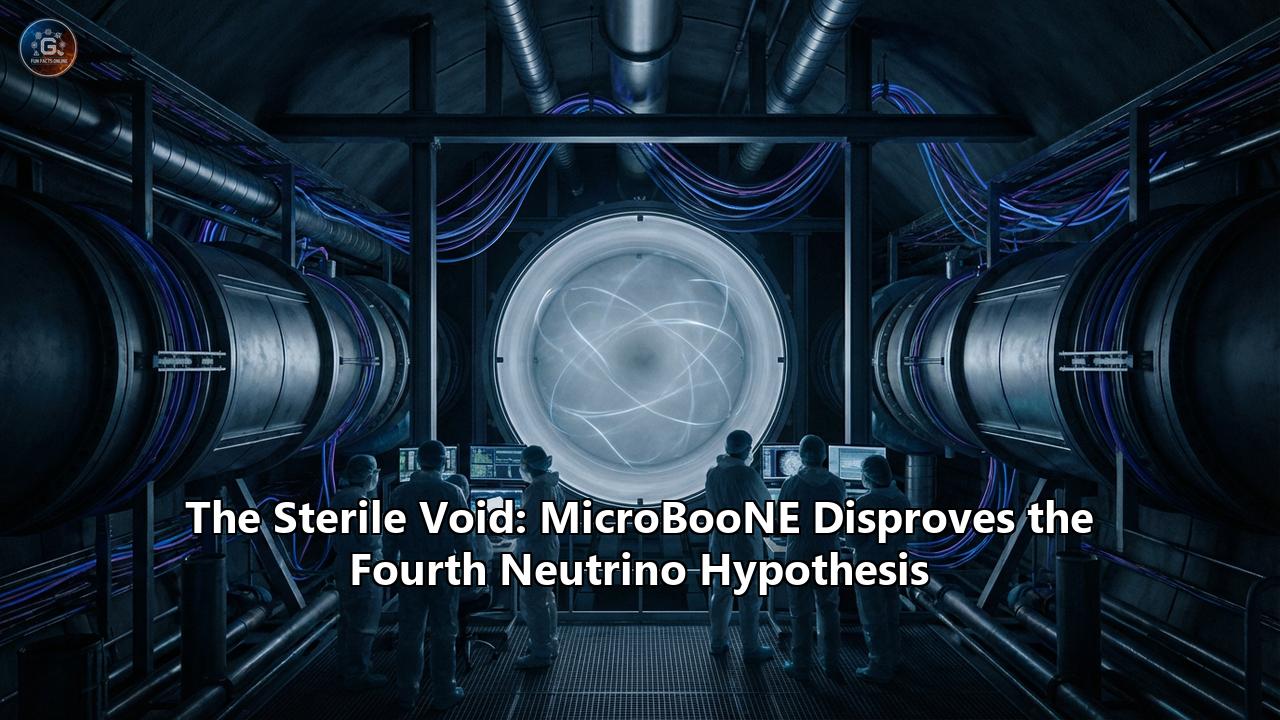
But in late 2021, a team of nearly 200 scientists from around the world, working at the Fermi National Accelerator Laboratory (Fermilab) outside Chicago, delivered a stunning verdict. Their experiment, MicroBooNE, had stared into the heart of the anomaly with a giant, liquid-argon eye. They looked for the fingerprint of the sterile neutrino, and they found... nothing. A sterile void.
This article explores the dramatic rise and fall of the Fourth Neutrino Hypothesis. It is a story of scientific detective work, massive engineering feats, and the exhilarating, terrifying realization that the universe is still hiding its deepest secrets in the dark.
Part 1: The Ghost in the Machine – A Brief History of the Neutrino
To understand the magnitude of the MicroBooNE result, we must first understand the particle it was hunting. The neutrino was born of desperation. In 1930, physicists were baffled by a process called beta decay, where an atomic nucleus spits out an electron. The math didn't add up; energy seemed to be vanishing into thin air, violating the sacred law of conservation of energy.
Wolfgang Pauli, a giant of quantum mechanics, proposed a "desperate remedy." He suggested that a tiny, invisible, electrically neutral particle was carrying away the missing energy. "I have done a terrible thing," he famously wrote. "I have postulated a particle that cannot be detected."
He was almost right. It took 26 years—until 1956—for Clyde Cowan and Frederick Reines to finally catch a neutrino in a detector, proving Pauli right. We eventually learned that neutrinos come in three "flavors," corresponding to their charged partners:
- Electron Neutrino: The partner of the electron.
- Muon Neutrino: The partner of the muon (a heavy electron).
- Tau Neutrino: The partner of the tau (an even heavier electron).
For a long time, the Standard Model assumed neutrinos were massless, traveling at the speed of light, fixed in their identities. But in the late 1990s, a revolution occurred. Experiments like Super-Kamiokande in Japan and the Sudbury Neutrino Observatory in Canada discovered that neutrinos could change flavor. A muon neutrino created in the atmosphere could morph into an electron neutrino or a tau neutrino as it traveled.
This phenomenon, called neutrino oscillation, implied two earth-shattering things:
- Neutrinos have mass (however tiny).
- They experience time (massless particles do not).
This discovery won the Nobel Prize in 2015, but it also opened a Pandora's box. If neutrinos have mass, the Standard Model in its original form was wrong. And if they oscillate, the pattern of that oscillation is determined by the difference in their masses. The three known neutrinos fit into a neat "three-flavor" oscillation pattern.
But then, an experiment in Los Alamos noticed something that didn't fit the pattern at all.
Part 2: The Anomaly That Wouldn't Die
The trouble began with the Liquid Scintillator Neutrino Detector (LSND) experiment at Los Alamos National Laboratory in the mid-1990s. LSND was looking for muon antineutrinos oscillating into electron antineutrinos over a short distance.
According to the standard three-neutrino model, this shouldn't happen significantly over such a short baseline. Yet, LSND saw an excess of electron antineutrinos. It was a clear signal, but it was "weird." It implied an oscillation frequency that required a mass difference much larger than the one observed in solar or atmospheric neutrinos.
To explain the LSND result while keeping the other oscillation data, you couldn't just use the three known neutrinos. You needed a fourth mass state. You needed a fourth neutrino.
The MiniBooNE MysteryThe physics community was skeptical. "Extraordinary claims require extraordinary evidence," as the saying goes. So, Fermilab built a new experiment specifically designed to check LSND. They called it MiniBooNE (Booster Neutrino Experiment).
MiniBooNE ran for over a decade, collecting data. In 2018, they released their final results, and the physics world held its breath. MiniBooNE didn't just confirm LSND; it doubled down. They observed a significant "Low Energy Excess" (LEE)—a surplus of electron-neutrino-like events at low energies.
The statistical significance was 4.8 sigma, tantalizingly close to the 5-sigma gold standard for discovery. Combined with LSND, the significance soared past 6 sigma. The chance of this being a random fluctuation was less than one in a million.
The data screamed: "Something is happening here!" The most popular explanation was the existence of a fourth neutrino that was mixing with the other three, causing these rapid, short-distance oscillations.
Part 3: The Sterile Candidate
Why was this hypothetical fourth neutrino called "sterile"?
The three known neutrinos interact via the Weak Nuclear Force. This is the force that governs radioactive decay. It is "weak," but it allows neutrinos to occasionally interact with matter—turning a neutron into a proton, for example.
However, measurements of the decay of the Z boson (a carrier of the weak force) at CERN in the 1990s had already proven that there are only three "active" neutrinos that feel the weak force. If there were a fourth active neutrino, the Z boson would decay faster than it does.
So, if a fourth neutrino existed, it could not feel the weak force. It would not feel the electromagnetic force (no charge). It would not feel the strong force. It would interact with the universe only through gravity and by mixing with the other neutrinos.
It would be a ghost among ghosts. A sterile neutrino.
This idea was incredibly seductive for theorists because a sterile neutrino could solve more than just the LSND/MiniBooNE anomalies:
- Dark Matter: If the sterile neutrino had a certain mass (in the keV range), it could be stable enough to survive from the Big Bang and massive enough to account for Dark Matter, the invisible scaffolding of the cosmos.
- Matter-Antimatter Asymmetry: Heavier sterile neutrinos could have played a role in the early universe to ensure matter won out over antimatter, allowing us to exist.
The "Fourth Neutrino Hypothesis" became the leading contender to explain the anomalies. It was elegant, it used known quantum mechanics (oscillation), and it pointed the way to New Physics.
But there was a catch. MiniBooNE was a "Cherenkov detector." It was a giant tank of mineral oil lined with photomultiplier tubes. When a neutrino hit an atom in the oil, it produced a charged particle that moved faster than light moves through oil, creating a shockwave of light (Cherenkov radiation).
The problem was that in MiniBooNE, an electron (produced by an electron neutrino) and a photon (a particle of light, potentially produced by other background processes) looked almost identical. Both produced a "fuzzy ring" of light. MiniBooNE couldn't tell them apart with certainty.
Was the "Low Energy Excess" really electron neutrinos (evidence of sterile neutrinos)? Or was it just a misunderstood background of photons? MiniBooNE couldn't say.
Enter MicroBooNE.
Part 4: The Giant Eye – MicroBooNE
To solve the riddle, physicists needed a detector with eyes sharp enough to distinguish an electron from a photon. They turned to a technology that represents the gold standard of modern neutrino hunting: the Liquid Argon Time Projection Chamber (LArTPC).
The Technology: "HD Video" for ParticlesImagine a school-bus-sized container filled with 170 tons of liquid argon, chilled to a cryogenic -186 degrees Celsius. Argon is a noble gas, meaning it is chemically inert, allowing electrons to drift through it freely.
When a neutrino smashes into an argon nucleus, it creates a spray of charged particles. As these particles race through the liquid, they strip electrons off the argon atoms, leaving a trail of ionization—like a plane leaving a contrail in the sky.
A massive high-voltage electric field pulls these ionization electrons toward a wall of thousands of fine wires. By measuring when and where the electrons hit the wires, computers can reconstruct a 3D image of the particle tracks with millimeter precision.
While MiniBooNE saw "fuzzy blobs," MicroBooNE sees "HD video."
- The Electron Signature: An electron moves through the argon, ionizing atoms, but it is light and scatters easily, creating a "shower" that is attached directly to the interaction vertex (the starting point).
- The Photon Signature: A photon is neutral. It travels some distance invisibly before converting into an electron-positron pair. This creates a "gap" between the interaction vertex and the start of the shower.
MicroBooNE could see the gap. It could tell the difference.
The experiment began collecting data in 2015. For six years, the team—led by scientists from Fermilab, Yale, Manchester, and dozens of other institutions—collected data from the same neutrino beam that fed MiniBooNE. They blinded their analysis (meaning they didn't look at the signal region until the very end to avoid bias) and developed sophisticated algorithms, including cutting-edge Deep Learning AI (Convolutional Neural Networks), to identify the tracks.
Part 5: The Verdict
On October 27, 2021, the MicroBooNE collaboration announced their first major results to the world. They had performed multiple independent analyses, searching for the excess of electron neutrinos that MiniBooNE claimed to see.
If the "sterile neutrino" hypothesis were true, MicroBooNE should have seen a specific excess of electrons matching the MiniBooNE energy and angle profile.
The Result: Null.MicroBooNE saw no excess. The data was perfectly consistent with the Standard Model's prediction of three neutrinos. They did not see the pile-up of electron events that would signal the presence of a sterile neutrino oscillating into existence.
- Ruling out the Electron Hypothesis: MicroBooNE ruled out the hypothesis that the MiniBooNE anomaly was due entirely to electron neutrinos with 95% confidence (nearly 2 sigma), and later analyses pushed this rejection even higher for specific models.
- Ruling out the Photon Hypothesis: They also checked if the excess was due to a specific type of background photon production (Delta radiative decay) that MiniBooNE might have missed. They found that this background was well-modeled and could not account for the anomaly either.
The "simple" sterile neutrino model—a single 4th neutrino responsible for the MiniBooNE anomaly—was dead. The MicroBooNE data disproved the most popular interpretation of the last two decades of anomalies.
Justin Evans, a co-spokesperson for the experiment from the University of Manchester, summarized it best: "We don't see what we expected to see if the anomaly was caused by electrons... We are closing the door on the sterile neutrino as the simple explanation."
Part 6: The Void Remains – If Not Sterile, Then What?
This is where the story gets truly strange.
MicroBooNE proved that the MiniBooNE anomaly was not simple electron neutrinos. But it did not prove that the MiniBooNE anomaly didn't happen. The MiniBooNE detector really did see flashes of light. The LSND detector really did see something.
If it wasn't electron neutrinos (sterile neutrinos) and it wasn't background photons, what caused the flashes?
The failure of the sterile neutrino hypothesis has not ended the search for New Physics; it has forced it to mutate into more exotic and fascinating forms. The "Void" left by the sterile neutrino is now being filled with "Dark Sector" theories. MicroBooNE is now combing its data for these even stranger ghosts.
Here are the leading suspects now that the simple sterile neutrino is gone:
1. Dark Tridents and the Dark PhotonThe Standard Model has photons (light). The "Dark Sector" might have Dark Photons. In this theory, the neutrino beam might contain dark matter particles or dark photons produced in the accelerator.
A "Dark Trident" event occurs when a dark particle interacts with the argon and creates an electron-positron pair (a lepton and an antilepton) plus a neutrino.
- Why it fits: To MiniBooNE's fuzzy eyes, an overlapping electron and positron look like a single electron (the signal they saw). MicroBooNE, with its high resolution, can see the difference between one track and two. The hunt for these specific "two-track" signatures is now on.
While the "light" sterile neutrino (eV scale) is ruled out, Heavy Neutral Leptons (MeV to GeV scale) are still very much in play. These are much heavier cousins of the neutrino.
- The Mechanism: An HNL could be produced in the beam, travel to the detector, and then decay into a regular neutrino and a photon, or an electron-positron pair.
- The Decay: If an HNL decays into a photon inside the detector, it would look like the MiniBooNE signal. MicroBooNE has already set strict limits on this, but specific mass ranges are still viable. This is a "zombie" sterile neutrino theory—the particle exists, but it's heavy and unstable, not light and oscillating.
Axions were originally proposed to solve a problem with the Strong Nuclear Force (the CP problem). But "Axion-Like Particles" are a generic class of light bosons that appear in many String Theory models.
- The Scenario: The proton beam at Fermilab could be creating ALPs. These ALPs travel to the detector and decay into two photons. If the two photons are very close together (collimated), they look like a single electron shower in MiniBooNE. MicroBooNE is uniquely capable of "unzipping" these merged photon showers to reveal their true nature.
Some theorists propose that the answer is a combination: perhaps a sterile neutrino exists, but it decays rapidly. This "decaying sterile neutrino" hypothesis combines oscillation and decay, creating a spectral shape that might hide from MicroBooNE's initial search while still fooling MiniBooNE.
Part 7: The Future Frontier
The MicroBooNE result is a classic example of how science actually works. It's not always about finding the "Eureka!" moment; often, it's about rigorously saying, "No, it's not that." By closing the door on the simple sterile neutrino, MicroBooNE has forced physicists to look in darker, more complex corners of theoretical space.
The quest is far from over. In fact, Fermilab has doubled down on the Short-Baseline Neutrino (SBN) Program.
MicroBooNE was just the middle child. It is now being joined by two other detectors on the same beamline:
- SBND (Short-Baseline Near Detector): Located very close to the neutrino source. It will characterize the beam before any oscillations happen, reducing systematic errors to almost zero.
- ICARUS: A massive detector (larger than MicroBooNE) that was shipped from Italy to Fermilab. It sits far away, acting as the "far detector."
Together, SBND, MicroBooNE, and ICARUS will act as a single, multi-detector system. They will be able to track the neutrino beam at three distinct points in space. This will allow them to definitively test the more complex "oscillating then decaying" models and the Dark Sector theories.
Beyond SBN lies DUNE (Deep Underground Neutrino Experiment). This is the "moonshot" of neutrino physics. Fermilab is currently blasting a beam of neutrinos 1,300 kilometers through the earth's crust to a colossal underground detector in South Dakota. DUNE will use the same Liquid Argon technology pioneered by MicroBooNE but on a scale massive enough to unlock the secrets of CP violation (why matter exists) and proton decay.
Conclusion: The Successful Failure
Did MicroBooNE fail? It didn't find the particle it was designed to check. It didn't confirm the anomaly that launched it. In the popular press, "finding nothing" is often framed as a disappointment.
But in physics, a null result is a triumph. For twenty years, the sterile neutrino hypothesis hung over the field like a fog, obscuring other possibilities and consuming theoretical resources. MicroBooNE has begun to clear that fog.
The anomaly of the "low energy excess" remains a stubborn, unexplained fact. The universe is still shouting at us that our model is broken. But thanks to MicroBooNE, we now know that the answer isn't a simple ghost neutrino. It is something stranger, something more elusive, something that mimics an electron but isn't one.
We are no longer looking for a simple fourth neutrino. We are looking for a crack in the wall of reality where the Dark Sector is leaking light. The void is sterile, but it is far from empty.
Reference:
- https://news.umich.edu/microboone-experiment-finds-no-evidence-for-the-long-sought-sterile-neutrino/
- https://scispace.com/papers/dark-tridents-at-off-axis-liquid-argon-neutrino-detectors-2895fiqfe1?references_page=2
- https://www.youtube.com/watch?v=p118YbxFtGg
- https://indico.cern.ch/event/1234324/contributions/5626489/attachments/2775039/4835943/nuphys_2023_vbasque_microboone.pdf
- https://lss.fnal.gov/archive/2019/slides/fermilab-slides-19-024-t.pdf
- https://arxiv.org/pdf/2202.03447
- https://arxiv.org/abs/2111.10359
- https://news.fnal.gov/2021/10/microboone-experiments-first-results-show-no-hint-of-a-sterile-neutrino/
- https://www.researchgate.net/publication/361285334_MicroBooNE_and_the_n_e_Interpretation_of_the_MiniBooNE_Low-Energy_Excess
- https://academiccommons.columbia.edu/doi/10.7916/1t4k-b180/download
- https://www.researchgate.net/publication/384699165_MicroBooNE_investigations_on_the_photon_interpretation_of_the_MiniBooNE_low_energy_excess
- https://www.researchgate.net/publication/330135599_Dark_tridents_at_off-axis_liquid_argon_neutrino_detectors
- https://ned.ipac.caltech.edu/level5/March06/Overduin/Overduin7.html
- https://arxiv.org/pdf/2211.02028
- https://losalamosreporter.com/2021/10/27/lanl-new-results-from-microboone-provide-clues-to-particle-physics-mystery/