
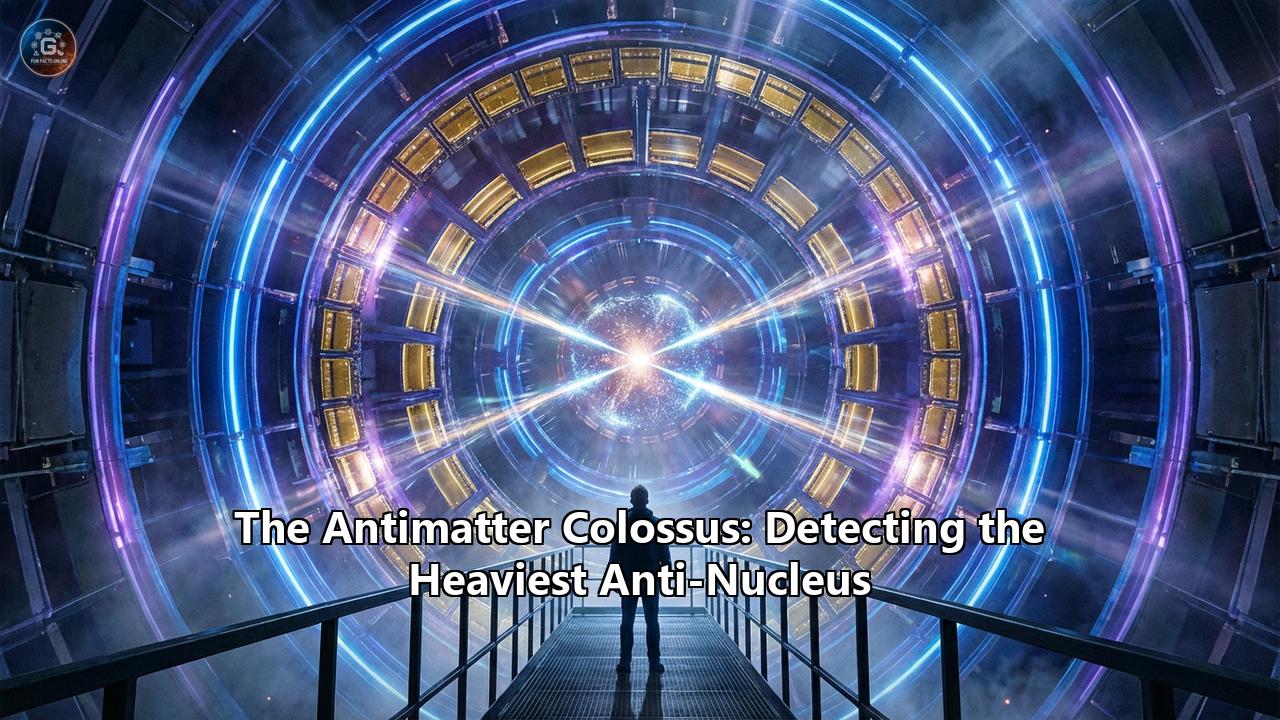
In the subatomic realm, where the fundamental laws of reality are written in the language of quarks and gluons, physicists have just uncovered a "monster." Deep within the data of billions of particle collisions, a team of scientists has fished out the heaviest antimatter nucleus ever detected: antihyperhydrogen-4.
This discovery is not merely a record-breaking entry in a table of isotopes. It is a profound glimpse into the mirror image of our universe. It offers a new way to test the broken symmetries that allow us to exist and provides a crucial map for hunting the most elusive substance in the cosmos: dark matter.
This is the story of how humanity recreated the conditions of the Big Bang to birth a "colossus" of the antimatter world, and what its fleeting existence tells us about the origins of everything.
Part I: The Mirror Universe and the Great Mystery
To understand the magnitude of this discovery, we must first look at the ghost in the machine of our reality: antimatter.
In 1928, the physicist Paul Dirac derived an equation that described the behavior of electrons. It was a triumph of mathematics, but it had a strange quirk: it allowed for two solutions. One described the electron, but the other described a particle with the same mass but opposite electric charge. Dirac had inadvertently predicted the existence of antimatter. Four years later, the positron (anti-electron) was discovered, confirming that for every fundamental building block of matter, there exists a mirror twin.
The Cosmic Paradox
This symmetry poses one of the greatest existential problems in science. According to our best theories, the Big Bang should have produced equal amounts of matter and antimatter. When matter and antimatter meet, they annihilate instantly in a burst of pure energy. Therefore, the infant universe should have been a self-canceling fireworks display, leaving behind nothing but light.
Yet, here we are. Stars, galaxies, planets, and people—we are all made of matter. Roughly 13.8 billion years ago, something tipped the scales, allowing a tiny fraction of matter (about one particle in a billion) to survive the great annihilation.
To solve this mystery, physicists hunt for subtle differences between matter and antimatter—cracks in the mirror—that could explain our survival. This is why creating and studying complex forms of antimatter, like antihyperhydrogen-4, is so vital. It allows us to test the laws of the universe under extreme conditions.
Part II: The Forge of the "Little Big Bang"
You cannot find antihyperhydrogen-4 in nature. It is too heavy, too complex, and too fragile to survive in the matter-dominated environment of Earth. To find it, you have to build it.
The stage for this discovery was the Relativistic Heavy Ion Collider (RHIC) at Brookhaven National Laboratory in New York. RHIC is a 2.4-mile atomic racetrack that functions as a time machine. By smashing heavy ions—specifically gold nuclei—together at 99.995% the speed of light, RHIC recreates the conditions that existed mere microseconds after the Big Bang.
The Quark-Gluon Plasma
When two gold nuclei collide at these energies, they do not just break; they melt. The protons and neutrons dissolve into a searing soup called quark-gluon plasma (QGP). This primordial fluid is hundreds of thousands of times hotter than the center of the sun.
For a fraction of a second, the collision zone is a miniature universe, teeming with free-roaming quarks and antiquarks. As this fireball expands and cools, these particles frantically recombine to form new matter. Most form ordinary particles like pions and protons. But occasionally, by sheer chance, a rare alliance occurs.
In the chaos of the cooling plasma, multiple antiparticles must find each other, align perfectly in position and velocity, and bind together before they fly apart.
Part III: The Discovery of the Colossus
The "Antimatter Colossus" discovered by the STAR Collaboration is antihyperhydrogen-4.
To appreciate its complexity, consider a normal hydrogen nucleus: just a single proton.
Now consider antihelium-4, the previous record-holder: two antiprotons and two antineutrons.
Antihyperhydrogen-4 goes a step further into the exotic. It is a "hypernucleus." It contains:- One Antiproton
- Two Antineutrons
- One Anti-Lambda Hyperon
The Anti-Lambda is the "strange" ingredient. Unlike protons and neutrons, which are made of up and down quarks, the Lambda particle contains a strange quark. This makes antihyperhydrogen-4 not just heavy, but "strange" in a literal, physical sense. It is a chunk of antimatter that extends into a third dimension of the nuclear chart.
Hunting the Needle in the Haystack
The detection of this particle was a feat of statistical heroism. The STAR detector, a house-sized digital camera wrapping around the collision point, tracks the thousands of particles that spray out from every gold-gold smashup.
The team, led by researchers from the Institute of Modern Physics in China, did not see the antihyperhydrogen-4 directly. It decays too quickly, vanishing after traveling only a few centimeters. Instead, they had to act as forensic detectives, looking for the specific "shrapnel" it leaves behind.
When antihyperhydrogen-4 dies, it breaks apart into two distinct pieces:
- An antihelium-4 nucleus
- A positively charged pion (π+)
The researchers analyzed 6.6 billion collision events. They had to trace the paths of millions of pions and antihelium nuclei backward in time to see if they originated from the exact same point in space—the "decay vertex."
Out of billions of collisions, they found just 16 candidates.
These 16 faint signals represented the strongest evidence yet of this exotic anti-nucleus. It is a testament to the precision of modern physics that we can discern 16 atoms of a new substance from a background of billions of chaotic interactions.
Part IV: The Symmetry Test
Once the researchers had their 16 particles, the real physics could begin. The primary goal was to test CPT Symmetry.
CPT Symmetry (Charge, Parity, Time) is a fundamental tenet of the Standard Model. It essentially states that if you were to swap all matter for antimatter (Charge), look at the universe in a mirror (Parity), and run time backward (Time), the laws of physics should remain identical.
A key prediction of CPT symmetry is that a particle and its antiparticle must have the exact same mass and the exact same lifetime.
The STAR team measured how long the antihyperhydrogen-4 survived before decaying and compared it to the lifetime of its matter twin, hyperhydrogen-4.
- Result: The lifetimes were identical within experimental uncertainty.
While this might seem like a "boring" result, it is actually a triumph. It confirms that our understanding of the fundamental symmetries of the universe remains solid, even for complex, strange-flavored composite antimatter. It means the answer to the matter-antimatter asymmetry paradox does not lie in the gross violation of these basic properties, forcing physicists to look for subtler mechanisms or entirely new physics.
Part V: The Dark Matter Connection
Perhaps the most exciting implication of this discovery lies not on Earth, but in the depths of space.
Astronomers are currently searching for dark matter, the invisible substance that makes up 85% of the universe's mass. One theoretical way to find dark matter is to look for its annihilation. If two dark matter particles collide in the center of the galaxy, they might annihilate and produce showers of regular particles and antiparticles.
Space-based detectors, like the Alpha Magnetic Spectrometer (AMS-02) on the International Space Station, scour cosmic rays for these antiparticles. If they see a spike in antinuclei (like antihelium), it could be the smoking gun for dark matter.
However, there is a problem: "noise." Ordinary cosmic ray collisions can also produce antimatter. To claim we have found dark matter, we need to know exactly how much antimatter the universe produces "naturally" through standard collisions.
This is where the STAR discovery becomes a Rosetta Stone.
By measuring exactly how often antihyperhydrogen-4 and antihelium-4 are produced in the "Little Big Bangs" at RHIC, physicists can calibrate their models. They now know the precise "production rate" of heavy antimatter in nuclear collisions.
- The implication: Creating heavy antimatter like this is incredibly rare in standard collisions. The finding tells us that the "background noise" of heavy antinuclei in space should be near zero.
- The hope: If a space telescope detects even a single heavy antinucleus (like antihelium-4 or heavier), we can now be much more confident that it did not come from a standard cosmic ray collision. It would almost certainly be a signal from exotic physics—potentially the annihilation of dark matter.
Part VI: The Future of Antimatter
The discovery of antihyperhydrogen-4 is a milestone, but it is not the finish line. It opens the door to a new era of "nuclear physics in the mirror."
- Heavier Nuclei: Can we find even heavier antinuclei? The production rate drops exponentially with mass (about a factor of 1,000 for every extra baryon). Detecting the next heaviest particle might require trillions of collisions or more luminous colliders.
- Internal Structure: Future experiments at RHIC and the upcoming Fair Facility for Antiproton and Ion Research (FAIR) in Germany will aim to measure the binding energy of these particles. Is the "glue" that holds antimatter together exactly the same strength as the glue inside matter?
- The ALICE Experiment: Across the Atlantic, the Large Hadron Collider (LHC) is also joining the hunt. Recent reports suggest the ALICE collaboration is observing similar heavy antimatter signatures, confirming that this new frontier is open for exploration.
Conclusion
The detection of antihyperhydrogen-4 is a triumph of human curiosity. We occupy a universe made of matter, yet we have built machines capable of summoning the ghosts of the creation event. We have forced 16 atoms of the heaviest, strangest antimatter into existence, if only for a few billionths of a second, to ask them a simple question: "Are you like us?"
For now, the answer appears to be "yes." The mirror remains unbroken. But with every new, heavier piece of antimatter we forge, we peer deeper into the reflection, searching for the crack that let the light in—the subtle imperfection that allowed the universe to become something rather than nothing.
Reference:
- https://physicsworld.com/a/rhic-nets-strange-antimatter/
- https://www.spacedaily.com/reports/New_Antimatter_Nucleus_Discovery_Sets_Heaviest_Record_Yet_999.html
- https://www.sci.news/physics/antihyperhydrogen-4-13197.html
- https://www.earth.com/news/scientists-detect-the-heaviest-antimatter-nucleus-ever-observed-helping-dark-matter-search/
- https://www.bnl.gov/newsroom/news.php?a=121912
- https://www.courthousenews.com/scientist-announce-discovery-of-new-antimatter-nucleus/
- https://scitechdaily.com/unmasking-antihyperhydrogen-4-the-heaviest-antimatter-hypernucleus-ever-discovered/
- https://www.livescience.com/physics-mathematics/particle-physics/scientists-discover-the-heaviest-antimatter-particle-ever-and-it-could-hold-secrets-to-our-universes-origins
- https://www.youtube.com/watch?v=03cuPkfPX2w
- https://newscenter.lbl.gov/2010/03/04/star-discovers/
- https://home.cern/news/news/physics/alice-finds-first-ever-evidence-antimatter-partner-hyperhelium-4
- https://arxiv.org/abs/2310.12674