
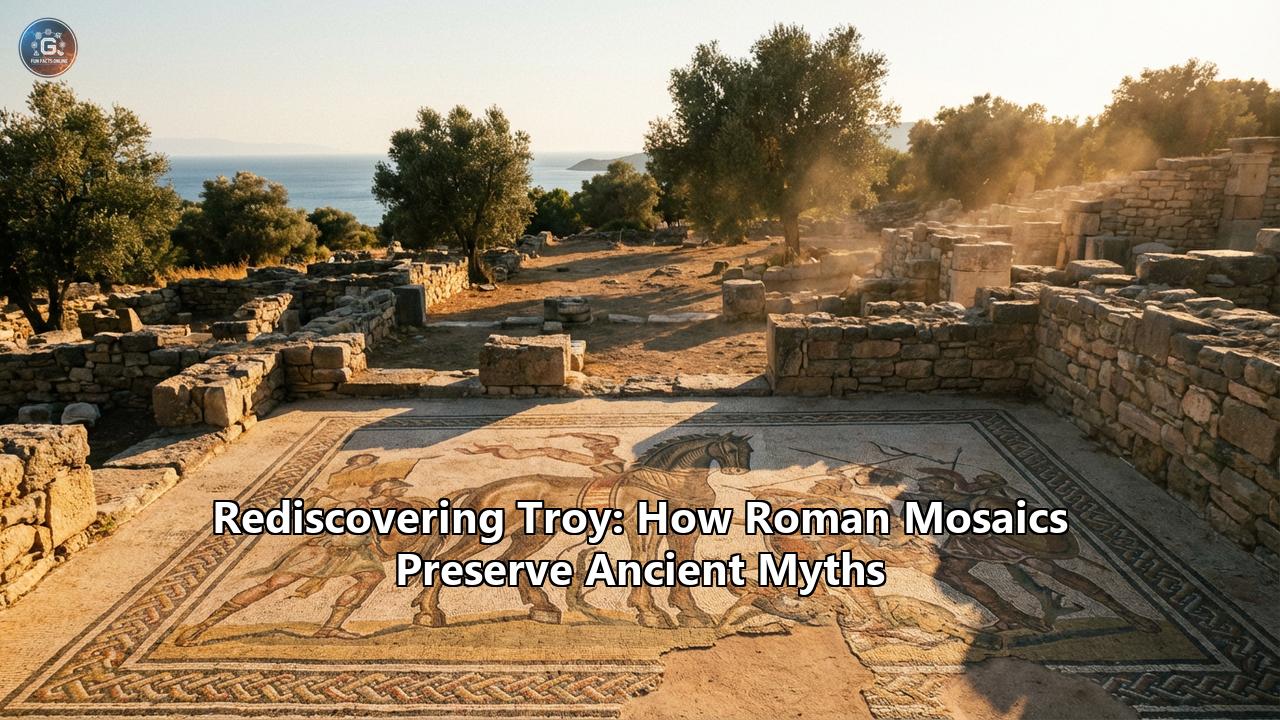
The year was 2020. The world had ground to a halt under the grip of a pandemic, and in the quiet fields of Rutland, England, a farmer’s son was taking a walk. What Jim Irvine stumbled upon that day—a scatter of pottery shards and orange tiles—would do more than just add a dot to a local heritage map. It would peel back the turf of the English countryside to reveal a vivid, technicolor connection to the ancient Mediterranean, challenging our understanding of Roman Britain and resurrecting a story that history had all but forgotten.
Beneath the soil lay the first Roman mosaic ever found in the United Kingdom to depict the Trojan War. But as archaeologists brushed away sixteen centuries of earth, they realized something even more startling: this wasn't the Trojan War we thought we knew. The floor didn't just illustrate Homer’s Iliad; it preserved a "director’s cut" of the myth, a version from a lost play that had vanished from the literary record.
This discovery is a gateway into a fascinating world where floors were books, dining rooms were theaters, and the myths of Greece and Rome were used to navigate the complex social hierarchy of the Empire. By examining the Rutland mosaic and its peers—such as the romantic tragedy of Dido and Aeneas at Low Ham or the protective Gorgons of the Isle of Wight—we can rediscover how Roman mosaics served as stone archives, preserving ancient myths in a way that manuscripts never could.
Part I: The Rutland Discovery – A Lost Version of the War
The Rutland mosaic, dating to the 3rd or 4th century AD, once adorned the floor of a triclinium (dining room) in a wealthy villa. It measures 11 meters by 7 meters, a grand canvas divided into three dramatic panels. To the casual observer, it is clearly the Trojan War. We see the hero Achilles, the doomed prince Hector, and the grieving king Priam. But to the classicist, the details are wrong—wonderfully, instructively wrong.
The Duel on Chariots
The first panel depicts the climactic duel between Achilles and Hector. If you were to read Homer’s Iliad, you would find this battle takes place on foot. Homer describes the heroes chasing each other around the walls of Troy, their feet pounding the dust. Yet, the Rutland artist has placed both heroes in chariots, wheels spinning, horses rearing.
For decades, scholars might have dismissed this as a provincial mistake—a British artist who didn't know his Homer. But the discovery reveals that this was a deliberate choice. The mosaic aligns with a different tradition of the myth, one that was popular in the 5th century BC but later fell out of favor. This specific iconography mirrors scenes found on ancient Greek pottery from centuries earlier, suggesting the artist had access to a visual "pattern book" that preserved traditions far older than the villa itself.
The Weighing of the Body
The most explosive revelation sits in the final panel. In the Iliad, King Priam ransoms his son’s body by bringing a wagon-load of treasure. There is no scale, no weighing. Achilles, moved by the old man’s grief, accepts the ransom without counting it.
The Rutland mosaic, however, shows a massive set of scales. On one side lies the limp, battered body of Hector; on the other, a heap of gold. This is a scene of cold transaction, not emotional reconciliation. This specific detail—the "weighing of Hector"—comes directly from a lost tragedy by the Athenian playwright Aeschylus, titled The Phrygians.
The text of The Phrygians has been lost to time, surviving only in fragmented references and marginal scribbles in medieval manuscripts. We knew the play existed, and we knew it featured a scale, but we had no visual record of how the ancients imagined it. The Rutland mosaic effectively resurrects the climax of a lost masterpiece of world literature. It proves that the owner of this villa in rural Britain was not just aware of the Trojan War, but was conversant in a niche, alternative version of the myth that would have signaled extreme cultural sophistication.
Part II: The Floor as a Library
Why put such a story on the floor? To understand this, we must step into the Roman mind. For the Roman elite, paideia—cultured education—was the ultimate currency. It was not enough to be rich; one had to be civilized.
The Dining Room as Theater
The triclinium was the social heart of the Roman villa. Guests would recline on couches arranged in a U-shape, eating, drinking, and talking. The mosaic floor in the center of the U was the focal point of the evening. It was designed to be looked at, discussed, and analyzed.
Imagine a dinner party in 4th-century Rutland. The host, perhaps a wealthy Romano-British aristocrat or a retired official from Gaul, pours wine. A guest points to the floor.
"I see you have Achilles," the guest might say. "But surely, they fought on foot?"The host smiles, the trap sprung. "Ah, you are thinking of Homer," he replies. "But this follows Aeschylus. Have you not seen the play?"
In this moment, the floor serves its purpose. It allows the host to perform his knowledge, distinguishing himself from the "uneducated" masses who only know the standard version. The mosaic is a conversation piece, a test of cultural literacy, and a badge of belonging to the broader Mediterranean world.
Pattern Books and Traveling Artisans
The existence of the Aeschylus scene in Britain also revolutionizes our understanding of Roman art production. It is unlikely the mosaicist had read the lost play. Instead, artisans likely carried "pattern books"—scrolls or sketches containing standard designs for mythological scenes.
These designs traveled thousands of miles. The image of the weighing of Hector on the Rutland floor is strikingly similar to images found on a silver cup in France and a coin from Turkey. This network of images proves that Britain was not a cultural backwater. It was plugged into a high-speed (by ancient standards) information highway of visual culture. A design created in Athens could end up on a coin in Turkey and a floor in England, preserving the story long after the original text had rotted away.
Part III: The "Roman" Trojan War – The Low Ham Mosaic
While Rutland gives us the Greek tragedy of Troy, another remarkable British mosaic gives us the Roman sequel. Discovered in 1945 in Somerset, the Low Ham Mosaic is the earliest narrative art in the UK, and it tells the story of Virgil’s Aeneid.
If the Rutland mosaic is about the end of Troy, Low Ham is about the beginning of Rome. It depicts the love affair between Aeneas, the Trojan refugee, and Dido, the Queen of Carthage.
A Story in Five Panels
Unlike the Rutland mosaic's "comic strip" action, the Low Ham floor is a study in emotion and tension.
- The Arrival: We see the Trojan ships arriving at Carthage. Aeneas stands ready, a hero in search of a home.
- The Hunt: The central panel shows Aeneas and Dido riding out on a hunt, their horses prancing. This is the "romance" phase, full of energy and promise.
- The Embrace: In a darker, more intimate scene, the two figures are shown embracing. It is the moment of their union, the fateful act that will doom Dido.
- The Betrayal: Virgil’s poem ends this romance with Aeneas leaving to found Rome, commanded by the gods. The mosaic captures the tragic irony of their love—it was doomed from the start.
The Political Statement
The Low Ham mosaic is fascinating because it is a piece of propaganda. The Aeneid was the national epic of Rome, commissioned by Emperor Augustus to justify Roman rule. By placing this story on their floor, the owner of the Low Ham villa was asserting their identity as a Roman. They were claiming descent—cultural, if not biological—from Aeneas himself.
Contrasted with the Rutland mosaic, we see the full spectrum of the Trojan cycle: the tragic Greek past (Rutland) and the hopeful Roman future (Low Ham). Together, they show how deeply these myths permeated the soil of Britain.
Part IV: Monsters and Magic – The Apotropaic Mosaics
Not all mythological mosaics were about high literature. Some were about primal fear. In the Roman world, images had power. They could attract luck or ward off evil.
The Medusa of the Isle of Wight
At the Brading Roman Villa on the Isle of Wight, visitors are greeted by the staring eyes of Medusa. In Greek myth, Medusa was a monster whose gaze turned men to stone. In Roman art, however, her severed head (gorgoneion) became a protective symbol.
The logic was simple: to fight evil, you need something terrifying. By placing a Medusa head in the center of a floor, the homeowner was creating a spiritual shield. The "evil eye"—bad luck, envy, curses—would be caught by Medusa’s stare and neutralized.
The Brading Medusa is a masterpiece of this genre. She is not depicted as a hideous monster, but as a stylized, almost hypnotic figure, snakes radiating from her hair like sunbeams. She is a guardian. This function of myth—as a magical tool for home security—adds a layer of practicality to the artistic beauty.
The Mystery of the Cockerel-Man
Also at Brading is one of the most puzzling mythological figures in Britain: a man with the head of a cockerel and feet made of serpents. This figure is often associated with Abraxas, a deity from Gnostic mysticism, or it may be a satire of a gladiator or emperor.
Unlike the clear narratives of Troy, this image reminds us that the Roman world was a melting pot of cults, mysteries, and obscure beliefs. Mosaics preserved not just the "mainstream" myths of Homer and Virgil, but the strange, hybrid beliefs that bubbled up from the provinces.
Part V: The Legacy of Stone
The discovery of the Rutland mosaic has forced a rewrite of the history books. For years, the narrative was that Roman Britain in the 3rd and 4th centuries was a place of decline, a frontier crumbling as the Empire retreated. The art was assumed to be crude, the culture fading.
These mosaics tell the opposite story. They reveal a society that was vibrant, wealthy, and intellectually ambitious. The people who commissioned the Rutland and Low Ham mosaics were not barbarians squatting in ruins; they were connoisseurs commissioning original art that referenced 800-year-old plays.
The Stone Archive
In a way, these mosaics have outlasted the culture that created them. The library of Alexandria burned. The scrolls of Aeschylus turned to dust. The oral traditions faded. But the stones remained.
When we look at the Rutland mosaic today, we are seeing a "ghost" of the lost play The Phrygians. We are seeing the weighing scales that Aeschylus wrote about but that no surviving manuscript describes. The mosaic has become a primary source, a stone document that fills the gaps in our literary record.
Conclusion: A Rediscovery
"Rediscovering Troy" is not just about digging up a floor; it is about recovering a mindset. These mosaics remind us that the myths of the ancient world were not static stories locked in books. They were living, breathing parts of daily life. They were walked upon, dined over, and argued about.
From the tragic weight of Hector’s body in Rutland to the doomed romance of Dido in Somerset, these floors preserve the heartbeat of a civilization. They show us that even on the furthest, rain-soaked edge of the Empire, the fires of Troy still burned bright, kept alive by the enduring power of storytelling and the imperishable nature of stone.
Reference:
- https://www.youtube.com/watch?v=-ZCIVAoLqpI
- https://www.youtube.com/watch?v=HUCTPM9kJig
- https://www.discovermagazine.com/an-800-year-old-design-reveals-a-lost-trojan-tale-in-a-roman-mosaic-48367
- https://www.sapiens.org/archaeology/roman-mosaic-trojan-war/
- https://www.stone-ideas.com/90210/roman-mosaic-and-villa-in-rutland-uk/
- https://discover-rutland.co.uk/blog/rare-roman-mosaic-in-rutland/
- https://traj.openlibhums.org/article/id/9915/
- https://www.theguardian.com/uk-news/2021/nov/28/rutlands-roman-mosaics-bring-the-trojan-wars-to-life-in-the-east-midlands
- https://www.livescience.com/archaeology/romans/stunningly-preserved-roman-era-mosaic-in-uk-depicts-trojan-war-stories-but-not-the-ones-told-by-homer
- https://historicengland.org.uk/whats-new/news/rutland-roman-villa-mosaic-protected/
- https://greekreporter.com/2025/06/18/trojan-war-mosaic-england/
- https://imperiumromanum.pl/en/curiosities/roman-mosaic-showing-relationship-between-aeneas-and-dido/
- https://bradingromanvilla.org.uk/2021/06/medusa-the-myth-and-the-magic/