
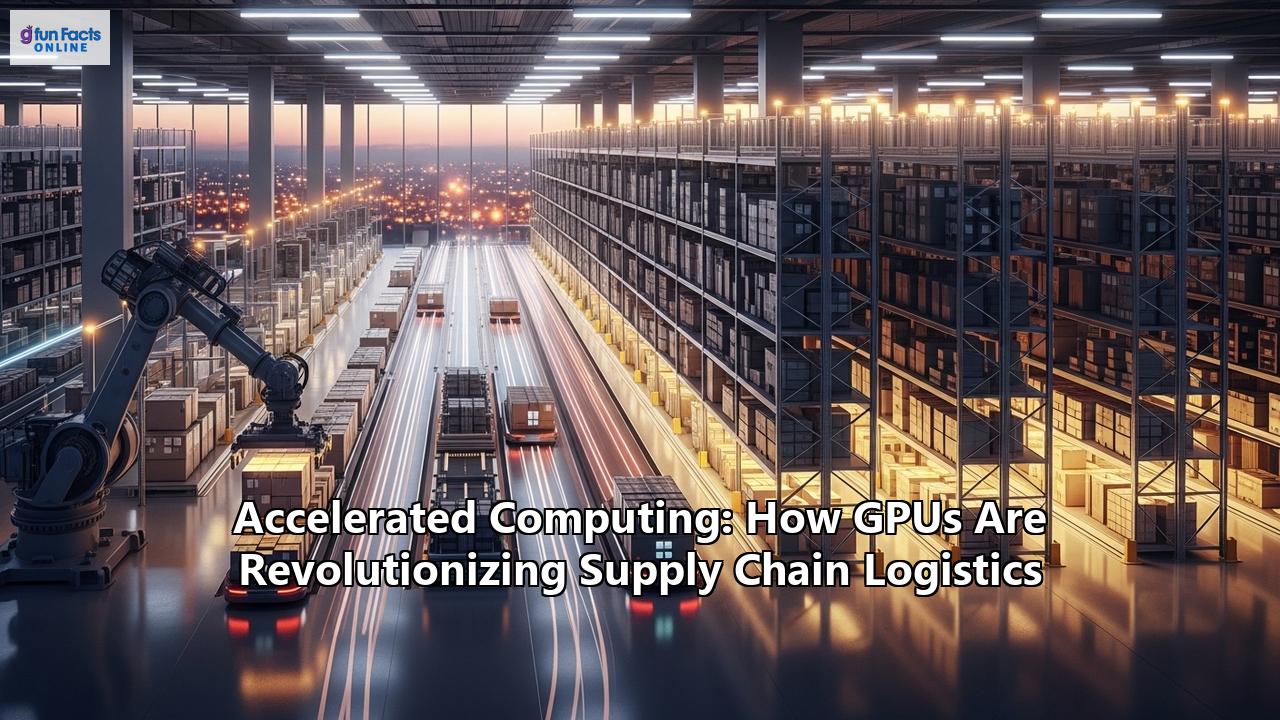
In an era defined by immediacy and unprecedented global connectivity, the supply chain stands as the invisible yet indispensable backbone of modern commerce. It is a system of immense complexity, a sprawling network of manufacturers, suppliers, distributors, and retailers all working in concert to move goods from conception to consumer. For decades, this intricate dance was managed by traditional computing systems, relying on central processing units (CPUs) to handle planning and execution. But the sheer volume, velocity, and variety of data now flooding these networks—from IoT sensors and real-time traffic to social media trends and geopolitical shifts—have pushed these legacy systems to their computational breaking point. The result is a system struggling with inefficiency, opacity, and a dangerous brittleness in the face of disruption.
Enter accelerated computing, a paradigm shift powered by the massive parallel processing capabilities of Graphics Processing Units (GPUs). Originally designed to render complex 3D graphics for video games, GPUs have been repurposed into the engines of the artificial intelligence revolution. Their unique architecture, featuring thousands of small, efficient cores, allows them to perform thousands of calculations simultaneously. This capability is not just an incremental improvement; it is a transformative leap that is fundamentally reshaping what is possible in logistics. By enabling near real-time analysis of colossal datasets, powering hyper-realistic simulations, and training sophisticated AI models, GPUs are turning the lagging, reactive supply chains of the past into the predictive, autonomous, and resilient networks of the future. This is the story of how a component once coveted by gamers became the most critical tool for solving the most complex challenges in supply chain logistics.
Chapter 1: The Computational Bottleneck: Why Traditional Supply Chains Hit a Wall
The modern supply chain is a data-generating behemoth. Every pallet, container, and truck is a source of information. IoT sensors on packages report their temperature and condition, RFID tags are scanned at checkpoints, GPS trackers transmit real-time locations, and warehouse management systems record every single inventory movement. When you layer this internal data with external feeds—weather patterns, port congestion reports, fluctuating fuel costs, social media sentiment driving flash sales, and unpredictable geopolitical events—the result is a multi-dimensional data tsunami that traditional systems simply cannot handle.
This explosion of data has exposed a fundamental architectural limitation in the way supply chains have been managed. For decades, the industry has relied on Central Processing Units (CPUs), the workhorse of traditional computing. CPUs are masters of sequential processing, designed with a few powerful cores that execute tasks one after another with incredible speed. This is perfect for running an operating system, a web browser, or a word processor. However, when faced with the modern supply chain's need to analyze millions of variables simultaneously, the CPU's sequential nature becomes a critical bottleneck.
Imagine a CPU trying to calculate the optimal route for a single delivery truck. It must consider the distance between stops, delivery time windows, traffic predictions, and driver hours. Now, scale that to a fleet of thousands of vehicles, each with hundreds of potential stops. The number of possible route combinations explodes into the trillions, a classic NP-hard logistical puzzle known as the Vehicle Routing Problem (VRP). A CPU, tackling these possibilities one by one, could take hours or even days to find a near-optimal solution. By the time the calculation is complete, the real-world conditions of traffic and demand have already changed, rendering the plan obsolete before it's even implemented. This forces logistics planners into a reactive state, relying on batch processing—running plans overnight—and heuristic-based decision-making that is often suboptimal.
This is the computational wall. Traditional systems are "compute-bound," meaning that even with vast amounts of memory and fast networks, the processing unit itself is the limiting factor. They struggle to provide the speed required for a world that demands instant answers. The digital supply network of today requires systems that can ingest massive, high-velocity data feeds and perform analytics in real time to make up-to-the-minute decisions on routing and inventory. This is where the architectural difference of the GPU becomes a game-changer.
Chapter 2: The Engine of Modern Logistics: How GPUs Work Their Magic
The Graphics Processing Unit (GPU) presents a fundamentally different approach to computation. While a CPU has a handful of powerful cores designed for sequential tasks, a GPU contains thousands of smaller, more efficient cores designed to work in parallel. This architecture was born out of the demands of 3D graphics rendering, where the color and position of millions of pixels on a screen must be calculated at the same time for every frame. The key insight was that these calculations, while numerous, were all relatively simple and could be performed independently.
This concept of massive parallelism is precisely what supply chain logistics problems require. Instead of analyzing one potential delivery route at a time, a GPU can evaluate thousands or even millions of them simultaneously. Instead of training a demand forecasting model on one product's sales history, it can process an entire catalog of products in parallel. This ability to handle thousands of threads at once is an order of magnitude greater than what a CPU can manage, leading to performance accelerations of 100x or more on many analytical workloads.
The ecosystem that unlocks this power is built around platforms like NVIDIA's CUDA (Compute Unified Device Architecture). CUDA is a parallel computing platform and programming model that allows developers to use a GPU for general-purpose computing. It gives them direct access to the GPU's virtual instruction set and parallel computational elements. Atop CUDA sits a rich stack of software libraries that make this power accessible for specific domains:
- NVIDIA RAPIDS: An open-source suite of software libraries for running end-to-end data science and analytics pipelines entirely on GPUs. It can accelerate data loading, processing, and machine learning, often speeding up feature engineering by 100x.
- TensorFlow and PyTorch: The world's leading deep learning frameworks, both heavily optimized to run on GPUs. Training complex neural networks for tasks like demand forecasting or computer vision is orders of magnitude faster on GPUs.
- NVIDIA cuOpt: A GPU-accelerated optimization engine designed specifically to solve complex routing problems like the VRP. It leverages metaheuristics and massive parallelism to find high-quality solutions in seconds, a task that could take hours on a CPU.
- NVIDIA Omniverse: A platform for creating and operating 3D simulations and digital twins. It uses the GPU's rendering and physics simulation capabilities to build physically accurate virtual replicas of warehouses, factories, and entire supply chains.
By leveraging this hardware and software stack, logistics companies can move from the slow, sequential world of CPUs to the massively parallel, accelerated world of GPUs. This allows them to finally analyze the torrent of data available to them and transform it from a liability into a strategic asset.
Chapter 3: Revolutionizing Demand Forecasting and Inventory Management
Accurate demand forecasting is the holy grail of supply chain management. Underestimate demand, and you face stockouts, lost sales, and unhappy customers. Overestimate, and you're saddled with excess inventory, high carrying costs, and the risk of obsolescence. Traditional forecasting methods, often relying on historical sales data and simple regression models, struggle in today's volatile market where trends can change in an instant.
GPU-accelerated computing is shattering these limitations by enabling the use of sophisticated deep learning models that can analyze a much richer and more complex set of inputs. These models can incorporate not only historical sales but also external factors like market trends, weather patterns, social media sentiment, and economic indicators to generate far more accurate predictions.
Case Study: Walmart's Billion-Dollar ForecastThe world's largest retailer, Walmart, faces the monumental task of predicting demand for over 100,000 different products across its 4,700+ U.S. stores, resulting in 500 million item-by-store combinations every week. Their previous system was state-of-the-art but struggled to keep up. By turning to a GPU-based solution using NVIDIA's RAPIDS libraries, Walmart's data science team achieved a breakthrough.
The GPUs accelerated the data processing and machine learning pipeline dramatically, allowing them to train their algorithms 20 times faster. This speed didn't just save time; it enabled them to use more complex and sophisticated algorithms that were previously computationally infeasible. The result was a stunning 1.7% to 4% improvement in forecast accuracy. While that percentage may seem small, for a company with over $330 billion in annual sales, it translates into billions of dollars in value through reduced stockouts, optimized inventory, and faster product delivery.
Deep Learning in ActionThe models making this possible, such as Long Short-Term Memory (LSTM) networks and Transformers, are particularly well-suited for time-series data. They can identify complex, non-linear patterns and seasonalities that older models would miss. However, training these models is computationally intensive. GPUs make it practical. A leading restaurant chain with over 2,000 locations used a new forecasting engine powered by deep learning on NVIDIA GPUs to improve its forecast accuracy by over 20%.
This newfound accuracy allows businesses to move beyond reactive replenishment. Instead of just reordering when stock is low, they can proactively position inventory across the network in anticipation of demand. GPU-powered generative AI models can continuously generate optimized replenishment plans based on real-time demand signals, supplier lead times, and current inventory levels, ensuring products are where they need to be before the customer even thinks of buying them.
Chapter 4: The Intelligent Warehouse: GPU-Powered Automation
Warehouses are the nerve centers of the logistics network, bustling hubs of activity where goods are received, stored, picked, packed, and shipped. For years, the drive for efficiency has led to increased automation, but this next wave, powered by AI and accelerated computing, is fundamentally different. It's about making the warehouse not just automated, but truly intelligent and autonomous.
At the heart of this transformation are edge computing devices—small, powerful computers located directly on robots, conveyors, and cameras. NVIDIA's Jetson platform, for instance, packs a powerful GPU into a compact, low-power module, making it ideal for deployment in a warehouse environment. These edge GPUs provide the necessary computational horsepower to run complex AI models in real time, right where the action is happening.
Computer Vision: Giving Machines the Power of SightGPUs are the engine behind the computer vision systems that are blanketing the modern warehouse. High-resolution cameras, powered by edge GPUs, can perform a multitude of tasks:
- Damage Detection: As packages move along a conveyor belt, AI-powered vision systems can instantly identify dents, tears, or leaks, flagging damaged goods for removal before they are shipped to a customer.
- Quality Control: In automated packing systems, vision can verify that the correct items and quantities are in each box.
- Worker Safety: These systems can detect if workers are in a hazardous area, such as the path of a forklift, or if they are not wearing the required personal protective equipment (PPE), triggering real-time alerts.
The most visible change in the intelligent warehouse is the proliferation of AMRs. These are not the simple automated guided vehicles (AGVs) of the past, which followed magnetic strips on the floor. Modern AMRs navigate freely and intelligently, and GPUs are critical to this capability.
Every AMR must solve the "Simultaneous Localization and Mapping" (SLAM) problem: it must build a map of its constantly changing environment while simultaneously determining its own location within that map. SLAM algorithms, such as the popular RTAB-Map, are computationally demanding. GPU acceleration is essential for real-time performance, allowing the AMR to process data from its LiDAR and camera sensors to refresh its map and make navigation decisions in milliseconds. This GPU-powered navigation, often running on an embedded NVIDIA Jetson module, allows AMRs to achieve centimeter-level positional accuracy, dynamically avoid unforeseen obstacles like a dropped pallet or a human worker, and calculate the most efficient path to their destination.
Automated Pick-and-PlaceFor decades, the task of picking individual items of varying shapes and sizes from a bin has been notoriously difficult to automate. Deep learning, accelerated by GPUs, is finally cracking this problem. An automated pick-and-place system uses a series of AI models: one to identify the best grasp point on an object, another to determine the object's 3D orientation, and a third to figure out the optimal way to place it in a shipping container for maximum density and stability. Running these models in real-time requires the parallel processing power that only a GPU can provide.
Through these GPU-powered advancements, warehouses are transforming from static storage facilities into dynamic, highly efficient, and safer ecosystems.
Chapter 5: The End of the Traffic Jam: Real-Time Route and Network Optimization
Logistics is, at its core, a problem of movement. Getting a product from point A to point B efficiently is paramount, but the "last mile" of delivery is notoriously complex and expensive, often accounting for over 40-50% of total shipping costs. The challenge is a variant of the Vehicle Routing Problem (VRP), where a fleet of vehicles must serve a number of stops with constraints like delivery time windows, vehicle capacities, driver breaks, and cold chain requirements.
This is an NP-hard problem, meaning the number of possible solutions grows exponentially with the number of stops, quickly overwhelming traditional CPU-based solvers which can take hours to produce a static, and quickly outdated, plan.
NVIDIA cuOpt: A World-Record-Breaking EngineNVIDIA cuOpt is a GPU-accelerated combinatorial optimization engine built to solve these problems at unprecedented speed. Instead of exhaustively checking every possibility, cuOpt uses advanced metaheuristics and large neighborhood search algorithms. The massive parallelism of the GPU allows it to evaluate tens of thousands of potential route improvements and feasibility checks every second.
The results are staggering. NVIDIA cuOpt has broken 23 world records on the largest public routing benchmarks, delivering solutions that are not only highly accurate but are also generated up to 100 times faster than leading CPU-based solvers. What takes a CPU hours now takes a GPU mere seconds.
From Static Plans to Dynamic ReroutingThis dramatic speedup unlocks a capability that has long been a dream for logisticians: real-time dynamic rerouting. The world doesn't stand still. A freeway clogs up with an accident, a high-priority order comes in, a delivery vehicle breaks down. With CPU-based systems, these events would throw the day's plan into chaos. With GPU acceleration, they become manageable variables.
When a disruption occurs, a new optimization problem can be sent to the cuOpt engine, which returns an updated, optimized plan for the entire fleet in seconds. This allows for trigger-based replanning. Domino's, for example, has explored real-time route planning with sub-second runtimes built with NVIDIA technology.
Case Studies in TransformationThe real-world impact is profound:
- Technician Dispatch: One organization used cuOpt to optimize routes for its field service technicians, achieving results 100 times faster while simultaneously reducing infrastructure costs by 90% and enabling more jobs per technician per day.
- Railway Maintenance: Kawasaki Heavy Industries partnered with Slalom to leverage cuOpt to optimize track maintenance and inspection routes for the US railroad market, making it easier and cheaper to keep tracks safe.
- Intra-factory Logistics: In massive factories that can span the area of 40 soccer fields, moving tens of thousands of parts can lead to millions of transport orders a day. GPU-optimized routing for internal AMRs can reduce operational costs by up to 20%.
By moving route optimization from an overnight, batch process to a real-time, dynamic one, GPU acceleration saves money on fuel and labor, increases the number of deliveries or service calls that can be completed, and dramatically improves customer satisfaction by ensuring on-time arrivals.
Chapter 6: Building The Matrix: Supply Chain Digital Twins with Accelerated Computing
What if you could test the resilience of your supply chain against a port shutdown without a single container being delayed? What if you could redesign a warehouse layout and test its efficiency with a thousand virtual robots before laying a single piece of concrete? This is the promise of the digital twin, and GPUs are the engines making it a reality.
A supply chain digital twin is far more than a static 3D model. It is a living, virtual replica of a physical asset, process, or an entire network, continuously updated with real-time data from IoT sensors, ERP systems, and other sources. This virtual environment, powered by platforms like NVIDIA Omniverse, becomes a risk-free sandbox for simulation, optimization, and "what-if" scenario planning.
Simulation at Unprecedented Scale and FidelityCreating a digital twin that accurately reflects reality requires immense computational power. GPUs are essential for two key aspects:
- Physically Accurate Rendering: To simulate how a robot's sensors will perceive the world, the digital twin must be visually realistic, with accurate lighting, shadows, and material properties. This is a core strength of GPUs.
- Physics Simulation: The twin must obey the laws of physics. GPUs can simulate the movement of conveyor belts, the dynamics of robotic arms, and the behavior of entire fleets of AMRs in a physically accurate way.
This fusion of real-time data and physically accurate simulation allows companies to gain incredible insights. A global Original Equipment Manufacturer (OEM) created a digital twin to optimize its outbound logistics policies, resulting in an 8 percent reduction in freight and damage costs. Other reported benefits are staggering, including up to a 30% improvement in forecast accuracy, a 15-20% increase in production output, and the ability to test strategies that strengthen resilience against disruptions.
Notable Implementations:- Foxconn and NVIDIA: The electronics manufacturing giant Foxconn is using NVIDIA Omniverse to create digital twins of its factories. This allows them to simulate and optimize automated production lines in a virtual setting before physical implementation, enabling them to replicate and standardize processes across their global facilities with greater speed and consistency.
- Accenture, KION Group, and NVIDIA: This collaboration is using Omniverse to reimagine warehouse automation. They can test and validate the performance of entire robotic fleets in a virtual warehouse that is connected to the real warehouse management system. This allows them to optimize workflows and predict operational KPIs in a way that is impossible in the physical world alone.
- EY and NVIDIA: The consulting firm EY has partnered with NVIDIA to create the EY.ai for supply chain platform. It uses digital twin simulations to give businesses "sharper foresight," allowing them to test and compare future-state scenarios. This has led to outcomes like a 30% increase in capacity and a 15% improvement in On-Time-In-Full (OTIF) performance for clients.
Digital twins empower a switch from reactive problem-solving to proactive, strategic management. By simulating the impact of decisions before they are made, companies can de-risk innovation, optimize for multiple competing priorities (like cost vs. speed vs. sustainability), and build supply chains that are not only efficient but also profoundly resilient.
Chapter 7: Implementing the Revolution: A Practical Guide
The transformational potential of accelerated computing is clear, but embarking on this journey requires a strategic approach to implementation. Adopting GPU technology is not merely a hardware upgrade; it involves a holistic look at infrastructure, software, and talent.
Hardware and Infrastructure: On-Premises vs. CloudA primary decision for any organization is where the GPU-powered computation will happen.
- On-Premises: For organizations with predictable, high-volume workloads and strict data security or latency requirements, investing in on-premises servers equipped with data center GPUs (like the NVIDIA H100 or A100 series) can be cost-effective in the long run. At the warehouse or factory edge, ruggedized, low-power systems like the NVIDIA Jetson family are deployed directly onto robots and machinery.
- Cloud-Based Solutions: For many, the cloud offers a more flexible and accessible entry point. Major cloud providers like AWS, Microsoft Azure, and Google Cloud Platform offer instances with powerful NVIDIA GPUs, allowing companies to pay for compute resources as needed. This "GPU-as-a-Service" model mitigates the high upfront cost and provides scalability, enabling a startup to experiment with a new AI model or an enterprise to handle a seasonal demand surge without purchasing physical hardware.
Harnessing the hardware requires a sophisticated software stack. This typically involves:
- Low-Level API: NVIDIA's CUDA provides the foundational programming interface.
- Data Science Libraries: The NVIDIA RAPIDS suite accelerates the entire data science workflow, from data manipulation to machine learning.
- AI Frameworks: GPU-optimized versions of TensorFlow and PyTorch are essential for training deep learning models.
- Specialized Engines: For specific problems, platforms like NVIDIA cuOpt for route optimization and NVIDIA Omniverse for digital twins provide pre-built, highly optimized solutions.
Justifying the investment in accelerated computing requires moving beyond abstract benefits and focusing on concrete Return on Investment (ROI) metrics. A successful business case will quantify the expected impact on key performance indicators (KPIs), such as:
- Cost Savings: Reduced fuel consumption from optimized routes, lower inventory carrying costs from better forecasting, and decreased labor costs from automation.
- Efficiency Gains: Increased picks per hour in the warehouse, more deliveries per vehicle per day, and faster time-to-market for new products.
- Service Level Improvements: Higher On-Time-In-Full (OTIF) delivery rates, reduced stockouts, and improved customer satisfaction scores.
- Resilience: Quantifying the cost of potential disruptions and demonstrating how simulation and real-time responsiveness can mitigate those losses.
A pilot project is often the best way to demonstrate ROI before a full-scale rollout. Starting with a well-defined problem, such as optimizing the routes for a single distribution center, can provide the tangible results needed to secure broader buy-in.
Overcoming the ChallengesThe path to implementation is not without its hurdles:
- Skills Gap: Developing GPU-accelerated applications requires specialized knowledge in parallel programming and AI. Companies can address this by investing in training for their existing teams, hiring new talent, or partnering with expert consultants.
- Legacy System Integration: Integrating these modern platforms with decades-old ERP and warehouse management systems can be complex. An approach based on microservices and APIs can help bridge this gap, allowing new capabilities to be added in a modular way without a complete overhaul of existing systems.
Chapter 8: The Elephant in the Room: The GPU Supply Chain Paradox
There is a profound irony at the heart of this technological revolution: the very hardware that promises to solve the supply chain's most intractable problems is itself the subject of one of the most significant supply chain crunches in recent memory. The explosion of interest in generative AI has created an insatiable, global demand for high-end GPUs, particularly those from NVIDIA.
This demand has strained manufacturing capacity to its limits. Chip manufacturers are operating at over 90% capacity and still cannot keep up. The intricate process of creating a high-performance GPU is a marvel of global logistics in itself. Advanced packaging technologies like TSMC's CoWoS (Chip-on-Wafer-on-Substrate) and critical components like HBM3 (High Bandwidth Memory) are themselves bottlenecks. A single chip may travel over 25,000 miles and cross more than 70 international borders before it reaches a data center.
The result is a bottleneck for AI industry growth, with long lead times and shortages affecting everyone from massive cloud providers to startups trying to get off the ground. This GPU supply chain paradox has forced companies to get creative. Some are solidifying long-term relationships and placing huge pre-orders to get ahead in the queue. Others are exploring "GPU-as-a-Service" models to rent computing power without purchasing the scarce hardware. Still others are refocusing on computational efficiency, finding ways to optimize their AI models to run effectively on older, more readily available GPUs.
This situation underscores the critical importance of supply chain management in the tech sector and highlights how geopolitical factors and manufacturing complexities can have a ripple effect across the entire global economy. The race to build more chip fabrication plants is on, but most will not be fully operational until 2025 or later, meaning this paradox will likely persist for the foreseeable future.
Chapter 9: The Future is Accelerated: What's Next for GPUs in Logistics?
The revolution sparked by accelerated computing is still in its early stages. The trajectory of innovation points toward an even more intelligent, autonomous, and interconnected supply chain ecosystem, with several key trends shaping the future.
The Rise of Generative AI and LLMsThe power of Large Language Models (LLMs), the technology behind applications like ChatGPT, is being harnessed to create a new human-machine interface for the supply chain. Instead of navigating complex dashboards and spreadsheets, a supply chain planner will be able to interact with their systems using natural language.
Imagine asking:
- "What is the root cause of the delays at the Port of Singapore and what are the top three mitigation strategies?"
- "Simulate the impact of a 10% increase in fuel costs on my Q4 logistics budget."
- "Generate an optimized replenishment plan for the Northeast region based on the latest holiday sales forecast."
Generative AI can analyze vast amounts of structured and unstructured data—from shipping manifests and inventory reports to news articles and supplier emails—to provide these answers. Microsoft is already working toward this vision of an "autonomous ERP," using LLMs to give planners deep insights and the ability to answer complex what-if questions. Case studies are emerging where LLMs have helped automakers reduce lead times by 15% and procurement costs by 20% by analyzing supplier performance and predicting delays.
Intelligence at the Extreme EdgeThe trend of processing data locally on edge devices will continue to accelerate. As GPUs become even more powerful and energy-efficient, more intelligence will be pushed directly into the hands of workers, onto trucks, and into smart containers. A delivery driver's handheld device could dynamically reroute them in real-time. A "smart pallet" could sense its own environment and communicate its needs to the network. This distributed intelligence reduces latency, improves resilience (as the system can function even without a constant cloud connection), and enables instantaneous decision-making.
A New Standard for SustainabilityThe same optimization power that drives cost savings also drives sustainability. Every gallon of fuel saved through an optimized route is a reduction in carbon emissions. Every product that avoids spoilage due to better demand planning is a reduction in waste. Digital twins allow companies to model and track their carbon footprint across the entire supply chain, identifying inefficiencies and testing greener strategies. As environmental, social, and governance (ESG) goals become increasingly important, the GPU's role in creating more sustainable logistics will be a key driver of its adoption.
Conclusion: The New Currency of Speed and Intelligence
The supply chains of the 21st century are no longer just about moving physical goods; they are about moving data. The ability to collect, process, and act upon that data in real time has become the single most important competitive differentiator. The old models, constrained by the sequential processing of CPUs, are being rapidly rendered obsolete in a world that operates at the speed of light.
Accelerated computing, powered by the massive parallelism of GPUs, has shattered this computational bottleneck. It has provided the engine necessary to power the advanced AI, complex simulations, and real-time analytics that modern logistics demand. From the predictive power of AI-driven forecasting and the autonomous intelligence of a robotic warehouse to the dynamic efficiency of real-time routing and the strategic foresight of a digital twin, GPUs are the common thread enabling this transformation.
The journey is far from over. Challenges related to cost, skill sets, and the GPU supply chain itself remain. Yet, the momentum is undeniable. Companies that embrace this technological shift will build supply chains that are not only faster, cheaper, and more efficient but also more transparent, resilient, and intelligent. They will move from a state of constant reaction to one of proactive optimization, navigating the complexities of the global market with a clarity and agility that was once the stuff of science fiction. The revolution is here, and it is being accelerated, one parallel computation at a time.
Reference:
- https://www.supplychainbrain.com/blogs/1-think-tank/post/41602-how-large-language-models-are-transforming-supply-chain-management
- https://www.nvidia.com/content/dam/en-zz/Solutions/industries/retail/NVIDIA-AI-Accelerated-Retail-Forecasting.pdf
- https://www.jusdaglobal.com/en/article/digital-twins-ai-transforming-predictive-supply-chain-ecosystems/
- https://medium.com/slalom-blog/down-to-the-last-mile-revolutionizing-route-optimization-with-nvidia-cuopt-4e346fd76857
- https://developer.nvidia.com/blog/record-breaking-nvidia-cuopt-algorithms-deliver-route-optimization-solutions-100x-faster/
- https://www.youtube.com/watch?v=9J_2bzmYGf8&pp=0gcJCRsBo7VqN5tD
- https://www.digitimes.com/news/a20241119PR201/foxconn-nvidia-digital-twin-supply-chain-technology.html
- https://www.sourcingchampions.com/generative-ai-in-supply-chain-management/
- https://www.ey.com/en_gl/insights/supply-chain/how-generative-ai-in-supply-chain-can-drive-value
- https://www.bigdatawire.com/2019/03/22/how-walmart-uses-gpus-for-better-demand-forecasting/
- https://www.researchgate.net/publication/391904912_Machine_Learning-Based_Forecasting_of_GPU_Demand_in_Hybrid_Cloud_Platforms
- https://www.ibm.com/think/topics/generative-ai-supply-chain-future
- https://www.slamcore.com/news/object-awareness-for-robots-with-nvidia/
- https://us.axiomtek.com/Default.aspx?MenuId=Solutions&FunctionId=SolutionView&ItemId=2776&Title=Warehouse+Automation
- https://www.youtube.com/watch?v=Fz82r6o_tWM
- https://embeddedvisionsummit.com/2025/session/optimizing-real-time-slam-performance-for-autonomous-robots-with-gpu-acceleration/
- https://www.einfochips.com/on-demand-gpu-accelerated-real-time-slam-optimization-for-autonomous-robots/
- https://www.slideshare.net/slideshow/optimizing-real-time-slam-performance-for-autonomous-robots-with-gpu-acceleration-a-presentation-from-einfochips/282411332
- https://www.youtube.com/watch?v=afNVwoX_zd0
- https://developer.nvidia.com/blog/deep-learning-in-robotic-automation-and-warehouse-logistics/
- https://www.youtube.com/watch?v=1V5_wJzTCzc
- https://acecloud.ai/blog/optimize-logistics-with-ai-based-route-planning-on-gpu/
- https://github.com/NVIDIA/cuopt-examples
- https://www.nvidia.cn/
- https://www.youtube.com/watch?v=z5-gKQFqE_4
- https://www.forbes.com/councils/forbestechcouncil/2025/04/29/digital-twins-in-the-supply-chain-transforming-operations-with-real-time-simulation-and-ai/
- https://www.dhl.com/content/dam/dhl/global/dhl-supply-chain/documents/info-graphics/SCI%20Article%20-%20Digital%20Twins%20have%20come%20alive%20in%20the%20supplychain_EN_Final.pdf
- https://technologymagazine.com/news/ey-nvidia-ai-alliance-supply-chain
- https://www.iml.fraunhofer.de/en/fields_of_activity/material-flow-systems/software_engineering/digital-twin-in-logistics/advantages-and-benefits-of-digital-twins-for-logistics-processes.html
- https://www.reportsnreports.com/semiconductor-and-electronics/industry-analysis-digital-twin-for-supply-chain-optimization-revolutionizing-efficiency/
- https://arxiv.org/html/2408.07705v1
- https://www.microsoft.com/en-us/research/video/genai-for-supply-chain-management-present-and-future/
- https://www.gocomet.com/blog/generative-artificial-intelligence-transforming-supply-chain-management/
- https://medium.com/@soumyashantharaju/llms-revolutionizing-supply-chain-63569848c3c1