
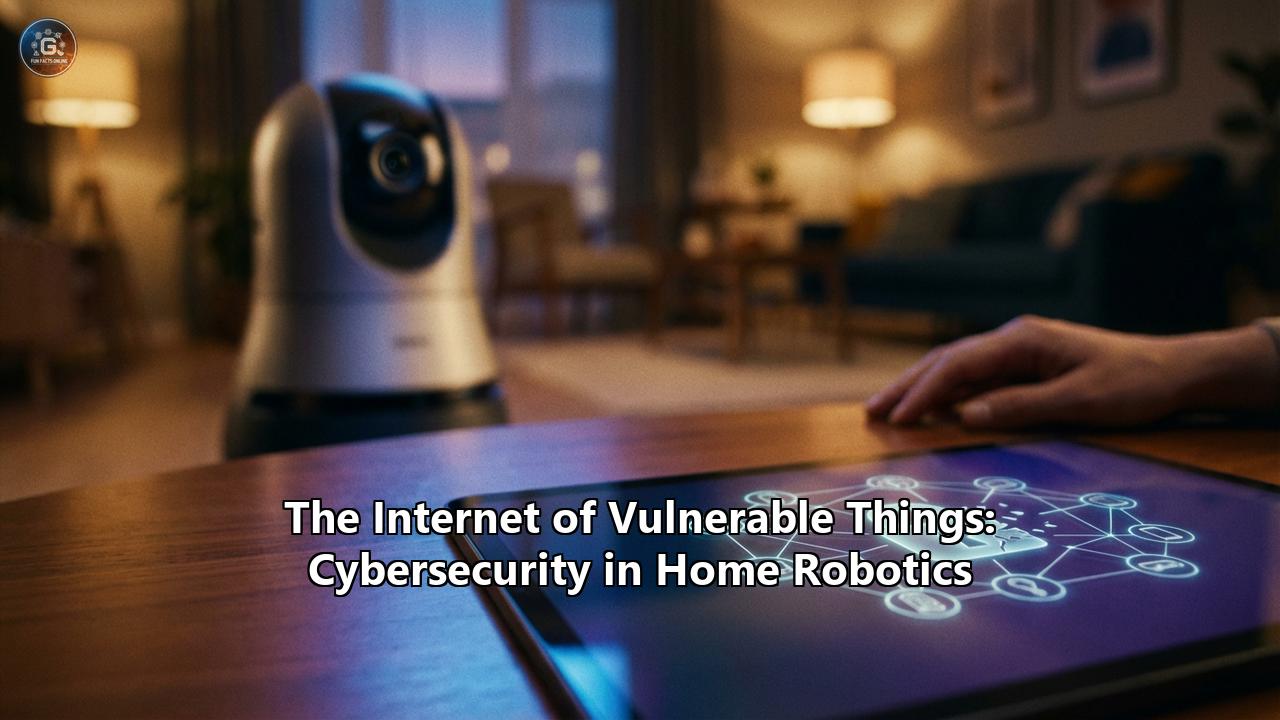
The modern smart home was sold to us as a frictionless utopia—a harmonious ecosystem where thermostats anticipate our thermal preferences, refrigerators order groceries, and robotic vacuums silently whisk away the detritus of daily life. However, as the Internet of Things (IoT) has evolved into the Internet of Vulnerable Things (IoVT), that utopian vision has been punctured by a chilling reality. We have invited a trojan horse into our most intimate spaces. Today, the devices populating our living rooms are no longer just passive sensors; they are autonomous, mobile, and equipped with high-definition cameras, sensitive microphones, and advanced artificial intelligence. They are home robots, and they represent the most complex cybersecurity challenge of the decade.
The transition from a stationary smart speaker to a roaming robotic vacuum or a fully autonomous companion robot fundamentally shifts the threat landscape. A hacked smart bulb might allow an attacker to flicker your lights; a hacked home robot gives an invisible adversary a mobile pair of eyes and ears that can map your floor plan, recognize the faces of your children, record your private conversations, and physically interact with your environment. As we navigate 2026, the intersection of robotics, consumer privacy, and cybersecurity has reached a boiling point, catalyzed by high-profile breaches, emerging global legislation, and the terrifying realization that our homes are only as secure as the weakest Wi-Fi-connected motor humming in the hallway.
The Evolution from Passive Sensors to Active Agents
To understand the gravity of the IoVT, we must first recognize how home robotics differ from traditional smart home devices. Early IoT devices were stationary and single-purpose. A smart thermostat monitored temperature; a smart lock secured a door. Home robots, however, are dynamic agents. They utilize Simultaneous Localization and Mapping (SLAM) and Light Detection and Ranging (LiDAR) to create intricate, centimeter-accurate topological maps of our homes.
When you purchase a high-end robot vacuum, a robotic security sentry like the Amazon Astro, or an AI-powered companion robot for an aging parent, you are deploying a machine that continuously ingests multi-modal data. These devices process visual feeds to avoid obstacles, use natural language processing to understand voice commands, and learn the behavioral routines of the household to optimize their tasks.
This mobility and autonomy create a perfect storm for cyber vulnerabilities. A stationary security camera has a fixed field of view, which a homeowner can control. A mobile robot, however, can be driven remotely into bedrooms, bathrooms, and home offices. The data these robots collect is not just operational; it is deeply personal. It includes the layout of your home, the location of your valuables, your daily schedule, and even biometric data. When this data is transmitted to cloud servers for processing, shared with third-party applications, or intercepted by malicious actors, the resulting privacy breach is devastating.
The Nightmares Are Real: Case Studies in Robotic Breaches
The theoretical risks of home robotics transitioned into terrifying reality over the last few years. Examining recent high-profile incidents reveals the exact mechanisms by which these devices are compromised and the psychological toll inflicted on the victims.
The Ecovacs Deebot X2 Hacks
In May 2024, a disturbing wave of cyberattacks targeted users of the Ecovacs Deebot X2, a premium robotic vacuum cleaner manufactured in China. The incidents, which occurred in multiple cities across the United States including Los Angeles, El Paso, and Minnesota, read like scenes from a dystopian thriller.
Daniel Swenson, a Minnesota lawyer, was relaxing with his family when his Deebot X2 suddenly began emitting strange, broken-radio-like noises. Upon checking the companion app, Swenson realized that a stranger was actively accessing the robot's live camera feed and its remote-control steering features. Believing it to be a glitch or a simple password compromise, he reset his credentials and rebooted the machine. Moments later, the vacuum sprang back to life. The onboard speakers blasted a human voice—sounding like a teenager—screaming racial slurs and obscenities directly in front of his 13-year-old son. In Los Angeles, a similarly hacked Deebot was used to chase the family dog around the house while projecting abusive language.
These were not isolated anomalies. Cybersecurity researchers Dennis Giese and Braelynn Luedtke had actually discovered and reported the critical vulnerabilities in the Ecovacs systems months prior, in December 2023. The researchers found that the robots suffered from a severe Bluetooth vulnerability, allowing anyone within roughly 450 feet (130 meters) to connect to the device. More egregiously, the four-digit PIN intended to secure the remote-control and live-video features was poorly implemented and easily bypassed. Despite the researchers' warnings, the manufacturer left the security gaps unresolved, initially attributing the hacks to "credential stuffing" (where hackers use passwords leaked from other websites) rather than acknowledging the systemic flaw. The Ecovacs incidents perfectly encapsulate the IoVT threat: a combination of poor authentication protocols, delayed firmware updates, and the chilling psychological invasion of a safe space.
Amazon Astro and the Surveillance Economy
While the Ecovacs hacks were executed by malicious third parties, other privacy concerns stem from the very design of the robots themselves. Enter the Amazon Astro, a $1,500 autonomous home patrol robot introduced as an "Alexa on wheels". Astro is designed to map the home, recognize individual family members using a feature called "Visual ID," and patrol the premises to investigate unusual sounds or unrecognized faces.
While Amazon has historically touted the Astro's privacy features—such as physical buttons to cut power to microphones and cameras, out-of-bounds zones, and local processing of facial recognition data—cybersecurity experts and privacy advocates have raised massive red flags. The Electronic Frontier Foundation (EFF) has warned that ubiquitous mobile surveillance inside the home creates a goldmine of data that could be exploited.
The Astro features a "Drop In" capability, allowing users to remotely pilot the robot and view its live camera feed. If an attacker were to compromise an Amazon account, they wouldn't just gain access to a user's shopping history; they would gain a remote-controlled drone inside the victim's house. Furthermore, experts warn of the legal and state-surveillance implications. Law enforcement agencies frequently serve warrants to tech companies for data recorded by stationary smart speakers. With a mobile robot, police could theoretically acquire a warrant to access Astro's data or live feed, effectively turning the robot into a roving wiretap and surveillance device without ever stepping foot inside the home.
Companion Robots: Emotional Manipulation and Deception
A rapidly growing sector of home robotics is dedicated to health and companionship, particularly for the aging population. Devices like ElliQ (created by Intuition Robotics) and various robotic pets are designed to mitigate loneliness, remind seniors to take medication, and facilitate social connection. ElliQ, for example, uses proactive artificial intelligence to initiate conversations, track health goals, and monitor subtle shifts in mood or sleep patterns.
However, the cybersecurity implications for companion robots are uniquely profound because they deal with vulnerable demographics and highly sensitive medical and emotional data. A breach of a companion robot goes beyond data theft. If a malicious actor gains access, they could alter medication reminders, leading to severe physical harm. Furthermore, there is the risk of emotional deception. Social robots are designed to form bonds; they use soothing voices, remember personal details, and simulate empathy. If a hacker hijacked a companion robot to socially engineer a lonely senior—perhaps convincing them to hand over financial information or isolating them from their family—the psychological abuse could be catastrophic. Even without malicious hacking, researchers worry about the "deception" inherent in these machines, where vulnerable users might forget they are interacting with an algorithm and over-rely on a machine that lacks true consciousness or moral judgment.
The Anatomy of a Home Robot Hack
To defend the Internet of Vulnerable Things, we must dissect how these devices are compromised. The architecture of a home robot generally consists of three layers: the physical hardware (sensors, actuators, ports), the local network connection (Wi-Fi, Bluetooth), and the cloud backend (APIs, mobile companion apps). Attackers can target any of these vectors.
1. Weak Authentication and Hardcoded CredentialsThe most common entry point for attackers is weak authentication. Many IoT devices ship with default, hardcoded passwords (e.g., admin/admin) that consumers never change. Even when consumers do set passwords, they often reuse them across multiple platforms, making them susceptible to the credential stuffing attacks that plagued Ecovacs users. Furthermore, as demonstrated by the Deebot X2 hacks, secondary authentication measures like four-digit PINs are frequently implemented without rate-limiting, allowing attackers to use brute-force software to guess the PIN in seconds.
2. Unsecured Communication ProtocolsRobots generate vast amounts of telemetry and video data. If this data is transmitted over the home network or to the cloud without robust encryption (such as TLS 1.3), it can be intercepted via Man-in-the-Middle (MitM) attacks. Additionally, many robots feature Bluetooth connectivity for initial setup. If the Bluetooth pairing mode is left perpetually active or lacks proximity authentication (requiring the user to physically press a button on the robot), attackers in close physical proximity can hijack the device, as seen in the 450-foot Bluetooth exploit discovered by researchers.
3. The Patching Deficit and Legacy FirmwareUnlike laptops or smartphones, which prompt users to install security updates regularly, IoT devices are notorious for their lack of firmware maintenance. Manufacturers operate on razor-thin margins and often abandon software support for older models shortly after releasing the next generation. Consequently, millions of home robots are currently roaming living rooms running outdated operating systems (like older versions of Linux or the Robot Operating System - ROS) that contain publicly known vulnerabilities. Without automated, over-the-air (OTA) updates, these robots become sitting ducks for automated botnets.
4. Insecure APIs and Cloud BackendsOften, the robot itself is relatively secure, but the cloud infrastructure managing it is flawed. Consumers control their robots via smartphone apps, which communicate with the manufacturer's APIs. If these APIs lack proper authorization checks (such as Broken Object Level Authorization, or BOLA), an attacker authenticated as User A might be able to manipulate the API parameters to access the video feed or steering controls of User B's robot.
5. Lateral Movement and Network SegmentationA compromised home robot is rarely the attacker's final goal; it is often a beachhead. Because home robots are connected to the main household Wi-Fi, an attacker who compromises a vacuum can use it to scan the local network for more lucrative targets, such as personal computers, network-attached storage (NAS) drives containing sensitive documents, or smart locks. This technique, known as lateral movement, highlights why the proliferation of cheap, unsecured IoT devices weakens the security posture of the entire home.
The Geopolitical and Supply Chain Realities
The cybersecurity of home robotics cannot be divorced from the realities of the global supply chain. A significant portion of the world's consumer robotics, including market leaders in the vacuum and smart appliance sectors, are manufactured in regions with complex geopolitical relationships to the West.
This raises profound questions about data sovereignty and national security. When a robot maps a home or records audio, where is that data stored? If the data is routed through servers in jurisdictions that do not adhere to strict privacy laws like the GDPR, it could theoretically be accessed by foreign intelligence services. While many manufacturers claim to anonymize data and utilize end-to-end encryption, the opaqueness of proprietary algorithms makes these claims difficult to independently verify. The concern is no longer just about a lone hacker spying on a family; it is about the mass aggregation of internal home layouts, daily routines, and audio data on a national scale.
The Regulatory Cavalry: 2025 and 2026 Milestones
For years, the consumer IoT market was a wild west, governed only by voluntary guidelines and market forces. However, recognizing the existential threat posed by unsecured connected devices, governments worldwide have finally deployed regulatory heavy artillery. The years 2025 and 2026 mark a watershed moment in IoT cybersecurity legislation.
The U.S. Cyber Trust Mark
In the United States, the Federal Communications Commission (FCC) officially launched the U.S. Cyber Trust Mark program in early 2025. Designed as a voluntary cybersecurity labeling program, it acts as an "Energy Star" rating for digital security. Qualifying devices, including wireless home security cameras, smart appliances, and robotic assistants, can display a recognizable shield logo and a QR code. By scanning the QR code, consumers can access a dynamic registry detailing the product's security features, data privacy policies, and the duration for which the manufacturer guarantees software updates.
The standards underpinning the Cyber Trust Mark are rigorous, drawing directly from the National Institute of Standards and Technology (NIST), specifically NISTIR 8425. To earn the mark, manufacturers must prove their devices feature unique identities, secure default configurations (no default passwords), robust data encryption at rest and in transit, and secure mechanisms for delivering over-the-air updates.
While initially voluntary, the landscape shifted dramatically on June 6, 2025, with the issuance of Executive Order 14306. This order mandates that by January 4, 2027, all vendors supplying consumer IoT products to the U.S. federal government must carry the U.S. Cyber Trust Mark. Because manufacturers generally prefer to produce a single, secure product line rather than maintaining separate lines for government and civilian use, this executive order effectively forces the entire industry to elevate its security baseline.
The EU Cyber Resilience Act (CRA)
Across the Atlantic, the European Union has taken an even more aggressive, mandatory approach. Adopted in late 2024 and moving through crucial implementation phases in 2026, the EU Cyber Resilience Act (CRA) is a groundbreaking legislative framework that fundamentally alters the economics of software and hardware development.
The CRA applies to all "products with digital elements" (PDEs), which encompasses everything from smart watches to industrial control systems and home robots. It makes "secure by design and by default" a legal requirement for gaining the CE mark necessary to sell products in the EU single market.
The timeline for the CRA is strict. By June 11, 2026, the framework for notifying conformity assessment bodies will be active. More critically, by September 11, 2026, mandatory vulnerability and incident reporting obligations take effect. Manufacturers will be legally required to report actively exploited vulnerabilities and severe incidents to the EU Agency for Cybersecurity (ENISA) within 24 hours. By December 11, 2027, the act will be fully enforced.
The CRA also demands that manufacturers provide a Software Bill of Materials (SBOM) for their products, ensuring transparency regarding open-source and third-party components. They must also guarantee security updates for a defined support period reflecting the expected lifetime of the product, up to five years. The penalties for non-compliance are severe, with fines reaching up to €15 million or 2.5% of the manufacturer's annual global revenue.
ETSI EN 303 645
Serving as the technical bedrock for much of this legislation is ETSI EN 303 645, the globally applicable standard for consumer IoT cybersecurity. Developed by the European Telecommunications Standards Institute, it outlines 13 critical provisions. These include the absolute prohibition of universal default passwords, the implementation of vulnerability disclosure policies, ensuring software integrity, and—crucially for home robotics—making it simple for consumers to delete their personal data from the device and its associated cloud services.
Defending the Fortress: Strategies for a Resilient Smart Home
As regulatory frameworks force manufacturers to improve their baseline security, the reality remains that millions of legacy devices—and perfectly compliant new devices configured poorly—will continue to operate in our homes. Securing the IoVT requires a shared responsibility model.
Manufacturer Imperatives
For robotics companies, security can no longer be an afterthought tacked onto the end of the product development cycle. Manufacturers must adopt the NIST Cybersecurity Framework (Identify, Protect, Detect, Respond, Recover) from the moment a robot is conceptualized.
- Hardware-Level Security: Robots should utilize Trusted Execution Environments (TEEs) or Hardware Security Modules (HSMs) to store cryptographic keys and sensitive biometric data securely.
- Physical Kill Switches: To alleviate consumer anxiety and provide absolute certainty, robots equipped with cameras and microphones should feature hardwired, physical kill switches that sever the electrical circuit to these sensors when privacy is required, circumventing any potential software exploit.
- Edge Computing: To minimize the risk of data interception and mass aggregation, manufacturers should prioritize edge computing. Facial recognition, spatial mapping, and voice command processing should occur locally on the robot's onboard processors rather than being uploaded to the cloud.
- Vulnerability Disclosure Programs: Companies must establish clear channels for independent security researchers to report flaws, backed by bug bounty programs to incentivize responsible disclosure rather than black-market sales of zero-day exploits.
Consumer Cyber Hygiene
Consumers must stop treating home robots as household appliances and start treating them as network-connected computers.
- Network Segmentation: The most critical defense mechanism a homeowner can deploy is network segmentation. Using a modern router, consumers should create a dedicated Virtual Local Area Network (VLAN) or a Guest Wi-Fi network specifically for IoT devices and robots. This isolates the robots from the primary network where sensitive devices like personal laptops, smartphones, and financial records reside. If a robot vacuum is compromised on a segmented network, the attacker cannot pivot to the homeowner's banking laptop.
- Aggressive Password Management: Consumers must change all default credentials immediately, utilizing lengthy, complex passphrases generated by a password manager. Furthermore, Multi-Factor Authentication (MFA) must be enabled on all companion apps.
- Strategic Placement and Usage: Users should critically evaluate the permissions they grant their devices. If remote viewing is not actively needed, it should be disabled in the app settings. Furthermore, docking stations should be placed in neutral areas (like a hallway or utility room) rather than intimate spaces like bedrooms, ensuring that if the camera is remotely activated while the robot is charging, it captures nothing sensitive.
- Lifespan Awareness: Consumers must factor cybersecurity into their purchasing decisions. Buying a heavily discounted robot from an unknown brand often means buying a device with zero future software support. Consumers should actively seek out devices bearing the U.S. Cyber Trust Mark or those explicitly complying with ETSI EN 303 645, and they should retire and ethically recycle devices that no longer receive security patches.
The Future: Navigating the Physical-Digital Bridge
We stand at the precipice of a new era in domestic living. The next generation of home robotics will blur the lines between machine and family member even further. Bipedal humanoid robots, advanced robotic chefs, and AI-driven home healthcare assistants are rapidly moving from research laboratories to commercial reality. These machines will possess unprecedented physical strength, dexterity, and cognitive capability.
If we fail to secure the current generation of robotic vacuums and rolling smart screens, the consequences of compromised next-generation robotics will escalate from privacy breaches to direct physical peril. A hacked companion robot delivering incorrect medication dosages, or a compromised bipedal robot physically tampering with home infrastructure, represents a paradigm shift in cyber-physical threats.
The Internet of Vulnerable Things is a solvable crisis, but it requires a fundamental recalibration of our relationship with convenience. The frictionless smart home is a myth; true security requires friction. It requires the friction of entering multi-factor authentication codes, the friction of segmenting home networks, the friction of regulatory compliance for manufacturers, and the friction of asking difficult questions about what we allow into our most private sanctuaries.
As we integrate these magnificent, complex machines into the fabric of our daily lives, we must do so with our eyes wide open. The home is the final frontier of absolute privacy. Securing the robots that patrol it is not just a matter of protecting data; it is a matter of preserving the sanctity, safety, and psychological peace of the modern sanctuary. The robots are already inside the house—it is entirely up to us to ensure they remain our servants, and never become our spies.
Reference:
- https://www.meritalk.com/articles/fcc-jumpstarts-effort-to-find-cyber-trust-mark-administrators/
- https://cycode.com/blog/cyber-resilience-act/
- https://www.kusari.dev/learning-center/eu-cyber-resilience-act
- https://www.infineon.com/product-information/eu-cra
- https://www.bakerdatacounsel.com/blogs/understanding-compliance-fccs-final-rule-on-iot-cybersecurity-labeling-and-executive-order-14306-a-new-mandatory-regime-for-connected-device-manufacturers/
- https://palindrometech.com/us-cyber-trust-mark
- https://www.ul.com/insights/us-cyber-trust-mark
- https://www.armorcode.com/learning-center/eu-cyber-resilience-act-cra-requirements-guide
- https://www.intertek.com/blog/2025/09-09-fcc-cyber-trust-mark/
- https://elliq.com/
- https://whyy.org/segments/how-ai-companion-robots-are-helping-seniors-feel-less-lonely/
- https://www.therobotreport.com/negotiating-independence-putting-user-agency-heart-robotics/
- https://www.frontiersin.org/journals/psychology/articles/10.3389/fpsyg.2023.1106633/full
- https://pursuit.unimelb.edu.au/articles/can-robots-really-be-companions-for-older-adults
- https://automationalley.com/2025/08/21/cybersecurity-and-safety-in-industrial-robotics-a-growing-imperative/
- https://www.aem.org/news/industrial-robotics-and-cybersecurity-how-manufacturers-can-minimize-risk-and-ensure-safe-operation
- https://www.tuv.com/content-media-files/master-content/global-landingpages/images/functional-safety-meets-cybersecurity/tuv-rheinland-whitepaper-robotics-en.pdf
- https://www.stephensonharwood.com/insights/data-and-cyber-update-january-2026/
- https://www.tuvsud.com/en-gb/resource-centre/stories/etsi-en-303-645-cybersecurity-for-consumer-internet-of-things