
The faint hum of a refrigerator in a remote clinic in sub-Saharan Africa might seem like a mundane sound, but for decades, it has been the fragile heartbeat of modern medicine. That hum represents the "cold chain"—a logistical tightrope that tethers the most advanced life-saving technologies to a continuous supply of electricity. If the power fails, the vaccines inside spoil, and the medicine dies. For over a century, the production of these medicines has relied on another fragile vessel: the living cell. Whether it is a genetically modified E. coli bacterium churning out insulin or a Chinese Hamster Ovary (CHO) cell producing monoclonal antibodies, biomanufacturing has been essentially farming. We brew cells in massive stainless-steel vats, feed them, coax them, and pray they don't get sick or mutate. We are beholden to the biological imperatives of a living organism that cares more about its own survival than our production quotas.
But a quiet revolution is dismantling this paradigm. In laboratories from Cambridge, Massachusetts to Kyoto, Japan, scientists are breaking the cell open, extracting its machinery, and discarding the shell. They are creating Cell-Free Foundries—synthetic environments that retain the miracle of biology without the constraints of life. This is not just a new way to make medicine; it is the digitization of biology, turning the slow, artisanal process of fermentation into a programmable, portable, and precise engineering discipline.
This article explores the dawn of the cell-free age, a shift that promises to allow astronauts to print medicine on Mars, soldiers to synthesize antidotes on the battlefield, and doctors to design personalized cancer treatments in hours rather than months.
Part I: The Black Box and the Open Field
To understand the radical nature of cell-free synthesis, one must first appreciate the tyranny of the living cell. Traditional biomanufacturing is, at its core, a negotiation with a living entity. When a bioengineer inserts a gene into a bacterium to produce a therapeutic protein, they are essentially asking the bacterium to divert its resources away from growth and reproduction toward making a foreign substance. The bacterium often resists. It may degrade the foreign protein, form insoluble clumps called inclusion bodies, or simply die from the toxicity of the product. The cellular membrane acts as a fortress, keeping the engineer out and the product in. To tweak the reaction conditions—to add a cofactor, adjust the pH, or introduce a non-natural amino acid—the engineer must figure out how to transport these molecules across the cell wall without killing the host.
The cell is a "black box." You put DNA in, you get protein out, but you have limited control over what happens inside.
Cell-Free Protein Synthesis (CFPS) changes the rules of engagement. The concept is brutally simple: if the cell is a factory, why do we need the walls, the janitors, and the cafeteria? We only need the assembly line. By lysing (breaking open) the cell and removing the genomic DNA and cell wall debris, scientists harvest the "soup" of life—the ribosomes, enzymes, tRNAs, and cofactors required for transcription and translation.This "lysate" is no longer a living thing. It is a chemical reagent. It does not grow. It does not evolve. It does not die. But it functions. When you add a DNA template to this soup, the ribosomes snap into action, reading the genetic code and synthesizing the protein just as they would inside a living cell.
The implications of this "open" system are profound. The cell membrane, once a barrier, is gone. The reaction is now an open field. If the protein needs a specific cofactor to fold? You simply pipette it in. If the reaction needs more energy? You add a scoop of ATP. If the product is toxic to living cells? It doesn't matter—there is no cell to kill.
The Alchemy of the Extract: The S30 Protocol
The journey from a living culture to a cell-free foundry begins with a process known as the S30 protocol, a method refined over decades to harvest the delicate machinery of translation without destroying it.
It starts with a specific strain of E. coli, often a variant of BL21, engineered to be low in nucleases (enzymes that chew up DNA and RNA) and proteases (enzymes that chew up proteins). These cells are grown in a nutrient-rich broth until they reach the "mid-log phase"—the metabolic sweet spot where the cellular machinery is most active, gearing up for rapid division.
The harvest is a violent but calculated affair. The cells are collected and washed, then subjected to lysis. In the early days, this was done with a French press, a device that squeezes cells through a tiny valve under immense pressure (20,000 psi) until they pop. Today, many labs use sonication—blasting the cells with high-frequency sound waves. The goal is to rupture the cell wall but leave the ribosomes intact.
The resulting goop is centrifuged at 30,000 x g (hence the name "S30") to spin down the heavy debris—cell walls, un-lysed cells, and large distinct bodies. The supernatant, the liquid floating on top, is the gold. It contains the ribosomes, the RNA polymerase, the tRNA synthetases, and the metabolic enzymes.
But there is a catch: this extract is full of the bacterium's own DNA and mRNA. If you added your synthetic DNA now, the ribosomes would be too busy translating the bacterium's own housekeeping genes to notice yours. The solution is the "run-off" reaction. The extract is incubated at 37°C for about 80 minutes. During this time, the ribosomes finish translating the remaining bacterial mRNA, and endogenous nucleases degrade the bacterial genetic material. The result is a "blank slate"—a biological computer with the operating system loaded but no programs running, waiting for the user to insert the code.
Part II: The Energy Problem and the PANOx-SP Solution
A living cell is a master of energy management. It constantly regenerates ATP (adenosine triphosphate), the cellular currency of energy, through glycolysis and oxidative phosphorylation. In a test tube, however, these cycles are broken. Without a constant supply of energy, the ribosomes stall, and the reaction dies within minutes.
For years, this was the Achilles' heel of cell-free systems. They were expensive toys, requiring the constant addition of pricey ATP and creatine phosphate. The breakthrough came with the development of sophisticated energy regeneration systems, most notably PANOx-SP.
PANOx-SP sounds like a jet fuel, and in a biological sense, it is. It stands for Phosphoenolpyruvate (PEP), Amino acids, NAD+, Oxalic acid, Spermidine, and Putrescine.
- PEP is a high-energy phosphate donor that allows enzymes in the lysate (like pyruvate kinase) to rapidly recharge ADP back into ATP.
- Oxalic acid is a metabolic "hack." It inhibits the enzyme succinate dehydrogenase, preventing the lysate from wasting energy on non-productive metabolic loops.
- Spermidine and Putrescine are polyamines that stabilize the DNA and RNA, mimicking the crowded chemical environment of a living cell.
More recent advancements have moved even further, using Maltodextrin—a cheap carbohydrate derived from corn starch—as an energy source. By utilizing the glycolytic pathway enzymes already present in the E. coli extract, scientists can generate ATP from maltodextrin for pennies. This shift from expensive high-energy phosphates to cheap sugars has been a key factor in reducing the cost of cell-free protein synthesis (CFPS) from thousands of dollars per gram to a price point where it can compete with traditional fermentation.
Part III: The Hardware of Creation
If the lysate is the software, the "foundry" is the hardware. In the past, cell-free reactions were performed in Eppendorf tubes—small plastic vials. Today, they are running in microfluidic chips, continuous flow reactors, and even on paper.
The Continuous Exchange Cell-Free (CECF) Reactor
In a standard "batch" reaction (like a pot of soup), the reaction stops when the energy runs out or waste products (like inorganic phosphate) build up and poison the system. To solve this, engineers developed the Continuous Exchange Cell-Free (CECF) system.
Imagine a small chamber divided by a semi-permeable membrane. On one side is the reaction mixture (the ribosomes and DNA). On the other side is a feeding solution (amino acids and energy). The membrane is permeable to small molecules but not to the large ribosomes or the synthesized protein. Fresh nutrients diffuse in to feed the reaction, and toxic waste products diffuse out. The result is a reaction that can run for 24 hours or more, producing protein yields of up to several milligrams per milliliter—orders of magnitude higher than a simple batch reaction.
The MIT Mobile Vaccine Printer
Perhaps the most visceral example of a "Cell-Free Foundry" is the Mobile Vaccine Printer developed by the laboratories of Ana Jaklenec and Robert Langer at MIT.
During the COVID-19 pandemic, the fragility of the global vaccine supply chain was laid bare. mRNA vaccines required deep-freeze storage (-80°C) and complex distribution networks. The MIT team asked: what if we could print the vaccine right where it's needed?
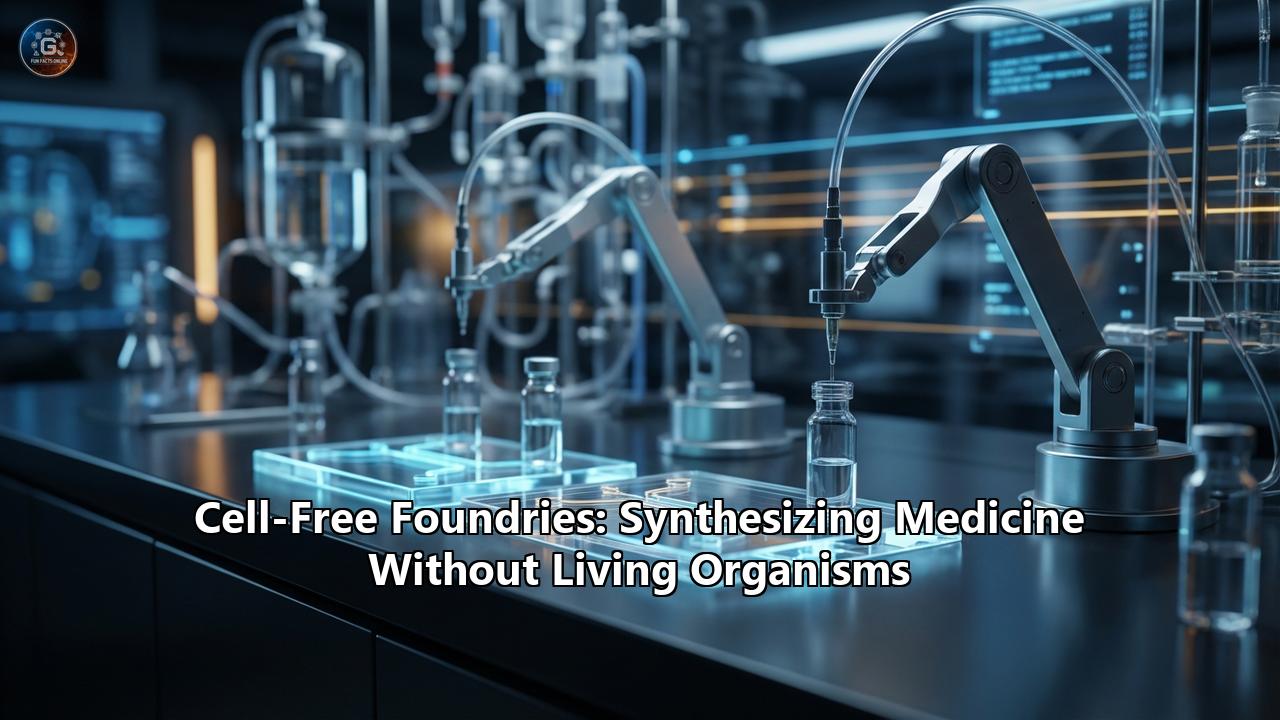
Their device, small enough to fit on a tabletop, is a fully automated foundry. It uses a "bio-ink" containing the DNA template for the vaccine antigen and the cell-free reaction components. Inside the machine, a robotic arm injects this ink into a mold containing hundreds of microneedles.
The magic happens inside the mold. The cell-free reaction occurs, synthesizing the vaccine payload (e.g., the Spike protein mRNA or the protein itself). The mold is then vacuum-dried. The result is a patch—a thumb-sized square bristling with dissolvable microneedles containing the vaccine. This patch is stable at room temperature for months.
Imagine the scenario: An Ebola outbreak is detected in a remote village in the DRC. Instead of waiting for a shipment of frozen vials from a factory in Belgium, a response team deploys with a briefcase-sized printer and digital files. They download the genetic sequence of the specific Ebola strain, and the printer begins churning out patches. No needles, no refrigerators, just on-demand immunity.
Digital Microfluidics: The "Cloud" Lab
Companies like Nuclera and Cellfree Sciences are taking this a step further with digital microfluidics. In these systems, droplets of liquid are moved around on a chip using electrical signals—"electrowetting." A droplet of DNA moves to meet a droplet of lysate; they merge, mix, and the reaction begins. This allows for massive parallelization. A single chip can screen hundreds of different DNA sequences or reaction conditions simultaneously. It is the biological equivalent of a computer processor, executing thousands of "threads" of protein synthesis at once.
Part IV: The Impossible Proteins
The true power of cell-free foundries is not just making more of what we already have, but making things that were previously impossible.
The Toxic Payload: Antibody-Drug Conjugates (ADCs)
One of the most promising frontiers in cancer therapy is the Antibody-Drug Conjugate (ADC). These are "guided missiles"—an antibody that homes in on a cancer cell, tethered to a toxic payload that kills it.
Producing ADCs in living cells is a nightmare. The payload is often a potent toxin (like a microtubule inhibitor) designed to kill cells. If you try to make this in a CHO cell, the cell commits suicide before it can produce enough of the drug.
Sutro Biopharma, a pioneer in commercial cell-free manufacturing, has solved this with their XpressCF platform. Because their system is dead, it is immune to the toxin. They can synthesize the antibody and the toxic payload in the same reactor, or use non-natural amino acids to create precise attachment points for the toxin. In living cells, conjugation is messy—the toxin might stick to the antibody in random places, creating a heterogeneous mixture where some antibodies have zero toxins and others have ten. Sutro's cell-free system allows for site-specific conjugation, creating a homogeneous, safer, and more effective drug. Their lead candidate, Luveltamab tazevibulin (Luvelta), targeting ovarian cancer, is a testament to this capability.The Membrane Frontier: G-Protein Coupled Receptors (GPCRs)
G-Protein Coupled Receptors (GPCRs) are the gatekeepers of the cell, involved in everything from sensing light to regulating blood pressure. They are the target of nearly 35% of all FDA-approved drugs. Yet, they are notoriously difficult to study. They are snake-like proteins that weave in and out of the cell membrane seven times. Without the membrane support, they collapse into useless tangles.In a living cell, overexpressing a GPCR often clogs the membrane, killing the cell. In a cell-free system, scientists can add "nanodiscs"—tiny patches of lipid bilayer held together by a belt of protein—or microsomes derived from the ER. The cell-free machinery synthesizes the GPCR and inserts it directly into these nanodiscs.
This technique has allowed researchers to produce difficult targets like the Endothelin-B receptor or the Cannabinoid receptor CB2 in quantities sufficient for X-ray crystallography and drug screening. It is unlocking a vast library of drug targets that were previously "undruggable" simply because we couldn't make them in a lab.
Part V: Digital Biology and the AI Loop
The transition from biological "farming" to "foundries" brings biology into the realm of data science. Because cell-free reactions are chemical processes defined by precise inputs (concentrations of magnesium, potassium, DNA, amino acids), they are perfectly suited for Machine Learning (ML) optimization.
In a living cell, if you change the magnesium concentration, a thousand different regulatory pathways might activate, causing unpredictable side effects. In a cell-free lysate, the response is linear and predictable.
Researchers are now using Active Learning loops to optimize these systems. A robot (like the Echo liquid handler) mixes 384 different "recipes" of lysate, varying the concentrations of salts, energy sources, and tRNAs. A plate reader measures the protein output (usually a fluorescent reporter like GFP). An AI algorithm analyzes the data, identifies which variables are driving yield, and designs the next 384 recipes.
In one study, this approach allowed researchers to explore a combinatorial space of 4 million possible buffer compositions. The AI quickly converged on a recipe that increased protein yield by 34-fold. This "debugging" of biological code is only possible because the system is stripped of the noise of life. It is turning biology into an engineering discipline where "Yield = f(Inputs)" is a solvable equation.
Part VI: Beyond Earth – The NASA Connection
If cell-free foundries are useful in remote African villages, they are absolutely critical for the ultimate remote location: Mars.
Space travel imposes strict limits on mass and volume. You cannot pack a pharmacy for a three-year mission to Mars. Medicines expire; radiation degrades them. You cannot pack a fermenter and thousands of liters of media to grow cells.
NASA’s CUBES (Center for the Utilization of Biological Engineering in Space) is betting on cell-free biology. The concept is "In Situ Resource Utilization" (ISRU)—living off the land.The BioNutrients project is testing yeast strains (and eventually cell-free systems) that can produce beta-carotene and zeaxanthin (essential antioxidants) on demand. But the cell-free vision goes further.
Imagine a "Bio-Foundry" on the ISS or a lunar base. It consists of freeze-dried pellets of lysate—lightweight, stable, and compact. When an astronaut gets an infection, they don't look through a medicine cabinet. They sequence the pathogen, email the data to Earth, where scientists design a specific antimicrobial peptide. The code is beamed back to the ship. The astronaut prints the DNA template, hydrates a lysate pellet with water, and adds the DNA. In hours, the medicine is synthesized.
The BioAsteroid experiment has already tested the interaction of microbes with rock in microgravity, paving the way for "biomining"—using biological systems to extract rare earth metals from asteroid regolith to build the infrastructure for these foundries.
The Zero-Waste concept is central here. On Mars, carbon is scarce. CUBES researchers are designing systems where the "waste" from one reaction (or even astronaut waste) is converted into the feedstock for the next. Cell-free systems, which can be powered by simple sugars or even potentially light-driven regeneration systems (using thylakoids extracted from plants), fit perfectly into this closed-loop ecology.
Part VII: The Distributed Future and Regulatory Frontiers
The technological pieces are falling into place, but the societal shift is just beginning. Cell-free foundries propose a move from Centralized Manufacturing (one giant factory supplying the world) to Distributed Manufacturing (thousands of small factories at the point of care).
This terrifies regulators. The FDA is built on the idea of validating the process. A factory is inspected, the pipes are checked, the air quality is monitored. If the factory is a briefcase in a pharmacy, or a machine in a patient's home, how do you regulate quality?
In October 2022, the FDA released a discussion paper on "Distributed and Point-of-Care Manufacturing," signaling their willingness to engage with this new reality. The framework suggests a "Hub and Spoke" model. A central "Hub" creates the validated "kits" (the lysate, the DNA, the hardware). The "Spoke" (the local pharmacy) simply runs the validated protocol. The quality control might be automated—the machine itself checks the purity of the product before dispensing it.
This democratization of biomanufacturing has immense potential. It could lower drug costs by eliminating the cold chain and reducing waste. It could allow for "N=1" medicine—drugs designed and synthesized for a single patient's unique tumor or genetic condition.
Conclusion: The Second Age of Biology
We are leaving the age of domestication, where we tamed cells like livestock to do our bidding. We are entering the age of the Cell-Free Foundry, where we dismantle the biological machine to understand its parts and reassemble them into engines of creation.
It is a shift from the wet, unpredictable, and fragile world of the living to the precise, robust, and digital world of the synthetic. From the shelf-stable vaccine patches of the MIT printer to the cancer-killing ADCs of Sutro Biopharma, and the lunar labs of NASA, cell-free biology is synthesizing a future where medicine is no longer grown, but computed, printed, and delivered anywhere in the universe.
The hum of the refrigerator in that remote clinic may one day be silenced, replaced by the quiet whir of a printer, generating life-saving cures from a tube of freeze-dried powder and a stream of digital code.
Deep Dive: The Technical Architectures of Cell-Free Systems
To fully grasp the magnitude of this technology, we must look under the hood at the specific architectures that make it possible.
1. The Lysate Source: E. coli vs. Wheat Germ vs. Mammalian
Not all extracts are created equal. The choice of the "chassis" determines what proteins you can make.
- E. coli S30 (Prokaryotic): The workhorse. Cheap, high-yield (up to 2-3 g/L), and easy to make. Perfect for simple proteins, vaccines, and nanobodies. However, it lacks the machinery for complex "post-translational modifications" (PTMs) like glycosylation (adding sugar chains), which are essential for many human therapeutic proteins.
- Wheat Germ (Eukaryotic): Derived from the embryos of wheat seeds. It is a "clean" system with very low endogenous nuclease activity, allowing for the synthesis of massive proteins that would degrade in E. coli. It is the gold standard for complex eukaryotic proteins but has historically been slower and more expensive.
- Rabbit Reticulocyte & CHO Lysates (Mammalian): The closest to human biology. These extracts contain the microsomes and enzymes needed for complex glycosylation. They are essential for making "human-identical" proteins but suffer from lower yields and higher costs.
- The PURE System (Reconstituted): This is the extreme end of the spectrum. Instead of a crude lysate, the PURE (Protein synthesis Using Recombinant Elements) system is built by mixing 36 individually purified enzymes (ribosomes, T7 RNA polymerase, translation factors, etc.). It is a fully defined composition. If you want to know exactly how a specific variable affects translation, or if you want to eliminate all background noise, you use PURE. It is expensive but offers ultimate control.
2. The Energy Regeneration Landscape
The battle for yield is a battle for ATP. The standard batch reaction fails because ATP hydrolysis produces inorganic phosphate/pyrophosphate, which eventually chelates the magnesium ions required by the ribosomes.
- Phosphoenolpyruvate (PEP): The classic high-energy donor. Very efficient but expensive.
- Creatine Phosphate (CP): Used in eukaryotic systems (like rabbit reticulocyte) because their enzymes recognize it.
- 3-Phosphoglycerate (3-PGA): A cheaper alternative that feeds into the glycolytic pathway.
- Maltodextrin/Starch: The "slow-release" carb. It mimics the cell's natural energy storage. By slowly breaking down starch, the system maintains a steady level of ATP without flooding the reaction with inhibitory phosphate.
- Cytomim: A specific buffer formulation designed by the Swartz lab at Stanford to mimic the cytoplasm's reducing environment, using glutamate and putrescine instead of standard chloride salts, significantly boosting the folding of complex proteins.
3. The Paper-Based Revolution: Bio-Bits
James Collins and his team at MIT and the Wyss Institute developed Bio-bits, a platform that freeze-dries cell-free reactions onto small discs of paper. These are essentially "just add water" synthetic biology experiments.
They have demonstrated:
- Diagnostics: A paper disc containing a genetic switch that turns red in the presence of Zika virus RNA. It costs pennies and requires no electricity.
- Education: "Bio-bits" kits are now used in classrooms to teach students about DNA and proteins without the need for biosafety level labs or incubators. The "foundry" is now in the backpack of a high school student.
The Economic Model: From CAPEX to OPEX
The pharmaceutical industry is addicted to CAPEX (Capital Expenditure). Building a biologic manufacturing plant costs $500 million to $1 billion and takes 5 years. It is a massive bet. If the drug fails in Phase III trials, that steel cathedral becomes a ruin.
Cell-free foundries shift the model to OPEX (Operating Expenditure). You don't need the giant plant. You need a room with liquid handlers and a supply of lysate.
- Scale-out vs. Scale-up: In traditional fermentation, going from a 10L lab reactor to a 10,000L production tank is a nightmare of fluid dynamics, oxygen transfer, and shear stress. In cell-free, "scaling up" just means adding more volume to the bag or running more parallel micro-reactors. The reaction kinetics in 1mL are identical to 100L because there are no cells to suffocate or starve.
- Pandemic Responsiveness: When a new virus hits, a cell-free facility can switch from making Vaccine A to Vaccine B in hours. You just change the DNA template. A fermentation plant might need weeks of cleaning, sterilization, and seed-train growth (growing the cells from a frozen vial to production volume) before it can switch products.
The Road Ahead: Challenges to Overcome
Despite the promise, cell-free foundries are not yet ubiquitous. Challenges remain:
- Cost: While costs have dropped (from ~$1000/g to <$50/g for some systems), it is still more expensive than large-scale microbial fermentation for simple proteins like insulin. The extract preparation needs to become even cheaper—perhaps by engineering "autolytic" strains of E. coli that lyse themselves at the push of a chemical button.
- Protein Folding: While nanodiscs help, some incredibly complex proteins still struggle to fold correctly outside the meticulously chaperoned environment of a living cell.
- Glycosylation Control: While we can do glycosylation in cell-free systems, controlling the exact pattern of sugars (the glycan profile) to match human standards is still an active area of research. This is critical for avoiding immune reactions in patients.
Final Thoughts
The history of technology is often the history of miniaturization and democratization. Computers went from room-sized mainframes to pockets. Printing went from guild-controlled presses to home desktops. Energy is moving from centralized power plants to distributed solar.
Biology is next. Cell-free foundries are the mechanism of this transition. By stripping life down to its molecular essence, we are turning the creation of medicine from a biological art into a digital manufacturing capability. It is a future where the remedy for a disease is just a file download away, where the "means of production" for life-saving drugs belongs not just to the few, but to the many.
Reference:
- https://parts.igem.org/Chassis/Cell-Free_Systems/Homemade_E.coli_S30/Preparation_Protocol
- https://static.igem.org/mediawiki/2009/a/af/E.Coli_cell_free_system_protocol.pdf
- https://pmc.ncbi.nlm.nih.gov/articles/PMC5074584/
- https://journals.plos.org/plosone/article/file?type=printable&id=10.1371/journal.pone.0165137
- https://cell-free.com/blogs/cell-free-protein-expression/a-brief-history-of-extract-based-cell-free-protein-expression-systems
- https://www.youtube.com/watch?v=0Zn89Xx6v28
- https://www.researchgate.net/figure/PANOx-energy-regeneration-system-Underlined-are-PANOx-additives-amino-acids-not-shown_fig3_345988276
- https://www.mdpi.com/1422-0067/24/3/2808
- https://pmc.ncbi.nlm.nih.gov/articles/PMC6316570/
- https://www.leniobio.com/protein-in-profile-membrane-protein/
- https://www.researchgate.net/figure/Active-learning-loop-to-explore-the-buffer-composition-of-a-cell-free-system-Illustration_fig2_340785433