
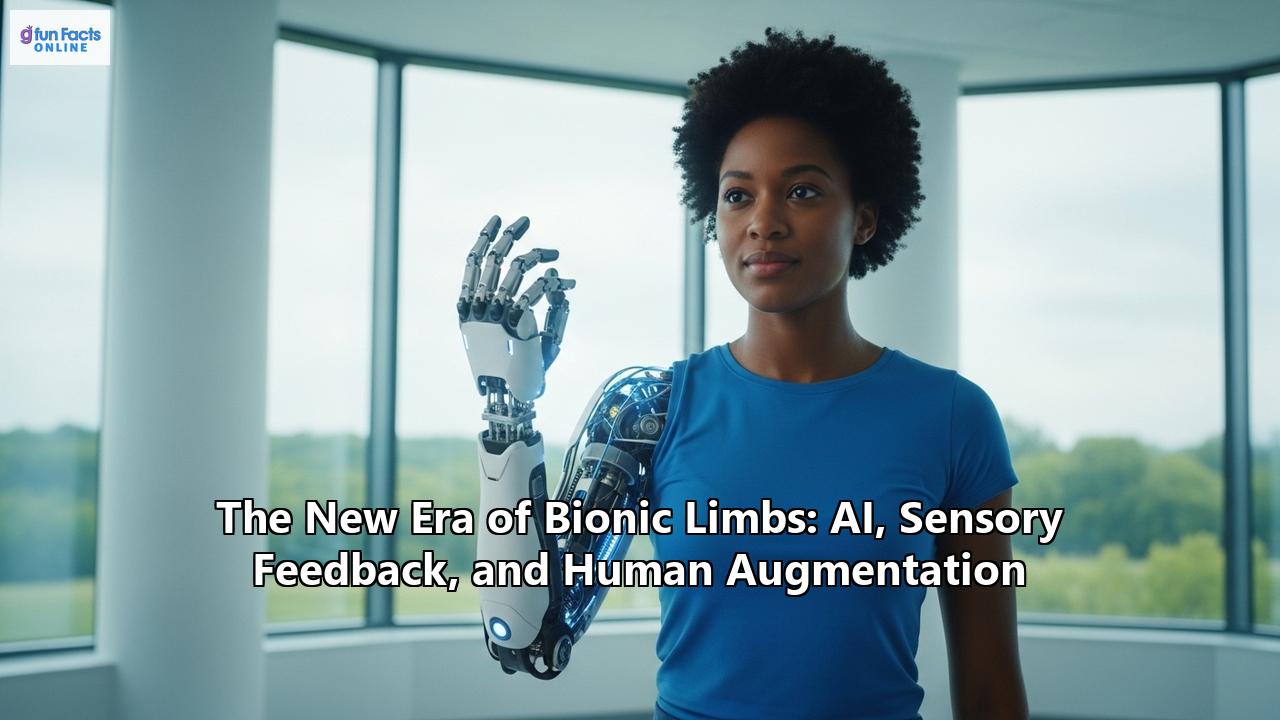
The line between human and machine is blurring, and nowhere is this more apparent than in the revolutionary field of bionic limbs. Once the stuff of science fiction, advanced prosthetics are now a reality, transforming the lives of individuals with limb loss and pushing the boundaries of what it means to be human. This is not merely about replacing a missing part; it's about restoring a sense of wholeness, functionality, and even enhancing capabilities beyond our biological limits. We are entering a new era where artificial intelligence (AI), sophisticated sensory feedback, and the concept of human augmentation are converging to create bionic limbs that are more integrated, intuitive, and lifelike than ever before.
The Dawn of Intelligent Limbs: The Role of Artificial Intelligence
For decades, prosthetic limbs were often cumbersome, relying on manual controls or simplistic, pre-programmed movements. However, the integration of artificial intelligence is ushering in a new generation of "smart" prosthetics that can learn, adapt, and even predict the user's intentions.
At the heart of this revolution is machine learning, a subset of AI that enables these devices to become more personalized and intuitive over time. By analyzing vast amounts of data from sensors that detect muscle signals, movement patterns, and environmental cues, AI algorithms can translate a user's intent into fluid, precise motion. This means that instead of consciously thinking about each movement, a user can begin to control their bionic limb with a naturalness that approaches that of a biological limb.
Key roles of AI in modern bionics include:
- Predictive Movement: AI algorithms can anticipate a user's next move based on past actions and current muscle signals. For instance, if a person frequently reaches for a cup with a specific grip, the AI can learn this pattern and prepare the prosthetic hand to form the correct shape automatically, reducing the mental effort required.
- Real-Time Adaptation: AI-powered prosthetic legs can analyze data from pressure sensors and accelerometers to adjust to different terrains in real-time, whether walking on a flat surface or an uneven path. This enhances stability and reduces the risk of falls. At CES 2025, the Bio Leg, a commercially available prosthesis with AI-assisted gait management, received a "Best of Innovation" award for its ability to help users navigate stairs and inclines with a natural gait.
- Personalized Learning: AI allows prosthetics to adapt to a user's unique habits and preferences. Over time, the device learns from repeated actions, fine-tuning its responses to make movements feel more natural and efficient.
- Enhanced Control Through Brain-Computer Interfaces (BCIs): The future of prosthetic control lies in the synergy between AI and BCIs. These systems decode brain signals, allowing users to control their bionic limbs simply by thinking about the desired movement. AI plays a crucial role by filtering out noise from brain activity and focusing on the relevant signals, making the control more reliable and precise.
Feeling the World Again: The Revolution of Sensory Feedback
Perhaps one of the most profound advancements in bionic technology is the restoration of sensory feedback. For individuals with limb loss, the inability to feel touch, pressure, or temperature can create a significant disconnect from the world and make everyday tasks challenging. Modern bionic limbs are now being equipped with sophisticated systems that can transmit these sensations back to the user, bridging the gap between the artificial and the biological.
The science behind sensory feedback is complex and multifaceted, involving a range of technologies designed to mimic the body's natural communication with the brain:
- Haptic and Tactile Feedback: This is one of the most common forms of sensory feedback. Sensors embedded in the prosthetic limb detect pressure, texture, and temperature. This information is then translated into signals that the user can perceive, often through vibrations or electrical stimulation on the skin of their residual limb. For example, a stronger grip might produce a more intense vibration, allowing the user to gauge the force they are applying.
- Neural Interfaces and Direct Nerve Stimulation: For a more direct and natural-feeling sensation, researchers are developing neural interfaces that connect the prosthetic directly to the user's nervous system. Tiny electrodes can be implanted near or on the residual nerves, delivering precise electrical pulses that the brain interprets as touch. This has allowed some users to report feeling the softness of a pillow or the texture of a rock through their bionic hand. A groundbreaking surgical procedure known as the agonist-antagonist myoneural interface (AMI) reconnects severed nerve and muscle pairs, allowing for more natural and intuitive control, and even a degree of proprioception—the sense of where the limb is in space.
- Proprioception: Beyond touch, proprioception is crucial for coordinated movement. New research is focused on restoring this "sixth sense." By providing feedback about the limb's position and movement, users can achieve a more fluid and natural gait without having to constantly watch their prosthetic.
- Advanced Materials and "E-Skin": The development of synthetic skins that can mimic the properties of human skin is another exciting frontier. These materials are not only more lifelike in appearance but can also be embedded with sensors to detect a wide range of sensory information.
The psychological impact of restoring sensation is immense. It can reduce the feeling of phantom limb pain, a common and often distressing condition for amputees. Furthermore, the ability to feel a handshake or the warmth of a loved one's hand can profoundly improve a person's sense of connection and well-being.
Beyond Replacement: Human Augmentation and the Future of Bionics
While the primary goal of bionic limbs is to restore lost function, the technology is also paving the way for human augmentation—the use of technology to enhance human capabilities beyond biological norms. This concept, once relegated to science fiction, is now a tangible reality.
Examples of how bionics are pushing the boundaries of human potential include:
- Enhanced Strength and Endurance: Some bionic limbs are already stronger and more efficient than their biological counterparts. High-tech prosthetic legs used by Paralympic athletes, for example, can outperform natural legs in terms of speed and energy efficiency. Robotic exoskeletons, initially designed for rehabilitation, are now being used in industrial settings to help workers lift heavy objects with minimal effort, significantly reducing the risk of injury.
- New Abilities: The potential exists for bionic limbs to incorporate features that biological limbs do not possess. This could include integrated tools, advanced sensors for detecting things beyond human perception, or even additional limbs. The "third thumb" project at the University of Cambridge, for instance, explores how the brain can adapt to controlling an extra robotic digit.
- Extreme Environments: Bionic limbs could be designed for use in environments where humans are at a disadvantage, such as deep-sea exploration or space.
This raises profound questions about what it means to be human and where we draw the line between therapy and enhancement. As the technology becomes more advanced and accessible, society will need to grapple with the ethical and social implications of human augmentation.
The Road Ahead: Challenges and a Glimpse into the Future
Despite the remarkable progress, there are still challenges to overcome. The cost of advanced bionic limbs can be prohibitive for many, and issues of durability, maintenance, and power consumption remain. Innovations like solar-powered prosthetics, which integrate photovoltaic cells into the limb's design, are being explored to address some of these limitations.
Looking toward the horizon between 2025 and 2030, we can expect to see even more significant leaps forward. The integration of AI will become more seamless, leading to prosthetics that can adapt and learn with even greater sophistication. The development of less invasive neural interfaces will make intuitive control and rich sensory feedback more widely available. Furthermore, the use of 3D printing will continue to drive down costs and allow for highly customized prosthetic designs.
We are on the cusp of a future where bionic limbs are not just replacements but are fully integrated, sensory-rich extensions of the human body. The continued convergence of AI, advanced materials, and neuroscience promises a world where the loss of a limb is no longer a barrier to a full and active life, and may even open the door to capabilities we are only just beginning to imagine.
Reference:
- https://www.robobionics.in/blog/grippy-future-of-bionic-hands/
- https://www.robobionics.in/blog/bionic-limbs-in-2025-2030-are-we-closer-to-fully-functional-cybernetics/
- https://www.robobionics.in/blog/how-bionic-prosthetics-mimic-natural-movement-better-than-ever/
- https://pmc.ncbi.nlm.nih.gov/articles/PMC11325936/
- https://prothotic.com/2024/08/the-intersection-of-technology-and-prosthetics-how-ai-is-shaping-the-future/
- https://www.robobionics.in/blog/the-growing-role-of-machine-learning-in-customizing-prosthetics-2025-2030/
- https://qwadra.com/ai-in-the-orthotics-and-prosthetics-industry/
- https://www.youtube.com/watch?v=_9AeKPJDIn4
- https://www.robobionics.in/blog/innovations-in-sensory-feedback-can-bionic-prosthetics-restore-touch/
- https://livingwithamplitude.com/best-technology-for-amputees-ces-2025/
- https://www.friendlylikeme.com/access-spotlight/how-ai-powered-prosthetic-arm-can-be-an-accessibility-game-changer
- https://www.robobionics.in/blog/next-gen-prosthetic-arms-the-most-anticipated-innovations-of-2025-2030/
- https://pharma.researchfloor.org/bionics-in-medicine-the-future-of-organ-replacement/
- https://www.robobionics.in/blog/the-future-of-sensory-feedback-in-artificial-limbs/
- https://opcenters.com/the-future-of-prosthetic-sensory-feedback/
- https://news.mit.edu/2024/prosthesis-helps-people-with-amputation-walk-naturally-0701
- https://www.robobionics.in/blog/the-future-of-waterproof-and-multi-terrain-prosthetics-2025-2030/
- https://www.medicaldirector.com/news/future-of-health/how-human-augmentation-is-transforming-health/
- https://projects.research-and-innovation.ec.europa.eu/en/horizon-magazine/helping-body-and-brain-welcome-bionic-limbs-and-implants
- https://www.youtube.com/watch?v=GgTwa3CPrIE
- https://www.numberanalytics.com/blog/future-of-prosthetic-limbs
- https://8msolar.com/solar-powered-prosthetics-the-future-of-accessible-medical-technology/