
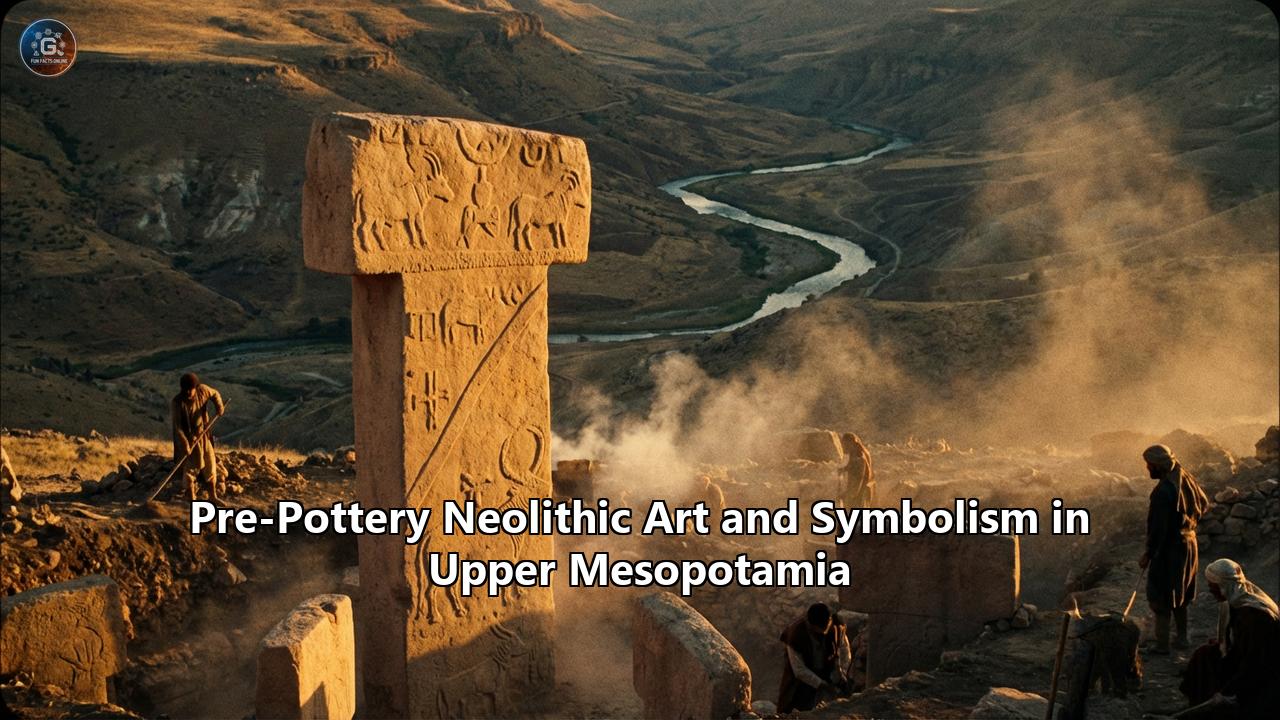
The Stone Gods of the Golden Triangle: Pre-Pottery Neolithic Art and Symbolism in Upper Mesopotamia
The dust of the Harran Plain in southeastern Turkey hides a secret that has fundamentally rewritten the history of humanity. For decades, the standard model of human evolution was linear and economic: first, we learned to farm; then, we settled down; and finally, with bellies full of grain and surplus resources, we invented religion, monumental art, and complex social hierarchies.
That story is wrong.
In the rolling limestone hills of Upper Mesopotamia—specifically the "Golden Triangle" between the Tigris and Euphrates rivers—archaeologists have uncovered a constellation of sites that prove the exact opposite. Here, over 11,000 years ago, bands of hunter-gatherers who had not yet domesticated a single grain of wheat or tamed a single goat came together to build the most sophisticated megalithic temples the world had ever seen.
They did not build these monuments because they had settled; they settled because they needed to be near their monuments. It was the urge to worship, to ritualize, and to carve their cosmology into stone that pulled humanity out of the Paleolithic wild and into the first permanent villages. This was not an Agricultural Revolution; it was a Revolution of Symbols.
This article explores the artistic mastery and profound symbolism of the Pre-Pottery Neolithic (PPN) in Upper Mesopotamia. From the towering T-shaped pillars of Göbekli Tepe to the haunting "winter solstice" chamber of Karahan Tepe, and from the narrative reliefs of Sayburç to the lost statues of Nevalı Çori, we will journey into the minds of the people who carved the very first gods from the living rock.
I. The "Taş Tepeler" Context: A Sacred Landscape
To understand the art, one must first understand the canvas. The region surrounding the modern city of Şanlıurfa is now known as Taş Tepeler (Stone Hills). This is not a collection of isolated sites but a dense, interconnected network of ritual centers and settlements spanning the Pre-Pottery Neolithic A (PPNA, c. 9,600–8,800 BCE) and B (PPNB, c. 8,800–7,000 BCE) periods.
The sheer density of these sites suggests a shared spiritual culture. They were likely visible to one another—Harbetsuvan Tepesi, for instance, offers a direct line of sight to both Göbekli Tepe and Karahan Tepe. This inter-visibility implies a sacred geography where specific hills served as nodes in a vast ritual network, perhaps utilized by different clans or tribes who gathered seasonally to feast, trade, and initiate their youth.
The art found here is unlike anything that came before. While Paleolithic art (like the cave paintings of Lascaux) was hidden deep in the earth, Neolithic art in Upper Mesopotamia was public, monumental, and architectural. It was designed to be seen, to intimidate, and to instruct.
II. Göbekli Tepe: The Cathedral on the Hill
Discovered in 1994 by German archaeologist Klaus Schmidt, Göbekli Tepe ("Potbelly Hill") remains the epicenter of this phenomenon. The site consists of multiple circular enclosures (Enclosures A–H), each dominated by two massive central T-shaped pillars surrounded by a ring of smaller pillars embedded in the walls.
The T-Pillars: Abstract Anthropomorphism
The defining artistic innovation of this culture is the T-shaped pillar. Ranging from 1.5 to 5.5 meters in height and weighing up to 20 tons, these monoliths are not merely structural supports; they are abstract statues of beings.
We know they represent figures because of the low-relief carvings found on their sides. The central pillars of Enclosure D, for example, feature arms carved in relief that run down the sides of the pillar, terminating in hands with long, slender fingers that clasp across the "belly" (the front of the pillar). Some wear belts with U-shaped buckles and loincloths made of fox pelt.
However, these figures have no faces. The crossbar of the "T" represents the head, but it is featureless. This abstraction is deliberate. As we will see later, these people were perfectly capable of carving realistic human faces (as seen in the Urfa Man statue). The choice to render these colossal beings as faceless giants suggests they represent something other than living humans—perhaps ancestors, totemic spirits, or the first conception of gods who exist in a realm beyond individual identity.
The Bestiary of Enclosure D
If the pillars are the gods, the animals carved upon them are their guardians or avatars. The relief carvings at Göbekli Tepe are technically "flat reliefs," but their execution is masterful. The stone is not merely scratched; the background is cut away to leave the animal standing out in the limestone.
Pillar 43, often called the "Vulture Stone," is the most famous example. It depicts a chaotic yet structured scene:- A large vulture holds a circular object (possibly a sun or a severed head) on its wing.
- Below it are scorpions, snakes, and a headless human body.
- The imagery is terrifying. Unlike the peaceful herds painted in later Neolithic sites like Çatalhöyük, the art of Göbekli Tepe focuses on the dangerous and the venomous. Scorpions, spiders, snakes, and boars dominate.
Scholars like Dr. Lee Clare, the current excavation coordinator, suggest this imagery served a protective or apotropaic function—warding off evil spirits. Others, like Dr. Martin Sweatman, have proposed controversial astronomical interpretations, viewing Pillar 43 as a starchart recording a comet strike (the Younger Dryas impact theory). While the astronomical theory is debated, the vulture's association with death is archaeologically sound. In many Neolithic cultures, vultures were seen as agents of excarnation—cleaning the flesh from the dead to release the soul.
The "Burial" Myth vs. Scientific Reality
For years, it was believed that the people of Göbekli Tepe "ritually buried" their temples under tons of soil when they were done with them. This idea fueled immense speculation about "time capsules" left for the future.
However, recent sedimentological analysis has overturned this. The "fill" inside the enclosures is not clean soil brought from elsewhere; it is slope wash and rubble mixed with domestic refuse (animal bones, flint flakes). It appears that rather than a ritual burial, the enclosures were gradually filled in by natural erosion and landslides after they were decommissioned, or perhaps filled with the debris of the settlement that expanded around them. This changes the narrative from a "mysterious burial" to a complex history of renovation, abandonment, and the gradual encroachment of daily life upon the sacred.
III. Karahan Tepe: The Winter Solstice and the Cult of Rebirth
If Göbekli Tepe is the "cathedral," Karahan Tepe—located 46 kilometers away—is the "seminary" or the "secret society lodge." Excavations led by Prof. Necmi Karul have revealed a site that is contemporary with the later phases of Göbekli Tepe but arguably even more complex in its ritual architecture.
The Chamber of the Phalluses (Structure AB)
The most shocking discovery at Karahan Tepe is Structure AB, a sunken chamber carved directly into the bedrock. Unlike the vast circles of Göbekli Tepe, this room is intimate and undeniably intense.
- The Phalluses: Along one wall, ten phallus-shaped pillars are carved directly out of the bedrock floor. They are not T-shaped; they are explicitly phallic, standing like a regiment of stone sentinels.
- The Serpent: A winding channel is carved along the top of the phallus wall, ending in a snake head that protrudes into the room. Fluid (water? blood?) poured into this channel would have flowed over the snake and dripped onto the phalluses below.
The Human Head and the Solstice
But the centerpiece of this room is a human head carved into the bedrock wall. It gazes out over the phalluses with a serene, perhaps trance-like expression. It has a prominent "Adam's apple," emphasizing its maleness.
In December 2021, researchers confirmed a stunning alignment. On the morning of the Winter Solstice, the rising sun shines through a specific porthole stone in the wall. The beam of light cuts through the darkness and hits the human head directly, illuminating it while the rest of the room remains in shadow.
This is almost certainly a ritual of rebirth. The Winter Solstice is the longest night of the year, the moment when the sun "dies" and is born again. The imagery of the phalluses (fertility/generation), the snake (fluid/life), and the illuminated head suggests a ceremony where the community—or perhaps a shamanic initiate—marked the return of the light and the regeneration of the world.
The "Skeletal" Man
Karahan Tepe also yielded a terrifying statue: a seated human figure with visible ribs and a spine, appearing almost skeletal or emaciated. This figure holds his phallus with both hands. The combination of death imagery (exposed ribs) and vitality imagery (the phallus) reinforces the site's obsession with the cycle of life and death. It is a stark reminder that for these people, survival was a constant negotiation with the forces of extinction.
IV. Sayburç: The First Narrative Scene
In 2021, beneath a modern village house at the site of Sayburç, archaeologists found a Neolithic bench carved with a relief that stunned the art world. It is being hailed as the oldest narrative scene in human history.
The panel features two scenes that are clearly linked:
- Scene A: A human figure stands between two leopards. The leopards are shown in profile, mouths open, teeth baring, tails curled forward aggressively. The human, however, faces the viewer (frontally). He holds his phallus in his right hand.
- Scene B: A second human figure is shown kneeling or squatting, facing a bull. This figure holds a snake or a rattle in one hand.
Why is this a "narrative"? In previous Paleolithic art, figures were often floating in space without clear interaction. Here, the composition is deliberate. The man is between the leopards. The kneeling figure is interacting with the bull.
The frontal gaze of the leopard-tamer is significant. He is not looking at the animals; he is looking at us, the viewers. By holding his phallus, he is asserting dominance and virility. He is saying, "I am the one who stands amidst the danger." This is likely a depiction of a mythological hero or a specific ancestor—a "Neolithic Gilgamesh"—whose story was told to initiates sitting on that very bench.
V. Nevalı Çori: The Lost Temple and the Domestic Turn
Before Göbekli Tepe became famous, there was Nevalı Çori. Excavated in the 1980s and early 90s, this site was tragically flooded by the waters of the Atatürk Dam in 1992. However, before it drowned, it provided the Rosetta Stone for understanding PPN architecture.
The Transition to Rectangles
Göbekli Tepe's structures are round (oval). Nevalı Çori's temple was rectangular. This shift in geometry is profound. It marks the transition from the organic, womb-like shapes of the PPNA to the ordered, grid-like architecture of the PPNB.
The "Cult Building" at Nevalı Çori featured a terrazzo floor—made of burnt lime, polished until it shone like marble—and 13 standing pillars.
The Totem Pole and the Bird-Man
Nevalı Çori produced sculpture that was more three-dimensional than Göbekli Tepe's reliefs.
- The Totem Pole: A limestone pillar carved with a vertical stack of figures: a bird standing on a human head, which in turn rests on another bird. This is the earliest known "totem pole" arrangement, suggesting a hierarchy of spirits.
- The Bird-Man: A statue of a creature with a bird's body and a human mask. This suggests shamanic transformation—the idea that ritual specialists could don the "skin" of a vulture to travel between worlds.
VI. The Minor Sites: A Network of "Silent Sentinels"
The "Taş Tepeler" project has expanded excavation to over 12 sites. These "minor" sites fill in the gaps of the social network.
- Sefertepe: Here, excavators found beads depicting human heads and smaller T-pillars. It appears to be a smaller satellite site, perhaps for a specific clan.
- Çakmaktepe: This site is older than Göbekli Tepe's main enclosures. Its pillars are simpler, often lacking the T-shape, described instead as "I-shaped" or simple stelae. At the base of walls, archaeologists found burned skulls of bulls and gazelles, arranged like masks. This hints that the "pillar cult" evolved from an earlier tradition of displaying animal parts directly.
- Harbetsuvan Tepesi: Located high on a ridge, this site served as a surveillance point for game. It contains a "seated male" statue similar to those at Karahan Tepe, reinforcing the uniform iconography across the region.
VII. Symbolism: Decoding the Neolithic Mind
What does it all mean? While we cannot read their lost language, the symbols speak of a consistent worldview.
1. The Skull Cult and Ancestor Veneration
Throughout the PPN, people practiced secondary burial. They would bury the dead, wait for the flesh to rot, and then dig up the skull.
- Defleshing: Marks on bones at Göbekli Tepe show that bodies were sometimes defleshed with flint tools.
- Decoration: At sites like Jericho and 'Ain Ghazal (in the Levant), skulls were plastered to look lifelike. In Upper Mesopotamia, the focus was more on carving. Grooves were cut into skulls, perhaps to hang them from the ceiling.
- The Stone Masks: The T-pillars likely represent these ancestors. They are faceless because they are "generic" ancestors—the collective spirit of the tribe—rather than specific individuals.
2. The Masculine Imperative
The art of Taş Tepeler is overwhelmingly male. The pillars wear loincloths; the statues hold phalluses; the animals are male (bulls, boars).
- Where are the women? Explicit female imagery is rare. There is a "birthing figure" graffito at Göbekli Tepe (carved later, perhaps by a visitor) and some crude female figurines at Gürcütepe (a later site).
- Theory: This may reflect a "men's cult" or secret society. The enclosures might have been clubhouses for male initiation rites, where boys were traumatized by terrifying images of scorpions and vultures to become men.
3. Entanglement and the Cognitive Revolution
Archaeologist Ian Hodder describes this period as an era of "entanglement." As people began to settle, they became "entangled" with things—mud bricks that needed repair, heavy statues that couldn't be moved, and ancestors who were buried under the floor.
Trevor Watkins calls this a "Cognitive Revolution." The invention of the T-pillar was a way to store information externally. Instead of keeping the image of the god in your mind, you carved it into stone. This external storage of symbolism allowed for more complex societies, as the "rules" of the society were permanently visible in the architecture.VIII. Conclusion: The Legacy of the Stone Gods
Around 8,000 BCE, the great enclosures of Göbekli Tepe were abandoned. The people did not disappear; they just changed. They moved into the rectangular houses of the PPNB. They domesticated wheat, sheep, and pigs. The intensity of the "cult of the wild" faded. The terrifying scorpions and vultures were replaced by more domestic symbols.
But the legacy of Taş Tepeler remains. These people proved that the human drive for meaning, for ritual, and for art is not a luxury of civilization—it is the engine of civilization. They built the temple first, and the city followed. In the silent stare of the Urfa Man and the faceless gaze of the T-pillars, we see the moment humanity first looked into the mirror of stone and decided to carve what it saw.
Reference:
- https://brewminate.com/exploring-ancient-gobekli-tepe-and-the-dawn-of-village-life-in-the-cradle-of-civilization/
- https://anamed.ku.edu.tr/en/gobekli-tepe-long-term-developments-from-the-neolithic-to-the-anthropocene-2/
- https://en.wikipedia.org/wiki/Neolithic
- https://www.ancient-origins.net/premium-preview/karahan-tepe-0020116
- https://grahamhancock.com/newmanainsworth2/
- https://www.youtube.com/watch?v=nVqYmXO2i5U
- https://www.youtube.com/watch?v=n8RuQWMuhKg
- https://blog.hypnosis.land/solstice-magic-at-karahan-tepe-the-winter-solstice-geo-magnetic-influences-and-altered-states-of-consciousness/
- https://en.wikipedia.org/wiki/Karahan_Tepe
- https://www.rupestre.net/tracce/?p=16322
- https://www.finestresullarte.info/en/archaeology/turkey-discovered-the-work-with-the-first-narrative-scene-in-history
- https://news.artnet.com/art-world/archaeologists-have-discovered-one-of-the-worlds-oldest-pieces-of-narrative-art-and-its-nsfw-2225995
- https://the-past.com/news/neolithic-carvings-discovered-in-turkey-may-represent-the-earliest-known-narrative-scene/
- https://www.cambridge.org/core/services/aop-cambridge-core/content/view/3A35B54B3265C7224CB225FE70EBDD02/S0003598X22001259a.pdf/sayburc_reliefs_a_narrative_scene_from_the_neolithic.pdf
- https://www.researchgate.net/figure/Phallus-shaped-pillars-and-a-human-head-shaped-from-the-bedrock_fig7_354865014
- https://www.researchgate.net/publication/230220211_Soils_and_soil_sediments_at_Gobekli_Tepe_southeastern_Turkey_A_preliminary_report
- https://www.youtube.com/watch?v=iY8Tsy66xks
- https://www.easternturkeytour.org/karahan-tepe/
- https://archaeology.org/issues/may-june-2021/features/turkey-gobekli-tepe-hunter-gatherers/