
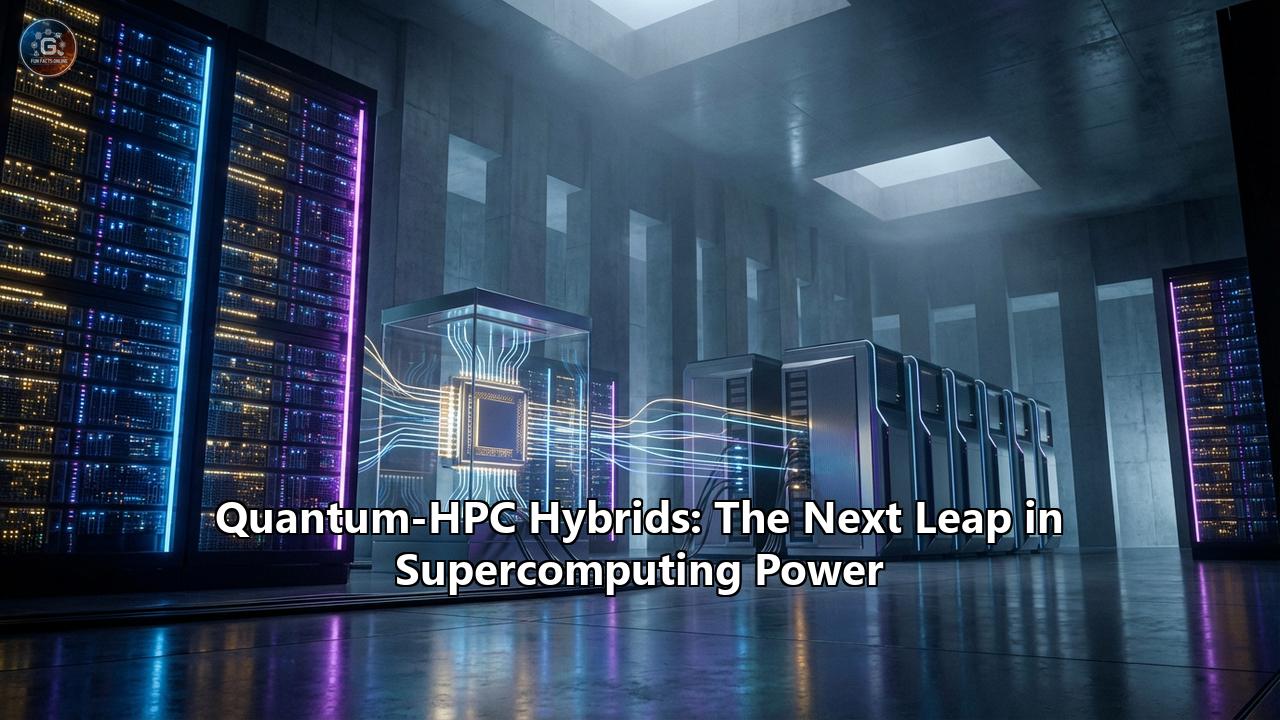
The year is 2026. The era of "Quantum Supremacy" experiments—where quantum computers solved useless mathematical riddles just to prove they could—is over. We have entered the era of Quantum Utility, and it looks nothing like the standalone, science-fiction monoliths we once imagined. Instead, the revolution has arrived in the form of a hybrid: the Quantum-HPC (High-Performance Computing) Supercluster.
In data centers from Jülich to Oak Ridge, a quiet transformation is rewriting the rules of computation. The world’s most powerful supercomputers are no longer just vast arrays of CPUs and GPUs; they are becoming heterogeneous monsters, integrating Quantum Processing Units (QPUs) as a new class of accelerator. Just as the GPU emerged in the 2010s to shoulder the burden of AI and graphics, the QPU is now slotting into the server rack to tackle the problems that defy the laws of classical physics.
This is the story of the next leap in human capability—a convergence of brute-force exascale power and the delicate, probabilistic magic of quantum mechanics.
Part I: The Convergence Point (2025-2026)
For decades, quantum computing and classical supercomputing existed in parallel universes. Supercomputers were the workhorses of science, modeling climate change and nuclear stockpiles with deterministic precision. Quantum computers were the fragile darlings of physics labs, requiring silence, darkness, and temperatures colder than deep space to function for mere microseconds.
By late 2025, those universes collided.
The catalyst was not a single breakthrough, but a realization across the industry: Quantum computers cannot work alone. Even a fault-tolerant quantum computer will be terrible at basic arithmetic, I/O management, and data processing. Conversely, classical supercomputers, despite hitting the Exascale barrier (10^18 calculations per second), are hitting a wall of energy efficiency and algorithmic complexity when simulating chemistry or materials.
The answer was the Hybrid Node.
The Flagships of the Hybrid Era
The landscape of 2026 is dominated by massive government-backed initiatives and corporate alliances that have physically co-located these technologies:
- JUPITER (Joint Undertaking Pioneer for Innovative and Transformative Exascale Research): Located in Germany, JUPITER was Europe's first exascale system. By late 2025, it wasn't just a number-cruncher; it became the anchor for the "JUPITER AI Factory." Its modular architecture allows it to offload specific subroutines to integrated quantum modules—ranging from superconducting qubits to neutral atom simulators—acting as a massive testbed for the hybrid future.
- The IBM-AMD Alliance: In a landmark late-2025 announcement, IBM and AMD formalized "Quantum-Centric Supercomputing." This partnership signaled the end of the proprietary silo. By placing AMD’s massive Instinct accelerators alongside IBM’s "Heron" and "Eagle" quantum processors, they created a specialized architecture where the classical supercomputer acts as the life-support system for the quantum brain, handling the intense error-correction workload in real-time.
- Google’s "Willow" & The NVIDIA Connection: Google Quantum AI’s "Willow" chip, unveiled in late 2024 with 105 physical qubits, demonstrated verifiable quantum advantage. But the real story in 2026 is how NVIDIA’s CUDA-Q platform has become the "glue" of the industry. NVIDIA GPUs are now standard equipment for controlling quantum computers, running the complex decoding algorithms needed to keep qubits stable.
Part II: The Anatomy of a Hybrid Beast
To understand why this is a "leap," one must look inside the architecture. A Hybrid Quantum-HPC system is not simply a quantum computer connected to a laptop via USB. It is an engineering marvel of latency management and thermal isolation.
1. The Heterogeneous Node
In a traditional supercomputer node, you might find two CPUs and four GPUs. In a 2026 hybrid node, the topology has evolved. The node now includes a QPU Link.
The QPU (Quantum Processing Unit) sits inside a dilution refrigerator (for superconducting qubits) or a vacuum chamber (for trapped ions/atoms), often located meters away from the hot, noisy racks of classical servers. The challenge is latency.
For a hybrid algorithm to work, the classical computer must send instructions to the QPU, wait for the quantum measurement, read the result, and adjust the next set of instructions—all within the coherence time of the qubits (often microseconds).
- The Interconnect Breakthrough: Technologies like NVQLink (an evolution of NVLink optimized for quantum control) and proprietary optical links have reduced this round-trip latency to near-real-time. This allows the classical GPU to "feed" the QPU with pulse sequences and "read" the errors instantly.
2. The Role of the GPU: The "Timekeeper"
Ironically, the rise of quantum computing has triggered a boom in GPU usage. Why? Error Correction.
Qubits are noisy. To create one "logical" (perfect) qubit, you might need hundreds of physical qubits working together, constantly checked for errors.
- The Decoding Loop: Checking these errors is a massive classical computational task. It requires solving a graph matching problem millions of times per second. In 2026, racks of NVIDIA Blackwell or AMD MI300 GPUs are dedicated solely to this "decoding" loop. They watch the quantum computer like hawks, spotting errors and calculating corrections faster than the errors can propagate.
Part III: The Software Crisis and CUDA-Q
Hardware is useless without software. The biggest hurdle to the hybrid era was the "language barrier." Classical physicists wrote in C++ or Fortran; Quantum physicists wrote in Python (Qiskit/Cirq) or assembly (QASM).
The unification arrived with Hybrid Kernels.
CUDA-Q and the Kernel Model
NVIDIA’s CUDA-Q (formerly CuQuantum) became the de facto standard by 2026 because it treated the QPU just like another GPU.
- Unified Source Code: A developer can now write a single C++ or Python program. Using a decorator (like @kernel), they designate a specific function to run on the QPU. The compiler handles the rest: compiling the classical parts for the CPU/GPU and the quantum parts for the specific QPU backend (whether it’s superconducting, ion trap, or photonic).
- The "Shot" Paradigm: Hybrid computing is probabilistic. You don't run a function once; you run it 10,000 times (shots) to build a probability distribution. The classical supercomputer aggregates these shots, optimizes the parameters using AI, and sends the job back to the QPU. This loop, known as VQE (Variational Quantum Eigensolver) or QAOA (Quantum Approximate Optimization Algorithm), is the heartbeat of hybrid computing.
Part IV: The Killer Applications (Why We Are Doing This)
We are not building these hybrids to play chess. We are building them to survive and thrive. The applications emerging in 2026 address the "Grand Challenges" of humanity.
1. Pharmacology and the "Imipramine" Breakthrough
In late 2025, researchers using a hybrid setup (Quantinuum H-Series coupled with GPU clusters) achieved a milestone: the accurate simulation of the imipramine molecule (an antidepressant) and its binding affinities, with a precision that classical approximation methods (like DFT) could never achieve efficiently.
- The Impact: Classical computers struggle with the "electron correlation problem"—the fact that every electron interacts with every other electron. For a drug molecule, this calculation grows exponentially. A QPU simulates this naturally because the qubits are quantum objects, just like the electrons. The hybrid system uses the QPU to calculate the high-energy electron interactions and the Supercomputer to manage the rest of the molecular structure. This is slashing drug discovery timelines from years to months.
2. Materials Science: The Battery Revolution
The hunt for the perfect solid-state battery electrolyte is a quantum optimization problem. We are looking for a material that conducts ions but blocks electrons, is stable, and cheap.
- Hybrid Workflow: In 2026, AI models on the classical supercomputer screen billions of candidate materials, narrowing them down to a few hundred promising structures. The QPU is then brought in to perform deep-dive energy simulations on these specific candidates, revealing properties (like band gaps) that the AI might have hallucinated or missed. This "AI-screening, Quantum-verifying" workflow is the new gold standard in materials R&D.
3. Climate and Energy: The Nitrogen Problem
The Haber-Bosch process (making fertilizer) consumes ~2% of the world's energy. Nature does it at room temperature using an enzyme called Nitrogenase. We still don't fully understand how, because simulating the "FeMoco" (Iron-Molybdenum cofactor) at the heart of the enzyme is too complex for classical computers.
- The 2026 Attempt: Projects at EuroHPC centers are currently using hybrid systems to simulate small clusters of this enzyme. While a full solution is likely years away, hybrid algorithms are peeling back the layers of this mechanism, promising a future where we can manufacture fertilizer with solar power and zero natural gas.
Part V: The Challenges That Remain
Despite the optimism, the path is fraught with engineering nightmares.
- The Thermal Wall: Superconducting quantum computers need to be at 20 millikelvin. Supercomputers run hot. Co-locating them requires massive, specialized infrastructure. You cannot simply put a cryostat in a standard server aisle.
- The Data Bottleneck: Moving classical data into a quantum state ("loading" data) is incredibly slow. We currently cannot load "Big Data" into a quantum computer. We can only load small, complex parameters. This limits the use of Quantum Machine Learning (QML) on large datasets.
- Energy Consumption: While QPUs themselves are low energy, the cooling systems and the massive classical "control stack" (the GPUs running error correction) burn megawatts. A hybrid data center is currently less energy efficient per calculation than a pure classical one, although this is expected to flip once "Quantum Advantage" is sustained for useful problems.
Part VI: The Future Outlook (2027-2030)
As we look toward the end of the decade, the roadmap is clear.
- 2027: The rise of Logical Qubits. We will stop counting physical qubits (100, 1000, etc.) and start counting logical qubits (5, 10, 20). These are error-corrected, reliable units of computation.
- 2028: The Quantum Utility Tipping Point. Hybrid systems will begin to outperform classical-only systems in economic terms—producing results that are financially more valuable than the cost of the compute time.
- 2030: Democratization via Cloud. The average developer will not know they are using a quantum computer. They will call a function in a Python library for "molecular optimization," and the cloud provider (AWS, Azure, or a new decentralized player) will route that specific kernel to a QPU backend invisibly.
The "Next Leap" is not about replacing the supercomputer; it is about completing it. The Quantum-HPC Hybrid is the synthesis of our two greatest intellectual achievements: the ability to manipulate bits of logic and the ability to manipulate the fabric of reality itself.
In 2026, we are no longer waiting for the future of computing. We are compiling it.
Reference:
- https://eu.36kr.com/en/p/3624758715462150
- https://www.innovationnewsnetwork.com/eurohpc-ju-opens-e4m-call-to-transform-benchmarking-of-hpc-systems-across-europe/64873/
- https://www.olcf.ornl.gov/2025/08/29/ornl-study-plans-quantum-hpc-software-stack/
- https://www.innovationnewsnetwork.com/eurohpc-ju-driving-europes-digital-future/63974/
- https://www.eurohpc-ju.europa.eu/jupiter-launching-europes-exascale-era-2025-09-05_en
- https://www.eurohpc-ju.europa.eu/jupiter-officially-propels-europe-exascale-era-2025-11-17_en
- https://www.techpowerup.com/news-tags/quantum%20computer