
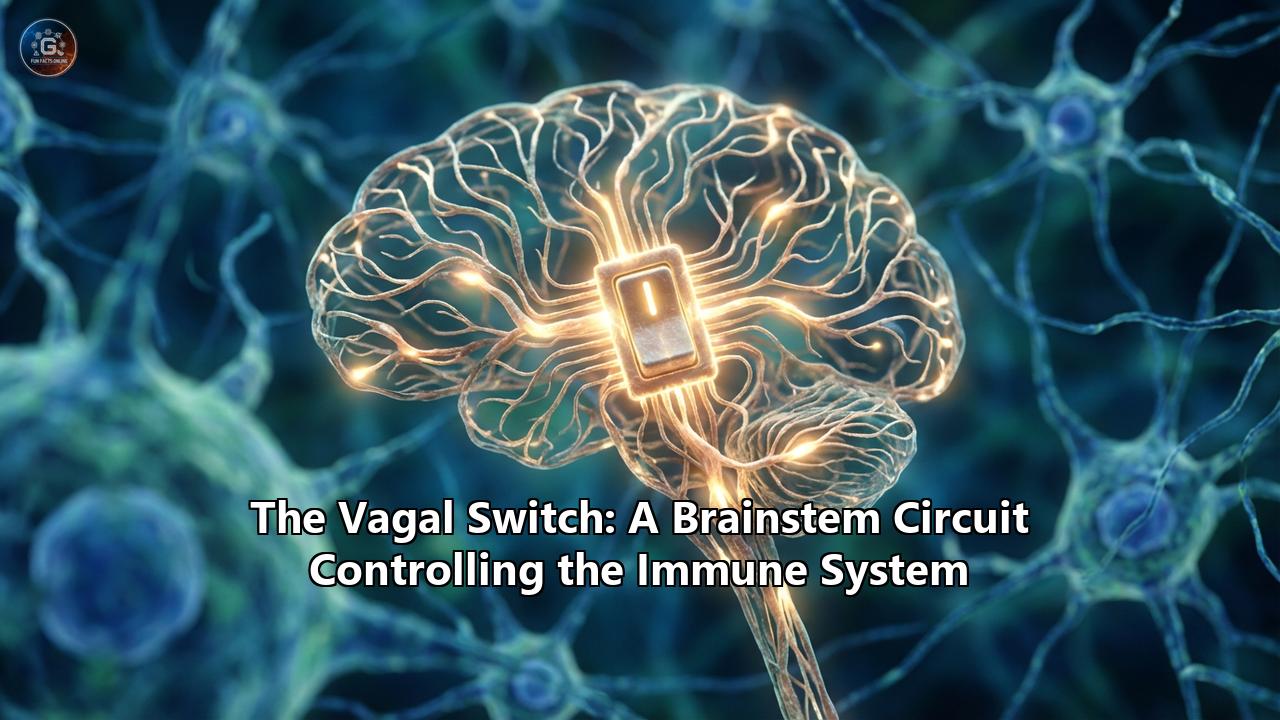
Recent scientific breakthroughs have fundamentally reshaped our understanding of how the body fights disease. For decades, the immune system was viewed as an autonomous defense force—a biological army that marched to its own beat, largely independent of the brain’s central command. But a paradigm-shifting discovery has revealed that the brain is not just a passive observer of infection; it is the general on the battlefield.
Hidden deep within the brainstem lies a sophisticated neural circuit—a "Vagal Switch"—that acts as a master thermostat for the immune system. This discovery opens the door to a new era of medicine where we may treat autoimmune diseases, cytokine storms, and chronic inflammation not with pills that flood the entire body, but with precise bioelectronic signals that retune the body's natural defenses.
Part I: The End of Autonomy – A New Paradigm
To understand the magnitude of the "Vagal Switch," we must first appreciate the scientific dogma it shattered. For most of the 20th century, immunology and neuroscience were treated as separate disciplines. The brain had the blood-brain barrier to protect it, implying a desire to stay isolated from the messy, chaotic wars fought by white blood cells in the bloodstream.
The immune system was thought to rely solely on chemical signals—cytokines—that floated through the blood like messages in bottles. If a macrophage saw a bacterium, it released inflammatory chemicals to alert its neighbors. The brain was thought to only find out about this later, perhaps through a fever or a general sense of malaise (sickness behavior), but it wasn't viewed as the entity controlling the reaction.
This view began to crack in the late 1990s with the work of Dr. Kevin Tracey, a neurosurgeon who stumbled upon the "Inflammatory Reflex." Tracey found that severing the vagus nerve in rats caused lethal inflammation, while stimulating it halted the production of inflammatory toxins. This was the first hint that the nervous system acted as a "brake" on immunity.
However, a mystery remained. If the vagus nerve was the brake, where was the foot pressing it? How did the brain know when to apply the brake and when to let the immune system run wild to kill a virus? The "black box" of the brainstem remained closed until a landmark 2024 study by Dr. Charles Zuker and his team at Columbia University finally pried it open.
Part II: The Discovery of the Body-Brain Thermostat
In May 2024, the journal Nature published a study that will likely be cited in medical textbooks for decades. The research team, led by Dr. Hao Jin and Dr. Charles Zuker, identified the specific neural machinery that allows the brain to monitor and control inflammation.
The researchers used a powerful bacterial toxin called lipopolysaccharide (LPS) to trigger an immune response in mice. This toxin mimics a severe bacterial infection, usually causing the immune system to go into overdrive—a state often called a "cytokine storm."
Using advanced calcium imaging techniques, which allow scientists to watch neurons fire in real-time, the team peered into the nodose ganglion—a cluster of sensory nerve cells that sit just outside the brainstem. What they saw was a flurry of electrical activity. The body was screaming "Infection!" and the vagus nerve was carrying that scream to the brain.
But the true breakthrough was the specificity. They discovered that the vagus nerve wasn't just sending a generic "ouch" signal. It possessed two distinct populations of sensory neurons, akin to separate telephone lines:
- The Pro-Inflammatory Line: One group of neurons (identified by the marker CALCA) specifically detected pro-inflammatory cytokines (like TNF-alpha and IL-1beta). When these neurons fired, they told the brain, "The battle is raging, we need heat."
- The Anti-Inflammatory Line: A second, distinct group of neurons (identified by the marker TRA1) detected anti-inflammatory signals. These neurons conveyed the message, "The threat is neutralizing, cool it down."
These signals converged on a tiny region in the brainstem called the Caudal Nucleus of the Solitary Tract (cNST).
Part III: Inside the cNST – The Control Room
The Caudal Nucleus of the Solitary Tract (cNST) is the unsung hero of human survival. Evolutionarily ancient, this structure regulates basic functions like heart rate and breathing. Now, we know it is also the "situation room" for your immune system.
The Zuker study revealed that the cNST acts as a biological rheostat (a dimmer switch). It doesn't just turn inflammation on or off; it fine-tunes it.
- When infection strikes: The pro-inflammatory line lights up the cNST. The brain processes this threat and initially allows or even encourages inflammation to recruit immune cells to the site of injury.
- When the tide turns: As the infection is cleared, the body produces anti-inflammatory molecules. The TRA1 neurons sense this shift and update the cNST. The brain then sends a powerful command back down the vagus nerve to suppress the immune response, preventing the "friendly fire" that damages tissues.
To prove this circuit was the master controller, the researchers performed a series of elegant manipulations:
- Silencing the Switch: When they genetically silenced these brainstem neurons, the mice lost control. Even a minor infection caused a catastrophic, runaway inflammatory response. The "brake" was cut, and the immune system drove the body off a cliff.
- Artificial Activation: Conversely, when they artificially activated the anti-inflammatory circuit, they could halt inflammation in its tracks, reducing pro-inflammatory chemicals by over 70%.
This proved that the brain is not a bystander; it is the active regulator preventing us from dying of our own immune response every time we get a cold.
Part IV: The Anatomy of the Vagal Superhighway
To appreciate how this switch works, we must visualize the anatomy of this "superhighway." The Vagus Nerve (Cranial Nerve X) is the longest cranial nerve, wandering (hence "vagus," Latin for wandering) from the brainstem down through the neck, thorax, and abdomen.
The Afferent Arc (Sensing):Thousands of sensory fibers in the lungs, gut, and liver act as spies. They possess receptors for cytokines—the immune system's text messages. When a macrophage in your gut explodes a bacteria, it releases a cloud of cytokines. The vagal endings "taste" this cloud and send an electrical impulse up to the brainstem (cNST).
The Integration Center (Thinking):The cNST receives this data. It integrates it with other information (Are we stressed? Are we hungry? Is there a fever?). It then makes a decision: "More inflammation needed" or "Shut it down."
The Efferent Arc (Acting):If the decision is "Shut it down," the signal travels from the cNST to the Dorsal Motor Nucleus. From there, a motor signal travels back down the vagus nerve.
This is where the magic happens. The vagus nerve does not touch every immune cell directly. Instead, it connects to the Splenic Nerve. The spleen is the "boot camp" of the immune system, holding vast reserves of immune cells.
When the vagus fires, the splenic nerve releases norepinephrine. This chemical tells a special type of T-cell (the T-choline cell) to release acetylcholine.
Acetylcholine docks onto macrophages (the soldiers) via a specific receptor called the alpha-7 nicotinic acetylcholine receptor. This is the literal "off switch" on the cell. It stops the macrophage from producing inflammatory toxins instantly.
Part V: Clinical Revolution – Bioelectronic Medicine
The identification of this specific brainstem circuit is not just an academic triumph; it is the blueprint for a medical revolution known as Bioelectronic Medicine.
Current treatments for autoimmune diseases—like Rheumatoid Arthritis (RA), Crohn’s Disease, and Lupus—are "blunt instruments." Steroids and biologics suppress the immune system globally. They turn off the entire army, leaving patients vulnerable to infections and cancer.
The "Vagal Switch" offers a sniper's precision.
1. Implantable Vagus Nerve Stimulators (VNS):We already use VNS for epilepsy and depression. Now, companies like SetPoint Medical are trialing miniature implants for Rheumatoid Arthritis. These devices are the size of a vitamin pill, implanted on the vagus nerve in the neck. By delivering a specific electrical frequency, they hack the "efferent arc," tricking the spleen into releasing acetylcholine and calming the joint inflammation without the side effects of drugs.
2. Ending the Cytokine Storm:In conditions like sepsis or severe viral pneumonia (as seen in COVID-19), the cause of death is often the body's overreaction—the cytokine storm. The Zuker study suggests that this happens because the brainstem's "thermostat" is broken or overwhelmed. Imagine a future device that can "reset" this thermostat, artificially activating the anti-inflammatory neurons to save a patient in the ICU.
3. Treating "Psychosomatic" Illness:For years, patients with chronic fatigue, fibromyalgia, or "long COVID" have been told their symptoms are "in their head." This research proves that immune dysregulation is in the head—specifically in the brainstem. It validates the biological basis of these conditions. If the neural calibration of the immune system is slightly off, a person could feel perpetually "sick" (brain fog, fatigue, aches) because their brain is reading a false "pro-inflammatory" signal.
Part VI: The Future – A Body Rebalanced
The discovery of the Vagal Switch redefines the human body as a fully integrated network. We are not a collection of organs; we are a conversation. The brain and the immune system are in constant dialogue, whispering back and forth along the vagus nerve.
The implications extend even beyond medicine to lifestyle. While the study focused on molecular switches, it provides a hard-science foundation for why stress management matters. Chronic stress keeps the sympathetic nervous system (fight or flight) high and the vagal tone (rest and digest) low. If the vagal tone is low, the "brake" on the immune system is loose, potentially leading to the chronic low-grade inflammation that drives aging, heart disease, and metabolic disorders.
As we move forward, we will likely see a new class of "neuromodulating" drugs designed not to kill bacteria, but to talk to the brainstem. We may see wearable devices that tune our immune systems like we tune a radio.
The brain, it turns out, is the ultimate healer. We just finally found the switch.
Reference:
- https://pmc.ncbi.nlm.nih.gov/articles/PMC4535331/
- https://bigthink.com/health/discovered-a-brain-body-circuit-that-turns-inflammation-up-and-down/
- https://www.hhmi.org/news/finding-master-immune-system-controller
- https://zuckermaninstitute.columbia.edu/columbia-scientists-identify-new-brain-circuit-mice-controls-body-s-inflammatory-reactions
- https://www.technologynetworks.com/immunology/articles/how-our-brain-can-fight-infection-393420
- https://www.livescience.com/health/immune-system/master-regulator-of-inflammation-found-and-its-in-the-brain-stem
- https://pmc.ncbi.nlm.nih.gov/articles/PMC4056170/
- https://gut.bmj.com/content/62/8/1214
- https://www.pnas.org/doi/10.1073/pnas.1605635113
- https://pmc.ncbi.nlm.nih.gov/articles/PMC11793006/
- https://pmc.ncbi.nlm.nih.gov/articles/PMC4536565/