
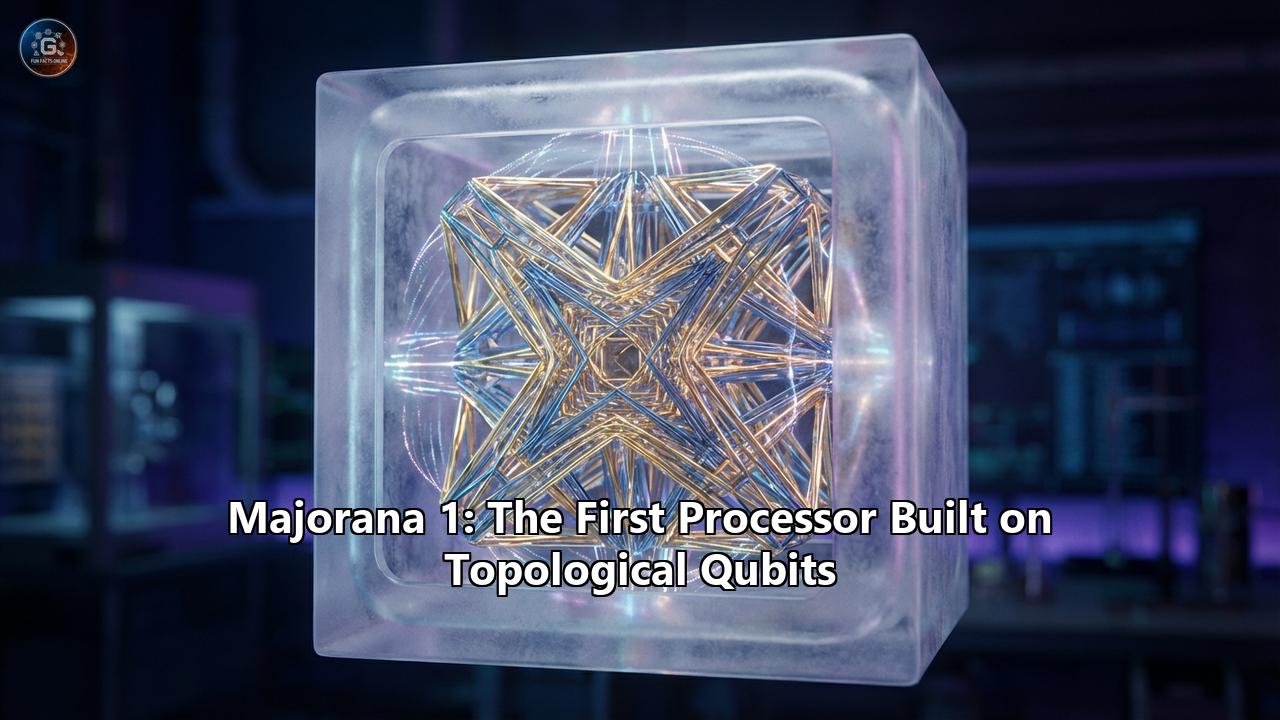
It has been nearly a year since the technology world shifted on its axis. On February 19, 2025, Microsoft ended decades of theoretical speculation and hushed laboratory whispers by unveiling Majorana 1, the world’s first quantum processor powered by topological qubits.
For years, the quantum computing race was defined by a brute-force numbers game—Google, IBM, and Rigetti fighting to pack more unstable, error-prone qubits onto a chip. They were building race cars with engines that exploded every few miles. Microsoft, meanwhile, was nowhere to be found on the leaderboard. They were quietly in the garage, reinventing the wheel itself.
As we stand here on New Year’s Day 2026, the dust has settled, and the landscape has changed. Majorana 1 was not just another incremental step; it was a fundamental divergence in how we approach quantum mechanics. By harnessing the elusive Majorana Zero Mode (MZM), Microsoft didn’t just build a better qubit—they built a nearly indestructible one.
This article explores the deep science, the engineering marvels, and the skepticism surrounding the chip that has promised to turn quantum computing from a "decades-away" dream into a "years-away" reality.
Part I: The Ghost in the Machine
To understand why Majorana 1 is revolutionary, we must first understand the "Achilles' heel" of quantum computing: noise.
Traditional qubits—like the superconducting transmon qubits used by Google’s Willow or IBM’s Eagle—are divas. They are incredibly sensitive to their environment. A stray photon, a fluctuation in temperature, or a microscopic vibration can cause them to "decohere," losing their quantum state and ruining the calculation. To fix this, engineers use Quantum Error Correction (QEC), which involves surrounding one logical qubit with thousands of physical qubits just to police its errors. It’s like hiring 1,000 bodyguards to protect one VIP.
Microsoft’s approach, championed for twenty years by visionaries like Chetan Nayak and Matthias Troyer, was to stop trying to protect the VIP and instead make the VIP immortal.
Enter the Majorana Fermion
In 1937, Italian physicist Ettore Majorana theorized a particle that was its own antiparticle. For nearly a century, it remained a mathematical curiosity. Microsoft betting their entire quantum roadmap on this particle was considered by many to be a suicide mission.
In the Majorana 1 chip, these particles are not found floating in space; they are induced as quasiparticles at the ends of a nanowire. When two Majorana Zero Modes are paired, they form a single topological qubit.
Here is the magic: the quantum information isn’t stored in the particle. It is stored non-locally—shared between the two separated Majoranas.
The Analogy of the Knot:Imagine you have a piece of string. If you write information on one inch of the string, a gust of wind (noise) could smudge it. But if you tie a knot in the string, the "information" (the knot) is a property of the whole string. You can twist it, pull it, or shake it, and the knot remains. The only way to untie the knot is to cut the string entirely.
Majorana 1’s qubits are that knot. Local noise cannot destroy the information because the information is "smeared" across the topology of the system. This property, known as topological protection, reduces the error rate by orders of magnitude at the hardware level.
Part II: Anatomy of Majorana 1
The chip itself is deceptively small—fitting easily in the palm of a hand—yet it represents one of the most complex materials science achievements in human history.
1. The "Topoconductor"
The foundation of Majorana 1 is a new state of matter. You cannot simply buy Majorana wires off the shelf. Microsoft had to invent a new class of materials they call "Topoconductors."
This involves a hybrid heterostructure: an indium arsenide semiconductor nanowire meticulously coated with a shell of aluminum superconductor. The interface between these two materials, when cooled to near absolute zero (~20 mK) and subjected to a precise magnetic field, forces the electrons to organize into a topological phase.
The precision required here is atomic. If the aluminum shell is too thick or the interface has even a single atomic defect, the topological state collapses. The fact that Microsoft can now fabricate these reliable arrays is a victory of engineering over chaos.
2. The "Tetron" Architecture
The basic building block of the Majorana 1 is not just a wire, but a structure called a Tetron. A Tetron consists of two parallel topological wires connected by a "trivial" superconducting bridge. This H-shape allows the system to host four Majorana Zero Modes.
While the debut chip announced in 2025 contained only 8 qubits, the architecture is what matters. Unlike trapped-ion systems that require complex laser arrays, or transmon qubits that need forest of analog wiring, the Tetron is designed to be printed. It is a scalable unit cell.
3. Digital Control: The Killer App
This is the feature that keeps competitors awake at night.
In a standard quantum computer, controlling a qubit is like tuning an old radio. You have to send precise analog microwave pulses to rotate the qubit’s state. If your pulse is 0.1% off, your calculation is wrong. As you scale to millions of qubits, the forest of analog cables becomes a nightmare of heat and crosstalk.
Majorana 1 is digitally controlled.
Because of the unique physics of topological braiding (which we will discuss next), you don’t need fine-tuned analog pulses. You effectively just need "on/off" switches. By using simple digital voltage pulses to connect and disconnect quantum dots to the nanowires, the chip manipulates the information.
This means the control electronics for a million-qubit Majorana processor could theoretically be as simple as the control logic in a standard stick of RAM.
Part III: The "Braiding" Breakthrough
If you ask a physicist how topological quantum computing works, they will wave their hands and say "braiding." But what does that actually mean inside the Majorana 1?
In the theoretical version, you physically move Majorana particles around each other, like plaiting hair. The history of their movement records the computation. If you move particle A around particle B, the quantum state changes. If you move it back, the state doesn't return to zero—it remembers the path. This is non-Abelian statistics.
However, physically moving particles inside a solid chip is impossible.
Majorana 1 uses Measurement-Based Braiding. instead of physically moving the Majoranas, the chip uses a sequence of measurements to teleport the quantum state between different Majoranas in the Tetron.
Imagine three seats in a row: Left, Middle, Right. You have a person (the Majorana state) in the Left seat. You measure the Left and Middle seats together, then the Middle and Right. Through a quirk of quantum mechanics (entanglement projection), the person effectively "teleports" to the Right seat without ever passing through the Middle.
By rapidly toggling these measurements using digital pulses, Majorana 1 performs logical gates. It is a computational dance where no one actually moves, yet the topology is tied in knots.
Part IV: The Skepticism and The Science
We must address the elephant in the room. The road to Majorana 1 was paved with retracted papers and controversy.
In 2018, Microsoft claimed to have found the Majorana fermion, only to retract the paper in 2021 due to data misinterpretation. This left a scar on the field. When Majorana 1 was announced in February 2025, the academic community reacted with a mixture of jubilation and "show me the raw data."
The controversy centers on the Topological Gap Protocol (TGP). This is the checklist Microsoft uses to certify that a signal is truly a Majorana and not a "doppelganger" (a trivial state that looks like a Majorana).
Throughout late 2025, independent physicists have scrutinized Microsoft’s Nature paper. Some, like the groups at the University of Maryland and researchers in Europe, have argued that the TGP might still generate false positives under specific disorder conditions.
However, Microsoft has held firm. In December 2025, as part of their "Quantum Ready" update, they released supplementary data showing the stability of the qubits over time periods that would be impossible for trivial states. While the "smoking gun" of a full topological braid resulting in a logic gate is the final proof the world is waiting for (promised for the March 2026 APS meeting), the consensus is shifting. The sheer quality of the fabrication and the stability of the digital control suggest that even if the physics isn't perfectly ideal yet, it is functional enough to build a computer.
Part V: Why "Years, Not Decades"?
The phrase "Years, not Decades" has become the mantra of Microsoft’s quantum team. Why are they so confident?
It comes down to Scaling Economics.
Google's Problem: To build a reliable computer, they need 1,000 physical qubits to make 1 logical qubit. To get a million logical qubits, they need a billion physical ones. A billion superconducting qubits would require a cooling system the size of a football stadium. Microsoft's Solution: Because topological qubits are hardware-protected, the error correction overhead is drastically lower. They might only need 10 or 100 physical qubits for one logical qubit. Furthermore, because the control is digital and the qubits are tiny (1/100th of a millimeter), they can pack them densely.The roadmap is aggressive:
- 2025: Majorana 1 (8 qubits) – Achieved.
- 2026-2027: The Fault-Tolerant Prototype (FTP). This is the goal of the current partnership with DARPA. It won’t just be a chip; it will be a complete system demonstrating the first "scientific gain"—doing something useful that a supercomputer cannot.
- 2030s: The Quantum Supercomputer. A machine with 1 million+ topological qubits.
This is why the industry is paying attention. If the physics holds, Microsoft’s slope of progress is a vertical wall compared to the gradual incline of their competitors.
Part VI: The World After Majorana
As we look ahead into 2026, the implications of this chip are beginning to materialize in specific industries. The Azure Quantum platform is already allowing partners to simulate how they would use Majorana 1 once it scales.
1. The End of "Forever Chemicals"
One of the first targeted applications is catalysis. Currently, creating fertilizer (nitrogen fixation) consumes ~2% of the world's energy. Nature does it for free using enzymes. Classical computers cannot simulate the quantum mechanics of these enzymes—they are too complex. Majorana 1 is designed to crack this. The ability to model the FeMoco (iron-molybdenum cofactor) could revolutionize agriculture and sustainability.
2. Self-Healing Materials
Materials science is currently trial-and-error. With a scaled topological processor, we can invert the design process: specify the properties we want (e.g., concrete that repairs its own cracks using bacteria-activated polymers) and have the quantum computer calculate the molecular structure required.
3. The Cryptographic Countdown
We cannot ignore the security elephant. A million-qubit topological computer will eventually break RSA encryption. This is why Microsoft’s announcement was paired with an aggressive push for Post-Quantum Cryptography (PQC). The timeline for "Q-Day" (the day encryption breaks) has likely moved from "maybe 2050" to "possibly 2035." Governments are taking notice.
Conclusion: The Bet of the Century
Majorana 1 is more than a processor; it is a vindication of "deep tech." In an era where tech companies are often obsessed with quick software wins and AI chatbots, Microsoft spent 20 years and hundreds of millions of dollars chasing a particle that might not have existed, in a material that didn't exist, to build a computer that shouldn't work.
As of January 2026, the gamble appears to be paying off. We are not at the finish line—scaling from 8 qubits to 1 million is a mountain of engineering challenges. But for the first time in history, we aren't just climbing the mountain; we have found a tunnel through it.
The topological age has begun. And it fits in the palm of your hand.
Reference:
- https://www.laptopmag.com/laptops/microsofts-majorana-1-breaks-the-quantum-computing-barrier-and-my-brain
- https://rewrite.technology/en/majorana-1-quantum-processor-microsoft/
- https://azure.microsoft.com/en-us/blog/quantum/2025/02/19/microsoft-unveils-majorana-1-the-worlds-first-quantum-processor-powered-by-topological-qubits/
- https://www.reddit.com/r/accelerate/comments/1itanx7/microsoft_claim_they_fit_above_million_qubits_on/
- https://www.theregister.com/2025/03/12/microsoft_majorana_quantum_claims_overshadowed/
- https://medium.com/sss-quantum/microsofts-majorana-1-quantum-processor-a-leap-forward-in-quantum-computing-240350881e5d
- https://news.microsoft.com/source/features/innovation/microsofts-majorana-1-chip-carves-new-path-for-quantum-computing/
- https://www.plainconcepts.com/majorana-1-microsoft/
- https://indianexpress.com/article/technology/tech-news-technology/microsoft-quantum-computing-breakthrough-expert-weighs-in-9848832/
- https://medium.com/@sahin.samia/microsofts-majorana-1-a-new-era-in-quantum-computing-fc9fcee5d909
- https://www.youtube.com/watch?v=xr_izIthZWQ
- https://www.securityium.com/quantum-skepticism-is-majorana-1-overhyped/
- https://www.usaii.org/ai-insights/microsoft-majorana-1-chip-all-you-need-to-know-guide
- https://www.constellationr.com/blog-news/insights/2025-year-review-quantum-computing-development-accelerates
- https://thequantuminsider.com/2025/03/10/major-debate-continues-to-swirl-around-majorana-findings/
- https://quantum.microsoft.com/en-us/vision/quantum-roadmap