
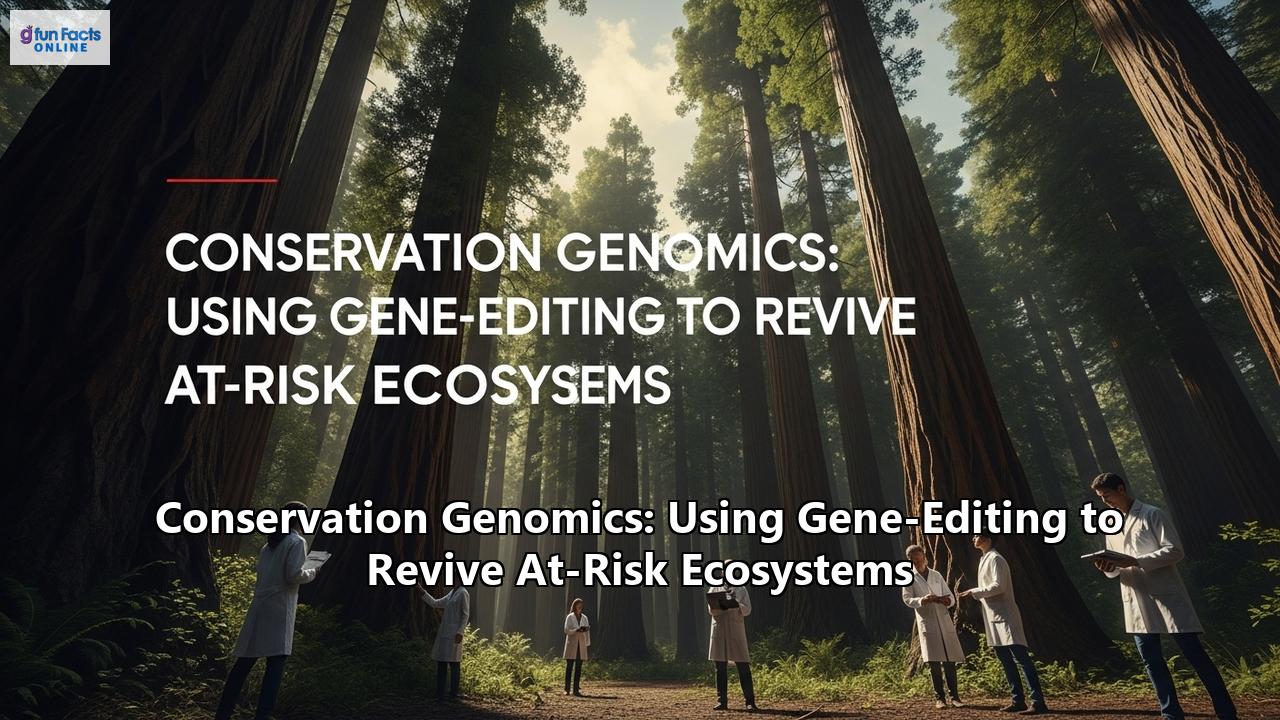
In an era where the Earth's biodiversity is facing unprecedented threats from climate change, habitat loss, and human activity, a revolutionary field is emerging at the intersection of genetics and conservation. Conservation genomics, armed with powerful gene-editing tools like CRISPR, offers a glimmer of hope for reviving at-risk ecosystems and pulling endangered species back from the brink of extinction. This is not the realm of science fiction; it is a rapidly advancing scientific frontier with the potential to rewrite the future of our planet's most vulnerable inhabitants.
The Power of a Genetic Scalpel: Understanding the Technology
At the heart of this revolution is a technology known as CRISPR (Clustered Regularly Interspaced Short Palindromic Repeats). Think of it as a pair of molecular scissors, guided by a specific RNA molecule to a precise location in an organism's DNA. This allows scientists to make incredibly accurate and efficient edits to the genetic code—cutting, modifying, or replacing specific genes. This level of precision was unimaginable just a decade ago and has opened up a vast new toolkit for conservationists.
Conservation genomics leverages this technology to study an organism's entire genome and how its genes interact, providing insights that were previously unattainable. By understanding the genetic basis of traits, scientists can identify genes associated with disease resistance, tolerance to environmental stressors like heat, or other factors crucial for survival. This knowledge empowers them to make targeted interventions to bolster the resilience of vulnerable populations.
Resurrecting Keystone Species: The American Chestnut and Coral Reefs
One of the most compelling examples of conservation genomics in action is the effort to restore the American chestnut tree. Once a dominant species in North American forests, it was decimated by a fungal blight in the 20th century, with over four billion trees perishing. This loss had a cascading effect on the entire ecosystem. Scientists are now using CRISPR to develop a blight-resistant variety of the American chestnut. The goal is to reintroduce these modified trees to their historic range, a move that could help restore the health and biodiversity of these forests. This project is currently awaiting regulatory approval.
Similarly, the world's coral reefs, which are bleaching and dying at an alarming rate due to rising ocean temperatures, could be another beneficiary of this technology. Researchers are working to identify genes that confer thermal tolerance in corals. In 2018, scientists successfully used CRISPR-Cas9 to modify genes in coral for the first time, a proof-of-principle that paves the way for future conservation efforts. The ability to edit the genes of corals to make them more resistant to bleaching could be a game-changer in the fight to save these vital marine ecosystems.
Genetic Rescue: A Lifeline for Endangered Animals
For many endangered species, small population sizes lead to inbreeding and a loss of genetic diversity, making them more susceptible to disease and less able to adapt to changing environments. "Genetic rescue" is a strategy aimed at increasing this vital genetic variation. Historically, this involved translocating animals from one population to another. A classic success story is the Florida panther, which was on the verge of extinction in the 1990s until individuals from a Texas cougar population were introduced, revitalizing the gene pool.
Today, gene-editing technologies offer a more direct and accelerated path for genetic rescue. A poignant example is the black-footed ferret, a species once thought to be extinct and now facing threats from disease. In 2021, scientists successfully cloned a black-footed ferret from the frozen cells of an individual that died decades ago, a significant step in increasing the species' genetic diversity. Future plans involve using CRISPR-Cas9 to edit the ferret genome to introduce genes for plague resistance, sourcing these resilient genes from their domestic relatives.
The Ambitious Horizon: De-extinction
Perhaps the most headline-grabbing, and controversial, application of conservation genomics is the concept of "de-extinction"—bringing extinct species back to life. Companies like Colossal Biosciences are actively working on projects to "resurrect" species like the woolly mammoth and the thylacine (Tasmanian tiger). The process involves using CRISPR to edit the genome of a closely related living species (like the Asian elephant for the woolly mammoth) to match the genetic blueprint of the extinct animal.
While the technological feat is awe-inspiring, de-extinction is fraught with ethical and ecological questions. Critics argue that these resurrected animals would be facsimiles, not true replicas, and that the immense resources required for such projects could be better spent on conserving existing endangered species. There are also concerns about the potential unforeseen consequences of reintroducing these animals into modern ecosystems.
Navigating the Ethical Maze
The power to edit the very fabric of life carries a heavy weight of responsibility, and the ethical implications of using these technologies in the wild are a subject of intense debate. Public perception is mixed, with a 2019 poll revealing that 70% of U.S. adults believe gene editing in wildlife could be misused. There is greater public support for using the technology to help endangered species survive than for controlling populations of pest insects.
Key ethical considerations include:
- Unintended Consequences: How will a genetically modified organism interact with its environment? Could it outcompete native species or have other unforeseen ecological impacts?
- "Playing God": The idea of fundamentally altering the genetic makeup of a species raises profound philosophical and moral questions about humanity's role in nature.
- Governance and Regulation: Current regulatory frameworks for biotechnology are largely outdated and insufficient to address the complexities of releasing gene-edited organisms into the wild.
- Equity and Access: Who gets to decide which species are saved and how these powerful technologies are deployed? There is a crucial need to include diverse perspectives, including those of Indigenous communities.
A Future of Informed Intervention
Despite the challenges, the potential of conservation genomics to address some of the most pressing environmental issues of our time is undeniable. It is not a silver bullet, but rather a powerful new set of tools that can complement traditional conservation methods like habitat restoration and captive breeding programs. The technology is also being applied in innovative ways to improve environmental monitoring, with CRISPR-based platforms like SHERLOCK enabling rapid and accurate identification of endangered species in the field.
As we stand at this new frontier, a balanced approach that prioritizes both caution and innovation is essential. Open dialogue, robust ethical analysis, and public engagement will be paramount in ensuring that we wield this incredible power wisely. The future of conservation may not be about preserving a static snapshot of the past, but about actively and responsibly shaping a more resilient and biodiverse world for generations to come.
Reference:
- https://thelifesciencesmagazine.com/crispr-gene-editing/
- https://frontlinegenomics.com/conservation-genomics-saving-a-million-species-from-extinction/
- https://www.thecgo.org/research/can-gene-editing-increase-ecosystem-and-species-resilience/
- https://colossal.com/transforming-ecology-and-conservation-biology/
- https://www.longdom.org/open-access/genetic-engineering-and-the-conservation-of-endangered-species-103171.html
- https://www.iomcworld.org/articles/the-potential-benefits-and-challenges-of-crispr-technology-in-biodiversity-conservation-1099481.html
- https://innovativegenomics.org/crisprpedia/crispr-in-agriculture/
- https://med.stanford.edu/news/all-news/2018/04/crispr-used-to-genetically-edit-coral.html
- https://reviverestore.org/what-we-do/genetic-rescue-toolkit/
- https://openpress.wheatoncollege.edu/molecularecologyv1/chapter/genetic-rescue/
- https://reviverestore.org/what-we-do/genetic-rescue/
- https://www.pbs.org/newshour/science/how-gene-editing-can-help-todays-endangered-species
- https://cssh.northeastern.edu/philosophy/wp-content/uploads/sites/11/2021/01/Sandler_Genetic-Engineering.pdf
- https://consensus.app/questions/what-ethics-gene-editing-wildlife-conservation/
- https://sigmaearth.com/ethical-implications-of-genetic-editing-in-wildlife/
- https://innovativegenomics.org/crisprpedia/crispr-ethics/
- https://ecoservantsproject.org/harnessing-crispr-for-environmental-solutions-a-new-frontier-for-ecoservants-and-the-planet/
- https://www.ucdavis.edu/climate/news/as-crispr-a-tool-for-conservation-not-just-gene-editing