
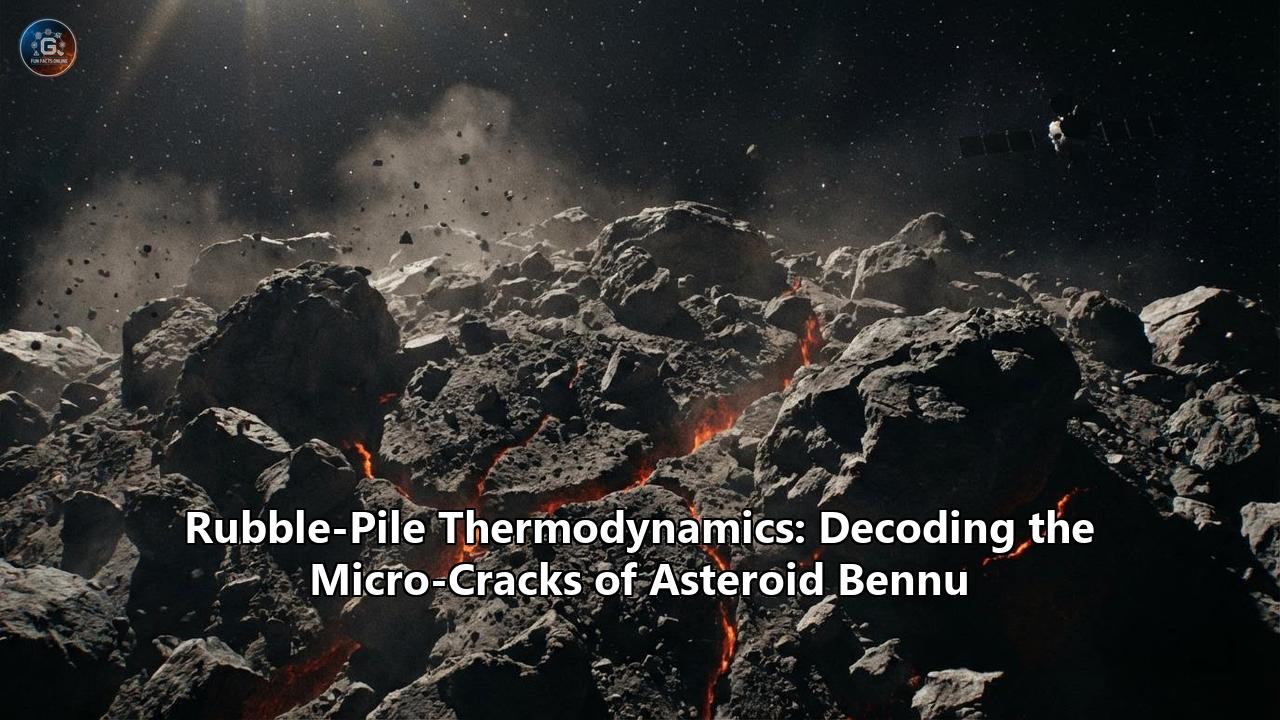
Deep in the vacuum of the inner solar system, an ancient survivor is slowly being dismantled by the very star that illuminates it. At a glance, Asteroid 101955—better known as Bennu—looks like a charcoal-dark, diamond-shaped mountain floating through the void. For decades, astronomers believed that the surfaces of such near-Earth asteroids were static, frozen in time since the dawn of the solar system, save for the occasional micrometeorite impact. But when NASA’s OSIRIS-REx spacecraft arrived at Bennu in late 2018, it did not find a dead, unchanging world. Instead, it uncovered a remarkably active, geologically dynamic "rubble pile" where rocks are literally popping, cracking, and shedding their skin under the relentless thermal hammer of the Sun.
The discovery that sunlight alone can violently fracture boulders on an airless body has revolutionized planetary science. But the plot thickened significantly when the OSIRIS-REx mission successfully returned 121.6 grams of Bennu’s pristine material to Earth in September 2023. Under the scrutiny of high-powered X-ray computed tomography (XCT) and lock-in thermography, scientists discovered a hidden universe of micro-cracks inside these rocks. These microscopic labyrinthine networks not only explain the strange, unexpectedly rugged surface of the asteroid, but they completely rewrite our understanding of rubble-pile thermodynamics.
To understand the micro-cracks of Asteroid Bennu is to understand the life cycle of the solar system itself—from the watery destruction of ancient planetesimals to the long-term orbital mechanics that could one day steer such a rocky leviathan toward Earth.
The Anatomy of a Cosmic Rubble Pile
Before we can decipher the thermodynamics that govern Bennu's behavior, we must first understand what Bennu physically is. The asteroid is not a single, solid monolith of rock. It is a "rubble pile"—a chaotic amalgamation of boulders, rocks, pebbles, and dust held together by the faintest whisper of gravity.
Billions of years ago, Bennu did not exist in its current form. Its material belonged to a much larger, volatile-rich parent body residing in the Main Asteroid Belt between Mars and Jupiter. This parent planetesimal was large enough to host a complex, asteroid-scale hydrothermal system. Deep within its crust, hot water interacted with rock, leaving behind intricate veins of carbonate and highly hydrated minerals—similar to the processes that occur at hydrothermal vents on Earth's ocean floor. We know this because the fragments returned to Earth contain these exact carbonates, stretching inches thick, serving as fossilized proof of an ancient, watery world.
Then came the cataclysm. A massive collision shattered this parent body, casting its debris into the void. Over time, the mutual gravitational attraction of these wandering fragments pulled them back together. They coalesced loosely, leaving massive voids and pockets of empty space between the larger boulders. This created the diamond-shaped rubble pile we see today.
When the OSIRIS-REx spacecraft executed its historic Touch-And-Go (TAG) sample collection maneuver in October 2020, the sampling arm met almost no resistance. It sank far deeper into the surface than engineers anticipated. If the spacecraft had not fired its thrusters to back away, it might have swallowed itself whole into the asteroid. The surface behaves less like solid ground and more like a pit of plastic balls. This extreme macroporosity—the empty space between the constituent boulders—is the first critical variable in the complex thermodynamic equation of Asteroid Bennu.
The Sun’s Anvil: Extreme Thermal Cycling
On Earth, rocks break down primarily through chemical weathering and the freeze-thaw cycle of water. Rainwater seeps into a small fault in a rock; when the temperature drops, the water freezes, expanding by about 9%, and wedges the crack further apart. Because Bennu has no atmosphere and no liquid water, scientists long assumed its boulders would remain relatively intact.
But Bennu lacks the insulating blanket of an atmosphere to regulate its temperatures. Furthermore, it rotates on its axis once every 4.3 hours. This means that a boulder sitting on Bennu’s equator is subjected to a brutally rapid day-night cycle. During the brief, searing day, surface temperatures can spike to 260 degrees Fahrenheit (127 degrees Celsius). Just a few hours later, the rock plunges into the dark, freezing void of space, where temperatures plummet to minus 100 degrees Fahrenheit (minus 73 degrees Celsius).
Any material subjected to a change in temperature will experience thermal expansion and contraction. Because rock is an exceedingly poor conductor of heat, the outermost layer of a boulder heats up and expands much faster than its cooler interior. This creates immense mechanical stress. The surface is trying to pull away from the core. Hours later, the surface freezes and shrinks rapidly, while the interior is still trying to hold onto the lingering warmth.
This relentless push and pull is known as thermal stress fracturing. Over time, the tension overcomes the tensile strength of the rock, causing it to snap.
When OSIRIS-REx mapped the surface of Bennu from orbit, the spacecraft's camera suite (OCAMS) captured stunning, definitive evidence of this process. High-resolution images, capable of spotting details smaller than a centimeter, revealed two distinct phenomena:
- Exfoliation: Small, thin layers of rock—ranging from 1 to 10 centimeters thick—flaking off the surfaces of larger boulders, like the skin of an onion peeling away.
- Linear Fractures: Massive cracks running through boulders in a distinct north-south direction. This specific alignment perfectly matches the line of stress that would be produced by the Sun tracking across the asteroid's sky from east to west.
While tectonic activity or meteoroid impacts can also crack rock, Bennu is far too small for tectonics, and meteoroid impacts would leave distinct craters and random fracture patterns. The north-south alignment of the cracks was the smoking gun: the Sun itself was breaking the rocks.
The Missing Sand Paradox and the Micro-Crack Revelation
The discovery of thermal fracturing was a monumental triumph, but it immediately collided with a baffling mystery that had haunted the OSIRIS-REx team since before the spacecraft even launched.
In 2007, NASA’s Spitzer Space Telescope observed Bennu in the infrared spectrum to measure its thermal inertia. Thermal inertia dictates how quickly an object heats up and cools down. A solid block of iron or a massive slab of bedrock has high thermal inertia; it takes a long time to heat up, but it will radiate that heat long into the night. Conversely, a surface covered in fine, loose powder—like a sandy beach—has very low thermal inertia. The tiny grains heat up instantly in the sun and freeze immediately in the shade because there is so much empty, insulating space between the grains.
Spitzer’s data indicated that Bennu had a remarkably low thermal inertia (around 350 J m–2 K–1 s–1/2). Based on standard thermodynamic models, scientists fully expected to arrive at Bennu and find vast plains of smooth, fine-grained regolith—dust and sand particles ranging from half a centimeter to five centimeters in diameter.
Instead, they found a jagged, rugged nightmare of a landscape. The asteroid was almost entirely covered in massive boulders, some larger than 30 meters across. There were almost no smooth, sandy beaches to be found.
How could a world covered in giant, solid boulders exhibit the low thermal inertia of a dusty sandbox?
The answer lay locked inside the 121.6 grams of material returned to Earth in 2023. When researchers placed the pea-sized, charcoal-dark fragments of Bennu into X-ray Computed Tomography (XCT) scanners at NASA's Johnson Space Center, they peered directly into the internal architecture of the rock without destroying it.
The XCT scans revealed a mesmerizing, highly porous interior. But it wasn't just simple porosity (like the bubbles in volcanic pumice). The rocks were riddled with a complex, dense, labyrinthine network of microscopic cracks. These micro-cracks threaded haphazardly around ancient mineral clasts and organic grains.
Through advanced laboratory techniques like lock-in thermography, scientists tested how heat moved through these micro-cracked samples. The results were staggering. The dense, interlocking crack networks acted as microscopic thermal barriers. When heat tried to conduct from the sunlit surface down into the rock, it hit a microscopic void—the vacuum of space trapped inside the crack. Because heat cannot easily conduct across a vacuum, it was stalled.
These internal fractures reduced the boulders' thermal conductivity by up to 40 percent compared to uncracked solid rock. In other words, Bennu’s massive boulders are so heavily shattered and micro-fractured on the inside that they behave thermodynamically like giant clumps of dust. The Spitzer telescope wasn't wrong about the thermal inertia; scientists just hadn't imagined that a boulder could be so profoundly broken on the inside while still maintaining its outward shape.
The Fast-Forward Aging of Asteroids
The implications of this widespread thermal fracturing are profound, particularly when it comes to the lifespan of an asteroid. Planetary geologists are accustomed to dealing in deep time—processes that take tens or hundreds of millions of years to unfold.
But Bennu is aging in fast-forward. By analyzing the length, angles, and distribution of more than 1,500 fractures seen in OSIRIS-REx images, scientists determined the timeline of surface regeneration. They discovered that the Sun’s heat can completely fracture and break down a boulder on Bennu in just 10,000 to 100,000 years. Geologically speaking, that is the blink of an eye.
"We were surprised to learn that the aging and weathering process on asteroids happens so quickly," noted Marco Delbo, a senior scientist studying the mission's imagery.
This rapid breakdown sheds light on another bizarre phenomenon observed by OSIRIS-REx: Particle Ejection Events. During its orbit, the spacecraft's navigational cameras caught Bennu actively spitting small rocks and pebbles into space. Sometimes, dozens or even hundreds of particles were ejected in a single event. Some of these particles escaped into the cosmos, while others briefly entered orbit around Bennu before raining back down onto the surface.
Scientists narrowed the cause of these ejections down to three likely culprits:
- Micrometeoroid Impacts: Tiny space rocks hitting Bennu’s surface and kicking up debris.
- Water Release: Hydrated minerals baking in the afternoon sun, releasing water vapor that builds up pressure inside the micro-cracks until the rock pops, shooting out debris.
- Thermal Stress Fracturing: The sheer mechanical force of the rock cracking under the afternoon heat, violently snapping and launching shrapnel into space.
It is highly probable that all three mechanisms are working in tandem. The relentless thermal fracturing chops the surface boulders into increasingly fragile, micro-cracked pieces. These weakened rocks are then easily agitated by the sudden expansion of released water vapor, or easily shattered by the microscopic impact of a rogue meteoroid. The result is an active, shedding world that is constantly generating its own fine dust—dust that eventually trickles down into the dark, hidden interior of the rubble pile.
Chemical Pristinity in a Mechanically Shattered World
One might assume that rocks subjected to such violent thermal fracturing and radiation would be chemically degraded. However, laboratory analysis of the returned insoluble organic matter (IOM) reveals another magnificent paradox about Bennu.
Using advanced techniques like Solid-State Nuclear Magnetic Resonance (ssNMR) and Elemental Analysis-Isotope Ratio Mass Spectrometry (EA-IRMS), scientists mapped the molecular structure of the organics inside Bennu’s rocks. They looked closely at the ratio of aliphatic hydrogen to aromatic carbon.
If the rocks had been subjected to extreme, long-term heat (deep internal heating from a planetary core, or the high-pressure shock of a catastrophic impact), those organic bonds would have fundamentally reorganized. Instead, the organic solids show minimal to almost no molecular evolution from thermal perturbation. The organics are incredibly pristine—virtually identical to the highly preserved, petrologic type 1 and 2 carbonaceous chondrites.
This presents a fascinating dichotomy. Macroscopically and mechanically, the rocks of Bennu are battered, cracked, exfoliated, and falling apart under the Sun. But chemically and molecularly, they are untouched time capsules. The heat of the Sun is enough to physically snap the rock via expansion and contraction, but it is not hot enough, nor sustained deeply enough into the rubble pile's core, to chemically alter the ancient organic building blocks.
This pristinity is what makes Bennu such a vital target for astrobiology. Within these highly fractured boulders, scientists have uncovered a treasure trove of prebiotic chemistry. The samples contain 14 of the 20 amino acids utilized by life on Earth to build proteins, alongside five essential nucleobases used to store genetic information. The micro-cracks might act as thermodynamic insulators, but they also act as microscopic vaults, protecting the delicate chemistry of the early solar system from the harshness of deep space.
The Yarkovsky Effect and Planetary Defense
Understanding the thermodynamics of a rubble pile is not merely an academic exercise; it is a matter of planetary survival. Bennu is classified as a Near-Earth Object (NEO) and a Potentially Hazardous Asteroid (PHA). Based on its current orbital trajectory, there is a small but non-zero probability (about 1 in 2,700) that Bennu could impact Earth in the year 2182.
Because of this risk, scientists must predict exactly where Bennu will be decades from now. But plotting the orbit of an asteroid is not as simple as calculating the gravitational pull of the Sun and the planets. You must account for the Yarkovsky Effect.
The Yarkovsky Effect is a subtle, non-gravitational force generated by the emission of thermal radiation. When Bennu rotates, its sunlit side absorbs heat. Because the boulders have low thermal conductivity (thanks to those micro-cracks), the heat stays near the surface. As the asteroid rotates into the afternoon and evening, that stored heat is radiated back into space as infrared energy.
Photons of infrared light carry momentum. When Bennu continuously exhales this heat in a specific direction, it acts like a microscopic, continuous thruster, pushing the asteroid slightly off its purely gravitational course. Over days and weeks, the push is negligible. Over centuries, it can alter the asteroid's orbit by thousands of miles—the difference between a near-miss and a direct impact with Earth.
To model the Yarkovsky Effect accurately, astronomers must know exactly how the asteroid absorbs and releases heat. For years, the models were built on the assumption that Bennu was covered in fine, sandy regolith due to its low thermal inertia. Now, thanks to the sample return and the decoding of the micro-cracks, the models can be refined with exquisite precision. We now know that the heat is being trapped and released by the highly porous, deeply fractured architecture of boulders. This allows dynamically updated orbital modeling, ensuring we know exactly when and where Bennu will cross Earth's path.
Furthermore, if humanity ever needs to deflect Bennu or a similarly composed rubble-pile asteroid, understanding its physical structure is paramount. Before OSIRIS-REx, planetary defense strategies often imagined slamming a kinetic impactor (like NASA's DART mission) into a solid block of rock. But Bennu is a spongy, macroporous collection of shattered rocks. A kinetic impactor hitting Bennu wouldn't shatter a monolith; it would plunge into the voids, compressing the rubble, and potentially dampening the kinetic transfer. The energy would be absorbed by the grinding and shifting of micro-cracked boulders. Deflecting a rubble pile requires different math than deflecting a solid body, and the thermodynamic data gathered from Bennu provides the exact coefficients needed for those future defense algorithms.
A New Vision of the Solar System
The story of Asteroid Bennu is a testament to the power of scientific inquiry. We began with telescopes peering through the dark, registering a thermal signature that whispered of sandy shores. We sent a robotic emissary across millions of miles of empty space, only to find a jagged, treacherous mountain of boulders. We captured the asteroid in the act of spitting rocks into the void and photographed the very cracks forming on its surface under the glare of the Sun. Finally, we brought pieces of that mountain back to Earth, peered inside them with X-rays, and found the microscopic voids that reconciled the entire mystery.
Asteroids are not just dead debris left over from the construction of the planets. They are highly active, rapidly evolving worlds. They are baked by the Sun, fractured by extreme temperature swings, and constantly shedding their mass into the solar wind. The thermodynamics of a rubble pile show us that even in the cold, silent vacuum of space, nature is never truly still. The micro-cracks of Asteroid Bennu are a beautiful, chaotic display of the universe in motion, relentlessly breaking down the old to pave the way for the new.
Reference:
- https://www.theweathernetwork.com/en/news/science/space/nasa-osiris-rex-shows-sunlight-is-cracking-bennu-boulders-apart
- https://news.arizona.edu/news/nasas-osiris-rex-discovers-sunlight-can-crack-rocks-asteroid-bennu
- https://scienceblog.com/the-cracks-inside-asteroid-bennus-rocks-finally-explain-its-strangely-cold-surface/
- https://science.nasa.gov/missions/osiris-rex/asteroid-bennus-rugged-surface-baffled-nasa-we-finally-know-why/
- https://www.asteroidmission.org/?post_type=latest-news
- https://www.techexplorist.com/sun-heat-fractures-rocks-asteroid-bennu/52690/
- https://tohoku.elsevierpure.com/en/publications/placing-asteroid-bennus-organic-solids-in-molecular-and-elemental/
- https://www.researchgate.net/publication/374066762_Daily_temperature_changes_reveal_compositional_variation_on_asteroid_101955_Bennu
- https://www.universetoday.com/articles/rocks-on-bennu-are-cracking-because-of-the-constant-day-night-cycling
- https://www.nasa.gov/missions/nasas-osiris-rex-mission-explains-bennus-mysterious-particle-events/
- https://oro.open.ac.uk/60676/1/DellaGiustina_et_al_2019.pdf
- https://www.discovermagazine.com/asteroid-bennu-s-surface-contains-cracked-boulders-instead-of-smooth-beaches-making-it-rapidly-lose-heat-48838