
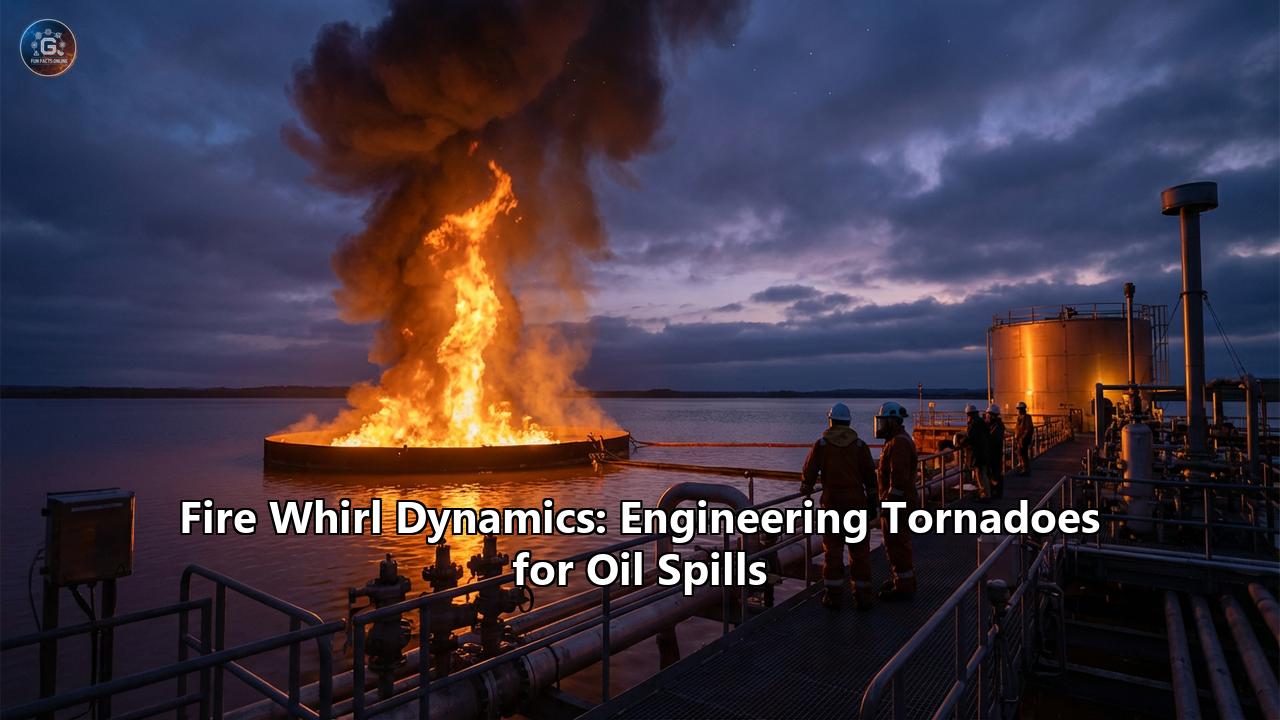
In the frantic, desperate hours following a catastrophic offshore oil spill, emergency responders are often forced into a grim and destructive calculus. When millions of gallons of toxic crude are spreading rapidly across the ocean surface, threatening fragile coastlines and marine ecosystems, containment options are agonizingly limited,. One of the most effective, albeit controversial, methods is in-situ burning—setting the floating slick on fire before it can reach land,. It is a blunt-force solution to a complex environmental disaster.
While in-situ burning can rapidly remove vast quantities of oil from the water, it comes at a steep environmental cost. Conventional fire pools spread horizontally, starving the center of the blaze of oxygen. This incomplete combustion creates apocalyptic plumes of thick, black smoke, releasing toxic soot and greenhouse gases high into the atmosphere,. Furthermore, when the fire inevitably chokes on its own lack of oxygen and dies out, it leaves behind a sticky, unburned tar mat on the ocean surface that continues to poison marine life,. For decades, the choice has been painfully clear: sacrifice the air to save the coast.
But what if the chaotic, devastating power of a natural disaster could be harnessed, engineered, and unleashed to solve this exact problem?
Welcome to the bleeding edge of combustion dynamics, where researchers are engineering massive, spinning columns of flame—fire tornadoes—to act as hyper-efficient, ocean-cleaning incinerators,. By manipulating the fluid mechanics of fire whirls, scientists have discovered a way to burn oil spills significantly faster, dramatically reduce toxic soot, and consume nearly all the spilled fuel,. It is a revolutionary approach that transforms a terrifying natural phenomenon into a precision tool for environmental remediation.
The Anatomy of a Monster: Natural Fire Whirls
To understand the genius behind engineering fire tornadoes for environmental cleanup, one must first understand the beast in its natural habitat. In the wild, fire whirls—often referred to as fire devils or fire tornadoes—are apocalyptic forces of nature. They occur spontaneously during intense wildfires or urban conflagrations when rising heat (thermal updrafts) collides with turbulent, converging winds,.
The resulting vortex acts like a chimney. As the column of air begins to spin, it creates a powerful low-pressure core that sucks in additional oxygen and fuel from the surrounding environment,. This spinning motion acts like a natural turbocharger,. The extreme inflow of oxygen forces the fire to burn at ferociously high temperatures, stretching the flames vertically into a tight, rotating pillar,. In the wild, these phenomena are uncontrollable disasters, capable of uprooting trees, hurling burning debris for miles, and generating hurricane-force wind speeds.
Yet, within this chaotic devastation lies a tantalizing mechanical advantage: efficiency. Because the vortex constantly pulls fresh oxygen into the core of the flame, a fire whirl combusts fuel far more completely than a flat, open-air fire.
The inspiration to harness this efficiency struck Dr. Elaine Oran, a prominent aerospace engineering professor, after a freak accident in 2003. Lightning struck a Jim Beam bourbon warehouse in Kentucky, igniting a massive cache of alcohol. Approximately 800,000 gallons of flaming bourbon spilled into a nearby lake, triggering the spontaneous formation of towering fire whirls that danced across the water's surface,. Observing the footage, researchers noted a fascinating phenomenon: larger fire whirls were actively pulling in and absorbing smaller ones, consuming the spilled fuel with terrifying speed. The question naturally arose: could this destructive force be tamed and put to work?
The 2016 Miracle: Discovery of the "Blue Whirl"
The journey from observing a bourbon-fueled fire tornado to engineering a tool for marine conservation led to a serendipitous and groundbreaking discovery in a laboratory at the University of Maryland,. In 2016, a team of researchers, including Dr. Oran, Dr. Michael Gollner, and Dr. Huahua Xiao, were experimenting with small-scale fire whirls over water to study their potential for oil spill cleanup,,.
Using a setup that included a pan of water layered with liquid fuel (n-heptane) and a pair of offset quartz half-cylinders to channel air into a vortex, the scientists ignited a conventional, chaotic yellow pool fire,,. As the offset cylinders drew in air tangentially, the yellow flames coalesced into a turbulent, twisting fire whirl,.
Then, something entirely unprecedented happened.
The loud, violently twisting yellow fire tornado began to shrink and stabilize,. The chaotic turbulence vanished, replaced by an eerie silence. The towering yellow flames collapsed into a tiny, vigorously spinning, bright blue flame shaped like a spinning top or an inverted cone,. The researchers had accidentally discovered a completely new state of combustion: the "Blue Whirl",.
In the world of combustion physics, color is everything. The bright yellow and orange colors of typical campfires, wildfires, and oil burns are essentially the glow of pollution. Those colors are generated by blackbody radiation from glowing, unburned soot particles, indicating that the fire lacks the oxygen required to fully combust the fuel,. A blue flame, on the other hand, indicates complete, soot-free combustion,. The blue and violet hues are caused by the chemiluminescence of excited molecular species, such as C2, CH, and OH radicals, which only occur when fuel and oxygen are perfectly mixed.
By forcing the fire to spin over a liquid boundary, the researchers had triggered a fluid-dynamic anomaly that allowed the fire to burn with virtually zero emissions,.
Decoding the Magic: Vortex Breakdown and Triple Flames
The discovery of the Blue Whirl sent shockwaves through the physics and engineering communities. However, creating it in a lab was only the first step; scientists needed to understand why it happened if they ever hoped to scale it up for real-world oil spills.
The answer lay in the realm of advanced fluid dynamics and required the processing power of supercomputers to unravel. Researchers utilized massive computational simulations to peer inside the invisible structures of the Blue Whirl, uncovering a mesmerizing interplay of airflow and chemistry,.
They discovered that the transition from a towering yellow fire whirl to a quiet blue one is governed by a fluid instability known as "vortex breakdown",. In a traditional fire whirl, the gases spin upward in what fluid dynamicists call a "spiral mode". But as the swirl intensity increases, the flow suddenly collapses into a "bubble mode",. The fast-moving air recirculates upon itself, creating a trapped, spinning bubble of localized pressure. You can observe similar vortex breakdowns in the swirling vortices shedding off the wings of fighter jets.
Within this swirling bubble of air, the supercomputer simulations revealed a masterpiece of combustion architecture. The Blue Whirl is not a single flame, but rather a complex ecosystem of three distinct flames seamlessly operating together,:
- The Rich Premixed Flame: Located at the bottom, where vaporized fuel actively mixes with incoming air, but where fuel still outnumbers oxygen molecules,.
- The Lean Premixed Flame: Located on the outer edges, where there is an excess of oxygen compared to the fuel,.
- The Diffusion Flame: A purplish, hat-shaped flame crowning the top, where unburned fuel from the inside finally meets the outside air,.
These three distinct flames converge at a singular, perfectly balanced intersection known as a "triple flame," which manifests visually as a brilliantly glowing, whirling blue ring,. The intense recirculation of the bubble mode forces the fuel and oxygen to mix rapidly and thoroughly before they ever reach the combustion zone,. This premixing ensures that every single hydrocarbon molecule is entirely obliterated, leaving no carbon behind to form soot,.
Scaling the Beast: The 2026 Large-Scale Breakthrough
While the Blue Whirl represented a holy grail of clean combustion, generating it required highly specific laboratory conditions at a very small scale,. An oil spill in the Gulf of Mexico cannot be cleaned up by a three-inch flame. The world needed to know if the physics of vortex-enhanced combustion could be scaled up to handle the immense, violent, and open-air conditions of a marine disaster,.
In February 2026, researchers provided a definitive and spectacular answer.
Funded by the Bureau of Safety and Environmental Enforcement (BSEE), a collaborative team led by Dr. Elaine Oran and Dr. Qingsheng Wang from Texas A&M University, alongside Dr. Michael Gollner from the University of California, Berkeley, successfully engineered the world's first large-scale fire whirl for oil spill remediation,,.
Moving out of the laboratory and into the sprawling Texas A&M Engineering Extension Service (TEEX) Brayton Fire Training Field, the team constructed a massive, 16-foot-tall, three-walled triangular structure,,. Inside this structure lay a large basin of water, heavily coated in crude oil,.
When the slick was ignited, the towering offset walls forced the drafting air into a vicious rotational pattern. The flames roared upward, quickly transitioning from a sluggish, smoky pool fire into a spectacular, stable, spinning vortex of fire that towered 17 feet into the air,,.
The performance metrics of this manufactured fire tornado, recently published in the journal Fuel, shattered expectations and fundamentally rewrote the rules of disaster response,:
- Supercharged Speed: The vortex acts like a giant incinerator, feeding oxygen to the fire at such an accelerated rate that the crude oil burned nearly 40 percent faster than it would in a conventional in-situ fire,. In the critical window of a spill, where every hour dictates how much coastline will be devastated, a 40% reduction in cleanup time is monumental,.
- Radical Emission Reduction: By drastically improving the oxygen mixture, the 17-foot fire whirl slashed the production of toxic soot by 40 percent,,. It effectively destroyed the particulates that normally form thick, choking smoke plumes, promising significantly cleaner air for response crews and coastal communities,.
- Near-Total Consumption: Traditional burns leave behind a thick, toxic sludge. The intense, localized heat of the fire whirl achieved an astonishing fuel consumption efficiency of up to 95 percent,. The extreme temperatures vaporized the crude oil almost entirely, preventing the formation of residual tar mats on the ocean's surface,.
Engineering the Uncontrollable: The Leap to the Open Ocean
The TEEX experiment proved beyond a shadow of a doubt that engineering fire tornadoes for massive environmental cleanups is physically possible and overwhelmingly effective,. However, transitioning this technology from a static testing facility in Texas to the rolling, unpredictable swells of the open ocean represents the next great frontier in offshore engineering,.
In the TEEX experiment, the fire whirl was coaxed into existence using heavy, 16-foot stationary walls,. In the middle of the North Sea or the Gulf of Mexico, erecting giant metal walls over a moving oil slick is logistically impossible,. The ocean is a dynamic environment plagued by high winds, rogue waves, and shifting currents. Fire whirls are inherently temperamental; if the wind blows too hard across the top of the vortex, the fluid dynamic "bubble" collapses, and the tornado reverts back into a dirty, smoky pool fire.
Consequently, the current focus of marine engineers and fluid dynamicists is the development of deployable, floating structures capable of shaping airflow in open water. Future remediation frameworks may involve autonomous, heat-resistant floating baffles or specialized fire-booms that can be rapidly towed around a slick by response vessels. These floating structures would be hydrodynamically designed to not only corral the oil but also feature engineered air-intake slits. As the ambient ocean breeze flows through the baffles, it would be mathematically redirected to initiate and sustain the rotational vortex required to spawn a fire whirl.
Another avenue of research involves active air injection. Rather than relying on passive walls to catch the wind, specialized responder drones or hovercraft could inject highly targeted streams of forced air into a burning slick, artificially inducing the vortex breakdown required to spin the fire into a tornado,. Achieving consistent, remote control of these massive thermal dynamics will be the critical hurdle before fire whirls become a standard integrated protocol in global spill response frameworks.
A Universal Physics: Applications Beyond the Sea
While the immediate application of this technology aims to save marine ecosystems, the implications of understanding and controlling fire whirls extend far beyond oceanography,. The fundamental physics of vortex-enhanced combustion unraveled by these experiments are triggering a paradigm shift across multiple industries,.
Fuel-Flexible Power Generation:The soot-free nature of the Blue Whirl has vast implications for global energy production,. The world relies heavily on liquid hydrocarbon fuels, but extracting energy from them cleanly is notoriously difficult. Researchers have successfully induced the Blue Whirl state using a wide variety of fuels, including n-heptane, n-octane, ethanol, and even raw, unrefined crude oil. Because the vortex mechanism relies more on fluid dynamics than specific chemical kinetics, it effectively bypasses the need for complex pre-vaporization or atomization of the fuel. This could lead to the development of highly efficient, fuel-flexible industrial burners and generators that can extract maximum thermal energy from low-grade or contaminated fuels with near-zero particulate pollution,,.
Wildfire Prediction and Management:On land, fire whirls remain deadly adversaries. By reverse-engineering how fire tornadoes form, stabilize, and collapse in the lab, scientists are providing wildland firefighters with unprecedented predictive models,. Understanding the exact thresholds of wind shear, thermal updraft, and boundary layer interference required to trigger a fire whirl allows meteorologists to better predict when and where these deadly phenomena might spawn during a forest fire, potentially saving the lives of frontline responders,.
The Future of Disaster Response
For decades, human industry has viewed fire as a primitive, untamable force—a destructive element to be suppressed, or at best, utilized as a blunt instrument of last resort,. The approach to massive ecological disasters like oil spills has been defined by choosing the lesser of two immense evils.
Through a synthesis of serendipitous discovery, supercomputing, and bold large-scale engineering, the narrative is changing,. By decoding the fluid dynamics of vortex breakdown and the complex architecture of triple flames, science is learning to harness the chaotic nature of the fire tornado,,.
The transition from a terrifying, uncontrollable monster to a quiet, pure blue flame, and eventually to a precisely engineered 17-foot incinerator, proves that even the most chaotic forces of nature can be bent toward restoration,,. As engineers continue to refine deployable oceanic airflow structures, the frantic, smoky, and toxic oil spill cleanups of the past may soon be replaced. In their stead, response crews will deploy perfectly controlled, towering pillars of spinning flame—burning hotter, acting faster, and breathing cleaner air back into the sky while leaving the oceans pristine below,.
Reference:
- https://www.earth.com/news/spinning-fire-whirls-may-clean-oil-spills-faster-and-with-less-smoke/
- https://theweek.com/environment/fire-tornadoes-oil-spills-climate-change-pollution
- https://www.environmentenergyleader.com/stories/fire-whirls-could-transform-oil-spill-response,116310
- https://www.sciencealert.com/this-new-blue-whirl-flame-could-lead-to-cleaner-energy
- https://stories.tamu.edu/news/2026/02/16/the-giant-fire-tornado-that-could-save-our-oceans/
- https://scitechdaily.com/scientists-create-giant-fire-tornadoes-that-could-save-our-oceans/
- https://www.popsci.com/scientists-discover-blue-whirl-flame-that-burns-nearly-soot-free/
- https://www.sciencefocus.com/news/firenadoes-oil-spills
- https://www.eurekalert.org/news-releases/751949
- https://firelab.berkeley.edu/2016/08/new-discovery-blue-whirl-published-in-pnas/
- https://www.pnas.org/doi/10.1073/pnas.1605860113
- https://wildfiretoday.com/scientists-discover-a-new-kind-of-fire-whirl/
- https://pmc.ncbi.nlm.nih.gov/articles/PMC7439297/
- https://www.proquest.com/openview/45c2d299e56a25d907ce87735e2fcb19/1?pq-origsite=gscholar&cbl=18750&diss=y
- https://newatlas.com/environment/fire-whirl-oil-spills/