
The Unspoken Tongue: How Digital Tools Are Helping Us Decipher the Khipu's Knotted Secrets
In the silent expanse of the Andean highlands, where the Inca Empire once flourished, a profound mystery endures, not in stone or clay, but in twisted threads of cotton and camelid fiber. For centuries, the khipu (also spelled quipu), an intricate system of knotted cords, has held the secrets of a civilization that built monumental cities, managed a vast empire, and tracked the movements of the stars, all without a single stroke of written script as we know it. These enigmatic artifacts, long dismissed by Spanish conquerors as mere accounting tools, are now at the center of a technological revolution in archaeology. Armed with powerful computational methods and vast digital databases, a new generation of researchers is beginning to unravel the khipu's complex, three-dimensional language, revealing a sophisticated system of communication that is forcing us to redefine the very concept of writing.
A Library of Knots: The Khipu in the Incan World
The word khipu translates from the native Quechua language to a simple, yet elegant term: "knot." These devices were the primary record-keeping tool of the Inca Empire, which reigned from approximately 1438 to 1533 CE. However, their origins stretch back even further, with the earliest examples attributed to the Wari Empire, a powerful state that flourished in the central Andes between 600 and 1100 CE.
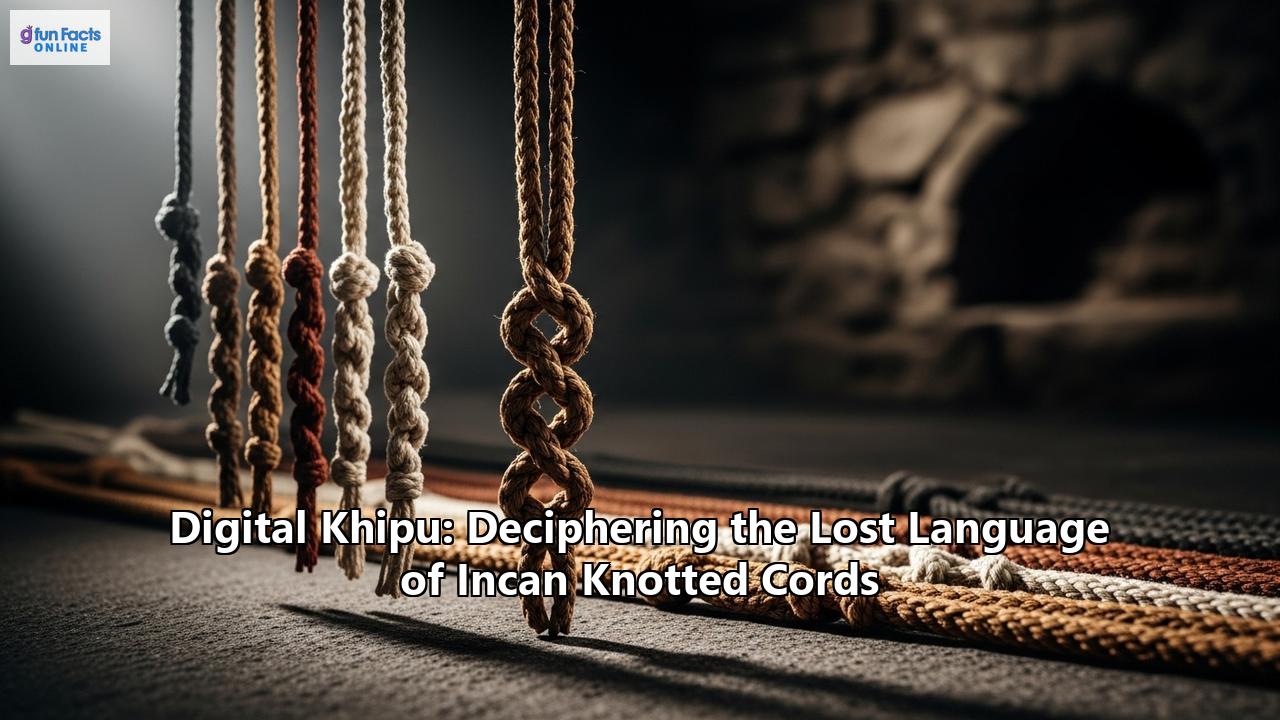
A typical Incan khipu consists of a main horizontal cord from which numerous pendant strings hang like fringe. These pendants can have their own subsidiary cords, creating a complex, hierarchical structure. The khipu makers, known as khipukamayuqs (knot-makers or keepers), were the highly trained administrators and accountants of the empire. They encoded information by making a series of deliberate choices in the khipu’s construction: the type of fiber (cotton or camelid wool), the color of the cords (using natural hues and vibrant dyes), the direction in which the strings were spun and plied, the way pendants were attached to the main cord, and, most famously, the types and positions of the knots themselves.
For much of the 20th century, our understanding of khipus was limited to their numerical function. In the 1920s, historian L. Leland Locke made the groundbreaking discovery that the knots on many khipus represented numbers in a base-10 positional system, much like the one we use today. Single knots, long knots with multiple turns, and figure-eight knots were used to denote digits from one to nine, with their position on the cord indicating their value (ones, tens, hundreds, etc.). This decimal system allowed the Incan administration to conduct extensive inventories, manage tax obligations, and record census data with remarkable precision. They tracked everything from harvests of maize and beans to military organization and calendrical information. Spanish chroniclers even noted that khipukamayuqs could be summoned to colonial courts, where their knotted records were recognized as valid legal testimony.
Despite this breakthrough, the purpose of the khipu's other features, particularly the dazzling array of colors, remained a puzzle. Spanish accounts were often contradictory; some claimed the khipus recorded histories, poems, and even songs, while others dismissed them as simple memory aids. The tragic reality is that during the Spanish conquest, countless khipus were destroyed, burned as objects of idolatry, taking with them an immeasurable wealth of knowledge. Of the hundreds of thousands that likely existed, only about 1,400 are known to survive today, scattered in museums and private collections across the globe. For centuries, it seemed their deepest secrets—their potential to hold narrative, history, and a lost Andean worldview—were gone forever.
The Dawn of the Digital Khipu: From Analog Artifact to Digital Data
The quest to unlock the khipu's secrets took a dramatic turn with the advent of the digital age. The sheer complexity of the khipus, with their thousands of potential combinations of color, fiber, spin, and knots, made manual comparison a monumental task. The solution was to transform these physical, three-dimensional texts into a new form: the Digital Khipu.
The pioneering effort in this domain is the Harvard Khipu Database Project (HDAKD), initiated in 2002 by anthropologist Gary Urton and his colleague Carrie Brezine. With funding from the National Science Foundation, the project began the meticulous process of documenting every characteristic of the surviving khipus. For each of the hundreds of khipus cataloged, the database records detailed information: the length, color, and fiber of every cord; the direction of its spin and ply; the way it is attached to the main cord; and the type, twist, and precise numerical value of every knot.
This project laid the groundwork for what is now the most comprehensive resource available: the Open Khipu Repository (OKR). Managed by a team including Jon Clindaniel at the University of Chicago, the OKR is an open-source database that consolidates the data from the HDAKD with records from other researchers, creating a massive, standardized dataset for computational analysis. This digital archive allows scholars to perform complex queries and statistical analyses that were previously impossible, searching for patterns across hundreds of khipus simultaneously.
This digital approach represents a fundamental shift in khipu studies. Researchers can now ask questions on a macro scale: Are there mathematical relationships that appear consistently across multiple khipus? Do certain colors always appear in the same positions? Can we use computational methods to identify distinct "genres" of khipus, such as accounting versus narrative records? Data science techniques like clustering algorithms and machine learning are being employed to classify khipus and generate new hypotheses about their meaning. In one remarkable application of this computational power, researchers were even able to digitally reunite two fragments of a single khipu that had been separated and housed in different collections, by demonstrating a unique mathematical relationship between their cords.
The Rosetta Khipu: A Breakthrough in the Santa Valley
For decades, the holy grail of khipu research was the discovery of a "Rosetta Stone"—a khipu with a corresponding Spanish translation that could provide a key for decipherment. While a true one-to-one translation remains elusive, a major breakthrough came from a collection of six colonial-era khipus (dating to the mid-17th century) from the Santa Valley on the coast of Peru.
The discovery, spearheaded by Harvard undergraduate Manny Medrano and his professor Gary Urton, involved comparing these six khipus to a Spanish census document from 1670. This document listed the names of 132 tribute-paying individuals from the region, organized into six clan-like groups called ayllus. When Medrano examined the khipus, he found a stunning correlation: the khipus contained a total of 133 pendant groups, a near-perfect match to the 132 individuals listed in the census.
This numerical link was just the beginning. The research, published in the journal Ethnohistory in 2018, revealed that non-numerical features of the khipus corresponded to information in the written document. The Spanish census divided the local society into two halves, or moieties (Hanan and Hurin), a common social structure in the Andes. Medrano discovered that the way the pendant cords were attached to the main cord—either in a "recto" (forward) or "verso" (reverse) direction—appeared to signify which moiety an individual belonged to.
Furthermore, the intricate color combinations of the cords seemed to correlate with the individuals' names. While the colors didn't spell out names phonetically, they appeared to function as unique signifiers for the 132 people on the tribute list. The six khipus, therefore, were not just a simple tally. They were a sophisticated register of the community's social structure, mapping individuals to their specific social groups and obligations. This was the first concrete demonstration that the physical construction of a khipu—its colors and the directionality of its cords—encoded complex, non-numerical, narrative information.
Untangling the Code: Binary, Phonetic, or Something Else Entirely?
The Santa Valley discovery proved that khipus held more than just numbers, but it didn't fully explain how they encoded this information. Was there a universal system? Two leading theories, both supported by digital analysis and deep ethnohistoric research, offer tantalizing possibilities.
The Binary Code Hypothesis
Gary Urton has proposed a compelling theory that the khipu system is fundamentally a three-dimensional, seven-bit binary code. This idea draws a direct parallel between the ancient Andean device and modern computers. Urton argues that at each stage of a khipu’s creation, the khipukamayuq made a series of binary, or "either/or," decisions. These include:
- Material: Was the cord made of cotton or camelid (wool) fiber?
- Color: Was the cord dyed a light or dark shade?
- Spin Direction: Was the fiber spun to the left (S-spin) or to the right (Z-spin)?
- Ply Direction: Were the spun threads plied together in an S- or Z-twist?
- Knot Direction: Was the knot itself tied in an S or Z direction?
- Attachment: Was the pendant cord attached to the main cord in a recto or verso manner?
- Numerical System: Does the knot represent a decimal number or something else?
By combining these seven binary choices, a khipukamayuq could create 2^7, or 128, unique coded units. Urton suggests that with further variables like the 24 distinct colors available, the system could have contained over 1,500 discrete information units. This is comparable in complexity to Sumerian cuneiform and greater than Egyptian hieroglyphs. In this view, the khipu is not just a record; it is a physical manifestation of a logical system, a woven computer program whose meaning could be read by anyone versed in the code.
The Logosyllabic and Phonetic Theory
A different, though equally revolutionary, theory has been advanced by anthropologist Sabine Hyland. Her research focuses on a pair of 18th-century khipus secretly guarded for centuries by the villagers of San Juan de Collata, Peru. According to the village elders, these were not accounting records but narrative letters (cartas) exchanged between local leaders during a rebellion against the Spanish.
Hyland's analysis, which required not just seeing but also feeling the cords to distinguish fiber types, suggests these khipus function as a logosyllabic writing system. In such a system, symbols represent phonetic syllables rather than individual letters. Hyland identified 95 distinct combinations of color, fiber type (from six different animals, including vicuña, alpaca, and deer), and ply direction, a number that falls comfortably within the range of known logosyllabic scripts.
Working with the oral history of the village, Hyland has proposed a phonetic decipherment of the names of two kinship lineages, or ayllus, represented on the khipus. The theory is that the specific colors and animal fibers were chosen because their names in Quechua corresponded to the syllables of the lineage names. For example, the blue color (ankas) might represent the syllable "KA." While these khipus are from the colonial period and could have been influenced by alphabetic writing, they share structural similarities with older Incan khipus. This discovery opens the incredible possibility that the Inca possessed a form of phonetic writing, a "talking knot" system that could record spoken language.
The Living Threads: Khipus in the Modern Andes
While the grand challenge of decipherment continues in labs and archives, the khipu tradition itself is not entirely a relic of the past. In several remote Andean communities, these knotted cords have survived not as administrative tools, but as powerful symbols of cultural heritage and ritual authority.
In the village of Tupicocha, in the Huarochirí province of Peru, a set of patrimonial khipus is brought out and displayed during the annual town meeting. Though no one in the community claims to be able to "read" them in the ancient sense, they are revered as sacred objects embodying the authority of their ancestors and the legitimacy of the village's governance. Similarly, the community of San Cristóbal de Rapaz guards its collection of khipus as its "Magna Carta," a physical link to their history and identity.
Perhaps most movingly, the tradition of funerary khipus continues in some communities. These khipus, often simple black-and-white cords, are created during the wake and wrapped around the deceased. The knots may represent prayers, and the cord itself is seen as a guide that strengthens the soul for its journey into the afterlife, allowing it to walk and overcome obstacles. Researchers have noted that this practice saw a revival during the COVID-19 pandemic, a testament to the enduring power of the khipu to provide order and comfort in times of crisis.
These living traditions provide an invaluable ethnographic link to the past. They remind us that khipus were not just abstract data; they were tactile objects, meant to be held and experienced. The multisensory nature of the khipu—its colors, textures, and three-dimensional structure—points to a uniquely Andean way of knowing and being in the world.
The journey to understand the khipu is far from over. It is a collaborative, multidisciplinary quest that bridges the gap between ancient textiles and modern technology. With each new entry into the digital databases and every new algorithm applied, we move closer to hearing the stories encoded in these silent, knotted threads. The Digital Khipu is more than just a tool for decipherment; it is a bridge to a lost world of knowledge, one that promises to rewrite our understanding of language, history, and the remarkable intellectual achievements of the Inca civilization.
Reference:
- https://smarthistory.org/inka-khipu/
- https://artsandculture.google.com/story/what-do-we-know-about-khipus/9AXRnol-w-3crQ?hl=en
- https://www.google.com/search?q=time+in+Inka+wamp%27uwatana+pruwinsya,+PE
- https://en.wikipedia.org/wiki/Quipu
- https://socialsci.libretexts.org/Bookshelves/Anthropology/Archaeology/Book%3A_Writing_as_Material_Practice_-_Substance_Surface_and_Medium_(Piquette_et_al.)/02%3A_The_Twisting_Paths_of_Recall_-_Khipu_(Andean_Cord_Notation)_as_Artifact_(Frank_Salomon)/2.05%3A_After_the_Inka_Canon_-_The_Khipu_(Paper_Interface_and_Its_Modern_Successors)/02%3A_The_Twisting_Paths_of_Recall_-_Khipu_(Andean_Cord_Notation)_as_Artifact_(Frank_Salomon)/2.05%3A_After_the_Inka_Canon_-_The_Khipu_(Paper_Interface_and_Its_Modern_Successors))
- https://research-portal.st-andrews.ac.uk/files/276407347/Khipus_to_Keep_Away_the_Living_Dead_Hyland_Lee_Palacios_copy.pdf
- https://studenttheses.universiteitleiden.nl/access/item%3A3640473/view
- https://www.anthropology-news.org/articles/khipus-to-keep-away-the-living-dead/
- https://artsandculture.google.com/story/history-of-khipus-and-empires-undeciphered/RAXhNJOYeqMCyQ?hl=en
- https://www.google.com/search?q=time+in+Huarochir%C3%AD,+PE
- https://artsandculture.google.com/story/khipus-in-modern-and-contemporary-art-mali-museo-de-arte-de-lima/HQVROKXYWNCZ4A?hl=en
- https://meridithkohut.photoshelter.com/image/I0000fdlSgmVsu00
- https://scholarworks.iu.edu/journals/index.php/mar/article/download/21/36
- https://books.openedition.org/ifea/5365?lang=en
- https://onesearch.library.wwu.edu/discovery/fulldisplay?docid=alma9977717230001453&context=L&vid=01ALLIANCE_WWU:WWU&lang=en&adaptor=Local%20Search%20Engine&tab=Summit_Plus_Articles&query=sub%2Cexact%2CKulturleben&offset=0