
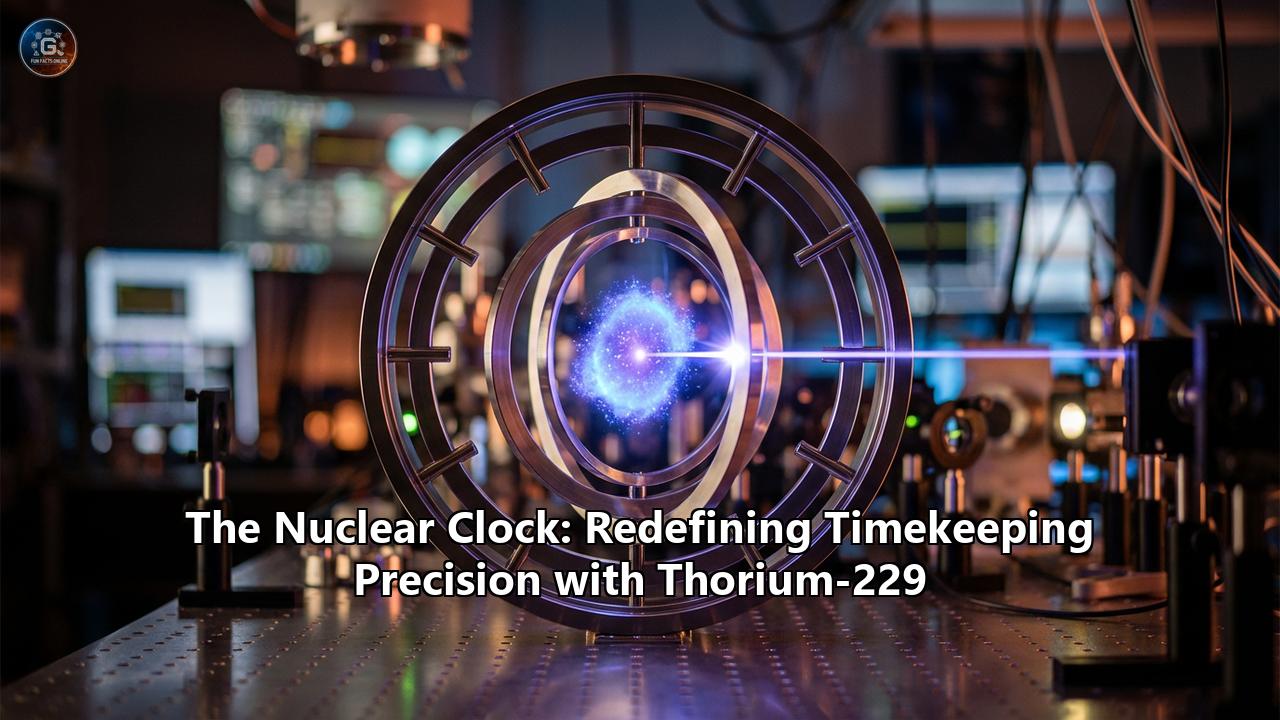
The pursuit of precision has defined the history of science. From the swinging pendulums of the 17th century to the vibrating quartz crystals of the 20th, humanity has relentlessly chased smaller and more stable divisions of time. Today, we stand at the precipice of a new era, one that leaves the electron behind and dives into the dense, shielded heart of the atom. This is the story of the Nuclear Clock, a device so precise it could detect the breathing of the universe itself.
Part I: The limit of the Electron
To understand the magnitude of the nuclear clock revolution, we must first appreciate the masterpiece it intends to replace: the optical atomic clock.
For the last half-century, our definition of time has been tied to the electron. The official International System of Units (SI) definition of the second is based on the cesium-133 atom. Specifically, a second is defined as 9,192,631,770 cycles of the microwave radiation absorbed or emitted when a cesium electron jumps between two hyperfine energy levels. This "tick"—a purely quantum mechanical flip—is incredibly stable. It is the heartbeat of the modern world, synchronizing the GPS satellites that guide our cars, the financial markets that trade our assets, and the internet that carries our thoughts.
In recent years, scientists have surpassed cesium with "optical lattice clocks" using atoms like strontium or ytterbium. These clocks tick much faster—at optical frequencies (trillions of times per second) rather than microwave frequencies (billions). The best of them are so precise that if they had started ticking at the Big Bang, 13.8 billion years ago, they would not have gained or lost a single second today.
But even these marvels have a fatal flaw.
The "pendulum" in an atomic clock is an electron. Electrons are flighty, lightweight particles that live on the outskirts of the atom. They are exposed to the world. A stray magnetic field from a nearby wire, a slight fluctuation in temperature, or even the collisions with background gas can distort the electron’s orbit. To build the world's best atomic clocks, physicists must build isolated vacuum chambers, use lasers to cool atoms to near absolute zero, and construct magnetic shields of immense complexity. The electron is a sensitive artist that refuses to perform unless the conditions are perfect.
Enter the nucleus.
Deep inside the atom, roughly 100,000 times smaller than the electron cloud, lies the nucleus. It is a fortress. Held together by the strong nuclear force—the most powerful force in nature—protons and neutrons are packed into a density that defies imagination. Because it is so small and so tightly bound, the nucleus is virtually immune to the external noise that plagues electrons. Magnetic fields, electric fields, and chemical bonds have almost no effect on it. The "shielding" provided by the surrounding electron cloud protects the nucleus like a soundproof booth in the middle of a noisy stadium.
If we could use a transition inside the nucleus as our pendulum—making a proton or neutron jump between energy states—we would have a clock potentially ten times more precise than the best optical clocks. More importantly, it would be a "solid-state" clock. Because the nucleus is so protected, you wouldn't necessarily need a vacuum chamber. you could embed the atoms in a crystal lattice, like a diamond, and the clock would still work.
This dream of a "nuclear clock" has existed for decades. But nature threw a seemingly insurmountable obstacle in the way.
The Energy Problem
In almost every known atom, the energy required to excite the nucleus is enormous. To make a nucleus jump, you typically need high-energy X-rays or gamma rays. We do not have lasers that can produce coherent gamma rays to "tickle" a nucleus. The energy gap is simply too wide, like trying to jump the Grand Canyon.
There is, however, one exception. A single "glitch" in the matrix of nuclear physics.
Among the thousands of known isotopes, there is one—Thorium-229—that possesses a freakishly low-energy excited state. It is an anomaly, a gift from nature that seems almost designed for us to find.
Part II: The Anomaly of Thorium-229
The story of Thorium-229 is a detective saga that spans fifty years.
In 1976, physicists L.A. Kroger and C.W. Reich were studying the decay of Uranium-233. They noticed something odd in the gamma-ray spectra. The energy accounting didn't quite add up. They hypothesized that Thorium-229, the daughter product of the uranium decay, must have an excited state (an "isomer") that was incredibly close to its ground state.
Most nuclear isomers decay in split seconds, blasting out gamma rays. But this theoretical state, dubbed Thorium-229m, was different. It was metastable (the "m" stands for metastable), meaning it could hang onto this extra energy for minutes or even hours.
For decades, this was just a theory. No one could find the state directly. The energy gap was so small that it was invisible to standard nuclear detectors, which are designed to catch roaring gamma rays, not the whisper of a low-energy photon.
The "hunt" became a multi-generational obsession for nuclear physicists.
- 1990s: Indirect measurements suggested the energy was around 3.5 electron volts (eV).
- 2007: Improved measurements shifted the estimate to 7.6 eV.
- 2019: A team at LMU Munich finally detected the electrons emitted during the decay of the isomer, confirming its existence but only narrowing the energy to somewhere between 7.8 and 8.5 eV.
This range was crucial. An energy of ~8 eV corresponds to vacuum ultraviolet (VUV) light. This is the "Goldilocks" zone. It is high energy, yes—requiring special lasers and vacuum setups because air absorbs UV light—but it is technically possible to generate with lasers. If the energy had been 100 eV, it would have been impossible. If it had been 1 eV, it would have been lost in the noise. At 8 eV, it was a target we could hit.
But knowing the neighborhood isn't enough. To build a clock, you need the exact address. You need the frequency to a precision of dozens of decimal places. The physicists were trying to tune a radio to a single station in a universe of static, without knowing the frequency of the station.
The 3:42 A.M. Breakthrough
The breakthrough finally arrived in late 2023 and 2024, through a fierce and friendly competition between some of the world's premier physics institutes: JILA (a joint institute of NIST and the University of Colorado Boulder), TU Wien (Vienna University of Technology), and PTB (Germany's national metrology institute).
The team at TU Wien, led by Thorsten Schumm, had spent years growing high-quality calcium fluoride crystals doped with Thorium-229. Unlike standard atomic clocks that trap individual atoms in a vacuum, the Vienna team believed the future was solid-state: billions of thorium atoms trapped inside a transparent crystal.
Meanwhile, the team at JILA, led by the legendary clockmaker Jun Ye, was perfecting the laser technology. They built a VUV frequency comb—a laser ruler that could scan the ultraviolet spectrum with unimaginable precision.
In May 2024, the final piece of the puzzle clicked into place.
At JILA, graduate student Chuankun Zhang was scanning the laser across the predicted frequencies. For weeks, there was nothing. Just noise. Then, in the dead of night, a tiny spike appeared on the monitor. The thorium nuclei were fluorescing. The laser had hit the resonant frequency.
They checked. They double-checked. It was real. The group text went out. At 3:42 A.M., the team gathered in the lab, sleep-deprived but electric with adrenaline, to take a selfie with the signal that physicists had been hunting for 48 years.
They had measured the "tick": 8.35574 electron volts, or a frequency of approximately 2,020 terahertz.
With this measurement, the door to the nuclear clock was kicked wide open.
Part III: How the Nuclear Clock Works
So, what does this device actually look like?
It is not a ticking grandfather clock. The current prototype at JILA looks like a complex table of mirrors, lasers, and vacuum chambers.
- The Crystal Heart: At the center is a small crystal of calcium fluoride, about the size of a fingernail. Inside this crystal, roughly 10 quadrillion Thorium-229 atoms are embedded in the crystal lattice.
- The VUV Laser: A specially designed laser generates vacuum ultraviolet light. This light is invisible to the human eye and is blocked by oxygen, so the entire beam path must be in a vacuum.
- The Frequency Comb: This is the "gearbox" of the clock. A frequency comb is a laser that emits light at hundreds of thousands of evenly spaced frequencies simultaneously—looking like the teeth of a comb. This allows the scientists to count the oscillations of the VUV light with perfect accuracy.
- The Excitation: The laser blasts the crystal. When the light hits exactly the right frequency (the resonant frequency of the Thorium-229m isomer), the nuclei absorb the energy. They "jump" to the excited state.
- The Readout: When the nuclei relax back to their ground state, they emit a photon of light (fluorescence). By monitoring this fluorescence, the computer locks the laser to that specific frequency.
If the laser drifts even a fraction of a hertz, the fluorescence stops, and the computer corrects the laser. The laser's frequency becomes the time.
The Solid-State Advantage
The decision to use a crystal is revolutionary. In a traditional optical clock, you might have 10,000 atoms trapped in a lattice of light. In the thorium crystal, you have 10 quadrillion atoms packed into a tiny solid.
This density provides a massive signal-to-noise ratio. It also makes the clock potentially rugged. Imagine a nuclear clock on a chip—a device no larger than a matchbox that is accurate to one second every 300 billion years. You could put one in a drone, a satellite, or even (decades from now) a smartphone.
But better timekeeping is just the boring application. The real reason physicists are weeping with joy over Thorium-229 is not because it keeps time. It’s because it measures the fabric of reality.
Part IV: Testing the Universe
A nuclear clock is less of a timepiece and more of a "fundamental physics telescope."
Because the transition happens inside the nucleus, it is governed by the interplay of two fundamental forces:
- The Strong Nuclear Force: Which holds the protons and neutrons together.
- The Electromagnetic Force: Which tries to push the positively charged protons apart.
The energy level of the Thorium-229 isomer is the result of a delicate cancellation between these two titanic forces. This makes the clock incredibly sensitive to any changes in the strength of these forces.
1. Are the Constants Constant?
We call them "fundamental constants"—the speed of light ($c$), the fine-structure constant ($\alpha$), Planck's constant ($h$). We assume they are fixed, immutable numbers written into the source code of the universe.
But are they?
Some theories of quantum gravity and string theory suggest that these constants might drift very slowly over time, or vary depending on where you are in the universe.
If the fine-structure constant ($\alpha$) changes by even a tiny fraction—say, one part in $10^{20}$—the delicate balance in the thorium nucleus would shift dramatically. The "tick" of the nuclear clock would change speed.
By comparing a nuclear clock (sensitive to the strong force) with a standard atomic clock (sensitive only to the electromagnetic force), scientists can measure the ratio of their ticks. If that ratio drifts over a year, it would be smoking-gun evidence that the laws of physics are evolving.
The sensitivity factor ($K$) for thorium is estimated to be around 5,900. For comparison, the best atomic clocks have a sensitivity factor of roughly 1. This means the nuclear clock is nearly six thousand times more sensitive to changes in the fundamental constants. It is the ultimate sensor for "new physics."
2. Hunting for Dark Matter
We know that Dark Matter makes up 85% of the matter in the universe, but we have no idea what it is. One leading theory suggests it is made of "ultralight" particles (like axions) that behave more like waves than billiard balls.
If this is true, we are constantly swimming through a sea of dark matter waves. As these waves pass through the Earth, they might subtly interact with normal matter, causing the fundamental constants to oscillate slightly.
An atomic clock might miss this oscillation. But the nuclear clock, with its extreme sensitivity, would see it. The frequency of the clock would "wobble" in sync with the dark matter wave.
This turns the nuclear clock into a Dark Matter Detector. Instead of building massive underground tanks of xenon to catch dark matter particles crashing into atoms, we can simply watch the time. If the time wavers, we have found the ghost in the machine.
Part V: The Future of Navigation and Geodesy
Bringing the tech back down to Earth, the implications are just as staggering.
GPS Independence:Currently, GPS relies on atomic clocks in satellites. The signal travels to Earth, and your phone calculates the delay. But GPS signals are weak; they can be jammed or spoofed. A portable nuclear clock would allow for "inertial navigation" of incredible precision. If you know exactly how you accelerated and exactly how much time has passed, you can calculate your position without needing a satellite signal. A submarine could stay submerged for months and know its position to within a millimeter.
Relativistic Geodesy:According to Einstein's General Relativity, time moves slower in stronger gravity. A clock at sea level ticks slower than a clock on Mount Everest.
Current atomic clocks are already sensitive enough to detect a change in height of about 1 centimeter. A nuclear clock, with its potential for 10x or 100x greater precision, could detect height changes of sub-millimeters.
This would turn the clock into a gravity sensor. You could place nuclear clocks along a fault line. As the stress builds up and the ground deforms by microscopic amounts (changing its distance from the Earth's center), the clocks would desynchronize, potentially providing an early warning system for earthquakes. You could use them to detect magma rising inside a volcano or to find oil and water deposits underground by measuring the minute changes in local gravity.
Conclusion: The Second Quantum Revolution
The realization of the Thorium-229 nuclear clock is not just an incremental improvement in keeping time. It is a change in kind.
We are moving from the electronic shell, which has served us for a century, to the nuclear core. We are harnessing the strong force for metrology.
The recent success by the JILA and Vienna teams is comparable to the first flight of the Wright brothers. The plane flew. It was short, it was a prototype, but it proved that the air could support us. Similarly, we have now proven that the nucleus can be tamed with lasers.
In the coming decade, we will likely see the first "logic" nuclear clocks that outperform the best strontium lattices. We will see networks of these clocks searching for dark matter. And perhaps, we will finally answer the question that has plagued philosophers for millennia: Is the universe static and eternal, or are its very laws shifting beneath our feet?
The Nuclear Clock has started ticking. Now, we just have to listen.
Reference:
- https://oar.ptb.de/files/download/681c535b53218de84f08e865
- https://thoriumclock.eu/wp-content/uploads/2021/03/Beeks-2021_The-thorium-229-low-energy-isomer-and-the-nuclear-clock.pdf
- https://jila.colorado.edu/sites/default/files/group-files/The%20First%20Nuclear%20Clock%20Will%20Test%20if%20Fundamental%20Constants%20Change%20_%20Quanta%20Magazine.pdf
- https://www.photonics.com/Articles/UV-Lasers-Combs-Provide-High-Frequency-Light-for/a70288
- https://www.youtube.com/watch?v=_CNb6l0H18k
- https://sites.lsa.umich.edu/kuzmich-lab/research/229th-nuclear-isomer/
- https://www.alphaxiv.org/overview/2407.17300v1
- https://validate.perfdrive.com/?ssa=4b426ed0-7033-4d78-df2b-37e1fe511813&ssb=15462280752&ssc=https%3A%2F%2Fopg.optica.org&ssi=5c3be801-d3hy-2686-f875-0ce3ab2263ce&ssk=botmanager_support@radware.com&ssm=17977120293685127135433587407603&ssn=a9a94f8bac5d63d1df9b2f1fd52e10ce8e99ea3d68d7-eb48-b0b9-a8232f&sso=c6994b9-a267-0ce003f776a76faec47673d70f748ac775ce1eaaeb666773&ssp=89133842691764284396176429245614573&ssq=55864769080668096635590805190089526132828&ssr=MTI0LjIxNy4xODkuMTMx&sst=python-requests%2F2.32.3&ssv=&ssw=
- https://newatlas.com/physics/nuclear-clocks-hunt-for-dark-matter/
- https://indico.cern.ch/event/1433194/contributions/6304209/attachments/2998955/5284233/Th-229_CERN_Peik.pdf
- https://home.cern/news/news/physics/isolde-takes-solid-tick-forward-towards-nuclear-clock
- https://cerncourier.com/a/counting-half-lives-to-a-nuclear-clock/
- https://arxiv.org/pdf/2511.13017
- https://jila.colorado.edu/sites/default/files/2022-11/VUV%20comb_Th229_OptLett2022.pdf
- https://www.thebrighterside.news/post/the-worlds-first-nuclear-clock-can-detect-changes-in-natures-fundamental-constants/
- https://arxiv.org/pdf/1811.03889
- https://pmc.ncbi.nlm.nih.gov/articles/PMC11637039/
- https://physicsworld.com/a/solid-state-nuclear-clocks-brought-closer-by-physical-vapour-deposition/
- https://en.wikipedia.org/wiki/Nuclear_clock
- https://thoriumclock.eu/uncategorized/the-first-ultra-precised-nuclear-clock-is-built/
- https://jila.colorado.edu/bibcite/reference/13576
- https://scitechdaily.com/atomic-clocks-in-space-the-new-trick-for-uncovering-the-secrets-of-dark-matter/
- https://arxiv.org/html/2407.17300v1