
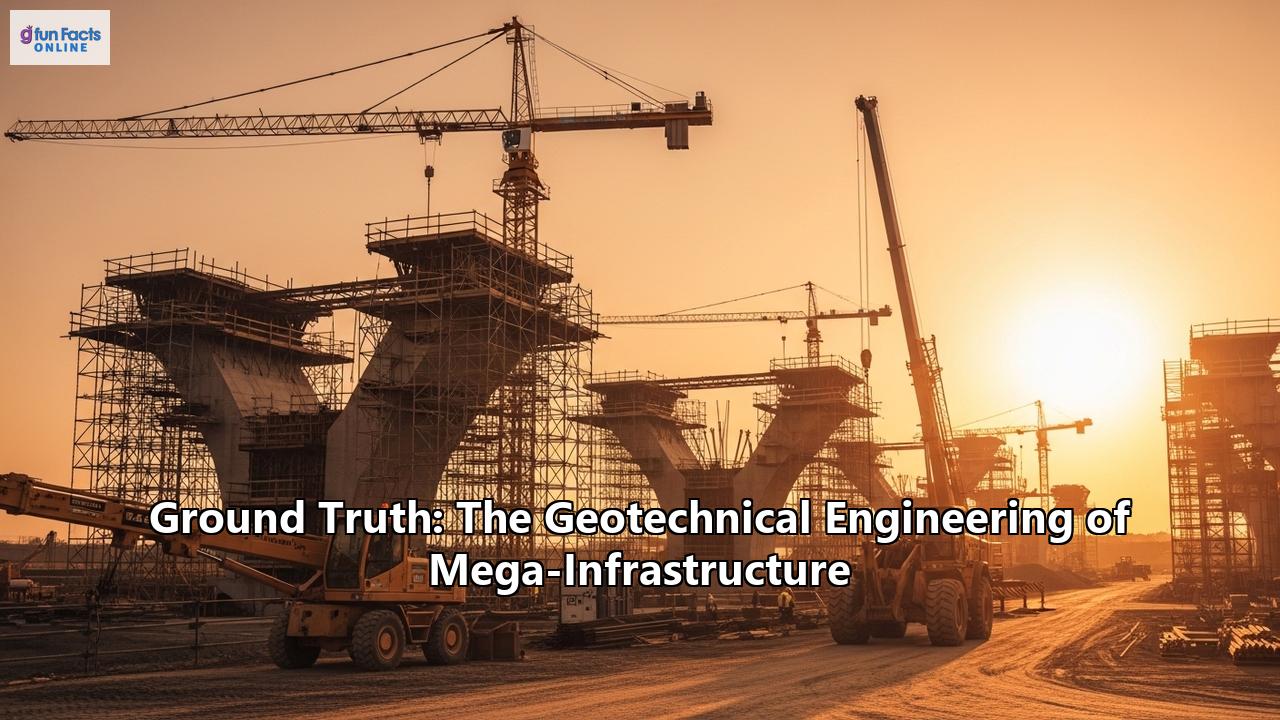
Beneath the Concrete Giants: The Unseen World of Geotechnical Engineering in Mega-Infrastructure
The soaring skylines of our modern cities and the vast networks of bridges and tunnels that connect them are testaments to human ingenuity and ambition. We see the gleaming steel and glass, the colossal spans of concrete, and the sheer scale of these mega-infrastructure projects. But beneath the surface, hidden from view, lies the foundational discipline that makes it all possible: geotechnical engineering. This is the science and art of understanding the ground beneath our feet and harnessing its properties to support the world's most ambitious structures. From the dizzying heights of the Burj Khalifa to the depths of the Channel Tunnel, geotechnical engineers are the unsung heroes who grapple with the complexities of the earth to provide a stable and secure "ground truth" for these monumental undertakings.
Mega-infrastructure projects, often defined as those costing billions of dollars and impacting millions of people, are characterized by their immense scale, complexity, and long lifespans. They are not merely larger versions of standard construction projects; they are undertakings that reshape landscapes, economies, and societies. The success of these ventures hinges on a profound understanding of the geological materials on which they rest. Geotechnical engineering, a specialized branch of civil engineering, is dedicated to this very task. It involves the meticulous investigation of soil and rock properties, the assessment of their behavior under stress, and the design of foundations and earth structures that can withstand the immense loads and environmental forces they will face over their operational lives. This article will delve into the critical role of geotechnical engineering in the creation of mega-infrastructure, exploring the unique challenges posed by different types of projects and the innovative solutions that are pushing the boundaries of what is possible.
The Bedrock of Ambition: Geotechnical Engineering for Skyscrapers
Skyscrapers, the quintessential symbols of urban progress, present a formidable challenge to geotechnical engineers. The immense weight of these vertical cities must be safely transferred to the ground, often in congested urban environments with complex subsurface conditions. The design of skyscraper foundations is a high-stakes endeavor, where miscalculations or a misunderstanding of the ground can lead to catastrophic failure.
The primary geotechnical considerations for skyscraper construction revolve around bearing capacity, settlement, and the impact on adjacent structures. Engineers must conduct exhaustive site investigations, often involving a combination of borehole drilling, laboratory testing, and in-situ tests to build a comprehensive picture of the subsurface. This data informs the selection and design of the foundation system, which for most skyscrapers falls into the category of deep foundations.
Pile foundations are a common solution, where long columns of concrete or steel are driven or drilled deep into the ground to transfer the building's load to stronger, more stable soil or rock layers. Another approach is the use of caissons, which are large, watertight retaining structures that are sunk into the ground and then filled with concrete to form a massive foundation element. In many modern skyscrapers, a hybrid approach known as a piled raft foundation is employed. This system combines the load-carrying capacity of both a large concrete raft and deep piles, creating a highly efficient and robust foundation.
The excavation for these deep foundations in dense urban areas presents its own set of challenges. The removal of large volumes of soil can cause ground movement and potentially damage neighboring buildings and underground utilities. Sophisticated excavation support systems, such as diaphragm walls and secant pile walls, are often required to ensure the stability of the excavation and protect the surrounding infrastructure.
Case Study: The Burj Khalifa, DubaiThe Burj Khalifa, soaring to a height of over 828 meters, stands on some of the most challenging ground conditions imaginable: a complex and highly variable subsurface of loose sand, weak sedimentary rocks, and a high water table. The geotechnical investigation for this colossal structure was one of the most extensive ever undertaken, involving numerous boreholes, pressuremeter tests, and advanced laboratory analysis.
The final foundation design for the Burj Khalifa is a piled raft system. A 3.7-meter-thick triangular raft is supported by 192 reinforced concrete piles, each 1.5 meters in diameter and extending approximately 50 meters deep into the relatively stronger layers of calcisiltite and conglomerate. One of the major geotechnical concerns during the design was the potential for cyclic degradation of the pile's skin friction due to wind loading on the tower. Extensive pile load tests, including cyclic loading tests, were conducted to verify the long-term performance of the foundation system. The performance of the foundation has been meticulously monitored and has exceeded expectations, with settlements being smaller than predicted. The success of the Burj Khalifa's foundation is a powerful testament to the critical role of detailed geotechnical investigation and innovative design in overcoming extreme geological challenges.
Spanning the Divide: The Geotechnical Challenges of Long-Span Bridges
Long-span bridges, which traverse wide rivers, deep valleys, and expansive sea channels, are another marvel of modern engineering where geotechnical expertise is paramount. The foundations for these structures must not only support the immense weight of the bridge deck and traffic but also resist powerful lateral forces from wind, water currents, and, in many regions, seismic activity. The environmental conditions in which these bridges are built often add another layer of complexity, with challenges ranging from deep water and soft riverbed sediments to steep, unstable slopes at the abutments.
The design of bridge foundations begins with a thorough geotechnical investigation to understand the subsurface conditions at the pier and abutment locations. This can be particularly challenging in marine environments, where access is difficult and the ground conditions can be highly variable. A variety of foundation types are employed for long-span bridges, depending on the specific site conditions. In locations with strong, shallow bedrock, spread footings may be sufficient. However, in most cases, deep foundations are required.
Caissons are frequently used for bridge piers in deep water. These massive, prefabricated structures are floated into position and then sunk to the riverbed or seabed, where they are excavated and filled with concrete to create a robust foundation. Cofferdams, which are temporary enclosures built in the water to create a dry working environment, are another common technique used for foundation construction. For bridges founded on weaker soils, large-diameter piles or drilled shafts are often used to transfer the loads to deeper, more competent strata.
The approach embankments to bridges also pose significant geotechnical challenges, particularly in areas with soft, compressible soils. These embankments can experience excessive settlement, which can create a "bump" at the bridge entrance and affect the long-term performance of the structure. Ground improvement techniques, such as the use of lightweight fill, preloading with vertical drains, and geosynthetic reinforcement, are often employed to mitigate these settlement issues.
Case Study: The Millau Viaduct, FranceThe Millau Viaduct, one of the tallest bridges in the world, elegantly spans the Tarn Gorge in Southern France. The viaduct's seven slender piers, the tallest of which is 245 meters high, are founded on a complex geological profile consisting of limestone in the northern part of the valley and marls in the southern part. Given the bridge's sensitivity to foundation settlements, a comprehensive geotechnical investigation was undertaken to characterize the rock and soil properties.
Each of the massive piers is supported by a thick concrete raft founded on four large-diameter shafts, typically 4.5 to 5 meters in diameter and 9 to 16 meters deep. The design of the foundations had to account for the different properties of the limestone and marl formations. For the piers founded on the weaker marls, the design was particularly challenging, and an observational approach was adopted to monitor the performance of the foundations during and after construction. The measured settlements and rotations of the foundations have been small and within acceptable limits, demonstrating the success of the geotechnical design in handling the complex ground conditions of this iconic structure.
Navigating the Underworld: Geotechnical Engineering in Tunneling
Tunnels are a critical component of modern infrastructure, providing vital links for transportation, utilities, and water conveyance beneath bustling cities and through formidable mountain ranges. The construction of these subterranean passages is one of the most challenging endeavors in civil engineering, with geotechnical considerations at the very heart of the process. Tunneling projects are often fraught with uncertainty, as engineers must contend with the geological conditions as they are revealed during excavation.
The primary geotechnical challenge in tunneling is dealing with the variability of the ground. A tunnel may pass through a wide range of materials, from hard, stable rock to soft, squeezing ground, and may encounter unexpected features such as fault zones, cavities, and high-pressure groundwater. A thorough geotechnical investigation is crucial to developing a "ground model" that can help predict these conditions and inform the choice of excavation method and support system.
For tunneling in rock, the stability of the excavation is a major concern. The orientation of rock joints, the presence of faults, and the in-situ stress conditions all play a role in determining how the rock mass will behave when a tunnel is excavated through it. Tunnel support systems, such as rock bolts, shotcrete (sprayed concrete), and steel arches, are used to stabilize the rock and prevent collapses.
Tunneling in soft ground, such as clay or sand, presents a different set of challenges. The primary concern in these conditions is controlling ground movement and preventing settlement of the ground surface, which can damage buildings and infrastructure above the tunnel. Tunnel Boring Machines (TBMs) are often used for soft ground tunneling. These sophisticated machines excavate the tunnel while simultaneously installing a precast concrete lining, which provides immediate support to the ground and minimizes settlement.
Case Study: The Channel TunnelThe Channel Tunnel, a 50.5-kilometer undersea rail tunnel linking the United Kingdom and France, is one of the most remarkable engineering achievements of the 20th century. The success of this mega-project was heavily reliant on a deep understanding of the geology of the English Channel. Extensive geological and geotechnical investigations were carried out over many years to identify the most suitable alignment for the tunnel. The preferred route was within a layer of chalk marl, a relatively soft, stable, and impermeable rock that is ideal for tunneling.
Eleven TBMs were used to excavate the three tunnels (two running tunnels and a central service tunnel). The TBMs were specifically designed to handle the conditions of the chalk marl, and they were equipped with probes to drill ahead of the machine to detect any changes in the geology. Despite the favorable ground conditions for much of the route, the project still encountered challenges, including zones of fractured and water-bearing rock. Sophisticated techniques, such as ground freezing and grouting, were used to stabilize these difficult ground sections and prevent water ingress. The successful completion of the Channel Tunnel is a testament to the power of thorough geotechnical investigation and the ability of engineers to adapt to the challenges of the underground environment.
Holding Back the Waters: The Geotechnical Imperative in Dam Engineering
Dams are among the most impactful of all mega-infrastructure projects, providing essential benefits such as water supply, flood control, and hydroelectric power generation. However, they also represent a significant potential hazard, and their safety is a matter of paramount importance. The stability and integrity of a dam are fundamentally dependent on geotechnical engineering principles. The failure of a dam can have catastrophic consequences, as tragically demonstrated by historical events like the St. Francis Dam failure in 1928 and the Teton Dam failure in 1976.
The geotechnical design of an embankment dam, which is a dam constructed primarily of compacted earth and rock, involves a number of key considerations. One of the most critical is seepage control. All dams will experience some level of seepage as water finds paths through the dam and its foundation. The goal of the geotechnical engineer is to control this seepage to prevent it from causing internal erosion, a phenomenon known as piping, which can lead to the progressive failure of the dam. Seepage control measures include the use of low-permeability clay cores, internal drainage systems such as chimney drains and drainage blankets, and foundation cutoff walls.
Slope stability is another major concern in embankment dam design. The upstream and downstream slopes of the dam must be stable under all loading conditions, including the end of construction, steady-state seepage during normal operation, and rapid drawdown of the reservoir. The analysis of slope stability requires a thorough understanding of the shear strength of the embankment and foundation materials.
The foundation of the dam is also a critical element. The foundation must be strong enough to support the weight of the dam and the pressure of the impounded water. Geotechnical investigations are required to identify and address any weaknesses in the foundation, such as layers of soft soil, fractured rock, or soluble materials.
Case Study: The Three Gorges Dam, ChinaThe Three Gorges Dam, the world's largest hydroelectric power station, is a concrete gravity dam, but its construction involved immense geotechnical challenges. The dam is located in a seismically active region, and its design had to account for the potential for strong ground shaking. The foundation of the dam is a massive granite rock mass, but it is intersected by numerous faults and shear zones.
An extensive geotechnical investigation and testing program was undertaken to characterize the rock mass and the properties of the fault materials. Sophisticated numerical modeling was used to analyze the stability of the dam and its foundation under both static and seismic loading conditions. The treatment of the weak zones in the foundation was a major undertaking, involving the excavation of the weak material and its replacement with concrete, as well as extensive grouting to improve the strength and reduce the permeability of the rock mass. The long-term performance of the dam and its foundation is continuously monitored by a vast network of instruments.
The Digital Frontier: Technological Innovations in Geotechnical Engineering
The field of geotechnical engineering is undergoing a digital transformation, with a host of new technologies emerging that are revolutionizing the way mega-infrastructure projects are designed, constructed, and maintained. These innovations are enabling engineers to better understand and manage the inherent uncertainties of working with natural materials, leading to safer, more efficient, and more sustainable projects.
Building Information Modeling (BIM) is a process that involves creating and managing a digital representation of a project's physical and functional characteristics. In geotechnical engineering, BIM is being used to integrate geological and geotechnical data into a 3D model of the subsurface. This allows for a more holistic understanding of the ground conditions and facilitates better collaboration between geotechnical engineers and other members of the project team. BIM can also be used to visualize and simulate construction processes, helping to identify potential problems before they occur. Artificial Intelligence (AI) and Machine Learning (ML) are also beginning to make a significant impact on geotechnical engineering. These technologies can be used to analyze large datasets from site investigations and laboratory tests to identify patterns and develop predictive models for soil and rock behavior. For example, ML algorithms are being used to predict soil liquefaction potential, assess slope stability, and optimize foundation design. AI and ML have the potential to significantly improve the accuracy of geotechnical predictions and reduce the risks associated with unforeseen ground conditions. Remote Sensing and the Internet of Things (IoT) are transforming the way geotechnical assets are monitored. Satellite-based remote sensing techniques, such as Interferometric Synthetic Aperture Radar (InSAR), can be used to monitor ground surface deformation over large areas with millimeter-level accuracy. This is particularly useful for monitoring the settlement of large infrastructure projects and detecting the early signs of potential instability. IoT-enabled sensors can be embedded in foundations, slopes, and other geotechnical structures to provide real-time data on their performance. This data can be used to create "digital twins" of these assets, which are virtual models that can be used to simulate their behavior and predict their future performance. Innovations in Ground Improvement are also expanding the possibilities for construction in challenging soil conditions. Bio-cementation, a technique that uses microorganisms to precipitate calcite and bind soil particles together, is an emerging sustainable alternative to traditional ground improvement methods. New types of geosynthetics, which are synthetic materials used to reinforce and stabilize soil, are being developed with enhanced properties. And techniques for mitigating soil liquefaction, a phenomenon where saturated soil loses its strength during an earthquake, are becoming more effective and less invasive.The Human and Environmental Dimensions of Ground Truth
The decisions made by geotechnical engineers on mega-infrastructure projects have far-reaching consequences that extend beyond the technical realm. These decisions can have significant economic, social, and environmental impacts, and it is increasingly recognized that these factors must be considered as an integral part of the design process.
The economic impact of geotechnical engineering is substantial. A thorough geotechnical investigation and a well-designed foundation can prevent costly delays, redesigns, and failures during construction. Conversely, unforeseen ground conditions are a major source of cost overruns and disputes on large construction projects. By reducing geotechnical risk, engineers can contribute to the economic viability of these massive investments.
The social impact of mega-infrastructure projects is also profound. These projects can displace communities, alter landscapes, and impact the quality of life for local residents. Geotechnical engineering decisions can play a role in mitigating these impacts. For example, by choosing a tunneling method that minimizes ground settlement, engineers can reduce the risk of damage to buildings and infrastructure in urban areas. By designing stable and secure dams, they can protect downstream communities from the risk of flooding.
The environmental impact of geotechnical engineering is another critical consideration. The construction of foundations and other earth structures can consume large quantities of natural resources, such as sand, gravel, and stone, and can generate significant carbon emissions. There is a growing movement within the geotechnical community to adopt more sustainable practices, such as using recycled materials, optimizing designs to reduce material consumption, and developing low-carbon ground improvement techniques. Life cycle assessment (LCA) is a tool that is increasingly being used to evaluate the environmental impact of geotechnical works over their entire lifespan.
Conclusion: Building the Future on a Solid Foundation
The mega-infrastructure projects that shape our world are feats of incredible complexity, and their success is inextricably linked to the unseen work of geotechnical engineers. From the deepest foundations to the highest dams, it is the mastery of the ground beneath that allows us to build with confidence and create structures that will endure for generations. The challenges are immense, from the inherent variability of the earth's materials to the increasing demands of a rapidly urbanizing and changing world. But as we have seen, the field of geotechnical engineering is continuously evolving, with new technologies and a growing awareness of its broader societal and environmental responsibilities. By embracing innovation, integrating a holistic understanding of risk, and committing to sustainable practices, geotechnical engineers will continue to provide the essential "ground truth" upon which our most ambitious mega-projects are built, ensuring a safer, more resilient, and more sustainable future for all.
Reference:
- https://www.encardio.com/blog/innovations-in-geotechnical-engineering
- https://www.issmge.org/uploads/publications/51/127/ARCSMGE2024-150.pdf
- https://www.jetir.org/papers/JETIR1702067.pdf
- https://www.internationaljournalssrg.org/IJCE/2016/Volume3-Issue7/IJCE-V3I7P125.pdf
- https://www.edtengineers.com/blog-post/expansive-soils-and-construction-implications
- https://www.researchgate.net/publication/375692462_Application_of_Machine_Learning_in_Geotechnical_Engineering_for_Risk_Assessment
- https://www.novatr.com/blog/role-of-bim-in-geotechnical-engineering
- https://www.numberanalytics.com/blog/machine-learning-geotechnics-essentials
- https://envirotacinc.com/how-to-deal-with-expansive-soil-during-construction/
- https://www.researchgate.net/publication/376515070_Geotechnical_solutions_for_urban_centers_Bridging_engineering_innovations_with_socio-economic_development
- https://intheloop.engineering.asu.edu/2020/07/24/soil-liquefaction-prevention-technique-turns-in-promising-performance/
- https://www.researchgate.net/publication/390802222_Innovative_Approaches_to_Liquefaction_Mitigation_in_Seismic_Zones_A_Comprehensive_Overview
- https://vgeotechexperts.com/geotechnical-engineering-trends-to-watch-in-2025/
- https://www.numberanalytics.com/blog/expansive-soils-ground-improvement
- https://encyclopedia.pub/entry/43844
- https://www.enginuityadvantage.com/navigating-the-most-challenging-geotechnical-projects-tips-from-industry-veterans/
- https://www.researchgate.net/figure/Impacts-and-influences-of-geotechnical-engineering_fig6_273193270
- https://www.encardio.com/blog/bim-methodology-megastructures-infrastructure
- https://www.nbmcw.com/article-report/infrastructure-construction/geotechnical-foundation-engineering/building-sustainable-foundations-for-infrastructure-projects.html
- https://www.mdpi.com/2412-3811/8/6/103
- https://www.preprints.org/manuscript/202406.1310/v1
- https://www.allplan.com/blog/bim-the-right-tool-for-large-infrastructure-projects/
- https://www.cfms-sols.org/sites/default/files/Actes/3171-3174.pdf
- https://www.researchgate.net/publication/320356441_Grounds_for_Concern_Geotechnical_Issues_from_Some_Recent_Construction_Cases
- https://ascelibrary.org/doi/10.1061/%28ASCE%29NH.1527-6996.0000537
- https://dev.to/abl_consultants/addressing-soil-settlement-foundation-challenges-in-singapores-soft-clay-terrain-1m5o
- https://www.willmerengineering.com/top-geotechnical-engineering-challenges-and-solutions-by-willmer-engineering/
- https://pilebuck.com/services-guide-geotechnical-engineering/
- https://www.geoinstitute.org/sites/default/files/inline-files/SM_GTT_Final_12122022.pdf
- https://cigmat.cive.uh.edu/sites/cigmat/files/files/conference/poster/2006/jano.pdf
- https://www.ceai.org.in/innovations-in-geotechnical-engineering-enhancing-infrastructure-stability/
- https://www.researchgate.net/publication/346531837_Megazonation_of_earthquake-induced_soil_liquefaction_hazard_in_continental_Europe
- https://www.mdpi.com/journal/geosciences/special_issues/applications_artificial_intelligence
- https://fastercapital.com/content/Liquefaction-and-Infrastructure-Resilience--Building-for-Seismic-Events.html
- https://www.emerald.com/insight/content/doi/10.1108/ijmpb-02-2024-0027/full/html?skipTracking=true
- https://www.researchgate.net/publication/273193270_Sustainability_and_geotechnical_engineering_perspectives_and_review
- https://www.tandfonline.com/doi/full/10.1080/09613218.2025.2487829?src=