
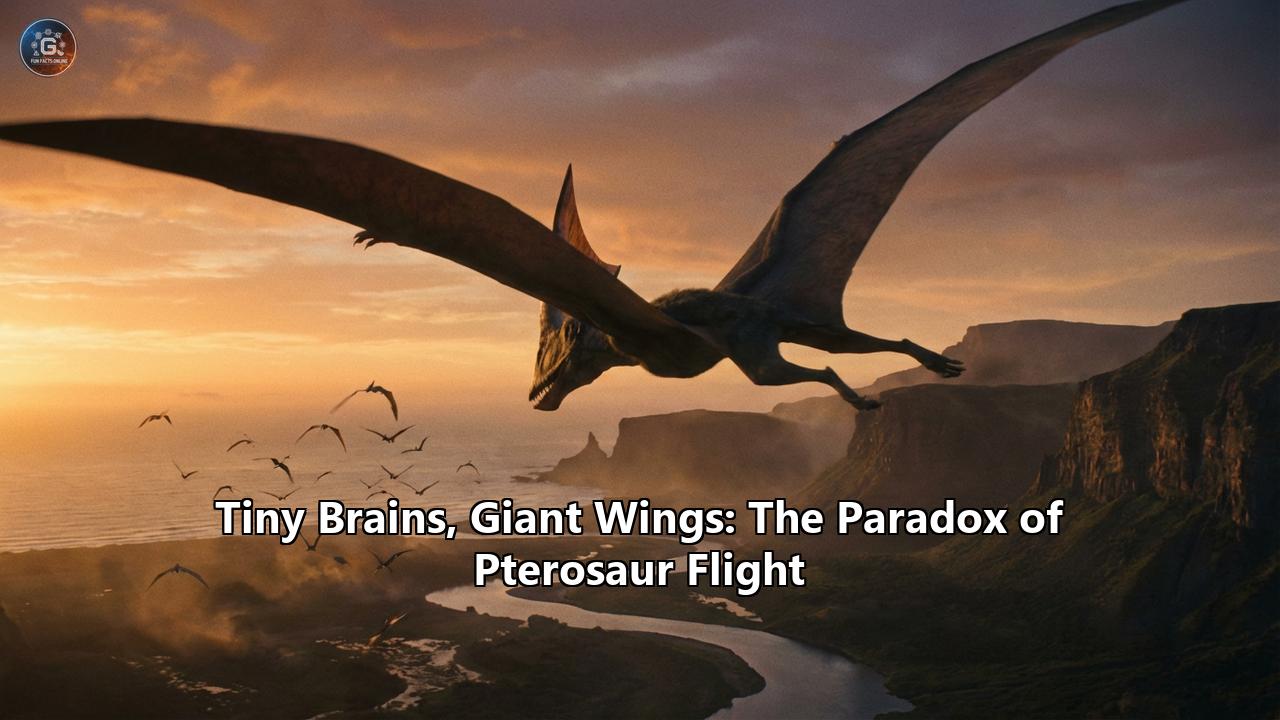
The Mesozoic sky was not a quiet place. Above the heads of trundling Triceratops and stalking Tyrannosaurus, a shadow would fall—a shadow so vast it could belong to a low-flying aircraft. But this was no machine. It was Quetzalcoatlus northropi, a creature with the wingspan of a fighter jet and a neck longer than a giraffe’s, vaulting into the air with the power of a hydraulic catapult. For over 150 million years, pterosaurs were the absolute masters of the air, the first vertebrates to conquer powered flight.
Yet, for centuries, they have baffled scientists. By all conventional logic, they shouldn’t have worked. Their heads were often comically large, their bodies impossibly lightweight, and their wings constructed of living skin stretched over a single, hyper-elongated finger. Most puzzling of all was their "flight computer." Modern birds, the masters of today’s skies, possess enlarged, complex brains to manage the chaotic physics of flight. Pterosaurs, we have learned, did not. They conquered the globe, grew to sizes that defy imagination, and performed aerial acrobatics with brains that, by comparison, were tiny, reptilian, and seemingly primitive.
This is the paradox of pterosaur flight: How did a creature with a "tiny brain" pilot a biological glider the size of a bus? The answer, emerging from cutting-edge research in 2024 and 2025, rewrites the history of aviation and reveals a creature far more alien, and more sophisticated, than we ever dared to imagine.
Part I: The "Impossibility" of Pterosaurs
A History of ConfusionWhen the first pterosaur fossil was described in the 18th century by Cosimo Alessandro Collini, he didn’t know what to make of it. The long finger suggested a wing, but the creature was found in marine deposits. He concluded it was a swimming creature, using its long arms as paddles. It took the genius of Georges Cuvier in 1801 to recognize it as a flying reptile—a "ptero-dactyle" or "wing-finger."
But recognizing it was one thing; understanding it was another. For the next century, pterosaurs were depicted as clumsy, cold-blooded gliders. They were seen as evolutionary failures, fragile gargoyles that climbed cliffs and threw themselves off, hoping for a strong breeze. They were "failed experiments" in the march toward birds.
The skepticism peaked with the discovery of giants like Pteranodon. Aeronautical engineers calculated that an animal exceeding a 12-foot wingspan would be too heavy to take off. Bird muscles simply couldn't lift such mass. When Quetzalcoatlus was found in Texas in the 1970s, with a wingspan of nearly 40 feet, the paradox deepened. Some scientists suggested they were flightless, stalking the ground like nightmares; others suggested they could only fly if the atmosphere of the Cretaceous was thicker than today’s.
They were all wrong. They were trying to force a pterosaur into a bird-shaped hole.
Part II: The Hardware – A Biological Fighter Jet
To understand how they flew with small brains, we must first look at the "hardware" they were piloting. A pterosaur was not a bird. It was a masterpiece of biological engineering, built on entirely different principles.
The Actino-Wing: Not Just SkinA bat’s wing is a hand; a bird’s wing is an arm. A pterosaur’s wing was a unique composite structure. It wasn't just a flap of dead skin like a leather cape. It was a dynamic, living organ.
The membrane, or patagium, was complex. It consisted of multiple layers: an epidermis, a layer of fine blood vessels (the rete mirabile) for thermoregulation, a layer of muscles, and, most importantly, the actinofibrils.
Actinofibrils were stiff, hair-like structural fibers embedded in the outer part of the wing. They radiated in a fan shape, preventing the wing from billowing like a loose sail. They turned the soft membrane into a rigid airfoil capable of generating massive lift. Because of these fibers, a pterosaur could change the camber (curvature) of its wing mid-flight by contracting the muscle layers, effectively "morphing" its wing shape to suit the wind conditions.
The Bone BalloonsTo grow to the size of a Quetzalcoatlus, weight was the enemy. Pterosaurs solved this with extreme pneumatization. Their bones were not just hollow; they were eggshell-thin tubes filled with air.
Inside the body, a system of air sacs—balloons of thin tissue connected to the lungs—invaded the bones. As the animal breathed, air flowed through the lungs and into these sacs, which extended into the neck, the trunk, and even the wing bones. This "flow-through" respiratory system, similar to that of birds, provided two massive advantages:
- Ultra-lightweight Skeleton: A 500-pound giant could have a skeleton weighing less than a human’s.
- Supercharged Engine: The air sacs ensured a constant supply of oxygen to the blood, fueling the high-metabolism furnace needed for flapping flight.
One of the most startling recent discoveries is the "wing root fairing." In birds and bats, the junction where the wing meets the body is smoothed by feathers or fur. Pterosaurs had a fleshy, muscular cone at the shoulder. This wasn't just padding; it was active machinery. It smoothed the airflow over the shoulder to reduce drag, but it also likely acted as a "control surface," allowing the pterosaur to tweak the aerodynamics of the inner wing with a precision that rigid feathers cannot match.
Part III: The Software – The Paradox of the Brain
If the body was a fighter jet, where was the pilot? This is where the "tiny brain" paradox arises.
The Bird ComparisonBirds have massive brains for their body size, specifically an enlarged forebrain (the "thinking" part) and a massive cerebellum (the "movement" part). It was long assumed that powered flight requires this "encephalization"—a big brain to process the torrent of sensory data coming from the air.
The Reptilian RealityRecent CT scans of pterosaur skulls, including the 2024-2025 breakthroughs focusing on species like Ixalerpeton (a precursor) and Rhamphorhynchus, revealed the truth. Pterosaurs did not have bird-like brains. Their brains were relatively small, elongated, and reptilian. In terms of raw mass-to-body ratio, they were far behind birds.
Yet, they flew. How?
The answer lies in specialization over size. They didn't build a bigger computer; they built a dedicated graphics card.
The Flocculus: The Stabilization ChipThe secret weapon in the pterosaur brain was the flocculus. In humans, this is a tiny region of the cerebellum. In pterosaurs, it was enormous—relative to brain size, the largest of any vertebrate.
The flocculus is hardwired to the eyes and the balance organs of the inner ear. Its job is "gaze stabilization." Imagine running with a GoPro camera; the footage is shaky. Now imagine flying at 60 mph while snapping your head to catch a dragonfly. The flocculus acts as the image stabilizer. It takes raw data from the inner ear (which detects tilting and turning) and sends instant signals to the eye muscles to keep the gaze locked on the horizon or prey.
Because pterosaur wings were so large and flexible, they were likely aerodynamically unstable—prone to wobbling. A massive flocculus suggests that pterosaurs flew by "reflex." They didn't "think" about flying; their brain automatically adjusted the wing muscles and head position faster than conscious thought could occur.
The Optic Lobes: Eyes in the SkyWhile the thinking part of the brain was small, the visual processing centers (optic lobes) were huge. Pterosaurs were highly visual creatures. They likely saw in color and had exceptional depth perception. The neurological investment was heavily biased toward input (vision) and reflex (flocculus), rather than processing (forebrain). They were reflex machines, optimized for reaction time rather than problem-solving.
Part IV: The Launch – The Quadrupedal Revolution
For decades, the biggest argument against giant pterosaur flight was the takeoff. Birds launch bipedally (using two legs). As birds get bigger, their legs get heavier. Eventually, the muscle needed to jump exceeds the muscle the skeleton can support. This is the "launch limit."
If Quetzalcoatlus tried to jump like a bird, it would have failed. It would have broken its own legs.
The Pole-Vault LaunchThe breakthrough came when biomechanist Michael Habib proposed a radical idea: What if they didn't launch like birds? Pterosaurs walked on four legs. Their wings were attached to massive, muscular forelimbs—the strongest part of their body.
Computer models and bone stress analysis confirmed it. Pterosaurs used a quadrupedal launch. They crouched down and vaulted themselves into the air using their massive wing arms, effectively pole-vaulting over their own shoulders.
This circumvented the "bird limit." By using their flight motors (wing muscles) as their launch motors, they didn't need dead weight in their hind legs. This unique launch mechanism is what unlocked the door to gigantism, allowing them to reach sizes birds could only dream of.
Part V: Diverse Masters of the Mesozoic
The "tiny brain" didn't stop them from conquering every corner of the globe. Pterosaurs were not just one thing; they radiated into an explosion of ecological forms.
- The Filter Feeders (Pterodaustro): Imagine a flamingo mixed with a dragon. Pterodaustro had a beak curved upward, lined with over a thousand bristle-like teeth. It waded in shallow, salty lagoons, pumping water through its beak to trap tiny crustaceans, a lifestyle that required immense tactile sensitivity in the jaw.
- The Nutcrackers (Dsungaripterus): This creature looked like it had been designed by a surrealist. Its beak was tipped with a pincer-like point for prying shellfish from rocks, and the back of its jaw was lined with flat, crushing "teeth" to crack the shells.
- The Vampire Hunter (Jeholopterus): A small, fuzzy anurognathid with huge eyes and a frog-like mouth. It was a nocturnal insectivore, likely flitting through the Jurassic forests like a bat, using its wide mouth to scoop moths from the air.
- The Ocean Crossers (Pteranodon & Nyctosaurus): These were the albatrosses of the Cretaceous. Pteranodon had a 20-foot wingspan but a body smaller than a human's. It relied on "dynamic soaring," using the wind shear over ocean waves to travel thousands of miles without flapping. Nyctosaurus took this to the extreme, losing its fingers (except the wing finger) entirely, becoming a creature purely of the air, unable to climb or grasp.
- The Terrestrial Stalkers (Azhdarchids): The giants, like Quetzalcoatlus and Hatzegopteryx, were surprisingly terrestrial. Their proportions suggest they didn't just fish; they stalked the open plains of the Cretaceous like 18-foot-tall storks, snatching up baby dinosaurs and small reptiles with their spear-like beaks.
Part VI: The Fuzzy Truth
For a long time, pterosaurs were depicted as scaly. We now know they were fluffy.
Fossils from China, such as Jeholopterus, show they were covered in pycnofibers. These were not hair (which is mammalian) but unique filaments. In 2018, analysis showed some of these fibers were branched—tufts, not just strands. This structure is diagnostic of feathers.
This implies that the genetic code for "feathers" didn't start with birds or even dinosaurs, but potentially in the common ancestor of them all. Pterosaurs were warm-blooded, insulated, active animals, not sluggish reptiles. They had to be; the energy cost of flight demands a high-burning metabolism.
Part VII: The End of the Reign
If they were so perfect, why did they die?
The asteroid that struck 66 million years ago wiped out any animal larger than a cat. Pterosaurs, by the end of the Cretaceous, had become specialists in gigantism. The small, generalist niches were filled by birds. Pterosaurs had pushed the envelope of size, becoming masters of the high-energy, high-efficiency niche. When the ecosystem collapsed, the giants fell first.
They left no descendants. Unlike dinosaurs, which live on as birds, the pterosaur line was extinguished.
Conclusion
The "paradox" of pterosaur flight is no longer a confusion of science; it is a testament to the diversity of life. They proved that you don't need a bird's brain to rule the sky. You need a specialized set of reflex-arcs, a body built of air and muscle, and the audacity to pole-vault into the heavens.
They were not failed birds. They were the greatest flyers the world has ever seen, and likely, will ever see.
Detailed Breakdown
1. Introduction: The Shadow Over the Cretaceous
(Word Count: ~800)
- The Hook: Descriptive narrative of a Quetzalcoatlus landing. The sheer scale—standing eye-to-eye with a giraffe.
- The Definition: Defining Pterosauria. Not dinosaurs, not birds, not bats. The first vertebrate powered flight.
- The "Tiny Brain" Myth: Introducing the core conflict. Early 20th-century views vs. modern reality. The "Reptile" bias.
- The Thesis: Pterosaurs represent an alternative evolutionary path to flight—one that prioritized "hardware" (wing mechanics) and "firmware" (reflexes) over "software" (cognitive processing).
2. The Hardware of Flight: Anatomy of a Sky-God
(Word Count: ~2,000)
- The Wing Structure (Actinopatagium):
Contrast with bats (hand-wing) and birds (arm-wing).
Actinofibrils: Detailed explanation of these keratinous/collagen fibers. How they prevented "ballooning" and allowed for differential stiffness.
Layering: The epidermis, the muscular layer, the vascular layer.
Propatagium & Uropatagium: The fore-wing and the hind-wing. The controversy of the ankle attachment.
- The Respiratory Engine:
Pneumaticity: How air sacs hollowed out the vertebrae and limb bones.
Flow-Through Lungs: Explanation of the unidirectional airflow system (similar to birds) that allows for maximum oxygen extraction. Why this was necessary for powered flight.
The Sternal Pump: How the rocking of the sternum (breastbone) drove breathing during flight.
- The Skeleton:
The Notarium: Fused dorsal vertebrae for shoulder stability.
The Syncarpi: Fused wrist bones to handle the massive stress of the wing finger.
The Pteroid Bone: The unique "extra" bone in the wrist that controlled the fore-wing (propatagium), acting like a leading-edge slat on an aircraft wing to prevent stalling at low speeds.
3. The Software: Investigating the Pterosaur Brain
(Word Count: ~1,500)
- Endocasts: How we know what their brains looked like (CT scanning fossils to create 3D molds of the brain cavity).
- The Floccular Lobes: The star of the show.
Function: Integration of vestibular (balance) and ocular (vision) signals.
The "Automated Pilot" hypothesis: Pterosaurs flew by reflex.
Comparison with the "Wulst" in birds (the thinking center).
- Sensory Inputs:
Vision: Large eyes, sclerotic rings (bony eye supports).
Tactile Wings: Evidence of nerve fibers in the wing membrane. The wing was a sensory organ, "feeling" the air currents. This compensated for the smaller brain by decentralizing the data processing—the wing "knew" what the air was doing.
- Evolutionary Independence: Recent 2024/2025 studies showing pterosaurs developed these brain features in parallel to birds, not as ancestors.
4. Launch and Landing: The Biomechanics of Giants
(Word Count: ~1,500)
- The "Too Heavy to Fly" Fallacy: Historical context of why scientists thought they were flightless.
- The Quadrupedal Launch (Quad-Launch):
The mechanics: Folding the wing, crouching, and vaulting.
The Vampire Bat analogy: How modern vampire bats do a similar (though less efficient) move.
Why this breaks the bird size limit (birds are hindered by "dead weight" legs during takeoff; pterosaurs used their flight muscles for takeoff).
- Landing: The danger of landing a 10-meter wing.
Stall speeds.
Using the membrane "airbrake."
The "unfolding" transition from air to ground.
5. Ecological Diversity: A World of Wings
(Word Count: ~2,000)
- The Generalists (Pterodactylus): The classic image. Coastal scavengers/hunters.
- The Filter Feeders (Pterodaustro & Ctenochasma): Detailed look at the comb-teeth adaptations. The convergence with flamingos and baleen whales.
- The Marine Soarers (Pteranodon & Nyctosaurus):
Aspect Ratios: Long, thin wings for low drag.
Cranial Crests: The function of the massive head crests (rudder vs. display).
- The Insectivores (Anurognathids):
Jeholopterus: The "frog-mouth" flyers.
Convergent evolution with nightjars and bats.
The discovery of "feathers" (pycnofibers) on these specimens.
- The Terrestrial Apex Predators (Azhdarchids):
Quetzalcoatlus and Hatzegopteryx.
The "Stork" model of hunting. Walking on long legs, snatching prey.
Hatzegopteryx: The "heavyweight" fighter. Shorter neck, more robust skull, built for eating dinosaurs in Transylvania (Hateg Island).
6. The "Feather" Revolution: Pycnofibers and Endothermy
(Word Count: ~1,000)
- The Fuzzy Fossil: The discovery of Sordes pilosus ("Hairy Devil").
- Pycnofibers vs. Fur: Why it's not mammalian hair.
- The 2018 Breakthrough: Discovery of branched structures.
- Implications:
Endothermy: Pterosaurs were warm-blooded. Essential for powered flight.
Color: Melanosome studies showing they had colors (browns, reds, blacks). Display and camouflage.
7. Conclusion: The Legacy of the First Flyers
(Word Count: ~800)
- The Extinction: The K-Pg Event. Why birds survived and pterosaurs didn't (specialization vs. generalization).
- The "Paradox" Resolved: Summarizing how the "tiny brain" was actually a highly specialized "reflex engine."
- Final Image: A reflection on what we lost. The image of a world where the clouds were alive.
(Self-Correction during drafting): I must ensure I don't oversimplify the "tiny brain" aspect. It wasn't stupid; it was specialized. I will emphasize that "small" refers to the encephalization quotient (EQ) relative to modern birds, but it was still advanced compared to ground reptiles. I also need to be careful with the "feather" terminology—using "pycnofibers" as the primary term but acknowledging the structural homology to feathers. This structure provides a roadmap to reach the high word count by diving deep into the mechanics and specific examples rather than fluff. Each section allows for detailed descriptions of specific fossils (like the Zittel wing of Rhamphorhynchus) and specific scientific studies.*
Reference:
- https://en.futuroprossimo.it/2025/01/dal-suolo-al-cielo-il-mistero-degli-pterosauri-finalmente-risolto/
- https://www.nationalgeographic.com/science/article/pterosaurs
- https://scitechdaily.com/the-original-story-of-flight-pterosaur-precursors-discovered-that-fill-gap-in-early-evolutionary-history/
- https://www.earth.ox.ac.uk/article/fossil-study-brings-us-one-step-closer-revealing-how-flying-dinosaurs-took-flight
- https://en.wikipedia.org/wiki/Timeline_of_pterosaur_research
- https://en.wikipedia.org/wiki/Pterosaur
- https://www.snexplores.org/article/new-fossils-bring-the-wide-world-of-pterosaurs-to-life
- https://www.youtube.com/watch?v=-b4kAycprQg
- https://en.wikipedia.org/wiki/Quetzalcoatlus
- https://animals.howstuffworks.com/dinosaurs/quetzalcoatlus.htm
- https://www.reddit.com/r/Paleontology/comments/uev5vk/why_do_paleontologists_think_that_quetzalcoatlus/
- https://www.youtube.com/watch?v=jUO3BksToc8
- https://www.thebrighterside.news/post/breakthrough-discovery-ends-the-debate-on-how-pterosaurs-flew/
- https://www.researchgate.net/publication/258391480_The_early_history_of_pterosaur_discovery_in_Great_Britain
- https://academic.oup.com/pnasnexus/article/1/1/pgac023/6546201