
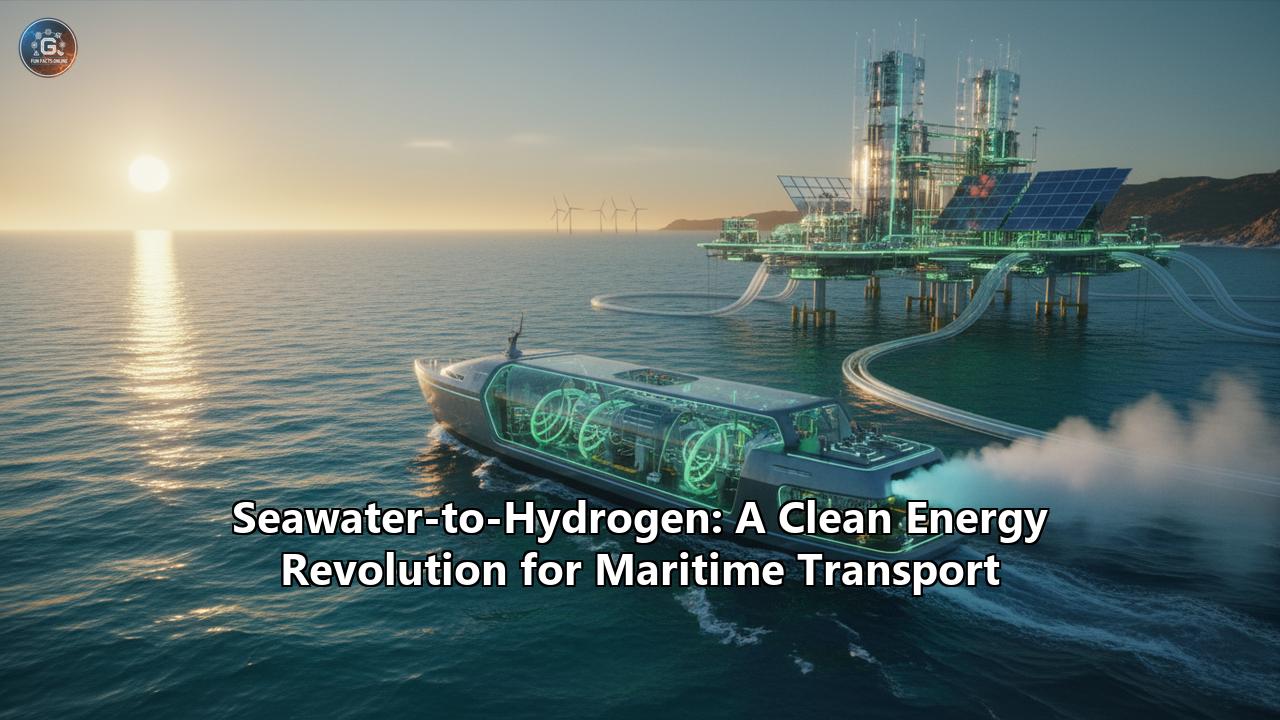
Seawater-to-Hydrogen: A Clean Energy Revolution for Maritime Transport
The global maritime industry, the lifeblood of international trade, stands at a critical juncture. Responsible for transporting approximately 80% of global trade by volume, its reliance on heavy fossil fuels has made it a significant contributor to greenhouse gas emissions, accounting for nearly 3% of the world's total. As the world grapples with the escalating climate crisis, the clarion call for decarbonization has reached the shipping sector, prompting an urgent search for sustainable and clean energy alternatives. Amidst a sea of potential solutions, a groundbreaking technology is emerging that holds the promise of not just reducing but eliminating the maritime industry's carbon footprint: the production of hydrogen directly from seawater. This revolutionary approach, turning the very medium ships traverse into a source of clean fuel, could herald a new era of zero-emission shipping, fundamentally reshaping the future of maritime transport.
The Allure of Hydrogen: A Zero-Emission Horizon
Hydrogen has long been touted as a clean energy carrier with the potential to decarbonize a multitude of sectors, and the maritime industry is no exception. When used in a fuel cell, hydrogen's only byproduct is water, making it a truly zero-emission fuel at the point of use. Its high energy content by weight, roughly three times that of conventional marine diesel, further adds to its appeal. The prospect of ships powered by hydrogen, emitting only water vapor that returns to the ocean, presents a compelling vision for a sustainable maritime future.
However, the widespread adoption of hydrogen in shipping has been hampered by significant challenges, primarily related to its production, storage, and infrastructure. Traditionally, "green" hydrogen is produced through the electrolysis of freshwater, a process that splits water into hydrogen and oxygen using renewable electricity. For an industry that operates on a global scale, the reliance on vast quantities of freshwater, a resource that is already scarce in many parts of the world, presents a significant logistical and ethical hurdle.
This is where the concept of seawater-to-hydrogen emerges as a game-changing solution. With oceans covering over 70% of the Earth's surface, seawater represents a virtually limitless and readily available feedstock for hydrogen production. The ability for a vessel to produce its own fuel from the surrounding water while at sea could revolutionize ship design, operation, and the very economics of maritime trade.
The Science of Splitting the Seas: How Seawater Becomes Fuel
The core principle behind producing hydrogen from seawater is electrolysis, the same process used with freshwater. However, the complex chemical composition of seawater introduces a unique set of challenges that have long been a barrier to its direct use.
The Challenge of Salt and Impurities
Seawater is not just water and salt; it's a complex cocktail of dissolved salts, minerals, organic matter, and even microorganisms. The most significant challenge is the presence of chloride ions, which are highly corrosive to the electrodes used in electrolysis. During the electrolysis process, these chloride ions can also lead to the undesirable production of toxic chlorine gas instead of oxygen at the anode, a phenomenon known as the chlorine evolution reaction (CER). This not only reduces the efficiency of hydrogen production but also poses a significant safety and environmental hazard.
Furthermore, the presence of other ions like magnesium and calcium can lead to the formation of precipitates on the electrodes, a process known as biofouling. This scaling can block the active sites of the catalysts, impeding the flow of ions and reducing the overall efficiency and lifespan of the electrolyzer.
Two Paths to Seawater Hydrogen: Direct vs. Desalination
To overcome these challenges, researchers and engineers are pursuing two primary pathways for producing hydrogen from seawater:
- Desalination Followed by Electrolysis: This is the more conventional and currently more established approach. It involves a two-step process where seawater is first desalinated to produce freshwater, which is then fed into a standard electrolyzer. The most common desalination method is reverse osmosis (RO), a mature technology that uses high pressure to force seawater through a semi-permeable membrane, leaving the salts and impurities behind. While this method is effective, the desalination process itself is energy-intensive and adds to the overall cost and complexity of the system. Studies have shown that the energy required for desalination is a small fraction of the energy needed for electrolysis, making it a technically viable option. A techno-economic analysis of a large-scale green hydrogen production facility in Sines, Portugal, found that the installation and operation of a desalination unit would increase the levelized cost of hydrogen by less than 1%. However, the capital expenditure (CAPEX) for the desalination plant, though smaller than the electrolyzer, is still a significant investment.
- Direct Seawater Electrolysis (DSE): This is the holy grail of seawater-to-hydrogen technology, aiming to produce hydrogen directly from untreated or minimally treated seawater in a single step. This approach eliminates the need for a separate desalination unit, which could significantly reduce the cost, complexity, and footprint of the system. The key to successful DSE lies in the development of advanced catalysts and membranes that can withstand the corrosive marine environment and selectively promote the oxygen evolution reaction (OER) over the chlorine evolution reaction.
Breakthroughs on the Horizon: Innovations in Direct Seawater Electrolysis
The quest for efficient and durable DSE systems has spurred a wave of innovation in materials science and electrochemistry. Researchers around the world are making significant strides in developing novel catalysts and membranes that can overcome the challenges of direct seawater splitting.
Advanced Catalysts: The Heart of the Reaction
The development of robust and selective catalysts is crucial for the success of DSE. These catalysts must be able to:
- Resist Corrosion: The highly corrosive nature of seawater, particularly the presence of chloride ions, can quickly degrade conventional catalysts. Researchers are exploring a range of corrosion-resistant materials, including transition metal alloys, nitrides, and phosphides. For example, a nickel-iron (NiFe)-based electrocatalyst interacting with copper-cobalt (CuCo) has shown high performance and stability in seawater electrolysis.
- Selectively Promote Oxygen Evolution: To avoid the production of harmful chlorine gas, the catalyst must be highly selective for the oxygen evolution reaction. This is a significant challenge as the thermodynamic potential for chlorine evolution is very close to that of oxygen evolution. Scientists are designing catalysts with specific atomic structures and electronic properties that favor the OER pathway. Some studies have even found that certain catalysts can benefit from the coordination of chloride ions on their surface, potentially enhancing OER performance.
- Prevent Scaling: The formation of precipitates on the cathode can be mitigated through various strategies, including the design of self-cleaning cathodes and methods for precipitate removal.
One promising breakthrough comes from researchers at Chung-Ang University in Seoul and Qingdao University of Science and Technology, who have developed a ruthenium (Ru)-based nanocatalyst. This catalyst, with its unique crystalline-amorphous heterostructure, has demonstrated significantly higher activity and stability in seawater electrolysis compared to conventional platinum catalysts.
Innovative Membranes: The Gatekeepers of the Process
The membrane in an electrolyzer plays a critical role in separating the hydrogen and oxygen gases and facilitating the flow of ions. In DSE, the membrane must also prevent the transport of chloride ions to the anode.
- Anion Exchange Membranes (AEMs): AEMs are a promising technology for seawater electrolysis as they operate in an alkaline environment, which is more favorable for using non-precious metal catalysts.
- Bipolar Membranes (BPMs): BPMs offer a unique solution by creating a pH gradient within the electrolyzer, which can help to suppress the chlorine evolution reaction and reduce corrosion.
- Thin-Film Composite Membranes: Researchers at Johns Hopkins University have shown that thin-film composite membranes, typically used for desalination, can be used directly in an electrolyzer to both purify the water and produce hydrogen in a single step, while avoiding the production of chlorine gas.
From the Lab to the High Seas: Pilot Projects and Real-World Applications
The theoretical promise of seawater-to-hydrogen is now being put to the test in a growing number of pilot projects and real-world demonstrations. These initiatives are crucial for validating the technology, understanding its operational challenges, and paving the way for commercial-scale deployment.
One of the most notable examples is the Energy Observer, a catamaran that is the first vessel in the world to be powered by a combination of renewable energies and hydrogen produced on board from seawater. The vessel is equipped with solar panels, wind turbines, and a system that desalinates seawater before feeding it into a PEM electrolyzer. The hydrogen is then compressed and stored to power a fuel cell, providing the vessel with a reliable and autonomous source of clean energy. Analysis of the hydrogen produced on the Energy Observer has demonstrated that it is of a quality compliant with the stringent ISO 14687:2019 standard for hydrogen fuel.
In the United Kingdom, a pioneering project led by Brunel University London and the startup Genuine H2 is developing a system to convert seawater directly into hydrogen fuel for ships. This project, part of the UK government's Clean Maritime Demonstration Competition, aims to create Britain's first integrated hydrogen maritime demonstrator. The technology features specialized electrodes for direct seawater electrolysis and an innovative storage system that uses a nano-film to store hydrogen as a molecular solid at room temperature and pressure, eliminating the need for high-pressure tanks or cryogenic systems. The project will be tested until March 2026.
In the United States, the Waterfront Maritime Hydrogen Demonstration Project in the San Francisco Bay Area is another key initiative. This project will demonstrate the integration of hydrogen production and refueling infrastructure to support maritime applications, and will be the first exposure of the U.S. Coast Guard to a hydrogen fueling barge.
The Port of Ngqura in South Africa is the focus of a techno-economic analysis for the production of green hydrogen from seawater using wave energy. The study examines the feasibility of using the produced hydrogen to power the port's electricity needs, refuel tugboats, and provide green hydrogen bunkering for commercial shipping vessels.
These and other projects are providing invaluable data and operational experience that will be critical for scaling up the use of seawater-to-hydrogen technology in the maritime industry.
The Economic Equation: Can Seawater Hydrogen Compete?
For any new technology to be widely adopted, it must not only be technically feasible and environmentally beneficial but also economically viable. The cost of hydrogen produced from seawater is a key factor that will determine its competitiveness with conventional marine fuels and other green alternatives.
The Cost Breakdown of Seawater Hydrogen
The levelized cost of hydrogen (LCOH) from seawater is influenced by several factors, with the cost of electricity being the most significant. Other key cost components include:
- Capital Expenditures (CAPEX): This includes the cost of the electrolyzer, desalination unit (if used), power supply, and other balance of plant components. The cost of electrolyzers is expected to decrease significantly in the coming years due to technological advancements and economies of scale.
- Operating Expenditures (OPEX): This includes the cost of electricity, maintenance, and replacement of components like electrodes and membranes.
- Water Costs: In the case of desalination, the cost of producing purified water from seawater is a factor, although studies have shown it to be a relatively small component of the overall cost of hydrogen production.
Current estimates for the cost of green hydrogen from electrolysis range from $3 to $8 per kilogram. However, with advancements in technology and a decrease in the cost of renewable electricity, the U.S. Department of Energy has set a target of reducing the cost of green hydrogen to $1 per kilogram within a decade. A study by researchers at Cornell University on a solar-powered seawater electrolysis device estimates that the technology could bring the cost of green hydrogen down to $1 per kilogram within 15 years.
Comparing Costs: Hydrogen vs. Other Marine Fuels
To be a viable alternative, seawater-derived hydrogen must be cost-competitive with both conventional marine fuels and other emerging green fuels.
- Conventional Fuels: Currently, green hydrogen is significantly more expensive than heavy fuel oil (HFO) and marine diesel oil (MDO). However, the increasing cost of carbon emissions through regulations like the EU Emissions Trading System (ETS) is expected to narrow this price gap.
- Green Ammonia and Methanol: Ammonia and methanol are two other promising green fuels for the maritime industry. While green hydrogen is currently more expensive per ton than green ammonia and methanol, its higher energy content per kilogram means that less fuel is required to produce the same amount of power. A comparative analysis of alternative marine fuels indicates that while methanol, hydrogen, and ammonia are more expensive to produce, their daily operational costs are not significantly higher than very low sulfur fuel oil (VLSFO), especially when used in highly efficient PEM fuel cells.
Ultimately, the economic viability of seawater hydrogen will depend on a combination of factors, including the price of renewable electricity, the cost of carbon emissions, and the development of supporting infrastructure.
Navigating the Challenges: Storage, Safety, and Infrastructure
While the production of hydrogen from seawater is a major breakthrough, its successful implementation as a marine fuel requires overcoming significant challenges related to on-board storage, safety, and the development of bunkering infrastructure.
The Storage Conundrum: A Volumetric Challenge
Hydrogen has a very low volumetric energy density, meaning that a large volume is required to store a significant amount of energy. This presents a major challenge for ships, where space is at a premium. There are two primary methods for storing hydrogen on board:
- Compressed Hydrogen (CH2): Hydrogen gas is compressed to high pressures (typically 350-700 bar) and stored in specialized tanks. While this is a mature technology, the high-pressure tanks are heavy and occupy a significant amount of space, which can reduce a ship's cargo-carrying capacity.
- Liquid Hydrogen (LH2): Hydrogen is cooled to a cryogenic temperature of -253°C, at which point it becomes a liquid. Liquid hydrogen has a higher energy density by volume compared to compressed hydrogen, which means it requires less storage space. However, it requires highly insulated cryogenic tanks to maintain its low temperature and prevent boil-off, where the liquid hydrogen evaporates. The experience gained from the use of liquefied natural gas (LNG) as a marine fuel can be valuable in developing liquid hydrogen storage and bunkering systems.
The choice between compressed and liquid hydrogen storage depends on the type of vessel and its operational profile. Compressed hydrogen may be suitable for smaller vessels with shorter ranges, such as ferries and tugboats, while liquid hydrogen is likely to be the preferred option for larger vessels like container ships and tankers on long-haul voyages.
Ensuring Safety at Sea: The Regulatory Landscape
The unique properties of hydrogen, particularly its high flammability, necessitate a robust regulatory framework to ensure the safety of hydrogen-powered ships. The International Maritime Organization (IMO) is in the process of developing regulations for the use of hydrogen as a marine fuel under its International Code of Safety for Ships using Gases or Other Low-Flashpoint Fuels (IGF Code).
In the interim, classification societies such as the American Bureau of Shipping (ABS), Lloyd's Register, and Bureau Veritas have developed their own rules and guidelines for hydrogen-fueled vessels. These rules cover all aspects of hydrogen systems on board, including storage, bunkering, machinery design, ventilation, and safety systems.
Building the Bunkering Infrastructure: A Port-to-Ship Challenge
The widespread adoption of hydrogen as a marine fuel will require the development of a global network of bunkering infrastructure at ports. This includes facilities for producing, storing, and transferring hydrogen to ships.
Ports are seen as key enablers of the hydrogen transition, with the potential to become "hydrogen hubs" that support both the maritime sector and other industries. Several ports around the world, including the Port of Rotterdam, are already investing in hydrogen import terminals and bunkering facilities.
The development of standardized refueling protocols is another critical challenge that needs to be addressed to ensure interoperability between ships and shore-based infrastructure.
The Environmental Balance Sheet: Beyond Zero Emissions
While hydrogen produced from seawater using renewable energy is a zero-emission fuel at the point of use, it is important to consider the broader environmental impacts of the entire "seawater-to-wake" lifecycle.
Lifecycle Emissions: A Holistic View
A comprehensive lifecycle assessment (LCA) must account for the emissions associated with:
- Manufacturing of Equipment: The production of electrolyzers, desalination units, solar panels, and wind turbines all have an environmental footprint.
- Electricity Generation: The carbon intensity of the electricity used for electrolysis is a critical factor. To be truly "green," the hydrogen must be produced using renewable energy sources.
- Brine Discharge: In the case of desalination, the disposal of the highly saline brine concentrate can have a negative impact on marine ecosystems. The high salt concentration and the presence of chemicals used in the desalination process can harm marine organisms. However, there are strategies to mitigate this impact, such as diluting the brine with seawater or wastewater before discharge and selecting appropriate discharge locations to maximize mixing. A study on the environmental impacts of seawater desalination for green hydrogen production found that electrodialysis is a more energy-efficient and environmentally friendly option compared to reverse osmosis.
The Promise of a Circular Economy
The seawater-to-hydrogen process also offers opportunities for creating a more circular economy. For instance, the pure water produced as a byproduct of hydrogen combustion in a fuel cell could be used for various on-board applications. Additionally, some innovative DSE technologies are being developed that can also extract carbon dioxide from the seawater to create bicarbonates, effectively making the process carbon-negative.
The Roadmap to a Hydrogen-Powered Maritime Future
The transition to a hydrogen-powered maritime industry will not happen overnight. It will require a concerted effort from all stakeholders, including governments, industry, and research institutions. A clear roadmap is needed to guide this transition, with key milestones and a shared vision for the future.
The Role of Government and Policy
Governments have a crucial role to play in creating a supportive policy and regulatory environment for the adoption of hydrogen in the maritime sector. This includes:
- Setting Ambitious Targets: Clear and ambitious targets for the uptake of zero-emission fuels, such as those set by the IMO, provide a strong signal to the industry and drive investment.
- Providing Financial Incentives: Subsidies, tax credits, and other financial incentives can help to bridge the cost gap between hydrogen and conventional fuels and de-risk early investments in hydrogen technologies.
- Investing in Research and Development: Continued public investment in research and development is essential for advancing seawater-to-hydrogen technology and bringing down its cost.
- Developing International Standards: Harmonized international standards for hydrogen production, storage, and bunkering are needed to ensure safety and interoperability.
Industry Collaboration and Investment
The maritime industry itself must take a proactive role in driving the hydrogen transition. This includes:
- Investing in Pilot Projects: Continued investment in pilot projects and demonstration vessels is crucial for testing and validating new technologies.
- Forming Strategic Partnerships: Collaboration between shipping companies, technology providers, port authorities, and energy companies is essential for developing integrated hydrogen supply chains.
- Developing a Skilled Workforce: The transition to hydrogen will require a new set of skills and expertise. The industry needs to invest in training and education to build a competent workforce.
Key Milestones on the Horizon
The roadmap for hydrogen adoption in the maritime sector includes several key milestones:
- By 2030: The goal is to have zero-emission marine vessels market-ready and to have established a network of ports supplying zero-emission fuels. The IMO's strategy aims for a 5-10% uptake of zero- or near-zero-emission fuels by 2030.
- By 2040: Major retailers have pledged to only move cargo on ships powered by zero-carbon fuels.
- By 2050: The IMO has set an ambitious target of achieving net-zero greenhouse gas emissions from international shipping.
A Voyage into a Cleaner Future
The journey towards a decarbonized maritime industry is a long and challenging one, but the emergence of seawater-to-hydrogen technology offers a beacon of hope. By harnessing the immense power of the oceans, the shipping industry has the potential to transform itself from a major source of pollution into a leader in the clean energy transition. The path forward will require continued innovation, bold investment, and unprecedented collaboration. But with the wind of technological advancement at its back and the tide of global climate action rising, the maritime industry is setting a course for a cleaner, more sustainable future, powered by the very waters it navigates.
Reference:
- https://www.mdpi.com/1996-1073/17/18/4683
- https://www.wsp.com/-/media/insights/global/documents/wsp---hydrogen-in-maritime-opportunities-and-challenges.pdf
- https://www.borntoengineer.com/zero-emission-ships
- https://comum.rcaap.pt/server/api/core/bitstreams/20186af2-c457-49d6-a7c0-af2408221bb0/content
- https://www.weforum.org/stories/2023/09/seawater-electrolysis-a-hydrogen-revolution-or-technological-dead-end-here-are-the-numbers/
- https://pdfs.semanticscholar.org/2994/21e57c12a70ea7b9551b8752ee82f4f8b11c.pdf
- https://www.frontiersin.org/journals/marine-science/articles/10.3389/fmars.2025.1601617/full
- https://www.ship-technology.com/comment/hydrogen-in-maritime-unlocking-sustainable-shipping/
- https://www.dma.dk/Media/637847381174295461/ZESM%20Roadmap.pdf
- https://www.groupebpce.com/en/all-the-latest-news/with-energy-observer-extracting-hydrogen-from-seawater-is-possible/
- https://www.mdpi.com/2227-9717/9/7/1252
- https://www.researchgate.net/publication/353385197_Hydrogen_for_Maritime_Application-Quality_of_Hydrogen_Generated_Onboard_Ship_by_Electrolysis_of_Purified_Seawater
- https://www.sustainability-times.com/energy/theyre-making-fuel-from-the-ocean-this-seawater-to-hydrogen-breakthrough-could-end-diesel-ships-forever-and-its-already-funded/
- https://decarbonisingfreight.co.uk/wp-content/uploads/2023/05/Raucci-et-al-2015-Hydrogen-on-board-ship.pdf
- https://www.hydrogen.energy.gov/docs/hydrogenprogramlibraries/pdfs/review23/ta045_pal_2023_o-pdf.pdf?sfvrsn=2fc74b1b_0
- https://theicct.org/the-price-of-green-hydrogen-estimate-future-production-costs-may24/
- https://www.youtube.com/watch?v=aE32UeDdYUg
- https://triplepundit.com/2023/green-hydrogen-seawater-offshore-wind/
- https://news.cornell.edu/stories/2025/04/sunlight-and-seawater-lead-low-cost-green-hydrogen-clean-water
- https://webthesis.biblio.polito.it/26113/
- https://www.researchgate.net/publication/351982637_Onboard_Hydrogen_Storage_for_Ships_An_Overview
- https://marine-service-noord.com/en/products/alternative-fuels-and-technologies/hydrogen/hydrogen-storage-on-a-ship/
- https://inspenet.com/en/articulo/hydrogen-shipping-maritime-fuel/
- https://livrepository.liverpool.ac.uk/3134920/1/seawater_preview%20no%20format.pdf
- https://www.rolandberger.com/en/Insights/Publications/Hydrogen-in-the-maritime-sector.html
- https://www.openaccessgovernment.org/hydrogen-technology-for-maritime-industry-decarbonisation/147848/
- https://hydrogeneurope.eu/wp-content/uploads/2021/11/How-hydrogen-can-help-decarbonise-the-maritime-sector_final.pdf