
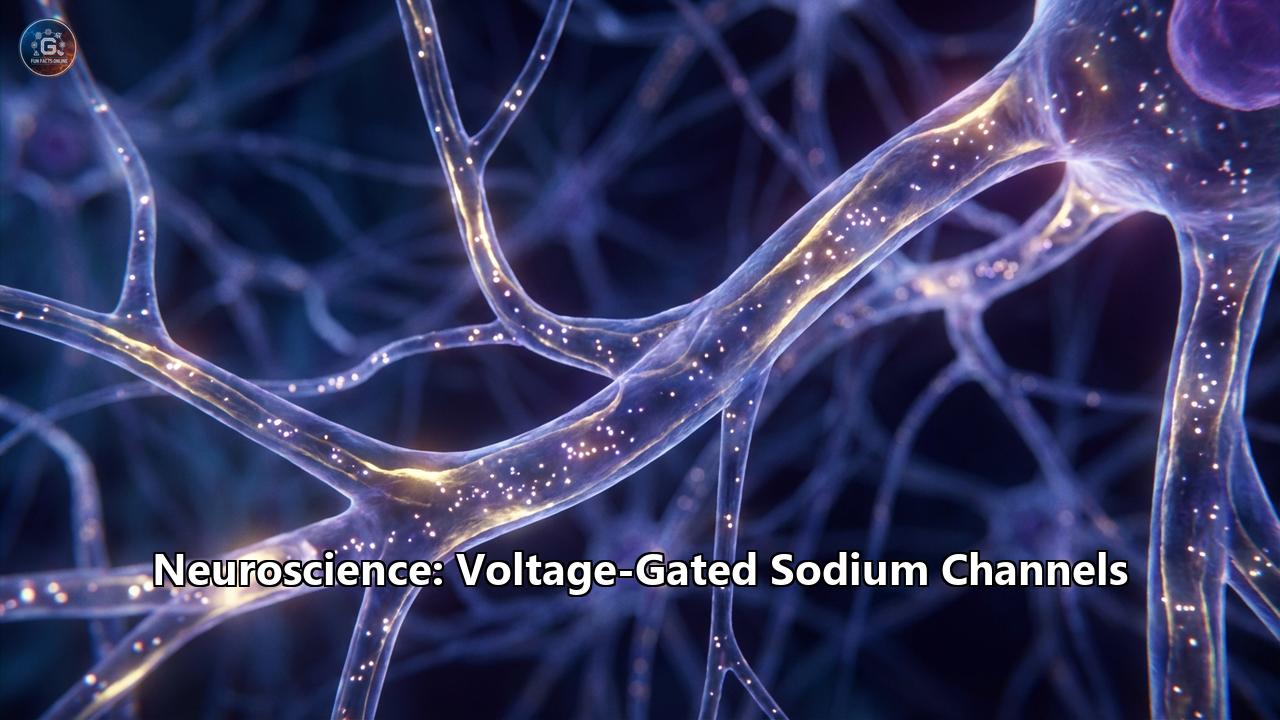
Introduction: The Atomic Lightning Bolt
In the vast, dark universe of the human body, a trillion microscopic lightning storms rage every second. They are the reason you can read these words, feel the texture of the device in your hand, and command your eyes to move across the page. This electrical storm is not chaotic; it is a symphony of precision orchestrated by a family of proteins that serve as the "transistors" of the nervous system: the Voltage-Gated Sodium Channels (VGSCs).
For decades, these channels were viewed simply as "on/off" switches—biological pores that opened to let sodium ions rush in, triggering the action potential that defines neuronal firing. Today, we know they are far more. They are evolutionary masterpieces that predate the nervous system itself; they are complex signal processors that can differentiate between a gentle caress and a searing burn; and they are shape-shifting machines that, when broken, lead to some of the most profound disorders known to medicine, from epilepsy to the complete inability to feel pain.
This article delves deep into the world of VGSCs, exploring their atomic architecture, their diverse personalities across the nine mammalian isoforms, their unexpected roles in cancer and immunity, and the cutting-edge therapies designed to tame them.
Part I: The Molecular Machine
To understand how a thought becomes an action, we must zoom in to the scale of angstroms. The voltage-gated sodium channel is a massive transmembrane protein, a leviathan of roughly 2,000 amino acids that weaves through the cell membrane like a suture.
1. The Alpha Subunit: The Core Engine
The functional core of the channel is the alpha subunit ($\alpha$). It is a single polypeptide chain folded into four homologous domains, labeled I, II, III, and IV. If you were to unfold the protein and lay it flat, it would look like four repetitive chapters of the same book.
- The 6-Transmembrane Architecture: Each of the four domains contains six transmembrane segments (S1–S6). These segments group together to form two distinct functional modules:
The Voltage-Sensing Module (S1–S4): This is the channel's "sensor." The S4 segment is particularly famous among biophysicists. It is studded with positively charged amino acids (arginine or lysine) at every third position. Like a magnet repelled by a like charge, the S4 segment moves outward when the inside of the cell becomes positive (depolarization). This physical movement is the trigger that opens the channel.
The Pore-Forming Module (S5–S6): These segments from all four domains come together in the center to form the ion-conducting pore. Between S5 and S6 lies the "P-loop," which dips into the membrane to form the selectivity filter—the gatekeeper that ensures only sodium passes through.
2. The Beta Subunits: The Sidekicks
While the alpha subunit can function alone, in the body it is rarely solitary. It is accompanied by one or two auxiliary beta subunits ($\beta1-\beta4$). These are smaller proteins that look like cell adhesion molecules (CAMs). They act as:
- Chaperones: Guiding the alpha subunit to the cell membrane.
- Modulators: Fine-tuning how fast the channel opens or closes.
- Anchors: The beta subunits have immunoglobulin-like folds (Ig-loops) that allow the channel to latch onto the extracellular matrix or cytoskeleton, effectively "gluing" the channel to specific spots like the Node of Ranvier.
3. The Mechanism of Action: A Three-Act Play
The life of a sodium channel is defined by three conformational states, cycling in milliseconds:
- Resting (Closed): The pore is shut, but the voltage sensors are reset, ready to fire.
- Activated (Open): Upon depolarization, the S4 sensors slide outward, pulling on the intracellular linkers (S4-S5 linkers) like a lever. This torque opens the activation gate formed by the crossing of the S6 helices. Sodium ions flood into the cell, driven by both concentration and electrical gradients. This influx is the rising phase of the action potential.
- Inactivated: Within a millisecond, the show is over. A hydrophobic cluster of amino acids (the IFM motif: Isoleucine-Phenylalanine-Methionine) located on the intracellular loop connecting Domains III and IV swings up and plugs the pore from the inside. This "hinged lid" mechanism stops the flow of ions even though the membrane is still depolarized, allowing the neuron to reset.
4. The DEKA Filter: Quantum-Level Selectivity
How does the channel let sodium in but keep potassium out, even though potassium is only slightly larger? The answer lies in the DEKA motif. The selectivity filter is formed by four specific residues, one from each domain: D (Aspartate), E (Glutamate), K (Lysine), and A (Alanine).
The Lysine (K) is the masterstroke. Its positive charge acts as a "bouncer," repelling other positive ions just enough to strip water molecules off the sodium ion. Sodium fits through this stripped-down state perfectly, while potassium is too large to fit without its water shell and too energetically expensive to strip naked.
Part II: The Family Tree – Evolution in Deep Time
We often think of sodium channels as "brain proteins," but their history begins billions of years before the first neuron fired.
From Bacteria to Biology
The ancestor of the VGSC is likely a bacterial channel, similar to the extant NaChBac. These primitive channels are homotetramers (four identical subunits coming together) rather than one long chain of four domains. They likely evolved to help single-celled organisms maintain osmotic balance.
The Great Duplication Event
The leap to complex life involved two rounds of gene duplication.
- 2-Domain Intermediate: An ancestral single-domain gene duplicated and fused, creating a channel with two domains.
- 4-Domain Final Form: Another duplication created the four-domain structure we see today in eukaryotes. This asymmetry allowed each domain to specialize (e.g., Domain I and II might focus on activation, while the linker between III and IV evolved the inactivation gate).
The Choanoflagellate Connection
Recent genomic studies on Choanoflagellates—single-celled organisms that are the closest living relatives to animals—revealed a surprise. They possess VGSC-like genes. This suggests that the machinery for electrical signaling existed before there were nervous systems to use it. In these proto-animals, sodium channels may have coordinated flagellar beating or sensing of the environment.
The Cnidarian Divergence
In jellyfish and sea anemones (Cnidarians), we see the first split into specialized sodium channel families. Interestingly, some jellyfish have "Nav2" channels that have unique selectivity filters (DKEA instead of DEKA). This ancient experimentation highlights that nature tried several designs before settling on the mammalian standard.
Part III: The Cast of Characters – The 9 Isoforms
In mammals, there are nine distinct VGSC genes (SCN1A through SCN11A), producing proteins named Nav1.1 through Nav1.9. While they share 75% of their DNA, that 25% difference dictates where they live and what they do. We can group them by their sensitivity to Tetrodotoxin (TTX), the deadly poison of the pufferfish.
Group A: The TTX-Sensitive (The Brain & Nerve Specialists)
These channels are blocked by nanomolar concentrations of TTX. They are the "classic" neuronal channels.
*Nav1.1 (SCN1A): The Interneuron’s Metronome
- Location: Inhibitory interneurons (GABAergic neurons) in the brain.
- Profile: Nav1.1 is built for speed. It recovers from inactivation incredibly fast. This allows inhibitory neurons to fire at high frequencies (hundreds of times per second) without "tiring out."
- Why it matters: Without Nav1.1, inhibitory neurons fail. The brain loses its "brakes," leading to runaway excitation (seizures). This is the root cause of Dravet Syndrome.
Nav1.2 (SCN2A): The Back-Propagator
- Location: Excitatory pyramidal neurons, specifically at the proximal Axon Initial Segment (AIS).
- Profile: Nav1.2 has a higher threshold for activation than its cousin Nav1.6. It is largely responsible for "back-propagation"—sending the action potential backwards from the axon into the dendrites. This tells the dendrites "we just fired," a crucial signal for synaptic plasticity and learning (Hebbian learning).
Nav1.3 (SCN3A): The Embryonic Echo
- Location: Embryonic nervous system.
- Profile: High expression during fetal development, then it largely disappears in adults.
- The Dark Side: Nav1.3 often reappears after nerve injury. Its re-expression in damaged adult nerves is a key driver of neuropathic pain, acting as a "ghost from the past" that shouldn't be there.
Nav1.4 (SCN4A): The Muscle Mover
- Location: Skeletal muscle.
- Profile: This channel initiates the muscle contraction. It is extremely abundant to ensure that every nerve impulse results in a twitch. Mutations here lead to "periodic paralysis" or myotonia (stiffness).
Nav1.6 (SCN8A): The Trigger
- Location: The distal Axon Initial Segment (AIS) and Nodes of Ranvier.
- Profile: Nav1.6 is the "hair-trigger" of the neuron. It activates at very negative voltages, meaning it is the first channel to open when a neuron is stimulated. It effectively decides when to fire. It also generates a unique "resurgent current" (see Part V) that helps neurons fire bursts of spikes.
Nav1.7 (SCN9A): The Amplifier
- Location: Peripheral sensory neurons (DRG), particularly nociceptors (pain sensors).
- Profile: Nav1.7 acts as a threshold amplifier. It opens in response to small, slow depolarizations (like a receptor potential from a burn). Its opening boosts the voltage enough to trigger Nav1.8.
- Fame: It is the "Pain Gene." Loss of Nav1.7 leads to complete pain insensitivity; gain of Nav1.7 leads to "man-on-fire" syndrome.
Group B: The TTX-Resistant (The Tough Guys)
These channels evolved distinct residues (Cysteine or Serine instead of Phenylalanine/Tyrosine) in the pore that make them immune to TTX.
Nav1.5 (SCN5A): The Heartbeat
- Location: Cardiac muscle.
- Profile: Nav1.5 drives the upstroke of the cardiac action potential. It differs from neuronal channels in its kinetics; it has a slow activation and inactivation profile suited for the rhythmic beat of the heart.
- Unique Feature: It is heavily regulated by calcium (via CaMKII) and metabolic status (NAD+ levels), linking the heart's electrical rhythm to its energy consumption.
Nav1.8 (SCN10A): The Upstroke Engine
- Location: Nociceptors (pain neurons).
- Profile: Nav1.8 is a workhorse. It activates only at very depolarized voltages but carries a massive amount of current. Once Nav1.7 amplifies a painful stimulus, Nav1.8 takes over to drive the actual spike upstroke. It is incredibly resistant to inactivation, allowing pain neurons to keep firing even during sustained damage.
Nav1.9 (SCN11A): The Background Hum
- Location: Small-diameter nociceptors and gut neurons.
- Profile: The most mysterious of the bunch. It has "ultra-slow" kinetics. It opens at voltages near the resting potential and stays open for a long time. It acts as a background "volume knob," setting the resting excitability of pain neurons. It is crucial for inflammatory pain (hypersensitivity of sunburned skin).
Part IV: Beyond the Action Potential – Non-Canonical Roles
Textbooks say sodium channels are for action potentials. Biology begs to differ. Recent research has uncovered VGSCs hiding in unexpected places, performing functions that have nothing to do with nerve impulses.
1. The Cancer Connection: Metastatic Machinery
One of the most alarming discoveries is that metastatic cancer cells often turn on VGSC genes, particularly neonatal splice variants of Nav1.5.
- Invadopodia: Cancer cells use VGSCs to drive sodium influx. This influx powers the Sodium-Hydrogen Exchanger (NHE-1), which pumps protons out of the cell. This creates an acidic microenvironment just outside the cell, which activates enzymes (cathepsins) that digest the extracellular matrix. This allows the cancer cell to drill through tissue and metastasize.
- Bio-Electricity: The electrical activity of the tumor itself seems to coordinate growth. "Electroceuticals" that block these channels are currently being explored to stop metastasis.
2. The Immune Soldier: Macrophage Phagocytosis
Macrophages, the white blood cells that eat pathogens, express Nav1.5 and Nav1.6. But they aren't on the surface—they are intracellular, located on the membranes of endosomes and lysosomes.
- The Mechanism: When a macrophage eats a bacterium, the endosome must acidify to kill it. Intracellular Nav1.5 allows sodium to escape the endosome, balancing the charge as protons are pumped in. Without this sodium leak, the "proton pump" would stall due to charge repulsion, and the macrophage would fail to digest its meal.
3. The Mitochondrial "Couplon"
In heart muscle cells, a sub-population of Nav1.5 resides not on the surface, but in T-tubules right next to mitochondria. This forms a structural "couplon." The sodium influx through Nav1.5 directly influences the mitochondrial Sodium-Calcium Exchanger (NCLX), regulating mitochondrial calcium levels. This links the heart's electrical excitation directly to its ATP production machinery—a failure here causes metabolic oxidative stress and arrhythmias.
Part V: Structural Nuances and "Resurgent" Currents
The Mystery of Resurgent Current
Most sodium channels open once and then lock shut (inactivate). But in some neurons (like cerebellar Purkinje cells), the channel re-opens briefly during the falling phase of the spike. This is the resurgent current.
- The Blocker: It turns out the "hinged lid" (IFM motif) isn't the only thing that can block the pore. A peptide from the cytoplasmic tail of the Navβ4 subunit can jam into the open pore before the inactivation gate can close.
- The Rebound: When the membrane repolarizes (becomes negative again), the β4 peptide is kicked out by electrical repulsion. Since the inactivation gate never closed, the channel is briefly open again, allowing a "resurgent" puff of sodium.
- Function: This mechanism acts as a "reset button," forcing the channel directly from Open to Closed (bypassing Inactivation). This allows the neuron to be ready to fire again almost instantly, enabling ultra-fast firing rates (up to 100 Hz).
TTX Resistance: The Structural Determinant
Why does the pufferfish toxin kill mammals but not the pufferfish (or our own heart)?
- The Ring of Aromaticity: In TTX-sensitive channels, a specific Tyrosine or Phenylalanine residue in the pore loop interacts with the toxin via pi-stacking (a bond between aromatic rings).
- The Escape: In Nav1.5, Nav1.8, and Nav1.9, this residue is replaced by a Cysteine or Serine. Without the aromatic ring, TTX cannot bind tightly. This single amino acid change effectively renders the toxin useless against the heart.
Part VI: When the Spark Fades – Channelopathies
Because VGSCs are so critical, even a single amino acid change can be catastrophic. These diseases are collectively called Channelopathies.
1. Epilepsy: The Spectrum of SCN1A
- Dravet Syndrome: Caused by "Loss of Function" (LOF) mutations in Nav1.1. As noted earlier, if inhibitory interneurons can't fire, the brain seizes. It is a heartbreaking disease appearing in infancy, often triggered by fever.
- GEFS+ (Generalized Epilepsy with Febrile Seizures Plus): Often caused by milder mutations that might just slow down the channel's recovery.
- The Paradox: Why treat a "loss of function" (less sodium current) with sodium channel blockers (which reduce current further)? In Dravet, you generally don't. But in other epilepsies caused by "Gain of Function" (GOF) in Nav1.2 or Nav1.6 (where excitatory neurons fire too much), blockers like Carbamazepine work wonders.
2. The Pain Triad: SCN9A, SCN10A, SCN11A
- CIP (Congenital Insensitivity to Pain): A child with a null mutation in Nav1.7 feels no physical pain. They can walk on broken glass or touch a hot stove without noticing. While it sounds like a superpower, it is dangerous; without pain, injuries go unnoticed and untreated.
- Primary Erythromelalgia (IEM): A GOF mutation in Nav1.7 lowers the activation threshold. The warmth of a blanket or mild exercise causes the hands and feet to feel like they are burning in lava. The "sensor" is set too sensitive.
- Paroxysmal Extreme Pain Disorder (PEPD): A different mutation in Nav1.7 impairs inactivation. The channel stays open too long. This causes excruciating pain in the rectum, eyes, and jaw, usually triggered by bowel movements.
3. Cardiac Chaos: Brugada and LQT3
- LQT3 (Long QT Syndrome Type 3): Caused by mutations (e.g., $\Delta$KPQ) in Nav1.5 that disrupt inactivation. The channel "leaks" a tiny trickle of late sodium current during the plateau of the heart beat. This prolongs the repolarization, creating a window of vulnerability where a fatal arrhythmia (Torsades de Pointes) can strike.
- Brugada Syndrome: A LOF mutation in Nav1.5. With less peak current, the electrical wave moves too slowly through the heart, leading to conduction blocks and sudden cardiac death during sleep.
Part VII: Pharmacology – From Toxins to AI
Humanity has been manipulating sodium channels for millennia, long before we knew they existed.
1. Nature’s Arsenal
- Tetrodotoxin (TTX): From pufferfish. Plugs the outer pore.
- Batrachotoxin (BTX): From poison dart frogs. Binds inside the pore and prevents the inactivation gate from closing. The victim's muscles contract violently and never relax.
- Scorpion Toxins: Often grab the extracellular loops of the voltage sensors (S3-S4), weighing them down so they cannot move.
2. The Clinical Classics
- Local Anesthetics (Lidocaine/Novocaine): These are "use-dependent" blockers. They are uncharged molecules that slip through the membrane, enter the cell, become charged, and then block the pore from the inside. Crucially, they bind best to open channels. This means they block hyper-active pain neurons more than quiet ones.
- Antiepileptics (Phenytoin/Carbamazepine): They stabilize the inactivated state. By keeping the "hinged lid" closed longer, they prevent neurons from firing high-frequency bursts (seizures) while allowing normal, low-frequency firing to continue.
3. The Holy Grail: Selective Painkillers
The problem with Lidocaine is that it blocks all* sodium channels (numb heart, numb brain, numb leg). The goal is to block only Nav1.7 or Nav1.8.
- VX-548 (Suzetrigine): A breakthrough small molecule that selectively binds to the "voltage sensor paddle" of Nav1.8. In 2024/2025 clinical trials, it showed powerful pain relief without the addictive potential of opioids.
- Monoclonal Antibodies: Drugs like SVmab target the extracellular S1-S2 loops of specific isoforms. Because these loops vary greatly between Nav1.7 and Nav1.5, antibodies can achieve perfect selectivity.
4. AI and the Future of Discovery
In 2024, researchers used diffusion models (similar to the AI that generates images) to design novel proteins that bind to the Nav1.7 voltage sensor. Tools like RosettaVS and AlphaFold are now allowing us to map the "druggable pockets" of these channels that change shape in microseconds, designing binders that only attach when the channel is in a specific pathological state.
Part VIII: Future Horizons
The study of Voltage-Gated Sodium Channels is entering a golden age. We are moving from simply "blocking" them to "editing" them.
- Gene Therapy: For Dravet syndrome, simply adding a blocker doesn't work. The company Stoke Therapeutics has developed STK-001, an Antisense Oligonucleotide (ASO). It doesn't target the protein; it targets the RNA, tricking the cell into producing more functional Nav1.1 from the healthy copy of the gene (treating the haploinsufficiency).
- Optical Control: "Photoswitchable" blockers are being developed. Imagine a painkiller that is inactive until you shine a red light on the skin, allowing for precise, on-demand anesthesia.
- Non-Addictive Pain Relief: As we unlock the secrets of Nav1.7, 1.8, and 1.9, we approach a world where chronic pain can be silenced at the source—the peripheral nerve—without ever touching the brain's opioid receptors.
The voltage-gated sodium channel is more than just a pore; it is the fundamental unit of animal behavior. From the first twitch of a jellyfish to the complex arrhythmia of a human heart, these proteins tell the story of life in the language of electricity. As we master their atomic secrets, we gain the power not just to understand that story, but to rewrite it.
Reference:
- https://pmc.ncbi.nlm.nih.gov/articles/PMC5398315/
- https://pmc.ncbi.nlm.nih.gov/articles/PMC3306330/
- https://www.frontiersin.org/journals/neurology/articles/10.3389/fneur.2021.600050/full
- https://journals.biologists.com/jeb/article/218/4/515/14125/Evolution-of-voltage-gated-ion-channels-at-the
- https://www.researchgate.net/publication/347787723_Structural_and_Functional_Characterization_of_A_Nav15-Mitochondrial_Couplon
- https://pmc.ncbi.nlm.nih.gov/articles/PMC4259529/
- https://www.jneurosci.org/content/31/32/11527