
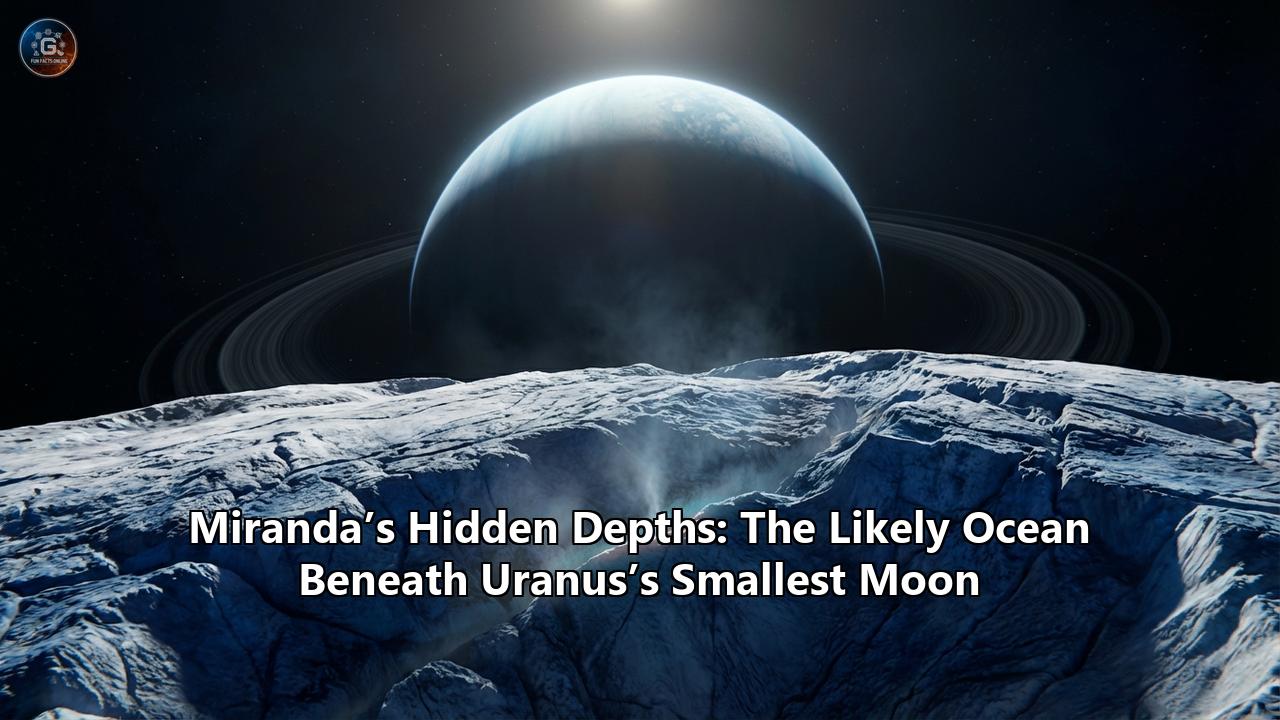
In the outer reaches of our solar system, where the sun is little more than a bright star in a perpetual twilight, a small, battered moon orbits the ice giant Uranus. For decades, it was dismissed as a frozen geological oddity—a "Frankenstein’s monster" of the planetary family, seemingly stitched together from mismatched parts. But new research has shattered that perception, revealing that beneath its scarred and chaotic surface, Miranda may hide a secret that could rewrite the rules of habitability in the cosmos: a vast, liquid ocean.
Part I: The Frankenstein Moon
The Voyager RevelationOn January 24, 1986, NASA’s Voyager 2 spacecraft swept past Uranus, becoming the first—and to date, the only—human-made object to visit the seventh planet. It had only a few hours to capture data on the entire Uranian system, but in that brief window, it snapped a series of images that would baffle planetary scientists for nearly forty years.
The target was Miranda, the smallest and innermost of Uranus’s five major moons. At just 470 kilometers (290 miles) in diameter, it should have been a dead, cratered ice ball, similar to Saturn’s Mimas. Conventional planetary science dictated that such a small body, lacking the internal heat of a larger world, would have frozen solid billions of years ago, preserving a static record of the early solar system.
Instead, Voyager 2 revealed a world of violent contradictions. Miranda looked as if it had been smashed apart and haphazardly reassembled. Its surface was a chaotic jumble of terrain types: heavily cratered ancient highlands sat abruptly next to young, smooth plains. Massive fault canyons, some twelve times deeper than the Grand Canyon, sliced through the crust. Most baffling of all were the coronae—three massive, oval-shaped features named Arden, Elsinore, and Inverness. These weren’t impact craters; they were vast, racetrack-like systems of ridges and grooves that looked like terrestrial racetracks or fingerprints stamped onto the ice.
For decades, the leading theory was catastrophic disruption: perhaps Miranda had been shattered by a massive impact and its gravity had clumsily pulled the shards back together. But in late 2024, a team of researchers led by Caleb Strom of the University of North Dakota, along with Tom Nordheim of the Johns Hopkins Applied Physics Laboratory, offered a different, more thrilling explanation. Miranda wasn’t broken from the outside; it was churning from the inside.
Part II: The 2024 Discovery
Reverse-Engineering a WorldThe breakthrough came not from new images, but from a forensic re-examination of the old Voyager data using modern computing power. The research team set out to map the specific stress patterns on Miranda’s surface—the cracks, ridges, and scarps—to determine what kind of internal forces could have created them.
Using a sophisticated computer model known as the "four-layer model," they simulated Miranda’s interior structure. They tested various configurations: a solid ball of ice, a moon with a rocky core and a thick ice shell, and finally, a moon with a liquid ocean sandwiched between the core and the crust.
The results were unambiguous. The only model that accurately predicted the placement and orientation of the surface cracks—specifically the trapezoidal shape of the coronae—was one where Miranda possessed a thin, brittle ice shell overlying a deep, global ocean.
The Numbers Behind the OceanThe study’s parameters paint a picture of a world far wetter than Earth. According to the model:
- Ocean Depth: The ocean likely extended at least 100 kilometers (62 miles) deep.
- Crust Thickness: The icy shell hiding this ocean was surprisingly thin, likely no more than 30 kilometers (19 miles) thick.
- Ocean Volume: Given Miranda’s tiny radius (235 km), this ocean would have occupied nearly half of the moon’s total volume.
This discovery transforms Miranda from a solid rock-and-ice body into a "water world" in the truest sense. If accurate, Miranda is not just a moon with an ocean; it is a drop of water encased in a thin shell of ice, orbiting in the deep freeze of the outer solar system.
Part III: The Engine of Chaos
How could such a tiny moon, so far from the sun, maintain a liquid ocean for hundreds of millions of years? The answer lies in the complex gravitational dance of the Uranian system.
The Resonance TrapMoons do not orbit in isolation. They tug on one another. In the Uranian system, this tug-of-war became a source of immense energy. The researchers identified that in the past, Miranda likely entered a 5:3 mean-motion resonance with Ariel, its larger neighbor.
In this configuration, for every five orbits Miranda completed, Ariel completed three. This periodic alignment meant that the two moons pulled on each other rhythmically, like a parent pushing a child on a swing. The resonance forced Miranda’s orbit to become eccentric (elliptical) rather than perfectly circular.
Tidal Heating: The Cosmic FrictionAs Miranda moved closer to and then further from Uranus in its elliptical orbit, the giant planet’s immense gravity stretched and squeezed the moon’s physical structure. This constant flexing created friction deep within Miranda’s rocky core and icy mantle. Just as bending a paperclip back and forth makes it hot, this "tidal heating" generated enough internal thermal energy to melt the ice.
This heat engine drove the formation of the ocean and powered the geological upheaval on the surface. The rising plumes of warm water or slushy ice likely pushed up against the brittle crust, fracturing it to create the coronae. The ridges we see today are essentially the stretch marks of a world that was expanding and churning from within.
Part IV: A Tour of the Surface
Understanding the ocean hypothesis brings the terrifying beauty of Miranda’s landscape into focus. We can now read the surface like a geological history book.
The Coronae: Windows to the DeepThe three coronae—Arden, Elsinore, and Inverness—are the smoking guns of cryovolcanism (ice volcanoes) and diapirism (upwelling of material).
- Inverness Corona: Located near the south pole, this feature is nicknamed "The Chevron" for its bright, V-shaped check mark. It is likely the youngest of the three, formed by a plume of warm slush that rose toward the surface but didn't quite break through, causing the crust to buckle and crack.
- Arden and Elsinore: These massive, ovoid features span hundreds of kilometers. The concentric ridges suggest that the surface was pulled apart as the underlying ocean churned. They are vast tectonic scars where the skin of the moon was stretched to its breaking point.
Perhaps the most famous feature on Miranda is Verona Rupes, a cliff face that defies imagination. Rising 20 kilometers (12 miles) above the surrounding terrain, it is the tallest cliff in the solar system. If you were to jump from the top, Miranda’s low gravity means you would fall for over 10 minutes before hitting the bottom.
Under the ocean hypothesis, Verona Rupes is a massive fault block, a piece of the crust that shattered and tilted as the moon’s interior expanded or contracted. It is a monument to the violent forces that a subsurface ocean can unleash on a solid shell.
Part V: Is the Ocean Still There?
The study suggests the ocean existed between 100 and 500 million years ago. But is it still there today?
The answer is a tantalizing "maybe."
Conventional wisdom holds that once the orbital resonance with Ariel broke, the tidal heating would have stopped, and Miranda should have frozen solid. However, the researchers found a critical clue suggesting otherwise: the absence of expansion cracks.
When water freezes into ice, it expands. If Miranda’s ocean had frozen completely solid, the global expansion would have ripped the surface apart in a specific pattern of "expansion fractures." The detailed mapping of the surface did not find evidence of these specific cracks.
This implies that Miranda is still cooling. A remnant ocean—perhaps thin, slushy, and rich in ammonia (which acts as antifreeze)—may still exist beneath the shell. Miranda might be a "dying" ocean world, caught in the final epoch of its liquid history, but it is not yet a frozen corpse.
Part VI: The Search for Life
The phrase "subsurface ocean" immediately triggers the biggest question in planetary science: Could there be life?
The Goldilocks Zone of the Outer SystemWhile Miranda is not as prime a candidate as Enceladus (which is actively spraying water into space) or Europa, it occupies a unique niche.
- Chemical Potential: If the ocean interacts with the rocky core, as the models suggest, there could be hydrothermal vents—underwater hot springs that provide chemical energy. On Earth, such vents host thriving ecosystems independent of sunlight.
- Ammonia Factor: The likely presence of ammonia to keep the water liquid at low temperatures poses a challenge for terrestrial-like life, as high ammonia concentrations can be toxic. However, it does not rule out exotic biochemistry adapted to such environments.
If life ever emerged in Miranda’s deep dark sea, it would currently be facing an existential crisis as the ocean slowly freezes. Yet, the resilience of life in Earth’s most extreme environments teaches us never to say "impossible."
Part VII: The Case for a Return Mission
The discovery of a potential ocean on Miranda adds immense weight to the calls for a dedicated mission to Uranus. The 2023-2032 Planetary Science Decadal Survey has already listed a Uranus Orbiter and Probe (UOP) as a top priority flagship mission.
What a Mission Would DoA future orbiter wouldn't just snap pictures; it would "taste" and "scan" the moon.
- Ice-Penetrating Radar: Instruments similar to those on the Europa Clipper could peer through Miranda’s ice shell to directly detect the water-ice boundary.
- Magnetometers: If Miranda has a salty ocean, it will conduct electricity. As Uranus’s magnetic field sweeps over the moon, the ocean would generate a secondary magnetic field that a spacecraft could detect—a technique used to confirm Europa’s ocean.
- Gravity Science: By flying close to the moon, a spacecraft could measure subtle changes in Miranda’s gravity field, revealing the distribution of mass inside (liquid vs. solid).
Conclusion: A New Class of Ocean World
Miranda forces us to rethink what it means to be an "ocean world." We used to think oceans were rare, restricted to large moons like Europa or Titan. Now, we are realizing that oceans might be a standard feature of icy satellite evolution, even for the runts of the litter.
The realization that this tiny, scarred moon, floating in the dark nearly 3 billion kilometers from the sun, could hold a liquid abyss challenges our imagination. Miranda is no longer just a jagged oddity; it is a priority target, a frozen treasure chest waiting to be unlocked. It reminds us that in the exploration of the cosmos, the most unassuming worlds often hide the deepest secrets.
Until we return, Miranda hangs in the black sky of Uranus, a silent testament to the power of tidal forces and the enduring mystery of water in the dark.
Reference:
- https://universemagazine.com/en/beneath-the-surface-of-miranda-there-may-be-an-ocean-lurking/
- https://www.space.com/astronomy/solar-system/icy-moons-in-our-solar-system-may-have-boiling-oceans-but-life-could-potentially-still-survive
- https://www.lpi.usra.edu/resources/outerp/usat.shtml
- https://www.jpost.com/science/science-around-the-world/article-826928
- https://www.researchgate.net/figure/A-diagram-of-the-four-layer-model-used-for-Miranda-in-SatStressGUI-The-diagram-shows-an_fig1_384943360
- https://www.researchgate.net/publication/384943360_Constraining_Ocean_and_Ice_Shell_Thickness_on_Miranda_from_Surface_Geological_Structures_and_Stress_Modeling
- https://www.researchgate.net/publication/342374958_Dynamical_History_of_the_Uranian_System
- https://arxiv.org/abs/2005.12887
- https://www.semanticscholar.org/paper/5b518399597f7c8cdcae8fe6f3347acdd7919fdf