
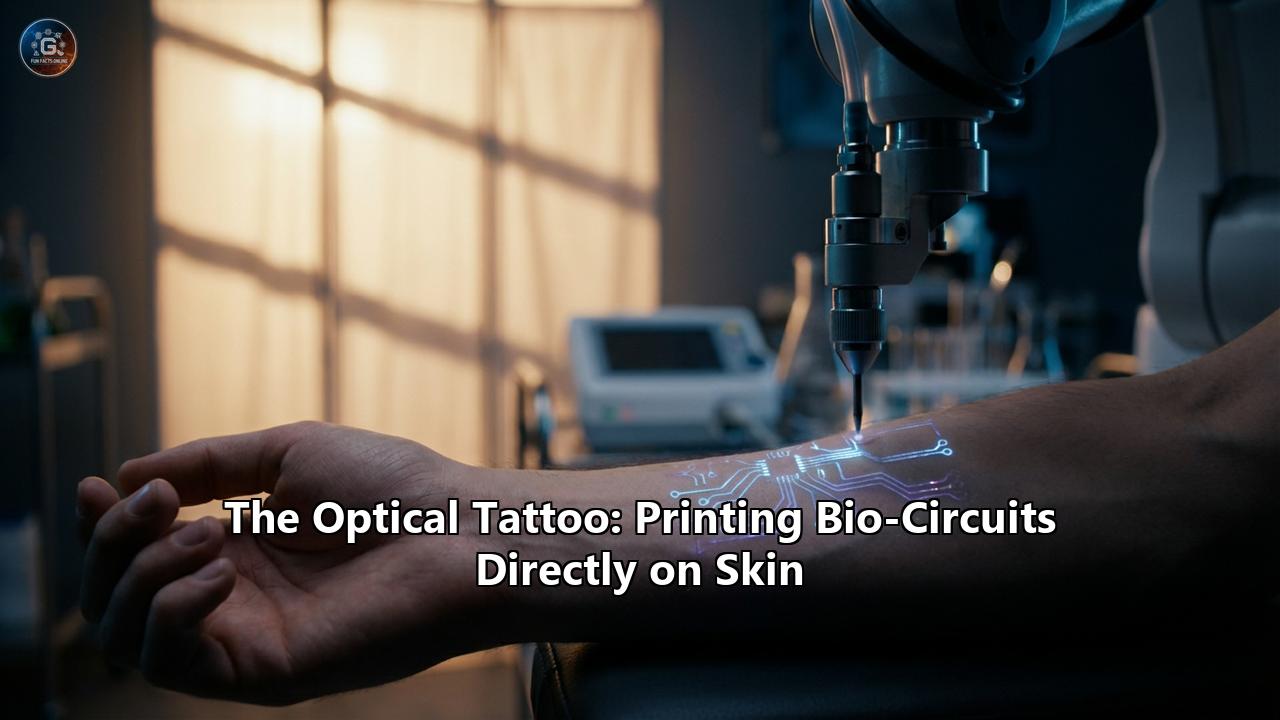
For thousands of years, the tattoo has been a static medium—a permanent mark of identity, memory, or rebellion, etched in ink and held in the dermis. But we are currently witnessing a metamorphosis of this ancient art form. We are moving from the age of ink to the age of information. The "Optical Tattoo" represents the convergence of biology, photonics, and electronics, a technology that does not merely sit on the skin but functions with it.
This is not science fiction. It is the result of breakthroughs in epidermal electronics, photonic skins, and biocompatible optical waveguides. Today, researchers are printing circuits directly onto human skin that can monitor glucose levels, transmit high-speed data via light, and control machines with a mere flick of a wrist. This article explores the comprehensive landscape of this technology: how it works, how it is printed, the materials that make it possible, and the revolution it heralds for healthcare and human capability.
Part 1: The Convergence of Light and Electronics
To understand the "Optical Tattoo," we must first distinguish between the two primary technologies vying for real estate on your arm: Electronic Skin (e-skin) and Photonic Skin.
Electronic Skin relies on the flow of electrons. It mimics the mechanical properties of human tissue—stretchable, soft, and curvilinear—while embedding conductive sensors to measure electrical signals like heart rate (ECG), muscle activity (EMG), and brain waves (EEG). Photonic Skin, however, is the true "optical" breakthrough. Instead of metal wires, it uses optical waveguides—microscopic channels that guide light. Light is immune to electromagnetic interference (EMI), a common plague in hospitals and industrial settings. By using light, photonic skins can measure biochemical markers that electricity struggles to detect. For instance, they can use spectroscopy to analyze the molecular composition of sweat or blood flow (hemodynamics) with extreme precision.The "Optical Tattoo" is the fusion of these domains: a bio-integrated device that uses light to sense and transmit data, printed with materials that are mechanically invisible to the wearer.
Part 2: Fabrication – How to Print on a Human
The greatest challenge in this field has been the substrate. Silicon chips are rigid and brittle; human skin is soft, textured, and constantly moving. Furthermore, skin sheds its outer layer every few weeks. Engineers have developed three primary methods to overcome these hurdles, effectively turning the human body into a printed circuit board (PCB).
1. Laser Scribing and Graphene Reduction
One of the most scalable methods involves Laser-Induced Graphene (LIG). Researchers at institutions like Tsinghua University and the University of Texas at Austin have pioneered a technique where a precursor material, such as graphene oxide (GO) or even a specific polymer, is applied to the skin (or a transfer tattoo paper). A precise laser then "scribes" the pattern.
The heat from the laser reduces the non-conductive oxide into highly conductive graphene. This process creates a "Graphene Electronic Tattoo" (GET) that is mere nanometers thick. These tattoos are transparent (about 85% optical transparency), breathable, and adhere via van der Waals forces—the same molecular attraction that allows geckos to stick to walls. No glues or needles are required.
2. Aerosol Jet Printing
At Duke University, engineers cracked the code on "print-in-place" electronics. Traditional printing requires high heat to sinter (melt together) conductive inks, which would burn human skin. The Duke team developed a silver nanowire ink that remains conductive without the need for high-temperature baking. Using an aerosol jet printer, they can spray this ink directly onto the skin.
The result is a mesh of nanowires that maintains conductivity even when stretched. In demonstrations, this method was used to print leads on a pinky finger that connected to an LED, which remained lit even as the finger bent and flexed. This allows for rapid prototyping of patient-specific layouts—a doctor could "print" a custom sensor array around a patient's wound or joint in minutes.
3. The BodyPrinter
Moving fabrication out of the lab, researchers have developed portable systems like the BodyPrinter (presented at UIST). This is a wearable plotting machine that straps onto the limb. It automates the deposition of conductive inks directly onto the skin, adjusting for the curvature and movement of the body. This democratizes the technology, suggesting a future where "tattoo parlors" might just be automated kiosks that dispense digital functionality.
Part 3: The "Optical" Architecture – Waveguides and Data
The "optical" component of these tattoos is arguably their most powerful feature. It moves beyond simple electrical resistance to complex light manipulation.
Optical Wireless Communication (OWC)
Implantable medical devices (like pacemakers or neural chips) typically use Radio Frequency (RF) to communicate with the outside world. RF is slow, power-hungry, and prone to interference. The Optical Tattoo acts as a high-speed data gateway.
By using Near-Infrared (NIR) light, which penetrates skin and tissue with minimal absorption, data can be transmitted from an implant to a surface optical tattoo at rates far exceeding Bluetooth. This "transdermal optical link" ensures that neural data or cardiac rhythms are offloaded instantly and securely, as the light beam is directional and harder to hack than a broadcasting radio signal.
Biocompatible Waveguides
To guide this light, we need "wires" made of something the body accepts. Scientists have synthesized waveguides from silk fibroin (derived from silkworm cocoons), hydrogels, and biodegradable polymers like PDMS and PLA.
- Silk Waveguides: These can be implanted or printed on the skin. They are optically transparent and, crucially, biodegradable. A silk optical tattoo could monitor a surgical site for infection and then harmlessly dissolve into the body once the wound heals.
- Hydrogel Fibers: These mimic the body's own tissue density. When functionalized with specific chemicals, they can change their refractive index in the presence of glucose or oxygen, effectively modulating the light passing through them to send a signal.
"Magic Ink" and Visual Biosensors
Not all optical data needs a computer to read. The Magic Ink project (University of Colorado Boulder) and similar "smart pigment" initiatives utilize photochromic microcapsules. These are tattoo inks that change color when exposed to specific stimuli.
- UV Detection: A tattoo that is invisible under normal light but turns bright blue when exposed to dangerous levels of UV radiation, acting as a permanent, re-settable sunburn warning.
- Glucose & pH: Inks that shift from green to brown as blood sugar rises, giving diabetics a "glanceable" interface for their health without needles or smartphones.
Part 4: Key Applications
The utility of the Optical Tattoo spans across industries, fundamentally altering how we interact with our own biology.
1. The Medical Revolution
- Continuous Glucose Monitoring (CGM): This is the "killer app" for bio-tattoos. Electrochemical GETs can analyze interstitial fluid (sweat) to track glucose. Combined with optical sensing, this offers a non-invasive "closed loop" for diabetes management.
- Smart Bandages: Optical tattoos printed around a wound can monitor temperature (a sign of infection) and oxygenation (critical for healing). If an infection is detected, the bandage could trigger a heat-release of antibiotics stored in a hydrogel layer.
- Neonatal Care: Premature babies are currently covered in wires and rigid sensors that damage their fragile skin. Epidermal electronics offer a "wireless" NICU experience, where a virtually weightless tattoo monitors vital signs without restricting the infant's movement or parental bonding.
2. Human-Machine Interface (HMI)
- Silent Speech: By placing graphene tattoos on the throat, the sensors can detect the subtle muscle movements and vibrations of the larynx. This allows for "subvocal" communication—controlling a computer or speaking on a phone call by merely mouthing words, a technology with immense potential for security forces or those with speech impairments.
- Drone and Robot Control: High-density EMG tattoos on the forearm can map individual finger tendons. This allows a user to control a drone, a robotic arm, or a video game character with intricate hand gestures, removing the need for joysticks or keyboards.
3. Photomedicine and Therapy
- Photochemical Tissue Bonding: Utilizing the waveguides mentioned earlier, optical tattoos can deliver precise wavelengths of light to deep tissue wounds, activating light-sensitive glues that bond tissue together. This effectively allows light to "stitch" a wound closed.
- Optogenetics: For patients with neural implants, optical tattoos can serve as the external interface, delivering the specific light pulses required to stimulate or silence neurons in the brain, treating conditions like epilepsy or Parkinson's.
Part 5: Challenges and Future Outlook
Despite the triumphs, the Optical Tattoo faces significant hurdles before widespread adoption.
1. Powering the Patch:You cannot plug a tattoo into a wall socket. Current solutions involve NFC (Near Field Communication), where a phone held near the tattoo powers it inductively. However, the future lies in bio-batteries—tattoos that harvest energy from the lactate in our sweat or the thermal gradient of our skin.
2. The Data Privacy of the Body:When your skin becomes a data transmitter, who owns the signal? An optical tattoo that broadcasts your heart rate, stress levels (via skin conductance), and location creates a "biometric fingerprint" that is highly sensitive. Encryption for these "Body Area Networks" (BANs) is a critical area of active research.
3. Durability vs. Physiology:The skin is a hostile environment. It stretches, sweats, and exfoliates. While graphene tattoos are durable, the natural shedding of the stratum corneum means surface tattoos are temporary by design (lasting 1-2 weeks). The industry must decide between low-cost, disposable daily tattoos or semi-permanent "sub-dermal" solutions that sit just below the exfoliation layer.
Conclusion
The Optical Tattoo is more than a wearable; it is the dissolution of the device. It represents a future where technology is not something we carry, but something we are. By printing bio-circuits and optical waveguides directly onto the skin, we are effectively upgrading the human operating system.
From the diabetic child who no longer needs to prick their finger, to the surgeon who controls a robotic arm with a gesture, to the everyday user warned of UV exposure by a glowing mark on their wrist—the optical tattoo promises a world where the boundary between the biological and the digital is not just blurred, but erased. The ink of the future is alive, and it is lighting the way forward.
Reference:
- https://pubmed.ncbi.nlm.nih.gov/28719739/
- https://www.futurity.org/printed-electronic-tattoos-sensors-2177602/
- https://validate.perfdrive.com/?ssa=cc64dfeb-e7a3-f80f-574a-e7e6df4e3b2c&ssb=10932262038&ssc=https%3A%2F%2Fopg.optica.org&ssi=5eeef65c-d3hy-2f35-e532-ca5885ff4a5e&ssk=botmanager_support@radware.com&ssm=49254245418326054131859978425720&ssn=dc5393f13efd09f1a78bb1044bc462401afa6ae464c4-af1d-a9d2-15113e&sso=116dbd2-17e1-6981f2a8f59e28026eec88b11502d5cd3bdead9217f1963d&ssp=44232564771767330727176739925561392&ssq=78717577846249384121078461717218135698203&ssr=MTI0LjIxNy4xODkuMTE5&sst=python-requests%2F2.32.3&ssv=&ssw=
- https://bioengineer.org/optical-wireless-data-transfer-enables-implantable-electronics/
- https://pmc.ncbi.nlm.nih.gov/articles/PMC7411870/
- https://www.colorado.edu/atlas/tech-tattoos
- https://www.youtube.com/watch?v=nJTf48NqZzc
- https://www.mdpi.com/1996-1944/11/8/1283
- https://pmc.ncbi.nlm.nih.gov/articles/PMC10046871/
- https://pmc.ncbi.nlm.nih.gov/articles/PMC4735646/