
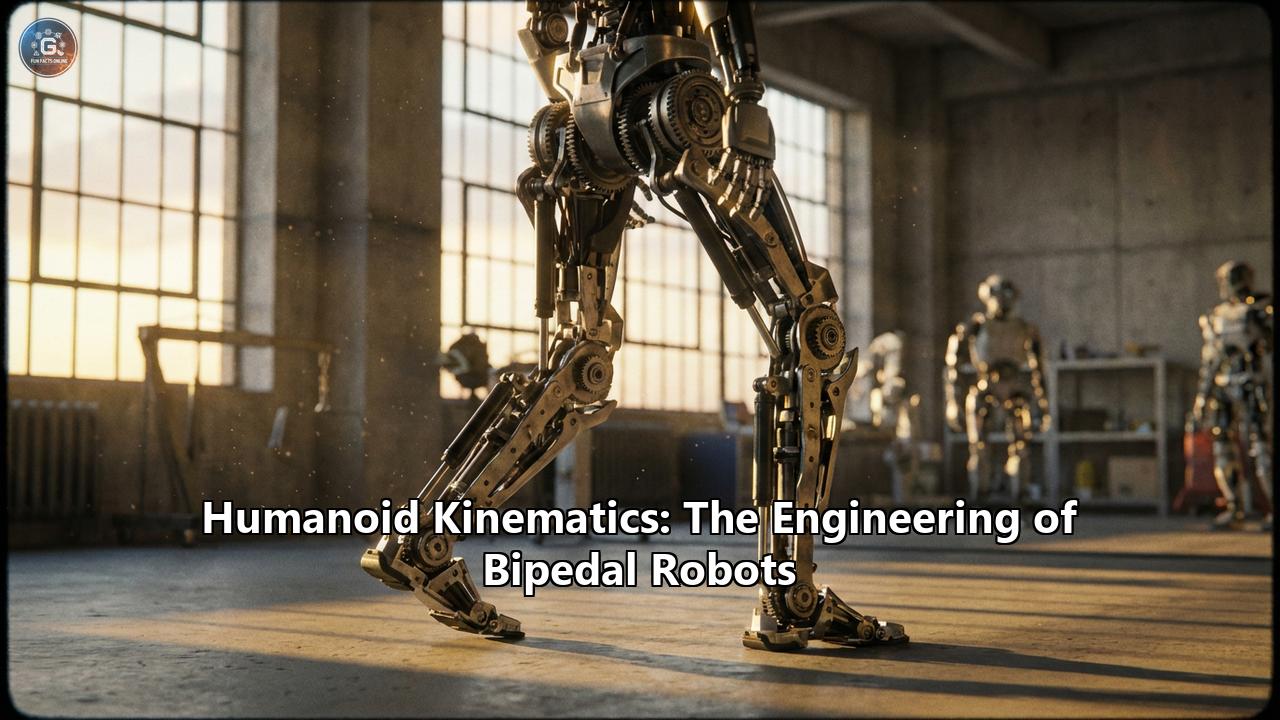
For decades, the idea of a bipedal, human-like robot was confined to the realm of science fiction and carefully staged, tightly controlled laboratory experiments. But as we navigate through 2026, the landscape of robotics has undergone a seismic shift. Humanoid robots have stepped out of the research labs and into global supply chains, automotive manufacturing plants, and even everyday domestic settings. If the past decade was defined by the promise of what these machines could do, the current era is defined by widespread deployment.
At the heart of this revolution is a field of engineering that serves as the invisible puppet master for every metallic limb, every articulated finger, and every perfectly balanced footstep: Humanoid Kinematics.
Kinematics is the branch of classical mechanics that describes the motion of points, bodies, and systems of bodies without considering the forces that cause them to move. In the context of humanoid robots, it is the mathematical translation of the human musculoskeletal system into algorithms and hardware. Replicating the human form is an engineering nightmare. We are inherently unstable, top-heavy creatures balancing on a relatively small base of support. Yet, we navigate stairs, recover from trips, and manipulate delicate objects with effortless grace. Teaching a machine made of titanium, aluminum, and wire to do the same requires solving some of the most complex geometric and physical puzzles in modern engineering.
The Foundation of Movement: Forward and Inverse Kinematics
To understand how a humanoid robot moves, we must first look at how it "thinks" about its own body in physical space. This awareness is rooted in two fundamental concepts: Forward Kinematics (FK) and Inverse Kinematics (IK).
Forward Kinematics is the straightforward calculation of where the robot's end-effector (like its hand or foot) will end up if all its joints are set to specific angles. Imagine holding your arm straight out. If you know the exact length of your upper arm and forearm, and you know the exact angle of your shoulder and elbow, you can use basic trigonometry to calculate exactly where your fingertips are located in 3D space. For a robot, FK is mathematically simple. It is a linear calculation that yields one definitive answer. Inverse Kinematics, however, is where the real magic—and the real headache—happens. IK asks the reverse question: If the robot needs to place its hand on a doorknob located at specific X, Y, and Z coordinates, what angles must the shoulder, elbow, and wrist joints adopt to get it there?Unlike FK, Inverse Kinematics does not have a single correct answer. Think about how many different ways you can contort your arm while keeping your hand fixed on a doorknob. Your elbow can swing up, down, or sideways. In robotics, this means there are multiple, sometimes infinite, mathematical solutions to a single movement goal. Furthermore, some points in space are physically unreachable, and certain joint configurations lead to "singularities"—points where the math breaks down and the robot effectively loses a degree of freedom, causing its joints to lock up or spin wildly.
Modern humanoids rely on incredibly fast, real-time IK solvers. These algorithms calculate thousands of potential joint configurations per second, optimizing for variables like energy efficiency, obstacle avoidance, and balance, before sending the final command to the actuators.
Degrees of Freedom: The Anatomy of a Machine
A "Degree of Freedom" (DoF) refers to a specific, independent direction in which a joint can move. In 3D space, a free-floating object has six degrees of freedom: it can move up/down, left/right, forward/backward (translation), and it can pitch, yaw, and roll (rotation).
The human body is an absolute marvel of mechanical complexity, boasting over 200 degrees of freedom. A human hand alone has roughly 27 DoF, allowing for the astonishing dexterity required to thread a needle or play a piano. Early humanoid robots were stiff and robotic precisely because they lacked sufficient DoF, often featuring only 6 or 7 DoF in their arms and rudimentary, pincer-like grippers.
The robots of 2026 have completely rewritten this standard. A prime example is Tesla’s Optimus Gen 3, which entered scalable commercial production this year. A significant portion of Optimus's engineering complexity is focused entirely on its hands, which have been upgraded to feature 22 degrees of freedom, closely mimicking human capability. To achieve this without making the hands too bulky, Tesla engineers utilized a tendon-driven architecture. By relocating the heavy actuators (the motors) to the robot's forearm, the fingers are manipulated via high-tension cables, much like how human fingers are controlled by muscles in the forearm. This reduces the weight at the end of the arm, exponentially increasing agility and allowing the robot to seamlessly handle both heavy automotive parts and delicate fragile components.
Conversely, some engineers are using kinematics to push beyond human limitations. Boston Dynamics' all-electric Atlas robot, completely redesigned from its earlier hydraulic iterations, boasts 56 total degrees of freedom. But rather than strictly mimicking human joint constraints, the new Atlas features 360-degree rotational joints in its torso, hips, and limbs. Utilizing slip rings that pass electrical currents continuously without tangling wires, Atlas can spin its limbs infinitely. It possesses no "home" position limitation. This allows the robot to perform movements that are mechanically impossible for humans—such as standing up from a prone position by folding its legs backward over its own body. By freeing the kinematic model from biological constraints, engineers have created a machine that is undeniably humanoid in shape, but superhuman in motion.
Bipedal Locomotion: Defying Gravity on Two Legs
While articulating an arm is complex, walking is a marvel of dynamic control. Bipedal locomotion is essentially a process of controlled falling. When you take a step, you throw your center of mass forward, temporarily unbalancing yourself, only to catch yourself with your swinging leg just in time.
In humanoid robotics, this process is modeled using the Inverted Pendulum concept. Imagine balancing a broomstick on the palm of your hand. The heavy head of the broom is the robot's torso (Center of Mass), and your hand is the robot's foot. To keep the broom from falling, you must constantly adjust the position of your hand.
To prevent the robot from tipping over, engineers rely on the calculation of the Zero Moment Point (ZMP). The ZMP is the point on the ground where the total sum of horizontal inertia and gravity forces equals zero. As long as the robot's ZMP remains within its "support polygon" (the area outlined by whichever feet are currently touching the ground), the robot will remain upright. If the ZMP shifts outside this polygon, the robot will fall.
Historically, robots used "static walking." They kept their center of mass rigidly over one foot, moved the other foot forward, planted it securely, and then shifted their weight. It was slow, shuffling, and highly inefficient. Today’s humanoids utilize "dynamic walking." They allow their ZMP to temporarily leave the footprint, utilizing momentum to carry them through the step. This requires split-second kinematic calculations. The robot must calculate the trajectory of its swing leg (the one in the air), the joint torques required for the stance leg (the one on the ground), and the optimal foot placement to absorb the shock of the next step, all while adapting to uneven terrain.
From Kinematics to Dynamics: The Role of Physics and AI
While kinematics deals purely with geometry and motion, Dynamics introduces the messy realities of the physical world: mass, inertia, gravity, friction, and torque. You can calculate the perfect kinematic trajectory for a robot to lift a box, but if that box weighs 50 pounds, the dynamic forces will pull the robot forward, instantly changing its center of mass.
To bridge the gap between kinematics and dynamics, modern robots utilize Whole-Body Control (WBC). Instead of controlling the arms and legs as separate entities, WBC treats the robot as a single interconnected system. If a humanoid reaches out to grab a heavy object, the WBC algorithm simultaneously instructs the ankles to flex, the knees to bend, and the hips to shift backward, dynamically counterbalancing the weight in real-time.
Historically, programming these dynamic responses required millions of lines of hardcoded physics equations. Today, the industry has aggressively pivoted toward Artificial Intelligence—specifically Reinforcement Learning (RL) and Large Behavior Models (LBMs).
Instead of writing explicit rules for how to walk over a pile of rubble, engineers create a hyper-realistic digital twin of the robot in a physics simulator (like Nvidia's Isaac platform or the Newton physics engine). The AI is given a goal—such as "walk from Point A to Point B"—and allowed to experiment through trial and error. Over millions of iterations, the AI discovers the most efficient kinematic synergies. This is exactly how Boston Dynamics taught the electric Atlas to perform highly dynamic stunts and recover from falls, and how Chinese innovators like Unitree Robotics endowed their $16,000 G1 humanoid with the ability to dynamically stabilize itself when violently pushed or kicked. The integration of LBMs allows robots to unify their locomotion and manipulation systems, enabling them to walk, balance, and use tools in continuous, fluid sequences rather than disjointed, robotic steps.
The Muscle of the Machine: Actuation Innovations
A kinematic equation is only as good as the hardware executing it. The joints of a humanoid robot are driven by actuators, which serve as the machine's muscular system.
For years, the gold standard for high-performance humanoids was hydraulic actuation. The legacy Boston Dynamics Atlas utilized highly pressurized fluid pumped through tubes to move its joints. Hydraulics offered immense power and shock absorption, enabling the robot to do backflips and parkour. However, hydraulics are incredibly heavy, prone to catastrophic fluid leaks, incredibly loud, and extremely difficult to scale for commercial manufacturing.
The breakthrough that enabled the 2025/2026 humanoid boom was the perfection of high-torque, all-electric actuators. Modern robots utilize advanced Brushless DC (BLDC) motors paired with harmonic drive gearboxes. These electric actuators offer incredible precision for delicate kinematic tasks, require minimal maintenance, and run silently.
To replicate the shock-absorbing properties of human tendons (and prevent the rigid metal gearboxes from shattering when the robot stomps its foot), engineers employ Series Elastic Actuators (SEAs) and Quasi-Direct Drives. These systems place a highly calibrated spring mechanism between the motor and the joint. When the robot's foot strikes the ground, the spring compresses, physically absorbing the impact spike before it reaches the delicate gears. This mechanical compliance is fed back into the kinematic loop, allowing the robot to "feel" the stiffness of the ground and adjust its gait dynamically.
Sensing the World: The Perception-Kinematics Loop
A robot cannot calculate its kinematics if it does not know where its body is or what its environment looks like. Humanoids rely on a continuous loop of sensory data divided into two categories: proprioception and exteroception.
Proprioception is the robot's awareness of its own body. Joint encoders track the exact micro-degree angle of every hinge and pivot. Inertial Measurement Units (IMUs)—highly advanced versions of the chips that tell your smartphone which way is up—measure the robot's acceleration and rotational velocity. Force-torque sensors located in the ankles and wrists measure the exact physical load the robot is bearing. This data is pumped into the kinematic solver at thousands of hertz, allowing the robot to adjust its balance instantly. Exteroception is the robot's awareness of the outside world. This is primarily handled by 3D spatial cameras, LiDAR, and tactile sensors. For a robot to pick up an irregularly shaped object, its vision system must generate a 3D point cloud of the object, identify the optimal grasp points, and feed those spatial coordinates to the Inverse Kinematics solver. In the newest models, tactile sensors embedded in the silicone fingertips provide haptic feedback. As the robot closes its 22-DoF hand around a fragile object, these sensors detect the exact moment of contact and measure the pressure, stopping the actuators before the object is crushed.The Class of 2026: State of the Art in Action
The convergence of advanced kinematics, electric actuation, and AI has resulted in a spectacular roster of commercially viable humanoids actively transforming global industries.
Tesla Optimus Gen 3: Moving aggressively from prototype to mass deployment, Tesla treats Optimus not just as a robot, but as an autonomous vehicle with legs and arms. Running on the FSD-v15 neural architecture, Optimus units are currently performing unscripted, autonomous tasks in Gigafactories. The shift of its kinematic actuators to the forearms has given it unprecedented, human-level dexterity, allowing it to manipulate flexible cables and delicate battery cells with ease. Boston Dynamics Electric Atlas: Abandoning the hydraulic spaghetti of its predecessor, the electric Atlas is designed for enterprise applications, specifically targeting automotive manufacturing. Its 56 DoF and infinitely rotating joints allow it to maneuver heavy car parts in tight spaces with a level of dynamic, whole-body mobility that surpasses human limitations. Agility Robotics (Digit) & UBTECH (Walker S2): These platforms have proven that practical kinematics can conquer the logistics and heavy industry sectors. Digit’s unique backward-bending "bird leg" kinematics allow it to squat efficiently and lift heavy totes in warehouses, seamlessly integrating into workflows alongside humans. Meanwhile, UBTECH’s Walker S2 has advanced its autonomous systems to the point where, when its battery is low, it uses its kinematic spatial awareness to walk to a station, reach behind its own back, and autonomously swap its own depleted battery for a fresh one in under three minutes. The Chinese Innovators: The rapid scaling of the humanoid industry is heavily propelled by Chinese manufacturers. Companies like Unitree Robotics (with their highly agile G1), Engine AI (with the robust T800), and Astribot (with the rapid-moving S1) are pushing the boundaries of affordable, highly dynamic bipedal platforms. These robots feature up to 29 degrees of freedom in their upper bodies alone and utilize AI-driven whole-body control to adapt to unpredictable, complex environments in real-time.The Future of Humanoid Kinematics
As we look toward the remainder of the decade, the engineering of bipedal robots is shifting from achieving basic stability to mastering extreme efficiency and seamless human integration.
One of the largest remaining hurdles is energy efficiency. The human body is remarkably conservative with energy; walking requires very little caloric burn because our kinematic structure allows our legs to swing like natural pendulums. Robots, by contrast, still expend massive amounts of electrical energy to constantly power their motors and maintain their ZMP. The next frontier in humanoid kinematics lies in "passive dynamic walking"—designing mechanical linkages that can swing and step using gravity alone, requiring motor power only to push off and maintain momentum.
Furthermore, as these machines step out of factories and into homes, eldercare facilities, and hospitals, "safe kinematics" will become paramount. A robot navigating a cluttered living room cannot rely on the rigid, powerful movements of an industrial arm. It must utilize compliant kinematics, allowing its limbs to yield softly if it bumps into a human or a pet, while still possessing the strength to assist someone out of a bed.
The engineering of bipedal robots represents one of the most magnificent cross-disciplinary achievements in modern history. By translating the biological elegance of human movement into the mathematical language of kinematics, dynamics, and artificial intelligence, engineers have not just created a new tool. They have birthed a new paradigm of automation—one that is built in our image, capable of seamlessly inheriting the spaces, tools, and tasks of the human world.
Reference:
- https://www.programming-helper.com/tech/tesla-optimus-gen-3-factory-deployment-2026-humanoid-robots-manufacturing-revolution
- https://www.articsledge.com/post/humanoid-robotics
- https://www.aparobot.com/articles/humanoid-and-quadruped-robots-in-2025-the-year-robotics-moved-toward-reality
- https://cybernews.com/entertainment/optimus-new-hand-upgrade/
- https://www.futunn.com/403
- https://www.youtube.com/watch?v=qgAw5eU9sjY
- https://www.youtube.com/watch?v=SlkUKKWYbpY
- https://www.reddit.com/r/Futurology/comments/1c7y7s2/boston_dynamics_new_humanoid_moves_like_no_robot/
- https://www.scribd.com/document/954426162/Robotics-2-Third-Year-SISY-2025-2026
- https://www.youtube.com/watch?v=jAwwcAhP5zQ
- https://en.wikipedia.org/wiki/Humanoid_robot
- https://www.teslarati.com/tesla-optimus-hands-22-degrees-of-freedom-upgrade-2024/
- https://bostondynamics.com/products/atlas/
- https://humanoidroboticstechnology.com/articles/top-10-chinese-humanoid-robots-of-2026/