
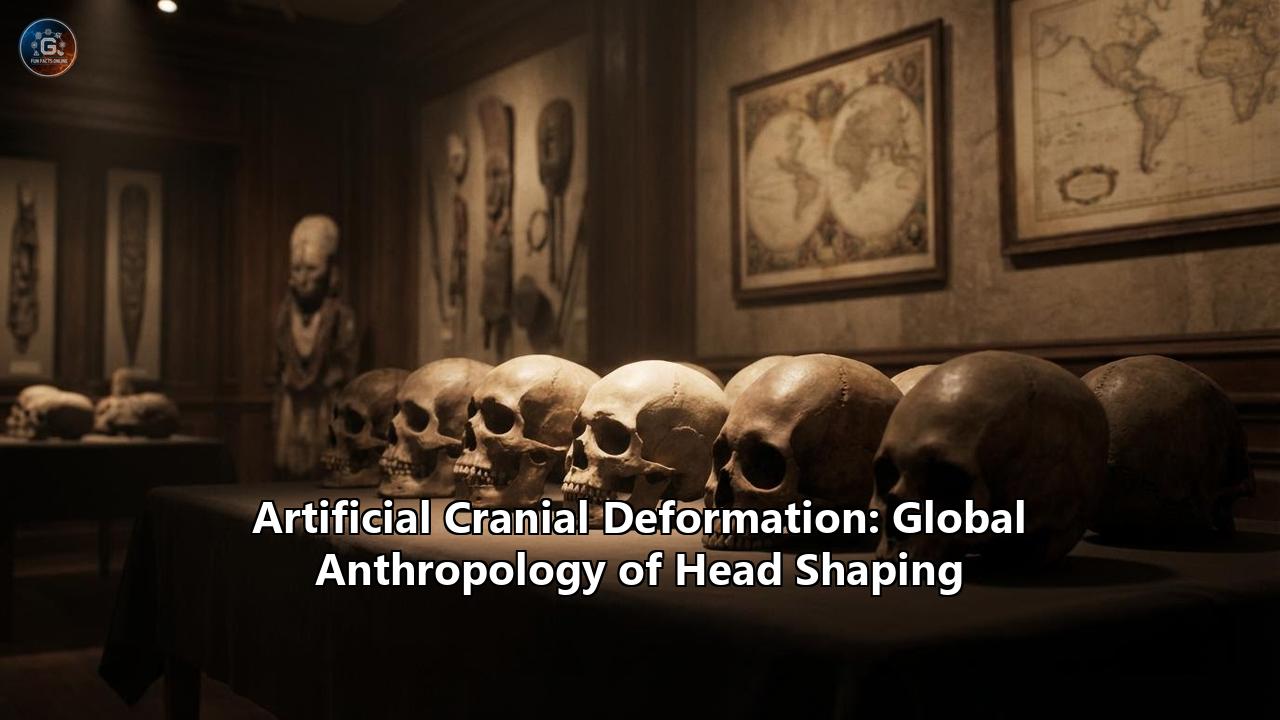
The human body has long been a canvas for cultural expression, identity, and art. From the intricate tattoos of the Polynesian islands to the foot-binding traditions of dynastic China, history is replete with examples of humans modifying their physical forms. Yet, of all the ways our ancestors sought to permanently alter their biology, none is quite as visually striking—or as deeply fascinating—as artificial cranial deformation (ACD).
Also known as head binding, head flattening, or intentional skull modification, artificial cranial deformation is the deliberate distortion of the normal growth of a child's skull through the application of external force. The result is a human head sculpted into astonishing shapes: dramatically elongated cones, wide and flattened spheres, or high, sloped domes. For thousands of years, across continents separated by vast oceans, diverse cultures independently developed methods to mold the human head.
But why did so many ancient societies go to such extraordinary lengths to reshape the very vessel of the human mind? How did they achieve these drastic anatomical changes without causing fatal brain damage? And what does this practice tell us about the lengths to which humans will go to define their identity, status, and concept of beauty?
The Biology of a Malleable Masterpiece
To understand how artificial cranial deformation is possible, one must first look at the brilliant, evolutionary design of the human infant. Human babies are born with brains that are exceptionally large relative to the size of the birth canal. To facilitate a safe delivery, and to allow for the rapid growth of the brain during the first few years of life, an infant's skull is not entirely solid. Instead, it is composed of several separate bony plates connected by flexible, fibrous joints known as cranial sutures. The intersections of these plates feature soft spots called fontanelles.
For the first few years of life, these bones are highly malleable. If left to its own devices, the brain expands, pushing outward uniformly and prompting the skull to grow into the familiar, rounded shape we recognize today. However, if consistent external pressure is applied to the skull during this critical developmental window, the bones will adapt. The skull's growth is not stunted; rather, it is redirected. If growth is blocked in one direction by a tight cloth or a wooden board, the expanding brain simply forces the skull to grow in the path of least resistance.
In a typical case of artificial cranial deformation, the process began just weeks after a child was born. Caregivers—usually mothers—would bind the infant's head using various apparatuses. The binding would be worn continuously for anywhere from six months to several years, until the cranial bones had fused and hardened enough to make the new shape permanent.
The Architectures of the Skull
Anthropologists and bioarchaeologists categorize the methods of cranial modification into a few distinct types, largely dependent on the tools used and the desired aesthetic outcome.
1. Circumferential Deformation: This technique was achieved by wrapping the infant’s head tightly in bands of cloth, leather, or woven textiles. As the brain grew, the circumferential pressure forced the skull to expand upward and backward, resulting in a striking, elongated, cylindrical, or conical shape. This method produced some of the most dramatic deformations in the archaeological record, rendering profiles that appear almost otherworldly. 2. Anteroposterior (Tabular) Deformation: In this method, stiff, flat objects—often wooden boards or padded planks—were bound to the front (anterior) and back (posterior) of the infant's head. This applied immense pressure to the forehead and the occipital region at the back of the skull. The result was a head that was flattened from front to back, forcing the sides of the skull to bulge outward, creating a wider, flatter face and a high, broad crown. 3. Cradleboarding: In many indigenous cultures of the Americas, infants were swaddled and strapped to rigid cradleboards to keep them safe while their mothers worked. Often, a smaller board or padded cushion was strapped over the infant's forehead to keep their head from lolling around. Over time, this constant pressure resulted in a flattened occiput (the back of the head) and a sloping forehead. While sometimes unintentional, many tribes recognized this side effect and eventually embraced it as a desirable cultural trait, purposefully adjusting the cradleboards to ensure a flattened profile.A Global Phenomenon: Tracing the Practice Across Continents
One of the most profound mysteries of artificial cranial deformation is its sheer ubiquity. It was not the isolated quirk of a single eccentric tribe; it was a global phenomenon. Cultures that never interacted, separated by thousands of miles and thousands of years, independently arrived at the exact same practice.
The Americas: Royalty, Gods, and Identity
Perhaps the most famous practitioners of cranial modification were the indigenous peoples of the Americas. For the ancient Maya, whose civilization spanned modern-day Mexico, Guatemala, and Belize, cranial deformation was heavily steeped in religion and social hierarchy. The Maya revered the Maize God, a deity often depicted with a dramatically elongated, swept-back head that mimicked the shape of an ear of corn. Elite Mayan families bound their infants' heads between wooden boards to achieve this sloping, conical profile. This oblique deformation was an immediate, visual indicator of high birth and divine favor. The general populace, if they practiced modification at all, utilized different methods that resulted in a rounded, erect deformation, ensuring that class lines were visibly drawn on the very bodies of the people.
Further south, in the arid coastal deserts of Peru, the Paracas culture (circa 750 BCE to 100 CE) took cranial deformation to its absolute extreme. In 1928, the "father of Peruvian archaeology," Julio Tello, excavated a massive, elaborate graveyard on the Paracas Peninsula. Inside the subterranean tombs, he found hundreds of mummies wrapped in some of the most intricate textiles ever discovered in the pre-Columbian Americas. But it was their skulls that shocked the world. The Paracas skulls are the largest and most profoundly elongated artificially deformed skulls ever found. By utilizing tight circumferential wrapping from birth, the Paracas people pushed the limits of human anatomy, creating high, swooping craniums that became the defining hallmark of their society.
In North America, the practice was widespread among various Native American tribes, including the Chinookan and the Choctaw. Interestingly, the tribe historically referred to by European settlers as the "Flathead Indians" (the Bitterroot Salish) did not actually practice head flattening. The misnomer arose from a misunderstanding of an indigenous sign language gesture; ironically, it was their neighboring tribes, who did practice head flattening, who considered the natural, unmodified rounded heads of the Salish to be "flat".
Eurasia: Warriors of the Steppes and Ancient Migrations
In the Old World, the history of cranial deformation is intimately tied to the great migrations of nomadic warriors. As far back as 400 BCE, the ancient Greek physician Hippocrates wrote of a distant people he called the "Macrocephali" (the Long-heads), noting that they believed those with the longest heads were the most noble, and actively molded their infants' skulls to achieve this.
During Late Antiquity (circa 300 to 600 CE), the practice became a defining cultural trait of nomadic steppe tribes such as the Huns, the Alans, and the Sarmatians. As the Huns swept westward out of Central Asia and into Europe, they brought the custom with them. The fearsome reputation of the Huns was likely visually enhanced by their elongated, towering skulls. The practice was so deeply associated with Hunnic royalty and power that several East Germanic tribes conquered by the Huns—including the Gepids, Ostrogoths, and Burgundians—adopted the custom themselves to emulate their conquerors and secure higher social standing.
Archaeologists have uncovered artificially elongated skulls across Eastern Europe, Russia, and even in Viking-era burials in Scandinavia. In a stunning 2013 discovery in the Alsace region of eastern France, archaeologists unearthed the 1,600-year-old tomb of a wealthy aristocrat. She was buried with rich adornments, but her most striking feature was her heavily deformed, cone-shaped skull—a physical testament to the migration of nomadic cultural practices deep into the heart of Western Europe.
Africa and Oceania: The Mark of Majesty
The practice also thrived in entirely different ecosystems. In the dense rainforests of the Democratic Republic of Congo, the Mangbetu people practiced a form of head elongation called Lipombo well into the 20th century. The Mangbetu viewed an elongated head as a symbol of great majesty, high intelligence, and profound beauty. They enhanced the sloping shape of the skull by weaving their hair into elaborate, woven, basket-like crowns that extended the profile of the head even further.
In the Pacific island nation of Vanuatu, cranial deformation was practiced up until very recently, and oral traditions regarding the practice remain strong. On the island of Malekula, residents viewed the elongated head as a sign of wisdom, a mark of spiritual elevation, and a prerequisite for entering the afterlife. The heads of infants were bound using a combination of woven pandanus leaves and soft clay.
The Curious Case of the "Toulouse Deformity"
While it is easy to relegate artificial cranial deformation to the realm of ancient empires and distant tribes, the practice survived in parts of Western Europe up to the dawn of the 20th century.
In the regions surrounding Toulouse and Deux-Sèvres in western France, a practice known as bandeau was commonplace among the rural peasantry. Unlike the Huns or the Maya, who shaped heads for nobility or divine reverence, the French peasants seemingly stumbled into cranial deformation out of misplaced medical caution. Believing that a newborn's head was highly vulnerable to injuries, impacts, and "evil winds," farmers tightly wrapped their infants' heads in linen bandages.
This binding was left on for months, inadvertently acting as a circumferential deformation device. The result was the déformation toulousaine (Toulouse Deformity)—a distinct elongation and tapering of the skull. Ironically, while ancient cultures viewed elongated skulls as a mark of high intelligence and elite status, the French bourgeoisie looked down upon the Toulouse Deformity as a mark of lower-class peasantry and diminished intellect. The practice only finally died out during the early 1900s as modern pediatric practices and urbanization spread through the French countryside.
Motivations: Why Bind the Mind?
When modern observers look at a profoundly deformed skull, the immediate question is: Why? What drove humans across the globe to endure the tedious, years-long process of molding their children's heads? The anthropological answers are as varied as the cultures themselves, though several overarching themes emerge.
1. Social Status and Hierarchy: In many societies, an elongated skull was the ultimate, un-counterfeitable mark of nobility. You could steal a king's robes, his jewels, or his crown, but you could never steal his skull. It proved, from a glance, that an individual had been cared for and designated for greatness from the very month they were born. 2. Tribal Identity and Cohesion: In regions where multiple tribes fiercely competed for resources, cranial deformation served as an immediate visual marker of "us" versus "them". If a warrior fell in battle, his skull would instantly identify his allegiance. It forged an unbreakable sense of in-group solidarity. 3. Spiritual and Religious Beliefs: The head is the highest point of the human body, the seat of the senses, and logically, the part closest to the heavens. Many cultures believed that altering the shape of the skull enhanced a person's receptivity to the spiritual realm. For the Maya, it was about mimicking the gods. For others, a modified skull was thought to prevent evil spirits from entering the child's body through the fontanelles. 4. Aesthetics and Beauty: Human standards of beauty are incredibly subjective. Just as some cultures find beauty in elongated necks, stretched earlobes, or bound feet, societies that practiced ACD simply viewed the altered skull shape as aesthetically superior. The sloping, sweeping lines of an elongated head were considered the pinnacle of physical attractiveness.Mind over Matter: The Medical and Cognitive Realities
Perhaps the most astonishing aspect of artificial cranial deformation is the medical reality: despite the extreme physical alteration of the skull, the practice appears to have had little to no negative impact on the cognitive function of the individual.
To the modern observer, tightly binding a baby's head sounds like a recipe for severe brain damage. However, the human brain is remarkably adaptable. As long as the volume of the cranial cavity is not reduced, the brain simply changes its shape to fit the new container. Research, including a comprehensive 2007 paper published in the journal Neurosurgery, concluded that "there does not seem to be any evidence of negative effect on the societies that have practiced even very severe forms of intentional cranial deformation". The volume of a deformed skull is virtually identical to that of an undeformed skull; the brain mass remains the same, it is merely redistributed.
That is not to say the practice was entirely without risk. Modern bioarchaeological studies suggest that if the binding was applied too tightly, too quickly, or asymmetrically, it could potentially cause localized issues. Some researchers theorize that extreme pressure could, in rare cases, lead to auditory or visual impairments due to the shifting of the eye sockets and ear canals, or potentially increase the risk of localized neurological pressure. However, the overwhelming ethnographic and archaeological evidence suggests that individuals with deformed skulls lived completely normal lives, possessing the same intelligence, emotional capacity, and physical capabilities as those with unaltered skulls. They ruled empires, engineered vast aqueducts, and created complex astronomical calendars.
The Paracas Skulls: Debunking the Extraterrestrial Myth
No discussion of artificial cranial deformation is complete without addressing the modern mythology that has sprung up around it—specifically, the infamous Paracas skulls of Peru.
Because the Paracas skulls are so dramatically elongated—some appearing up to 25% larger and 60% heavier than a standard human skull due to the exaggerated bone growth pathways—they have become the focal point of intense pseudoscientific speculation. Popularized by television shows like Ancient Aliens and fringe internet communities, conspiracy theorists argue that the Paracas skulls are not the result of human head-binding, but are rather the remains of an extraterrestrial race, or human-alien hybrids (the "Nephilim").
Proponents of the alien theory often point to alleged anatomical anomalies. They claim that the Paracas skulls are missing the sagittal suture (the connective tissue joint between the two parietal bones at the top of the skull) and that the foramen magnum (the hole at the base of the skull where the spinal cord enters) is positioned unusually far back. Furthermore, amateur researchers like Brien Foerster have publicized claims that DNA testing on the skulls revealed mitochondrial DNA (mtDNA) with mutations "unknown in any human, primate, or animal".
However, mainstream archaeologists, geneticists, and anthropologists have thoroughly debunked these extraterrestrial claims. The "missing" sutures are easily explained by the biology of cranial deformation: the immense, constant pressure of head-binding can cause cranial sutures to fuse prematurely (a condition similar to craniosynostosis), entirely obliterating the visible seam in the bone by the time the individual reaches adulthood. The altered position of the foramen magnum is likewise a direct mechanical consequence of the skull's base being subjected to years of structural stress; as the back of the head is forced upward and backward, the base of the skull warps to accommodate the shifting center of gravity.
As for the DNA, legitimate scientific sequencing has confirmed beyond any doubt that the Paracas skulls are 100% human. Interestingly, recent rigorous DNA analyses have revealed genuine historical surprises—just not of the alien variety. Some genetic testing has indicated that certain Paracas individuals possessed mitochondrial DNA haplogroups (such as Haplogroup T2b) that are more commonly associated with Eurasian populations. Rather than proving an otherworldly origin, this fascinating genetic data points to incredibly complex, ancient human migration patterns, suggesting that the Americas may have been populated by more diverse waves of human groups than previously understood. The truth of the Paracas skulls—that they represent the extreme ingenuity, cultural dedication, and migratory history of ancient human beings—is infinitely more wondrous than any science fiction story.
The Legacy of the Molded Mind
Today, the practice of artificial cranial deformation has almost entirely vanished from the earth. The arrival of European colonizers in the Americas and Africa, armed with different cultural norms and religious dogmas, led to the aggressive suppression of indigenous body modification practices. Furthermore, globalization, the homogenization of global beauty standards, and modern medical integration have relegated head binding to the pages of history.
Yet, the legacy of artificial cranial deformation remains a powerful testament to the human condition. When we look at an ancient, elongated skull in a museum display, we are not looking at a freak of nature or a relic of barbarism. We are looking at a profound expression of parental care and cultural pride. We are looking at a mother, thousands of years ago, carefully wrapping soft cloth around her newborn's head, whispering ancient hopes that her child would grow up to be noble, wise, beautiful, and deeply connected to their people.
The study of artificial cranial deformation bridges the gap between anatomy and anthropology. It reminds us that the human body is not merely a biological machine dictated by genetics; it is a living, breathing canvas. For over 10,000 years, humanity proved that even the solid bone of the skull could be made to bow to the sheer force of human culture, tradition, and identity.
Reference:
- https://en.wikipedia.org/wiki/Artificial_cranial_deformation
- https://www.atlasobscura.com/articles/head-space-artificial-cranial-deformation
- https://www.smithsonianmag.com/smart-news/parents-have-been-reshaping-their-kids-skulls-45000-years-180957343/
- https://www.thearchaeologist.org/blog/the-mysterious-elongated-skulls-of-paracas-a-glimpse-into-ancient-practices
- https://pmc.ncbi.nlm.nih.gov/articles/PMC6980596/
- https://www.discovermagazine.com/tracing-the-history-and-health-impacts-of-skull-modification-43269
- https://medium.com/teatime-history/why-did-cultures-artificially-deform-the-human-skull-in-ancient-times-53c9b1be0226
- https://www.youtube.com/watch?v=96bb9FflYkc
- https://www.alphabiolabs.co.uk/blog/alien-skulls-dna-tested/
- https://www.researchgate.net/publication/314422218_Artificial_Cranial_Deformation_Potential_Implications_for_Affected_Brain_Function
- https://www.quora.com/Whats-your-opinion-on-the-Paracas-skulls-which-have-different-DNA-than-normal-humans-and-are-elongated-not-due-to-skull-binding
- https://www.reddit.com/r/mesoamerica/comments/o4ai12/elongated_skulls_dna_and_questions_from_a_skeptic/