
The typical image of a revolution in physics is a particle collider smashing atoms at the speed of light or a telescope peering into the cosmic dawn. But in 2018, the scientific world was upended by something far simpler: a piece of scotch tape, a few flakes of carbon, and a literal twist.
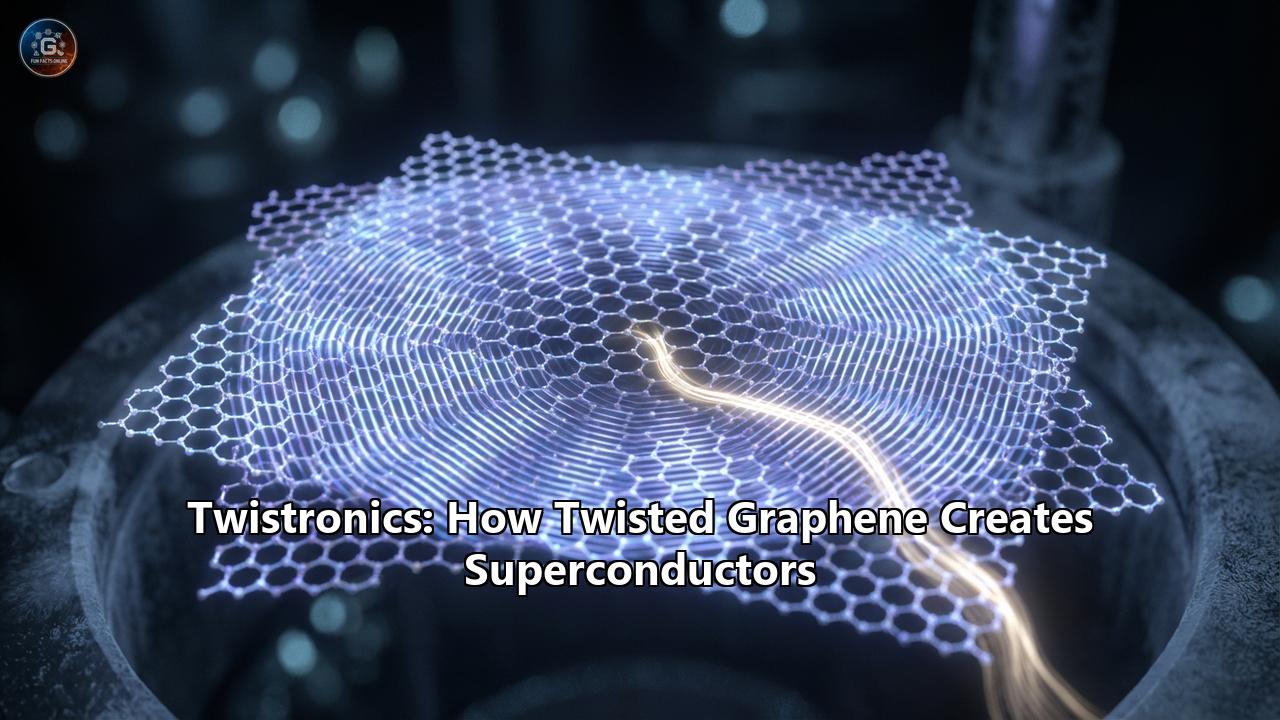
When a team at the Massachusetts Institute of Technology (MIT) rotated two sheets of graphene by exactly 1.1 degrees, they didn’t just create a new material; they unlocked a new dimension of condensed matter physics. This “magic angle” transformed the normally conductive graphene into an insulator, and then, with the flick of an electric switch, into a superconductor—a material that conducts electricity with zero resistance.
This discovery birthed the field of Twistronics, a discipline that asks a deceptively simple question: What happens when the geometry of a material becomes as important as its chemistry?
To understand why this is revolutionary, we must look beyond the headlines of "zero-resistance energy." Twistronics represents a fundamental shift in how we engineer matter. For the last century, we have modified materials by changing their chemical composition—doping silicon with phosphorus to make transistors, or alloying steel with chromium to prevent rust. Twistronics suggests that we can change a material’s destiny simply by rotating it.
This article is a deep dive into that twisted world. We will explore the quantum mechanics of Moiré superlattices, the engineering marvel of the "tear-and-stack" technique, the hunt for the "Holy Grail" of room-temperature superconductivity, and the future where twisted materials could power quantum computers and ultra-efficient optical networks.
Part I: The Prelude to Magic
The Graphene Paradox
To appreciate the "magic" of 1.1 degrees, we must first understand the mundane excellence of 0 degrees. Graphene, isolated in 2004 by Andre Geim and Konstantin Novoselov (who won the Nobel Prize for it), is a single layer of carbon atoms arranged in a hexagonal honeycomb lattice.
Graphene is a "semimetal." Its electrons are fast—exceptionally fast. In a standard conductor like copper, electrons bump into atoms and each other, creating resistance. In graphene, electrons behave as if they have no mass. They zip through the carbon lattice at 1/300th the speed of light, behaving like "Dirac fermions." This makes graphene an incredible conductor, but a boring one for those looking for exotic quantum states. The electrons move too quickly to interact with each other. They are like commuters on a high-speed train, ignoring their fellow passengers.
For superconductivity to occur, you need the opposite behavior. You need electrons to talk to each other. In conventional superconductors, electrons form "Cooper pairs," a marriage of two negatively charged particles that normally repel each other but are bound together by vibrations in the atomic lattice (phonons). These pairs flow in unison, like a superfluid, without resistance.
For years, theorists believed that to get graphene to superconduct, you would need to chemically dope it heavily or subject it to immense pressures. But a small group of theorists had a different idea.
The Prophet of the Twist
In 2011, Allan MacDonald, a theorist at the University of Texas at Austin, and his postdoctoral researcher Rafi Bistritzer, published a paper that was largely ignored by the mainstream community. They were calculating what would happen if you took two sheets of graphene and rotated them.
They predicted that at a very specific angle—around 1.1 degrees—something strange would happen to the electronic band structure. The massive speed of the graphene electrons would vanish. The "Dirac cones" (the graphs physicists use to map electron energy and momentum) would flatten out.
In physics terms, this is called a flat band. When an electronic band becomes flat, the kinetic energy of the electrons drops to zero. The electrons stop zooming around. And when electrons stop moving, they start interacting. The "commuters" get off the high-speed train and are forced into a crowded room. The dominance of kinetic energy is replaced by the dominance of Coulomb interactions (the repulsion between negative charges).
MacDonald and Bistritzer predicted that this "magic angle" would be a playground for correlated physics. But the experimental challenges were so immense that many dismissed the prediction as a mathematical curiosity. Creating a device with 1.1-degree precision was considered impossible. If you were off by just 0.1 degrees, the magic would disappear.
Part II: The Moiré Era Begins
The "Tear and Stack" Revolution
The breakthrough didn't come from a new million-dollar machine, but from a clever bit of manual dexterity known as the "tear and stack" method.
In the lab of Pablo Jarillo-Herrero at MIT, a graduate student named Yuan Cao was trying to solve the alignment problem. If you take two different flakes of graphene, you can never be sure of their original lattice orientation. Twisting them by 1.1 degrees is meaningless if you don't know where 0 degrees is.
The solution was elegant: don't use two flakes. Use one.
The Process:- Isolate: Start with a single, pristine flake of graphene on a substrate.
- Tear: Using a sticky polymer slide, pick up only half of the flake. The graphene tears, leaving half on the substrate and half on the polymer. Because they came from the same crystal, these two pieces are perfectly aligned—atom for atom.
- Twist: Rotate the stage holding the substrate by exactly 1.1 degrees.
- Stack: Lower the top half onto the bottom half.
This creates a Twisted Bilayer Graphene (TBG) heterostructure. But you can't see the atoms. What you see, if you look with a scanning tunneling microscope, is a Moiré pattern.
The Physics of the Moiré
A Moiré pattern is the interference pattern created when two grids are overlaid. You see it when looking through two screen doors or overlapping tulle fabrics. In twisted graphene, the two hexagonal atomic lattices interfere to create a new, larger periodic pattern—a "superlattice."
While the carbon-carbon distance in graphene is about 0.14 nanometers, the Moiré superlattice at the magic angle has a periodicity of about 13 nanometers. This massive unit cell is the key.
The Moiré potential acts as a trap for electrons. It creates a new landscape of energy valleys. At 1.1 degrees, the tunneling energy between the two layers exactly cancels out the kinetic energy of the electrons within the layers. The electrons are trapped in the Moiré cells.
The 2018 Discovery
In March 2018, Jarillo-Herrero’s team dropped two papers in Nature that shocked the physics world.
The first paper showed that Magic-Angle Twisted Bilayer Graphene (MATBG) could become a Mott Insulator. This is a state where electrons are stuck in place not because there are no paths to flow (like in wood or glass), but because they are repelling each other so strongly that traffic is gridlocked.
The second paper was the bombshell. By applying a tiny gate voltage—essentially a small electric field that adds a few extra electrons to the system—the Mott Insulator transformed into a Superconductor.
The critical temperature ($T_c$) was low, about 1.7 Kelvin. This is far colder than the "high-temperature" superconductors (which work at around 100 Kelvin). However, the density of electrons was incredibly low. Standard superconductors need billions of times more electrons to carry the current. MATBG was superconducting with a skeleton crew of charge carriers.
This suggested that the mechanism of superconductivity was not the standard phonon-driven one (BCS theory) found in aluminum or lead. It looked suspiciously like the mechanism in cuprates—the mysterious copper-oxide ceramics that hold the record for high-temperature superconductivity.
Suddenly, graphene wasn't just a material; it was a Rosetta Stone. Physicists hoped that by solving the puzzle of twisted graphene, they could unlock the secrets of cuprates and design room-temperature superconductors.
Part III: The Zoo of Phases
The Phase Diagram
If you plot the behavior of MATBG on a graph with Temperature on the Y-axis and Carrier Density (controlled by gate voltage) on the X-axis, you get a "phase diagram."
The phase diagram of magic-angle graphene is complex and beautiful, featuring a "superconducting dome."
- The Parent State: At the center is the Mott Insulator state.
- The Domes: As you add electrons (doping), you enter the superconducting dome.
- Strange Metals: Above the superconducting temperature, the material behaves as a "strange metal," where resistance scales linearly with temperature, a behavior that defies standard quantum theory.
This diagram is essentially a fractal of the cuprate phase diagram, but cleaner. In cuprates, you have to make a new chemical sample for every data point. In twistronics, you just turn a knob on a voltage source to move across the diagram. You can sweep from insulator to superconductor to metal in seconds.
Ferromagnetism and Topology
The magic didn't stop at superconductivity. Researchers found that at certain alignments, twisted graphene exhibits orbital ferromagnetism.
In standard magnets (like iron), magnetism comes from the spin of electrons. In twisted graphene, the magnetism comes from the orbital motion of electrons swirling around the Moiré cells. They create tiny current loops, effectively turning the material into a grid of microscopic electromagnets.
This leads to the Quantum Anomalous Hall Effect, where electricity flows along the edges of the material with zero resistance and zero magnetic field, protected by the laws of topology. This is a crucial property for developing low-power quantum electronics.
Part IV: Beyond Carbon – The Expanding Universe of Twistronics
While graphene grabbed the headlines, twistronics is not limited to carbon. The principles apply to any 2D material held together by Van der Waals forces.
Transition Metal Dichalcogenides (TMDs)
Materials like Tungsten Diselenide ($WSe_2$) and Molybdenum Disulfide ($MoS_2$) are semiconductors. When you twist bilayers of these materials, you get Moiré patterns similar to graphene, but with a twist (pun intended): Moiré Excitons.
An exciton is a quasiparticle consisting of an electron and a "hole" (the empty spot left by an electron) bound together. In twisted TMDs, the Moiré potential traps these excitons in specific spots in the superlattice.
This has created arrays of "single-photon emitters." Imagine a grid where each cell of the Moiré pattern can trap and release exactly one photon at a time. This is a holy grail for quantum information technology, which relies on single photons to carry qubits.
Furthermore, TMDs allow for Wigner Crystals. In 2020 and 2021, researchers observed electrons in twisted $WSe_2$ freezing into a solid crystal lattice due to their mutual repulsion. This "electron ice" is a state of matter predicted decades ago but rarely seen so clearly.
Twisted Homostructures vs. Heterostructures
- Homostructures: Stacking graphene on graphene, or $WSe_2$ on $WSe_2$. The lattice mismatch comes purely from the twist angle.
- Heterostructures: Stacking graphene on Hexagonal Boron Nitride (hBN). Since hBN has a slightly different lattice size than graphene (about 1.8% larger), a Moiré pattern forms even at zero twist angle. This provides a "built-in" Moiré potential that can be fine-tuned by twisting.
The Rise of Multilayers
Why stop at two layers?
- Twisted Trilayer Graphene: In 2021, researchers discovered that three layers of graphene, twisted in a specific sequence, are even more robust superconductors than bilayers. They can sustain superconductivity at higher magnetic fields, hinting at "spin-triplet" superconductivity, a very rare and useful type for quantum computing.
- Quadrilayers and Pentalayers: The complexity grows. Each layer adds new "bands" and new possibilities for tuning the electronic structure.
Part V: Engineering the Future
The Fabrication Challenge
For the first few years, twistronics was an artisanal craft. "Tear and stack" is brilliant, but it is slow and has a low yield. The relaxation of the atomic lattice is a major headache. The atoms want to snap back into the lower-energy AB stacking (Bernal stacking). They don't want to stay at 1.1 degrees.
This leads to "twist angle disorder." A sample might be 1.1 degrees in one corner and 1.2 degrees in another. Since the "magic" window is so narrow (roughly 1.0 to 1.2 degrees), a small variation can kill the superconductivity.
New Solutions:- Automated Assembly: Labs are building robotic stackers that use machine vision to align flakes with higher precision than human hands.
- MEGA2D: A technique developed at Harvard uses micro-electromechanical systems (MEMS) to dynamically twist the layers after the device is made. This allows researchers to tune the angle in real-time, effectively scanning through different physics in a single sample.
- Sonication and Cutting: New methods involve using ultrasonic waves to cut flakes cleanly or using laser-based cutting to avoid the ragged edges of manual tearing.
The Promise: What Can We Build?
1. Tunable Superconducting QubitsCurrent quantum computers (like Google's Sycamore) use aluminum superconductors. These are fixed; their properties are set during fabrication. A twistronic qubit could be tuned electrostatically. You could turn the superconductivity on or off, or change its frequency, just by changing a gate voltage. This could lead to a "voltage-controlled quantum computer," which would be smaller and easier to control.
2. "Smart" Materials for OpticsThe interaction between light and twisted materials is profound. Twisted graphene interacts strongly with infrared light. Twisted TMDs interact with visible light. We could build "super-resolution" sensors or cameras that can switch their sensitivity spectrum instantly.
3. Room-Temperature Superconductivity?This is the ultimate dream. MATBG itself will likely never be a room-temperature superconductor; its $T_c$ is too low. However, it serves as a simulator. By understanding exactly how the strong correlations in the flat bands create superconductivity, theorists hope to design new materials—perhaps synthetic lattices that don't exist in nature—that replicate the "flat band" physics at room temperature.
Part VI: The Deep Physics – Why is the Angle "Magic"?
The Bistritzer-MacDonald Model Revisited
To truly understand the "magic," we have to look at the electron tunneling.
In a bilayer, an electron can sit in the top layer or the bottom layer. It can also "tunnel" (hop) between them.
There are two types of hopping:
- AA Hopping: Hopping between an atom in layer 1 and an atom directly below it in layer 2.
- AB Hopping: Hopping between an atom in layer 1 and the center of a hexagon in layer 2.
At most angles, the velocity of the electron ($v_F$) is dominated by its movement within the sheet. But the twist creates a geometric frustration. As the angle decreases, the Moiré period gets larger ($L \approx a / \theta$). The time it takes for an electron to cross a Moiré cell increases.
At the magic angle, the time scale of the interlayer tunneling becomes comparable to the time scale of the intralayer motion. The two cancel out. The "renormalized Fermi velocity" drops to zero.
Mathematically, the Hamiltonian (the energy operator) of the system develops zero-energy eigenvalues that are "flat" across momentum space. This means the electron has no preferred speed—it is heavy, sluggish, and highly susceptible to the push and pull of its neighbors.
The "Hypermagic" Regime
Recent theoretical work has proposed "hypermagic" angles in other lattices or multilayer stacks where not just one band becomes flat, but multiple bands become flat simultaneously. This could lead to even more exotic states, such as "fractional Chern insulators" or high-order topological phases that have no analog in current materials science.
Conclusion: The Twist is Just the Beginning
Twistronics has transformed condensed matter physics from a study of "what we find in the ground" to "what we can build with geometry."
We are no longer limited to the periodic table. We have a third axis of control: the twist angle. This has democratized the study of strongly correlated physics. You don't need a high-pressure diamond anvil or a massive magnet lab to study the deepest mysteries of quantum mechanics. You just need a good microscope, some tape, and a steady hand.
As we improve our ability to twist, stack, and manipulate these 2D Lego blocks, we are moving toward an era of designer quantum materials. We are approaching a future where we can custom-order a superconductor or a topological insulator by specifying the layer count and the twist angle, much like a chef follows a recipe.
The "magic" of 1.1 degrees was just the first opening of the door. The room behind it is vast, and we have only just stepped inside.
Reference:
- https://physicsworld.com/a/magic-angle-graphene-reveals-a-host-of-new-states/
- https://www.electronicsforu.com/technology-trends/must-read/twistronics-twisting-changes-properties-2d-materials
- https://en.wikipedia.org/wiki/Twistronics
- https://collaborate.princeton.edu/en/publications/magic-angles-in-twisted-bilayer-graphene-near-commensuration-towa/
- https://marcuspandey.medium.com/the-magic-angle-how-a-tiny-twist-in-layered-graphene-unlocks-superconductivity-e2c9586f8372
- https://www.pnas.org/doi/10.1073/pnas.2410993121
- https://materialsmodeling.org/publications/2022-The-moire-potential-in-twisted-transition-metal-dichalcogenide-bilayers/
- https://www.researchgate.net/figure/Schematic-of-the-stacking-process-for-the-fabrication-of-twisted-bilayer-graphene-with_fig1_336910373
- https://xlab.hku.hk/pdf/Stacking_order_engineering_of_two-dimensional_materials_and_device_applications.pdf
- https://arxiv.org/pdf/2401.04313
- https://physicstoday.aip.org/features/twisted-bilayer-graphenes-gallery-of-phases
- https://physicsworld.com/a/twistronics-lights-up-with-moire-exciton-experiments/
- https://www.researchgate.net/publication/393598115_Twisted_Bilayer_Graphene_at_the_Magic_Angle_A_Review_of_Highly_Correlated_Physics_and_Unconventional_Superconductivity
- https://www.youtube.com/watch?v=ksnQ3dW0n0o
- https://www.researchgate.net/publication/393722198_Twistronics_and_moire_superlattice_physics_in_2D_transition_metal_dichalcogenides
- https://pubmed.ncbi.nlm.nih.gov/40664223/
- https://eureka.patsnap.com/report-how-twistronics-redefines-moir-superlattices
- https://eureka.patsnap.com/report-how-twistronics-facilitates-novel-exciton-behaviors
- https://www.researchgate.net/publication/362324144_Bistritzer-MacDonald_dynamics_in_twisted_bilayer_graphene
- https://cpb.iphy.ac.cn/article/2019/2006/cpb_28_10_107304.html
- https://pmc.ncbi.nlm.nih.gov/articles/PMC8986456/