
The Unseen Battle: How Bone-Crushing Predators Forged an Evolutionary Arms Race
In the grand theater of evolution, a silent, brutal war has been waged for millions of years. It is a conflict not of armies and nations, but of sinew and bone, of hunter and hunted. This is the story of the evolutionary arms race between bone-crushing predators and their prey, a relentless cycle of adaptation and counter-adaptation that has sculpted some of the most formidable creatures to have ever walked the Earth. From the savage efficiency of the spotted hyena to the colossal power of Tyrannosaurus rex, the ability to shatter bone has been a game-changing innovation, unlocking a vital source of nutrients and driving a co-evolutionary dance of epic proportions.
The Advantage of the Shattered Bone: Why Become a Bone-Crusher?
In the unforgiving wilderness, every calorie counts. For a predator, a kill is not just a meal; it is a precious package of energy that must be maximized. While flesh and organs are the primary targets, bone marrow and the bone itself represent a rich, often untapped, source of fats and minerals. However, accessing this bounty requires a specialized toolkit. Durophagy, the eating behavior of animals that consume hard-shelled or exoskeleton-bearing organisms, is a challenging niche to fill. It demands a suite of remarkable adaptations, from incredibly powerful jaws and robust teeth to skulls built to withstand immense forces.
The predators that have successfully evolved these traits have gained a significant competitive edge. In environments where prey is scarce or competition is fierce, the ability to consume an entire carcass, leaving virtually nothing behind, can be the difference between survival and starvation. This evolutionary pressure has led to a fascinating phenomenon known as convergent evolution, where unrelated species independently develop similar traits to solve similar problems. The bone-crushing predators are a prime example of this, with different lineages across vast stretches of geological time arriving at remarkably similar biomechanical solutions for shattering bone.
The Hyena: A Modern Master of Osteophagy
When one thinks of a bone-crushing predator, the spotted hyena (Crocuta crocuta) is often the first animal that comes to mind. These highly successful carnivores of the African savanna are not mere scavengers, as they are often portrayed in popular culture. They are incredibly skilled hunters, capable of taking down a wide variety of prey, from small gazelles to large wildebeest and zebras. What sets them apart is their extraordinary ability to consume virtually every part of their kill, including the bones.
The spotted hyena's skull is a masterpiece of biomechanical engineering, perfectly adapted for durophagy. It possesses a bite force of around 1,100 pounds per square inch (psi), significantly stronger than that of many other large carnivores. This immense power is generated by massive jaw muscles, particularly the temporalis and masseter muscles, which are anchored to a prominent sagittal crest running along the top of the skull. This crest provides a large surface area for muscle attachment, a common feature in animals that require a powerful bite.
The dental adaptations of the spotted hyena are equally impressive. Their premolars, the teeth located between the canines and the back molars, have evolved from blade-like structures into heavy, conical hammers. These robust teeth are designed to withstand the incredible forces required to crack open large bones. The enamel of their teeth also has a complex, three-dimensional structure that makes it highly resistant to fracturing under stress.
The evolution of the hyena family (Hyaenidae) showcases a clear trend towards increased bone-crushing capabilities. Early hyenas were more dog-like in their build, but over millions of years, a lineage of bone-crushing hyenas emerged and thrived, eventually giving rise to the modern spotted, brown, and striped hyenas. The fossil record reveals a gradual thickening and strengthening of their skulls and a specialization of their dentition for a durophagous diet.
The development of these bone-crushing adaptations in hyenas is a lengthy process. A young hyena's skull does not reach its full adult size and shape until around 35 months of age, long after they have been weaned. This extended development period highlights the significant investment in building the formidable weaponry necessary for a life of bone-crushing.
The Great Cats: A Tale of Two Kitties
The family of cats, the Felidae, has also produced its share of powerful predators, with some exhibiting remarkable bone-crushing abilities. While not as specialized in durophagy as hyenas, certain feline lineages have evolved the strength and weaponry to tackle the skeletons of their prey.
The Modern Skull-Crusher: The JaguarAmong modern big cats, the jaguar (Panthera onca) stands out for its incredibly powerful bite. While a tiger may have a stronger absolute bite force, the jaguar's bite is the strongest relative to its size. This is due to the arrangement of its jaw muscles and a slightly shorter jaw, which increases leverage. This powerful bite allows the jaguar to employ a unique killing technique: a direct bite to the skull of its prey, piercing through bone to the brain. This is a departure from the typical throat-suffocating bite used by many other large cats.
The American Lion: A Bone-Crushing King of the PleistoceneThe Pleistocene epoch was a time of giants, and roaming the landscapes of North America was one of the largest cats to have ever lived: the American lion (Panthera atrox). This formidable predator was about 25% larger than a modern African lion and possessed a suite of adaptations that suggest it was a proficient bone-crusher.
Fossil evidence indicates that Panthera atrox had a remarkably robust skull and incredibly thick teeth, often described as being like "railroad spikes." These features suggest a jaw capable of immense crushing power, more akin to a hydraulic press than the slicing jaws of its contemporary, the saber-toothed cat Smilodon fatalis. The American lion's postcranial skeleton was also incredibly robust, even more so than that of a modern lion, indicating a powerful build for tackling large and powerful prey.
Unlike the saber-toothed cats, which had long, blade-like canines ill-suited for bone contact, the American lion's dentition was built for crushing. This suggests a feeding strategy that involved not just consuming flesh but also breaking open bones to access the nutritious marrow within. This is a clear example of convergent evolution, with a feline lineage developing bone-crushing capabilities similar to those seen in hyenas.
The prey of the American lion included a variety of large herbivores of the Pleistocene, such as horses, camels, and the young of mammoths and mastodons. The ability to break open the bones of these large animals would have provided a crucial advantage in a competitive and often harsh environment.
The Ancient Canids: North America's "Hyenas"
Long before the arrival of modern wolves and coyotes, North America was home to a diverse and successful group of canids known as the Borophaginae, or "bone-crushing dogs." For over 30 million years, these predators were a dominant force in their ecosystems, and their fossil record provides a stunning example of convergent evolution with the hyenas of the Old World.
The borophagines evolved from smaller, more fox-like ancestors into a wide array of forms, including some of the largest canids to have ever lived. The most specialized of these, such as Borophagus and the massive Epicyon—which could reach the size of a grizzly bear—possessed skulls that were remarkably similar to those of hyenas. They had short, deep snouts, domed foreheads, and powerful jaws equipped with robust, rounded premolars perfect for cracking bone.
Fossil evidence, including coprolites (fossilized feces) filled with bone fragments, confirms that these canids were indeed consuming large quantities of bone. This hyena-like feeding strategy allowed them to fully exploit the carcasses of the large herbivores that roamed ancient North America, such as camels, horses, and rhinos.
The similarities between borophagines and hyenas are not just superficial. Biomechanical studies have shown that the skulls of derived borophagines were functionally convergent with those of bone-cracking hyenas, exhibiting similar patterns of stress distribution and adaptations for generating powerful bite forces. The discovery of clustered coprolites also suggests that some borophagines, like modern hyenas and wolves, may have been social animals that used latrines for scent-marking, and they may have even hunted in packs.
The eventual extinction of the borophagines around 1.8 million years ago is thought to have been caused by a combination of factors, including climate change and increasing competition from newly arrived felids from Eurasia. Their demise left a vacant ecological niche in North America, a void that was never truly filled by another large, specialized bone-crushing predator.
The Ultimate Bone-Crusher: Tyrannosaurus rex
To truly appreciate the power and antiquity of bone-crushing predation, we must travel back in time to the Late Cretaceous period, to a world dominated by dinosaurs. Here, we encounter the undisputed king of the bone-crushers: Tyrannosaurus rex.
For many years, the feeding habits of T. rex were a subject of debate, with some scientists arguing that it was a lumbering scavenger, while others maintained that it was a fearsome predator. However, a wealth of fossil evidence has now firmly established that T. rex was an active and incredibly powerful predator, capable of not just killing its prey but also pulverizing their bones.
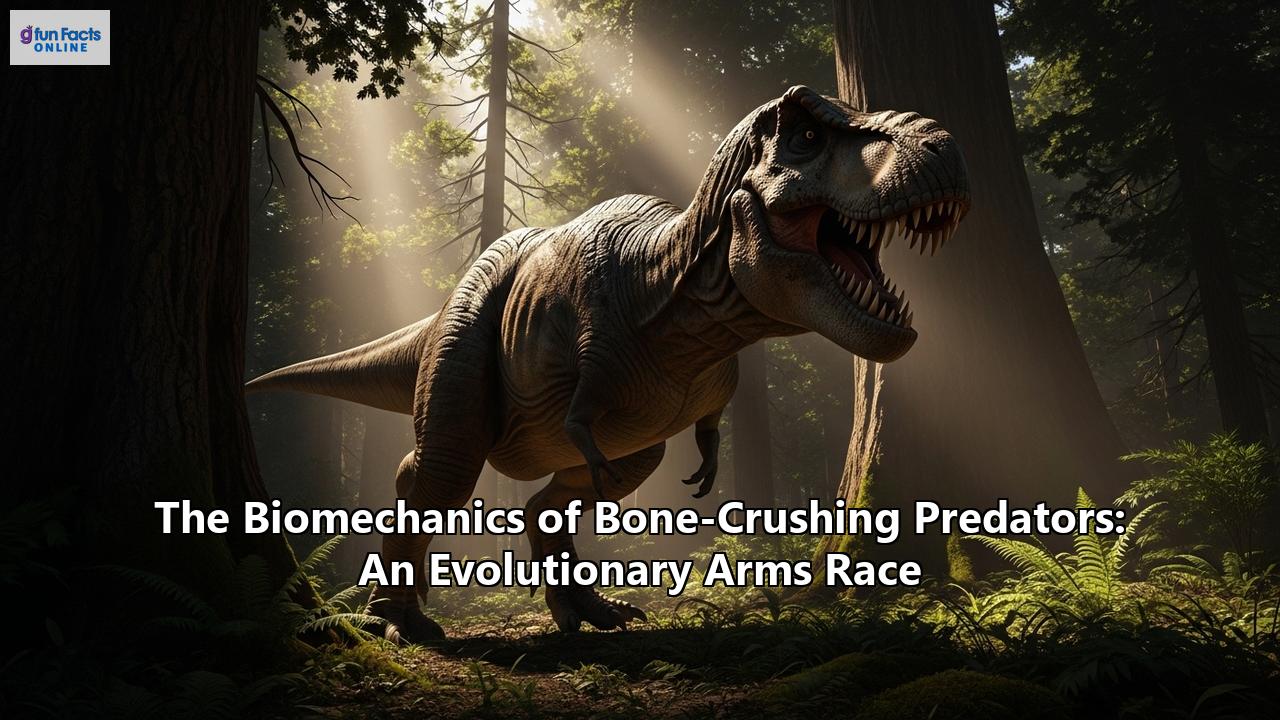
The skull of T. rex was a biomechanical marvel, a massive and robust structure capable of withstanding incredible forces. With a bite force estimated to be between 35,000 and 57,000 Newtons, T. rex had the most powerful bite of any terrestrial animal that has ever lived. This immense power allowed it to crush the bones of its prey with ease, a feat that is exceedingly rare among reptiles, whose teeth are not typically adapted for chewing bone.
The teeth of T. rex were not the sharp, blade-like daggers that many might imagine. Instead, they were thick, conical, and incredibly strong, often compared to "killer bananas." This robust morphology, combined with their deep roots, made them perfect for puncturing and crushing bone without breaking. The teeth had serrated edges that helped them to grip and tear flesh, and their arrangement in the jaw created a "fracture arcade" that could shatter bone with incredible efficiency.
The evidence for bone-crushing in T. rex is not just limited to its anatomy. Fossilized bite marks on the bones of its prey, such as Triceratops and hadrosaurs, show deep punctures and gouges that could only have been made by the powerful jaws of a T. rex. Some of these bite marks even show signs of healing, indicating that the prey animal survived the attack, providing definitive proof of active predation. Furthermore, the discovery of T. rex coprolites containing fragments of crushed bone provides a direct window into its durophagous diet.
The evolution of such extreme bone-crushing capabilities in T. rex was likely a key factor in its success as an apex predator. It allowed this colossal carnivore to fully exploit the resources available in its environment, leaving little to waste.
The Other Side of the Coin: Prey Adaptations
The evolutionary arms race is a two-way street. As predators evolve more effective weaponry, their prey must evolve equally effective defenses to survive. The intense pressure exerted by bone-crushing predators has undoubtedly driven the evolution of a variety of defensive adaptations in their prey.
For the prey of hyenas and other large African predators, these adaptations include speed, agility, and social behavior. Herding provides safety in numbers, and the coordinated defense of animals like zebras can be a formidable challenge for a predator.
In the case of the Pleistocene megafauna of North America, prey animals evolved a variety of defensive strategies. Some, like the bison and muskox, relied on their large size, formidable horns, and herd behavior for protection. Others, such as the glyptodonts, were walking fortresses, encased in a thick, bony carapace. The evolution of these defensive structures was likely a direct response to the powerful, bone-crushing predators they shared their world with.
The co-evolutionary relationship between T. rex and its prey is perhaps one of the most dramatic examples of this arms race. The massive, frilled skulls and formidable horns of ceratopsians like Triceratops were not just for display; they were powerful defensive weapons. Similarly, the thick, bony armor and clubbed tails of ankylosaurs would have presented a significant challenge to even the most determined T. rex. The very existence of such heavily armored and well-defended herbivores is a testament to the immense predatory pressure they faced. The constant struggle for survival drove both predator and prey to new evolutionary heights, a brutal but beautiful dance of adaptation and counter-adaptation.
A Legacy of Bone and Stone
The story of bone-crushing predators is a powerful illustration of the creative and destructive forces of evolution. It is a tale of convergence, where different lineages have independently arrived at similar solutions to the same ecological challenge. It is a story of co-evolution, where the hunter and the hunted are locked in a perpetual arms race, each driving the other to new extremes of adaptation. And it is a story written in the fossil record, in the shattered bones and fossilized remains of ancient creatures. By studying these remnants of a bygone era, we can begin to understand the intricate and often brutal dynamics that have shaped the history of life on Earth. The biomechanics of bone-crushing predators is more than just a fascinating chapter in the book of life; it is a testament to the relentless and unforgiving nature of the evolutionary process.
Reference:
- https://www.bohrium.com/paper-details/comparative-cranial-biomechanics-reveal-that-late-cretaceous-tyrannosaurids-exerted-relatively-greater-bite-force-than-in-early-diverging-tyrannosauroids/915064167998685589-5783
- https://pmc.ncbi.nlm.nih.gov/articles/PMC3391458/
- https://www.google.com/
- https://www.amnh.org/explore/news-blogs/fossils-t-rex-hunting-habits
- https://pmc.ncbi.nlm.nih.gov/articles/PMC1691752/
- https://www.researchgate.net/publication/280988652_The_Coevolution_of_Tyrannosaurus_Its_Prey_Could_Tyrannosaurus_Chase_Down_Kill_a_Triceratops_for_Lunch
- https://www.youtube.com/watch?v=ixUvY3Mg-E8
- https://kids.frontiersin.org/articles/10.3389/frym.2020.00101
- https://www.youtube.com/watch?v=zC95oX6Pjjw
- https://www.independent.co.uk/news/science/dinosaur-tyrannasaurus-rex-bite-weak-skulls-b2801962.html
- https://www.researchgate.net/figure/Tyrannosaurus-rex-dental-functional-morphology-A-Exemplar-tooth-pressures-along-the_fig3_317028057
- https://www.pnas.org/doi/10.1073/pnas.1216534110
- https://eric.ed.gov/?q=prey&id=EJ1044402
- https://pubmed.ncbi.nlm.nih.gov/23858435/
- https://www.researchgate.net/publication/374297498_Comparative_cranial_biomechanics_reveal_that_Late_Cretaceous_tyrannosaurids_exerted_relatively_greater_bite_force_than_in_early-diverging_tyrannosauroids
- https://www.archaeology.wiki/blog/2017/05/18/the-secrets-behind-t-rexs-bone-crushing-bites/
- https://www.sciencedaily.com/releases/2012/03/120318100451.htm
- https://www.sciencedaily.com/releases/2015/07/150728091720.htm
- https://www.discovermagazine.com/planet-earth/bone-bite-marks-suggest-that-t-rex-dabbled-in-cannibalism
- https://www.smithsonianmag.com/science-nature/tyrannosaurus-scat-96841015/
- https://www.latimes.com/archives/la-xpm-1998-jun-18-me-61111-story.html
- https://www.amnh.org/explore/news-blogs/fossilized-scat-t-rex-diet