
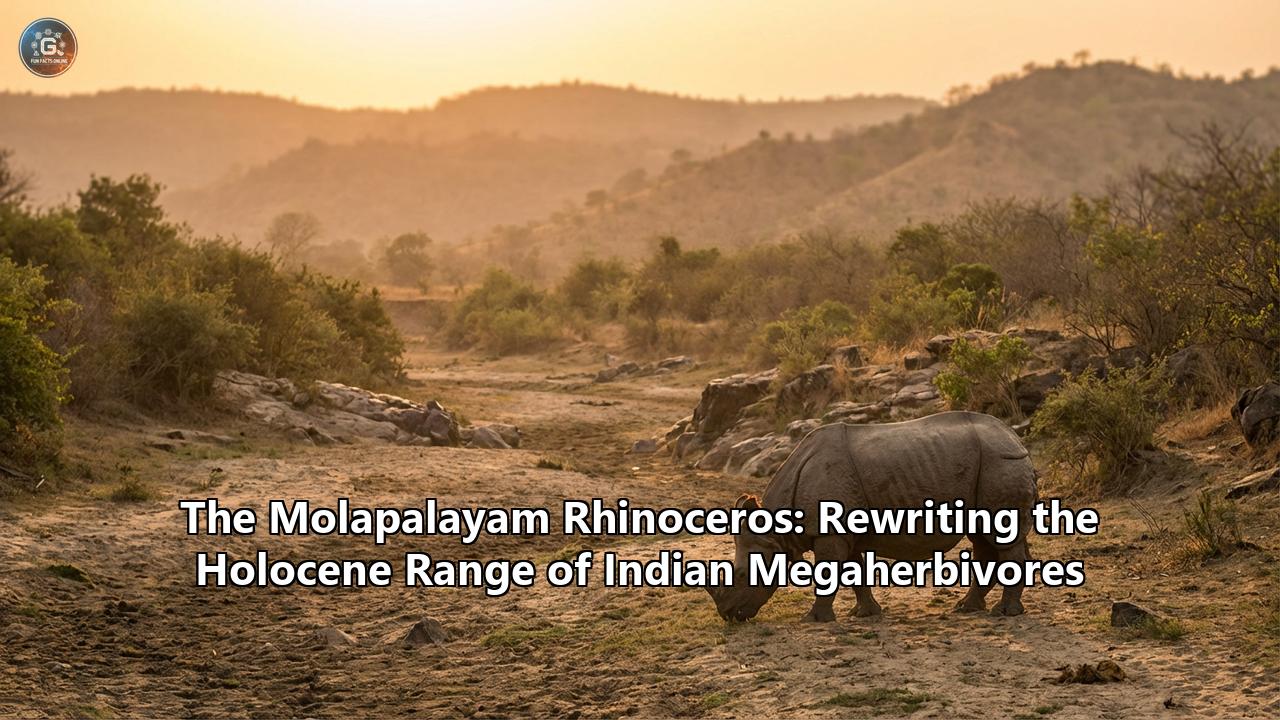
The history of the Indian subcontinent is often written in stone—in the inscriptions of emperors, the walls of temples, and the tools of the Neolithic age. But sometimes, history is written in bone, hidden beneath layers of soil, waiting to whisper a different story about the land we think we know. Such is the case with a remarkable discovery in Molapalayam, a quiet village near Coimbatore in Tamil Nadu. Here, amidst the remnants of a pastoral settlement from 3,500 years ago, archaeologists have unearthed four small, unassuming bone fragments that are shaking the foundations of Indian zooarchaeology.
They are not the bones of cattle, though cattle were plentiful there. They are not the bones of the blackbuck or the deer that still roam the fringes of the forests. They are the metacarpals and carpals—foot bones—of Rhinoceros unicornis, the Great Indian One-Horned Rhinoceros.
To the layperson, this might seem a trivial detail. To the paleontologist and the ecologist, it is a revelation. It suggests that until relatively recently, in the span of geological time, the dry, industrial heartland of western Tamil Nadu was a lush, swampy mosaic of tall grasslands and riverine forests, home to one of the world’s largest megaherbivores. The Molapalayam rhinoceros is not just a fossil; it is a ghost of a lost ecosystem, a witness to a dramatic climate shift, and a key that rewrites the Holocene range of Indian megafauna.
I. The Discovery at Molapalayam
The story begins in the Noyyal River valley, a region historically overshadowed by the grand dynasties of the Cholas and Pandyas but rich in prehistoric secrets. Between 2019 and 2024, a team of archaeologists led by Dr. V. Selvakumar of Tamil University, Thanjavur, undertook excavations at Molapalayam. The site was identified as a Neolithic settlement, a place where early humans transitioned from hunter-gatherer lifestyles to settled agriculture and animal husbandry.
The excavation was meticulous. As the layers of earth were peeled back, they revealed the daily life of a community that lived there around 1600 BCE to 1400 BCE. There were potsherds, stone tools, and the charred remnants of ancient hearths. But the most telling evidence came from the "garbage" of the past—the faunal assemblage.
Over two seasons of excavation, the team recovered a massive collection of bone fragments. To the untrained eye, they were an indistinguishable heap of calcium. But under the scrutiny of zooarchaeologists like G.S. Abhayan from the University of Kerala, the bones began to speak. They identified 28 different animal species. The vast majority were domesticates: humpbacked cattle (Bos indicus), sheep, and goats, painting a picture of a thriving pastoral economy. There were also wild animals—nilgai, blackbuck, four-horned antelope, chital, and sambar deer—evidence that these early farmers supplemented their diet with hunting.
And then, there were the four anomalies.
Two metacarpals and two carpals stood out for their robusticity and distinct morphology. They did not fit the gracile anatomy of the deer or the bovine structure of the cattle. Comparison with reference collections confirmed the impossible: they belonged to an adult Indian rhinoceros.
The dating was secure. The stratigraphy and associated radiocarbon dates placed these bones firmly in the middle of the second millennium BCE. This was not a fossil from the deep geological past, millions of years old. This rhino walked the banks of the Noyyal River at the same time the Egyptian pharaohs were building temples and the Vedic culture was taking root in the north.
II. Rewriting the Map: The Myth of the Northern Specialist
To understand why this discovery is so shocking, one must look at the modern and "traditional" historic map of the Indian rhinoceros. Today, the Rhinoceros unicornis is a conservation success story, but a geographically restricted one. It is found almost exclusively in the Terai Arc landscape—the humid, flood-prone grasslands along the southern foothills of the Himalayas in Nepal and India (Kaziranga, Chitwan, etc.).
For decades, standard zoological texts assumed this was the species' "natural" home. It was believed that the rhino was a specialist of the Himalayan wash plains. While historical records from the Mughal era mentioned rhinos as far west as the Indus Valley (modern Pakistan) and as far east as Myanmar, the southern limit was always fuzzy. Most maps drew a line somewhere around the Godavari River or the Narmada Valley in central India, assuming the dry Deccan Plateau was a barrier the moisture-loving rhino could not cross.
The Molapalayam find shatters this assumption. It pushes the range of the Indian rhino more than 1,500 kilometers south of its current stronghold. It proves that the species was not just a northern specialist but a pan-Indian megaherbivore capable of thriving in the deep south, almost to the tip of the peninsula.
This is not an isolated anomaly, though it is the most definitive. It connects the dots with two other overlooked discoveries in Tamil Nadu:
- Payyampalli: At this Neolithic site in the Tirupattur district, fragmentary rhino bones were found decades ago. At the time, they were treated as curiosities, with some speculation that they might have been brought there for medicinal purposes or used as anvils.
- Sathankulam: In the late 1970s, a fossilized rhino skull was found in a well in the Thoothukudi district, near the southern tip of India. However, this skull was dated to the Pleistocene (30,000–40,000 years ago), a much older epoch.
The Molapalayam find bridges the gap between the ancient Pleistocene presence and the modern era. It confirms that rhinos didn't just live in South India during the Ice Ages; they survived there well into the Holocene, coexisting with human civilizations that were building permanent villages.
III. The Lost "Green Holocene" of Tamil Nadu
The presence of a rhinoceros is a biological barometer. Unlike the leopard or the jackal, which can adapt to a wide range of environments, the Indian rhino is habitat-specific. It is a grazer that requires vast quantities of tall grass (like Saccharum and Phragmites) and, crucially, water. Rhinos are semi-aquatic; they need wallows to regulate their body temperature and escape biting insects. They cannot survive in true deserts or dry scrubland.
Therefore, the Molapalayam rhino is undeniable evidence that the environment of the Coimbatore region 3,500 years ago was radically different from today.
Present-day Coimbatore is in the rain shadow of the Western Ghats. It is a semi-arid region, famous for its cotton cultivation (which requires dry heat) and its industries. The landscape is dominated by dry deciduous forests, thorny scrub, and agriculture. If you released a rhino in the Noyyal River valley today, it would likely perish from heat stress and lack of suitable forage.
The fossil evidence implies that during the mid-Holocene, this region was a "Green Corridor." Paleoclimate data supports this. Studies of the Palar River paleochannels and pollen analysis from the Nilgiri hills indicate that the Indian Summer Monsoon was significantly stronger between 6,000 and 3,500 years ago. This "Holocene Wet Phase" would have turned the river valleys of Tamil Nadu into lush, swampy networks. The Noyyal River would not have been the seasonal, often dry stream it is today, but a perennial flow flanked by wide floodplains of elephant grass—a perfect rhino habitat.
This "Green Holocene" supported a guild of megafauna that is now fractured. The Molapalayam excavation found remains of the Gaur (Indian Bison) and the Water Buffalo alongside the rhino. These are all water-dependent grazers. It suggests a landscape similar to modern-day Kaziranga National Park—a wet savanna teeming with life—thriving in the shadow of the Western Ghats.
IV. The "Oru Kottu Aa": Cultural Echoes
The scientific "rewriting" of the rhino's range finds a fascinating parallel in the cultural memory of the Tamil people. Sangam literature, the ancient corpus of Tamil poetry dating from roughly 300 BCE to 300 CE, contains references that have long puzzled scholars.
There are mentions of an animal called the Oru Kottu Aa—literally "The One-Horned Cow" or "One-Horned Animal." In the Kalittokai and other anthologies, poets describe a powerful, thick-skinned beast. Later commentators often Sanskritized this as Kandamirugam. For years, historians debated whether these were mythical creatures or hearsay from travelers who had been to the north.
The Molapalayam discovery suggests these were not myths. They were memories.
If rhinos survived until 1400 BCE, they were present in the oral traditions that coalesced into the Sangam epics. The memory of the "One-Horned Beast" likely persisted in the folklore of the pastoral communities long after the animal itself had vanished from the landscape, eventually finding its way into the written verses of the Sangam poets.
Furthermore, rock art in Central India (Madhya Pradesh) vividly depicts rhinos being hunted by men with spears. While no definitive rhino rock art has been publicized in Tamil Nadu yet, the Molapalayam bones bear the marks of human interaction. The context of the find—mixed with food refuse—strongly suggests that the Neolithic inhabitants of Tamil Nadu hunted the rhino. It was not just a beast of the landscape; it was prey, a source of massive quantities of meat and hide, and perhaps a formidable adversary that lived in the cultural imagination as a symbol of raw power.
V. The Great Drying and the Local Extinction
If the rhino was there, why did it disappear? The Molapalayam bones date to the cusp of a major transformation. Around 1500 BCE to 1000 BCE, the climate of Peninsular India began to change. The "Holocene Wet Phase" gave way to a progressive aridification. The monsoon weakened. The broad, marshy floodplains of the Noyyal and Kaveri rivers began to dry out, shrinking into seasonal channels. The tall grasslands were replaced by the hardy, drought-resistant scrub vegetation we see today.
This climatic shift was the death knell for the southern rhino. Unlike the elephant, which could retreat up into the cooler, wetter hills of the Western Ghats (where they remain today), the rhino is a creature of the floodplains. It is not built for steep mountain terrain. As the wetlands dried up, the rhino populations would have been fragmented into smaller and smaller pockets of suitable habitat—"refugia" around the remaining permanent water bodies.
It was in this vulnerable state that they faced a second threat: the Neolithic human.
The pastoralists of Molapalayam were not just passive observers of nature. They were active modifiers of it. They grazed large herds of cattle, which would have competed with rhinos for the best grass. They likely burned forests to create pasture, altering the vegetation further. And, as the bone fragments testify, they hunted.
In a shrinking habitat, a slow-breeding animal like the rhino (which has a gestation period of 16 months and raises only one calf at a time) cannot withstand sustained hunting pressure. The combination of Climate Change (aridification) and Anthropogenic Pressure (hunting/habitat competition) created a "double whammy" that drove the Indian rhinoceros to extinction in South India.
This pattern mirrors the "Overkill vs. Climate" debate seen in megafauna extinctions globally, from the Woolly Mammoth in Siberia to the Diprotodon in Australia. In South India, it wasn't a sudden cataclysm, but a slow strangulation. The rhino held on longer than expected—surviving well into the agricultural age—but eventually, the drying land and the rising human population pushed it off the edge of the peninsula.
VI. Conclusion: A Lesson from the Bones
The Molapalayam Rhinoceros is more than a biological curiosity. It is a warning. It reminds us that the "natural" range of a species is often far vast than its current "conserved" range. We tend to think of the Indian Rhino as a Himalayan animal, but that is merely its final refugee camp. Its true heritage is that of a pan-Indian giant that once wallowed in the rivers of Tamil Nadu.
It also highlights the fragility of our ecosystems. The transition from the lush, rhino-supporting wetlands of 1500 BCE to the semi-arid scrub of today happened over just a few millennia—a blink of an eye in geological time. As we face a new era of rapid climate change, the fate of the Molapalayam rhino serves as a somber testament to what happens when the delicate balance between climate, habitat, and human activity is tipped.
The bones found near Coimbatore have done what no text could: they have resurrected a lost world. They force us to look at the dry fields of Tamil Nadu and see the ghosts of the tall grass, to hear the phantom splash of a two-ton giant in the Noyyal River, and to acknowledge that the history of India's wildlife is far deeper, and far more dynamic, than we ever imagined.
Reference:
- https://www.frontiersin.org/journals/earth-science/articles/10.3389/feart.2021.717420/full
- https://www.researchgate.net/publication/382338415_The_Rhinoceros_of_South_Asia_Bibliography
- https://www.research-collection.ethz.ch/server/api/core/bitstreams/a57f9ff2-1fbc-43a0-9f3a-91544c854cb5/content
- https://cp.copernicus.org/articles/19/2093/2023/
- https://www.researchgate.net/publication/292473758_Teris_of_southern_Tamil_Nadu_Saga_of_Holocene_climate_change
- https://www.researchgate.net/publication/229062229_Holocene_aridification_of_India
- https://palaeontologicalsociety.in/2015/2015_60_2/6.pdf
- https://jpsonline.co.in/index.php/jop/article/view/889