
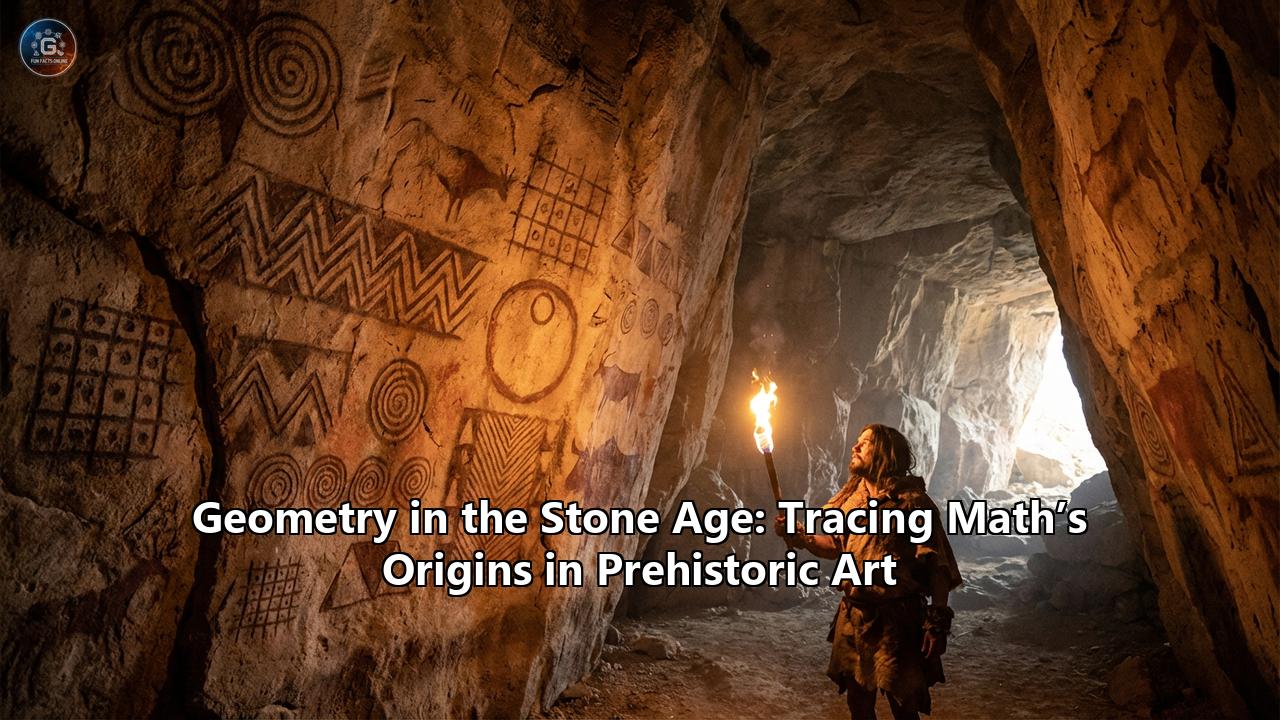
Geometry didn't begin with Euclid's proofs or the pyramids of Egypt. Long before the first written equation, our Stone Age ancestors were already thinking in shapes, patterns, and symmetries. From the deliberate chipping of a handaxe to the precise layout of a megalithic circle, prehistoric humans were laying the cognitive foundations for mathematics.
This article traces the hidden origins of geometry, exploring how the human mind first grasped the concepts of form, space, and measurement in the deep past.
I. The First Shapes: Embodied Geometry in the Paleolithic
The story of geometry begins not on paper, but in stone. For over a million years, the primary way humans interacted with geometric concepts was through lithic reduction—the making of stone tools.
The Acheulean Handaxe: A Study in Symmetry
Around 1.7 million years ago, Homo erectus began crafting the Acheulean handaxe. Unlike earlier, rougher tools, these were teardrop-shaped and bifacial (flaked on both sides). What is remarkable is their bilateral symmetry.
- The Cognitive Leap: To create a symmetrical object from a rough nodule of flint requires a "mental template." The maker must visualize the finished 3D shape within the stone before striking a single blow. This ability to rotate an object mentally and impose a geometric plan on raw material is one of the earliest evidences of advanced spatial cognition.
- Aesthetic vs. Functional: While symmetry improves the tool's aerodynamics and handling, many handaxes are "over-engineered"—symmetrical to a degree that exceeds functional necessity. This suggests an early aesthetic preference for geometric regularity, a precursor to the concept of "ideal forms."
Clovis Points: The Geometry of the Hunt
Jumping forward to around 13,000 years ago in North America, the Clovis people took this "embodied geometry" to new heights.
- Advanced Flaking: Clovis projectile points are masterpieces of craftsmanship. They are lanceolate (leaf-shaped) with parallel or slightly convex sides and a distinct concave base.
- Technological Standardization: Recent 3D geometric morphometric analysis has shown that Clovis points found thousands of miles apart share an astounding consistency in their proportions. This implies a standardized system of measurement or a highly rigid cultural transmission of geometric ratios—essentially, an unwritten engineering standard.
II. The Birth of Abstract Art: Signs, Symbols, and Entoptic Phenomena
While tools showed implicit geometry, cave art revealed explicit geometric thought. Deep in the caves of Lascaux, Chauvet, and Altamira, alongside the famous bulls and horses, are thousands of abstract signs: dots, grids, zigzags, and nested curves.
Blombos Cave: The World's Oldest Geometry?
In 2002, archaeologists in South Africa made a stunning discovery at Blombos Cave. They found pieces of ochre (a soft, iron-rich stone) engraved with a cross-hatch design, bounded by parallel lines.
- Date: These engravings are approximately 73,000 to 100,000 years old.
- Significance: This is not a doodle. It is a deliberate, repetitive geometric pattern. It suggests that early Homo sapiens were capable of abstract representation—using a symbol to stand for an idea—long before the famous European cave paintings. The cross-hatch is a foundational geometric grid, arguably the earliest evidence of a "drawing" that isn't of an animal or person.
Entoptic Phenomena: The Neuroscience of Patterns
Why do we find the same geometric shapes (spirals, grids, zigzags) in prehistoric rock art all over the world, from Ireland to Australia?
- The Theory: Archaeologists David Lewis-Williams and Thomas Dowson proposed the Neurovisual Resonance Theory. They argue that these shapes are "form constants" or entoptic phenomena—visual effects generated by the human nervous system during altered states of consciousness (trance, sensory deprivation, or ritual dance).
- The Connection: In the first stage of a trance, the brain "sees" geometric patterns (grids, dots, spirals). Paleolithic shamans may have projected these internal visions onto cave walls. Thus, the earliest "geometry" might have been an attempt to map the architecture of the human visual cortex itself.
III. The Neolithic Revolution: Architecture and the "Megalithic Yard"
When humans settled down to farm, their relationship with geometry changed. They needed to measure fields, build permanent houses, and track the seasons. This led to the first monumental geometry.
Göbekli Tepe: The Triangle Before the Wheel
In southeastern Turkey, the 11,500-year-old site of Göbekli Tepe rewrote the history books. It was built by hunter-gatherers, not farmers, yet it features massive T-shaped pillars arranged in circles.
- The Hidden Plan: In 2020, Israeli archaeologists Gil Haklay and Avi Gopher used algorithms to analyze the layout of the site's three oldest enclosures. They discovered that the center points of these enclosures form a nearly perfect equilateral triangle.
- Implication: This suggests that the builders didn't just place stones randomly; they had a master plan. Laying out an equilateral triangle on this scale requires an understanding of basic geometric relationships and possibly the use of ropes or measuring cords—thousands of years before the invention of the wheel or writing.
Stonehenge and the "Megalithic Yard"
In the UK and France, stone circles like Stonehenge and the Carnac stones display sophisticated planning.
- Pythagorean Triples? Researchers have long debated whether these builders knew the Pythagorean theorem (a² + b² = c²) millennia before Pythagoras. Some stone circles, like the Crucuno rectangle in Brittany, form precise 3:4:5 right triangles.
- The Megalithic Yard: Engineer Alexander Thom analyzed hundreds of stone circles and proposed they were built using a standard unit he called the "Megalithic Yard" (exactly 2.72 feet or 0.829 meters). While controversial, his work showed that many "circles" are actually complex shapes like flattened circles or egg shapes, which require multiple center points and radii to construct—a clear sign of "compass and rope" geometry.
Skara Brae: The Platonic Solids of Scotland
In the Neolithic village of Skara Brae (Orkney, Scotland), inhabitants carved mysterious stone balls.
- Symmetry: Many of these balls are carved with knobs or disks arranged in perfect symmetry. Some resemble Platonic solids (regular polyhedra like the tetrahedron or dodecahedron).
- Function: While their use is unknown (weapons? status symbols? bolas?), their manufacture demonstrates a fascination with dividing a sphere into equal, symmetrical sections—a complex 3D geometry problem.
IV. Global Geometries: A Universal Language
The geometric impulse was not limited to Europe or the Near East.
- The Americas:
Caral-Supe (Peru): The oldest civilization in the Americas (c. 3000 BCE) built massive sunken circular plazas and pyramidal mounds. The precise circularity and cardinal alignment of these structures indicate a strong grasp of radial geometry and astronomy.
Cueva de las Manos (Argentina): Alongside the famous handprints (9,000+ years old) are distinct geometric sets: zigzag patterns, dots, and basic shapes that may represent clan markers or astronomical events.
Valdivia Pottery (Ecuador): One of the earliest pottery traditions in the Americas, featuring intricate incised geometric motifs that play with symmetry and repetition.
- Oceania (Lapita Culture):
The Lapita people, explorers of the Pacific (c. 1600 BCE), are famous for their pottery. It was decorated with dentate stamping (tooth-like impressions) forming complex, interlocking geometric friezes.
Mathematical Analysis: Anthropologists analyzing these patterns have found they strictly follow specific rules of symmetry operations (translation, reflection, rotation)—the same rules used in modern group theory to classify patterns.
- Asia (Hongshan Culture):
Neolithic China (c. 3500 BCE) saw the creation of ritual jades like the Bi disc (a circle with a hole, symbolizing heaven) and the Cong tube (a square tube with a circular bore, symbolizing earth). The precision of these perfect circles and squares, ground from extremely hard jade without metal tools, is a triumph of prehistoric engineering.
V. From Art to Math: The "Token" Evolution
How did we get from "artistic" geometry to "mathematical" geometry? The bridge might lie in humble clay objects found in the Near East.
- The Token Theory: Denise Schmandt-Besserat discovered that before writing, people used small clay tokens to count goods.
- Geometric Shapes: These tokens came in specific geometric forms:
Cone = Small measure of grain.
Sphere = Large measure of grain.
Ovoid = Jar of oil.
Disk = Sheep.
- The Abstraction: This system separated the quantity from the object. A cone wasn't just a shape; it was a standardized unit. Over thousands of years, these 3D geometric shapes were impressed onto clay tablets, becoming 2D circles and wedges—the first written numbers. Thus, the cone and the sphere are the direct ancestors of our written "1" and "10."
Conclusion: The Geometer's Mind
Tracing geometry in the Stone Age reveals that mathematics is not an invention of the classroom, but an innate capability of the human mind.
- It started as embodied skill: The symmetry of the handaxe.
- It became symbolic: The ochre grids of Blombos and rock art.
- It became architectural: The triangles of Göbekli Tepe and circles of Stonehenge.
- It became abstract: The counting tokens of the Near East.
When we look at a skyscraper or a microchip today, we are using the same cognitive tools that our ancestors used to navigate the stars and shape the stone. We are, and always have been, a species of geometers.
Reference:
- https://www.smithsonianmag.com/smart-news/ancient-geometry-discovered-worlds-oldest-temple-180974991/
- https://www.livescience.com/gobeklitepe-built-with-geometry.html
- https://www.ancient-origins.net/news-history-archaeology/gobekli-tepe-geometry-0013627
- https://www.saexpeditions.com/blog/post/all-you-need-to-know-about-argentinas-cueva-de-las-manos
- https://www.britannica.com/place/Cueva-de-las-Manos