
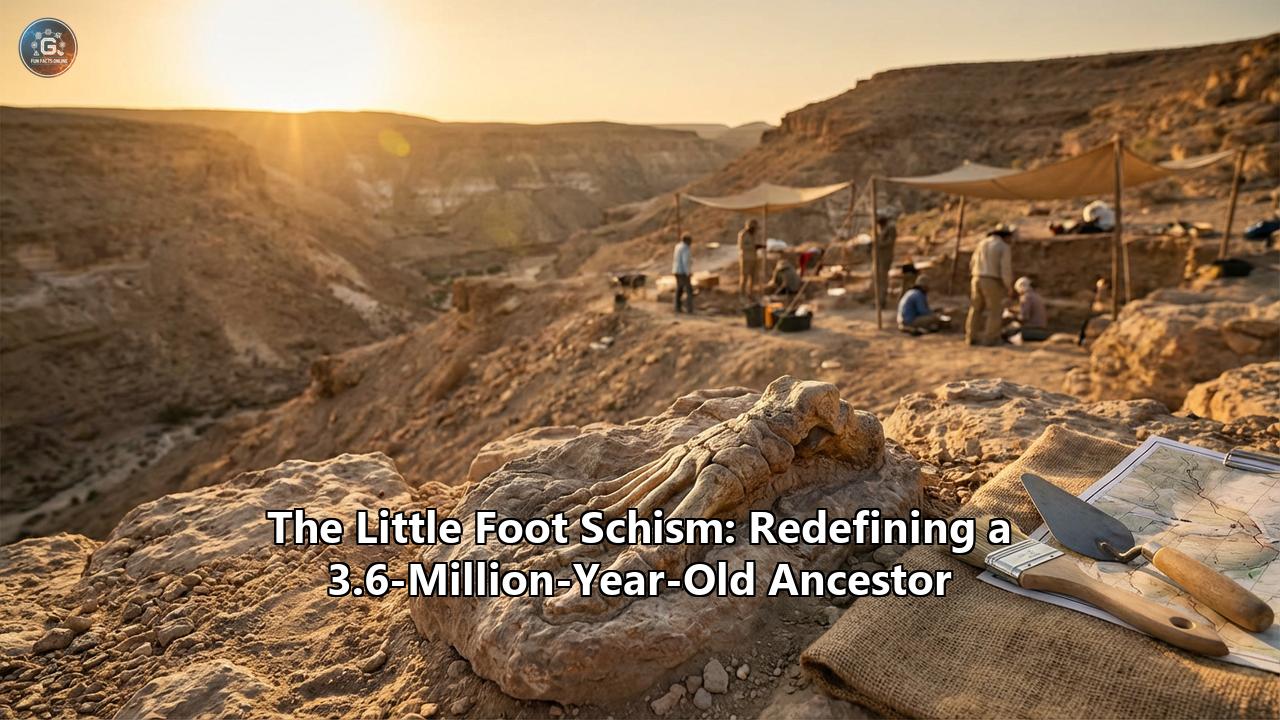
The Silence of the Silberberg Grotto was broken not by the roar of a predator, but by the meticulous, rhythmic chipping of a dental pick. It was a sound that would echo for twenty years, a slow-motion drumbeat heralding the return of a ghost. Deep within the calcified veins of the Sterkfontein Caves, northwest of Johannesburg, a creature was waiting. She had waited for three million, six hundred and seventy thousand years. She had fallen into the darkness, perhaps fleeing a leopard or losing her footing in a terrifying moment of vertigo, and there she had lain, encased in nature’s concrete, while the world above her shifted, continents drifted, and her distant descendants learned to make fire, split the atom, and fly to the moon.
When she finally emerged, piece by painstakingly recovered piece, she did not bring clarity. She brought chaos.
Known to the world as "Little Foot," and to the scientific register as StW 573, this nearly complete skeleton has become the centerpiece of one of the most ferocious and fascinating debates in the history of paleoanthropology. She was supposed to be the "Rosetta Stone" of human origins, the fossil that would bridge the gap between the ape-like wanderers of the Pliocene and the genus Homo. Instead, she has become a wedge, driving a deep fissure through the established timeline of human evolution.
This is the story of the Little Foot Schism. It is a saga that spans a century of discovery, from the dusty offices of Raymond Dart in the 1920s to the high-tech imaging labs of 2026. It is a tale of scientific titans locking horns over the shape of a skull and the curve of a toe. And at the heart of it all stands a small, battered, female hominin who refuses to fit into the boxes we have built for her.
As we stand here in January 2026, the dust is yet to settle from the latest bombshell—a study that suggests Little Foot is neither the Australopithecus africanus of textbooks nor the Australopithecus prometheus of her discoverer’s dreams, but something else entirely. Something new. Something that forces us to rewrite the prologue of the human story.
Part I: The Resurrection of a Titan
To understand the schism, one must first understand the miracle of the discovery itself. In the high-stakes world of paleoanthropology, finding a single tooth is cause for a press conference. Finding a jawbone is career-defining. Finding a partial skeleton, like the famous "Lucy" (Australopithecus afarensis), is a historical event.
Little Foot is in a league of her own. She is more than 90% complete. She has her head, her hands, her legs, her pelvis, and, crucially, her feet. She is the most complete skeleton of a human ancestor older than 1.5 million years ever found. But her journey to the light was anything but straightforward.
The story begins in 1994, not in a cave, but in a box. Dr. Ronald Clarke, a paleoanthropologist with a reputation for a hawk-like eye and a stubborn streak, was rummaging through boxes of fossil fragments at the University of the Witwatersrand in Johannesburg. These boxes contained "faunal" remains—animal bones—excavated from the Silberberg Grotto of the Sterkfontein Caves years earlier by miners and previous researchers. They had been dismissed as the remains of monkeys or antelopes.
Clarke pulled out four small foot bones: a talus, a navicular, a medial cuneiform, and a first metatarsal. They were small, yes, but the anatomy was unmistakably hominin. They belonged to an upright walker. He dubbed the owner "Little Foot," assuming the bones were all that remained of a small Australopithecus.
But Clarke was nagged by a hunch. The breaks on the bones looked fresh. If the rest of the foot was still in the cave, maybe the rest of the body was there too. In a move that has become legendary in the field, he went back to the Silberberg Grotto—a dark, damp, treacherous cavern deep underground—with a cast of the broken shinbone in hand. He asked his assistants, Stephen Motsumi and Nkwane Molefe, to look for the matching break in the vast walls of breccia (a concrete-like rock formed of sediment and calcium carbonate).
It was a task akin to finding a specific needle in a haystack made of needles. Yet, after two days of searching by the light of handheld lamps, they found it. Embedded in the rock floor was the cross-section of a bone that perfectly matched Clarke’s cast.
"It was a moment of absolute shock," Clarke would later recount. "We weren't just looking at a foot. We were looking at a leg. And leading into the rock was the rest of her."
What followed was perhaps the most arduous excavation in the history of science. The skeleton was not buried in soft dirt; it was encased in breccia harder than the bone itself. To remove it with standard tools would shatter the fossil. For the next twenty years, Clarke and his team worked with air scribes (miniature jackhammers) and dental picks, removing the rock grain by grain. They worked in the dark, in cramping humidity, often lying on their stomachs for hours.
As the years passed, the skeleton revealed herself. First the legs, long and human-like. Then the pelvis. Then the arms—surprisingly long, with a healed fracture on the left forearm that hinted at a childhood trauma. And finally, the skull. It was crushed and distorted, but even in its damaged state, Clarke could see it was different. The face was flatter than expected. The teeth were bulbous and large.
Clarke, a man who had studied under the legendary Phillip Tobias, began to form a hypothesis that would alienate him from the mainstream. He looked at the anatomy of Little Foot and saw something that didn't match the dominant species of South Africa, Australopithecus africanus. He saw something older, something more primitive, yet in some ways more human.
He reached back into the archives of history and dusted off a name that had been discarded half a century earlier: Australopithecus prometheus.
Part II: The Ghost of Raymond Dart
To understand why the name prometheus is so controversial, we have to travel back to 1948. The field of paleoanthropology was still reeling from Raymond Dart’s discovery of the Taung Child (Australopithecus africanus) in 1924. Dart was a visionary, but he was also prone to flights of fancy.
In the late 1940s, fossils were found at another South African site called Makapansgat. Among them was a fragment of an occipital bone (the back of the skull), cataloged as MLD 1. Dart, ever the dramatist, believed that these hominins were fire-users. He saw blackened bones in the cave and assumed they were charred by hearths (it was later proven to be manganese staining). He named the species Australopithecus prometheus, after the Greek titan who stole fire from the gods.
Dart went further. He proposed that A. prometheus was a violent, predatory ape-man, the architect of an "Osteodontokeratic" (bone-tooth-horn) culture, who used the bones of his enemies as weapons. This image of the "Killer Ape" permeated pop culture, inspiring the opening sequence of 2001: A Space Odyssey.
However, science eventually corrected Dart. The "tools" were just hyena leftovers. The "fire" was mineral staining. And the fossils, including the MLD 1 fragment, were absorbed into the variable species Australopithecus africanus. A. prometheus was thrown into the dustbin of taxonomy, a warning label for over-enthusiastic naming.
When Ron Clarke revived the name for Little Foot, he wasn't reviving the "Killer Ape" or the fire myth. He was reviving the biological reality of a second species. He argued that the MLD 1 fossil and Little Foot shared anatomical traits that were distinct from A. africanus.
"The name prometheus is valid," Clarke insisted in paper after paper. "It describes a specific anatomy. The behavioral baggage Dart attached to it is irrelevant. The bones tell the story."
But the scientific community is a conservative beast. For decades, the consensus had been that South Africa was home to only one species of Australopithecus during this period: A. africanus. This species was the "lumper's" dream—highly variable, sexually dimorphic (males much bigger than females), and the likely ancestor of early humans.
By claiming Little Foot was a different species, Clarke was challenging the "single lineage" model. He was suggesting that the human family tree in South Africa was a bush, not a straight line. And he was doing it with a name that made many researchers cringe.
Part III: The Dating War
Before the taxonomic war could fully ignite, the dating war had to be fought. In East Africa, where Lucy was found, fossils are dated using volcanic ash layers. You measure the argon isotopes in the ash above and below the fossil, and you get a precise date.
South African caves like Sterkfontein are different. They are chaotic sinkholes where water, mud, and bones tumble in together, mixing layers and confusing time. There is no volcanic ash. Dating a fossil here is a nightmare.
Initial estimates for Little Foot were all over the map. Some suggested she was 2.2 million years old. Others said 3 million. Clarke, looking at the primitive anatomy, felt she had to be older—perhaps 3.5 million years or more. This would make her a contemporary of Australopithecus afarensis (Lucy) in East Africa, or even older.
If she was only 2.2 million years old, she was just a late-surviving africanus, an evolutionary dead end. But if she was 3.6 million years old, she was a contender for the root of the Homo lineage, potentially usurping Lucy’s position as the "Mother of Humankind."
The breakthrough came in 2015, thanks to a technique called cosmogenic nuclide dating. This method measures the accumulation of isotopes like Aluminum-26 and Beryllium-10 in the quartz grains surrounding the fossil. These isotopes are produced when rocks are exposed to cosmic rays on the surface. When the rocks fall into the cave and are buried, the "clock" starts ticking as the isotopes decay.
The result was a bombshell: 3.67 million years ± 160,000 years.
Little Foot was not a latecomer. She was an elder. She walked the earth nearly half a million years before Lucy. She was alive when the Pliocene world was cooler and drier, a contemporary of the earliest hominins in East Africa.
This date changed everything. It meant that while Lucy’s kind was evolving in the Rift Valley of Ethiopia, another, distinct lineage was thriving in the woodlands of South Africa. It validated Clarke’s intuition about her antiquity. But it also raised the stakes of the classification debate. If she was that old, and that different from Lucy, who was she?
Part IV: Anatomy of an Enigma
To understand why the classification of Little Foot has caused a schism in 2026, we have to look closely at the bones. We have to perform a virtual autopsy of StW 573.
The Skull:The face of Little Foot is striking. It is "dish-faced" (concave) in the way A. africanus usually is, but it is flatter and longer. The cheek teeth (molars and premolars) are massive, heavily worn, suggesting a diet of tough, fibrous vegetation—tubers, roots, perhaps bark. This is a "mega-dont" hominin, a creature built for chewing. But the brain case is small, roughly 408 cubic centimeters, barely larger than a chimpanzee’s.
The Shoulders:Here is where things get truly strange. In 2021, a study of the pectoral girdle revealed that Little Foot’s shoulders were incredibly ape-like. The joint for the arm faces upward, like a gorilla’s, not out to the side like a human’s. The scapula is built for suspension. This suggests that while Little Foot walked upright, she was still a master of the trees. She likely slept in nests above the ground and fled into the canopy to escape predators.
The Legs and Feet:Her legs, however, are long. Longer than her arms. This is a derived, human-like trait. Lucy, by contrast, had relatively short legs. Little Foot’s femur angles in towards the knee (the valgus angle), a hallmark of bipedalism. But look at the foot itself—the source of her name. The big toe is less divergent than a chimp’s, but more mobile than a human’s. It could probably still grasp a branch, but it was stiff enough to push off the ground. She was a mosaic—a terrestrial walker who had not yet given up her arboreal passport.
The Injury:One of the most poignant details is the healed fracture on her left forearm. The ulna and radius are bowed, a deformity consistent with a "Parry fracture" or a fall from a height during childhood. She survived this trauma. Her bones healed. She grew to old age (her teeth are worn down). This speaks to the resilience of these early ancestors, and perhaps, the social care of her group. Someone fed her while her arm was useless.
The Mismatch:This unique combination of features is what fuels the debate.
- The Clarke Camp: Argues these traits (especially the skull shape and limb proportions) align with the MLD 1 specimen and define A. prometheus. They see her as a distinct lineage that might be the true ancestor of Paranthropus (the robust australopithecines) or even Homo.
- The Africanus Camp: Argues that the differences are just variation. Just as modern humans come in many shapes and sizes, so did A. africanus. They argue that erecting a new species (or reviving an old one) based on a single skeleton is "typological thinking"—an old-fashioned obsession with ideal types rather than population ranges.
Part V: The Schism of 2026
For nearly a decade after her full unveiling in 2017, the battle lines were drawn between "It's Prometheus" and "It's Africanus." But in late 2025, a third front opened.
A team of researchers, led by Dr. Jesse Martin of La Trobe University, published a landmark study in the American Journal of Biological Anthropology. They did something that hadn't been done comprehensively before: they rigorously compared the skull of Little Foot (StW 573) to the type specimen of A. prometheus (MLD 1) and the type specimen of A. africanus.
Their conclusion was a shock to the system.
"We found that Little Foot does not share a unique suite of traits with Australopithecus prometheus," Martin announced. The MLD 1 fragment, the very basis of the prometheus name, actually looked more like a standard A. africanus. If MLD 1 is just africanus, then the name prometheus is a synonym. It’s dead. You can't attach Little Foot to a dead name.
But here was the twist: Martin’s team also found that Little Foot did not look like A. africanus.
The base of her skull—the nuchal plane—was elongated and shaped differently. The way her skull connected to her neck was distinct. These are not features that change easily with diet or lifestyle; they are deep, genetic architectural blueprints.
"She is not prometheus," Martin argued. "And she is not africanus. She is something else."
This is the Little Foot Schism. We now have three warring factions:
- The Resurrectionists (Clarke et al.): Holding the line that A. prometheus is a valid species and Little Foot is its icon.
- The Unifiers (The Consensus): insisting she is just a very old, very complete A. africanus.
- The Separatists (Martin et al.): Arguing she represents a completely new, unnamed species—a "Ghost Lineage" that walked alongside the others.
The implications of the Separatist view are profound. If Little Foot is a new species, it means South Africa 3.6 million years ago was not a lonely place occupied by a single evolving line. It was a cosmopolitan hub of hominin experimentation. It suggests that nature was throwing multiple bipedal prototypes against the wall to see what stuck.
It also challenges the East African monopoly on human origins. For decades, the narrative has been that East Africa (Lucy’s home) was the engine of evolution. If South Africa had a distinct, ancient, and diverse array of hominins at the same time, the "Cradle of Humankind" might truly be a continental cradle, not a regional one.
Part VI: The World She Walked
Let us step away from the academic crossfire and imagine the world of Little Foot. 3.67 million years ago, the Sterkfontein valley was not the dry highveld it is today. It was a mosaic environment—a mixture of gallery forests along the riverbanks and opening grasslands stretching to the horizon.
Little Foot was an old woman when she died. Standing just over a meter tall (about 3.5 to 4 feet), she would have looked vulnerable in the tall grass. The landscape was prowled by formidable predators: the sabertooth cat Megantereon, the hunting hyena Chasmaporthetes, and giant eagles.
She moved in a small troop. They communicated with hoots, grunts, and perhaps subtle gestures, but not language. During the day, they foraged in the thickets. Little Foot’s massive teeth suggest she spent hours chewing tough foods—perhaps digging for tubers with simple sticks, or stripping the bark off trees during the dry season.
Her long legs allowed her to cover distance efficiently on the ground. She walked with a fully upright stride, her hands free to carry food or babies. But when the sun began to dip, or when the roar of a cat echoed off the cliffs, she looked to the trees. Her powerful shoulders and grasping big toes allowed her to shimmy up the trunks and find safety in the canopy.
One day, perhaps while foraging near a sinkhole obscured by bushes, she slipped. The fall into the Silberberg Grotto was deep—maybe 20 meters. She survived the fall, perhaps, but with broken bones, trapped in the dark, unable to climb out. The smell of the damp cave, the sound of dripping water, and the fading square of light high above were her last sensations.
Sediment washed in with the rains. It covered her body. Over millennia, the calcium carbonate dissolved from the limestone above dripped down, cementing the sediment into rock. The cave filled up. The roof collapsed. The landscape eroded. And there she stayed, a time capsule waiting for Ron Clarke’s flashlight.
Part VII: Why It Matters
Why does it matter if we call her africanus, prometheus, or Australopithecus sterkfonteinensis? Is this just semantic squabbling among academics?
It matters because names are how we organize reality. If Little Foot is just an africanus, then human evolution in South Africa was slow, gradual, and linear (Anagenesis). It suggests a single population slowly changing over time.
If she is a distinct species, whether prometheus or a new one, it means evolution was branching, splitting, and competitive (Cladogenesis). It means that different solutions to the problem of "being a hominin" were being tested simultaneously.
Did her species die out, leaving no descendants? Or did her lineage eventually give rise to Homo naledi, another mysterious South African specter? Or is she the true ancestor of modern humans, with Lucy’s kind being the dead end?
The "Little Foot Schism" forces us to confront the limits of our knowledge. We have a skeleton that is practically perfect, yet we cannot agree on what it is. It reminds us that evolution is messy. It does not produce distinct "links" in a chain; it produces a tangled bank of life.
Conclusion: The Lady in the Rock
As we move through 2026, the debate will intensify. New imaging techniques, perhaps even proteomic analysis (extracting ancient proteins), may one day settle the score. But for now, Little Foot remains an enigma.
She sits in a vault at Wits University, a silent witness to our confusion. She has challenged our dating methods, forced us to invent new excavation techniques, and now, she is breaking our taxonomy.
Ron Clarke, the man who spent half a lifetime freeing her from the stone, believes he knows her name. Jesse Martin and the new generation believe she is a stranger. But in the end, Little Foot belongs to no one. She is a messenger from the deep time, a reminder that we are the result of a million happy accidents and a million tragic ends.
The schism is not a failure of science; it is the engine of it. It is the friction of disagreement that polishes the truth. And as long as the debate rages, Little Foot is not just a fossil. She is alive in the collective mind of humanity, still teaching us, still surprising us, three and a half million years after she took her last step.
The "Little Foot Schism" is not just about a name. It is about the definition of us. And the redefining has only just begun.
Reference:
- https://news.ssbcrack.com/debate-erupts-over-classification-of-little-foot-a-significant-early-human-fossil/
- https://www.inrap.fr/en/little-foot-south-african-australopithecus-old-lucy-12058
- https://www.inrap.fr/sites/inrap.fr/files/atoms/files/cp-little-foot-english.pdf
- https://en.wikipedia.org/wiki/Little_Foot
- https://www.latrobe.edu.au/news/articles/2025/release/iconic-fossil-may-be-new-type-of-human-ancestor
- https://www.sci.news/othersciences/anthropology/little-foot-new-species-australopithecus-14426.html
- https://www.dailykos.com/stories/2025/12/30/2343806/-A-Closer-Look-at-Australopithecus-prometheus
- https://www.johnhawks.net/p/a-critical-look-at-the-idea-of-australopithecus-prometheus
- https://www.researchgate.net/publication/227575371_The_Makapansgat_proto-human_Australopithecus_Prometheus
- https://oxfordre.com/anthropology/display/10.1093/acrefore/9780190854584.001.0001/acrefore-9780190854584-e-558?d=%2F10.1093%2Facrefore%2F9780190854584.001.0001%2Facrefore-9780190854584-e-558&p=emailAS.Z7IPfPKDaM
- https://pmc.ncbi.nlm.nih.gov/articles/PMC12663899/
- https://www.popularmechanics.com/science/archaeology/a69805119/skull-doesnt-match-human-ancestor/
- https://www.livescience.com/64275-little-foot-hominin-excavated.html
- https://www.inc.com/bill-murphy-jr/365-inspiring-poignant-and-just-plain-great-quotes-for-2026/91283130
- https://es.wikipedia.org/wiki/Charlton_Heston
- https://www.theguardian.com/science/2025/dec/15/little-foot-hominin-fossil-may-be-new-species-of-human-ancestor
- https://floridafai.com/learn/bone-healing-in-the-foot/
- https://www.sciencedaily.com/releases/2026/01/260104202738.htm
- https://thedebrief.org/mysterious-little-foot-could-be-an-unidentified-humanlike-species-researchers-conclude/