
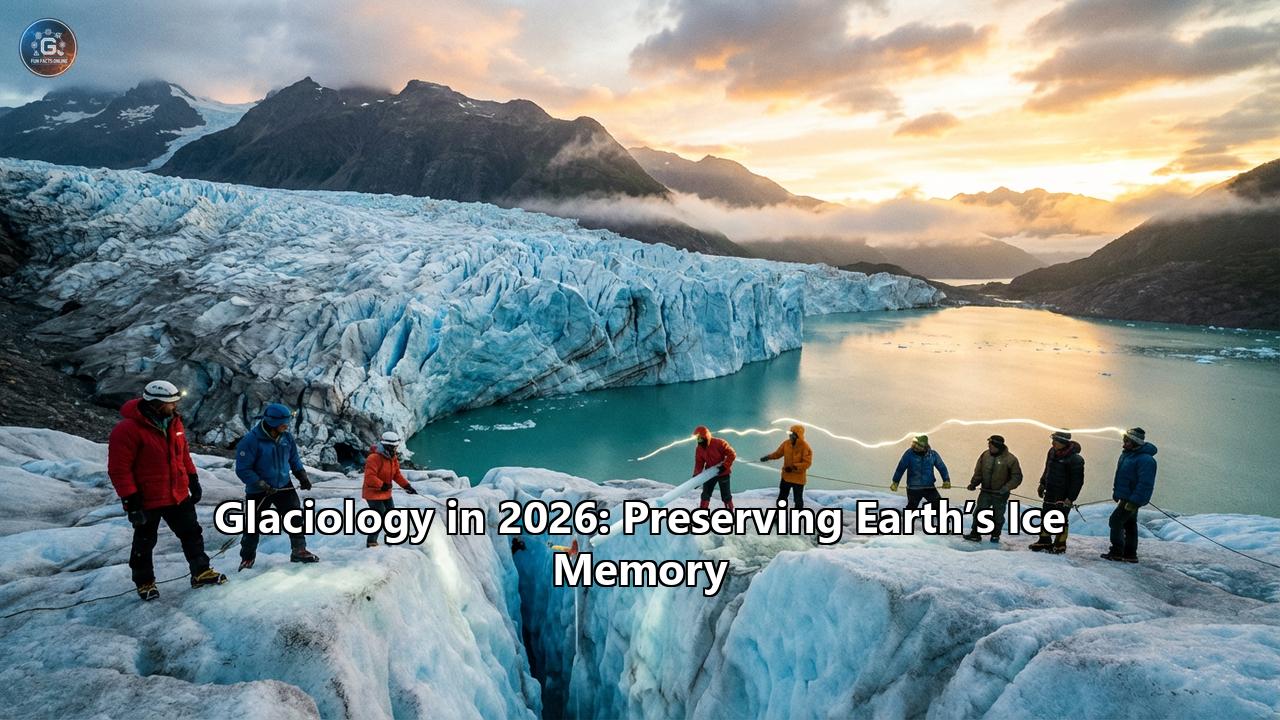
The wind howled across the Antarctic Plateau, carrying with it a chill that hovered near -50°C, but inside the newly excavated snow cave at Concordia Station, the mood was one of solemn triumph. On January 14, 2026, a small team of scientists, bundled in extreme-weather gear, lowered the final crate of ice cores into the vaults of the Ice Memory Sanctuary. These cylinders of ice—drilled from the dying glaciers of the Alps and the Andes—had traveled thousands of miles aboard the icebreaker Laura Bassi, crossing the Southern Ocean to reach the one place on Earth cold enough to keep them safe without electricity.
This inauguration wasn't just a ceremony; it was an admission of a stark reality. As we settle into 2026, the field of glaciology has shifted from purely monitoring decline to actively preserving the "DNA" of our climate system. We are no longer just watching the ice melt; we are racing to bank its memory before it disappears forever.
The Sanctuary at the End of the World
The opening of the Ice Memory Sanctuary at the French-Italian Concordia Station marks the defining moment of the cryospheric sciences this year. Approved by the Antarctic Treaty System in 2024 and funded by the Prince Albert II of Monaco Foundation, this facility is a "doomsday vault" for paleoclimatology.
"We have created a library of the atmosphere," said Dr. Carlo Barbante, a key figure in the project, during the broadcast from the station. The sanctuary stores heritage cores from non-polar glaciers like the Grand Combin in Switzerland and the Col du Dôme in France—glaciers that are currently melting at such accelerated rates that their surface layers, which contain recent climate data, are being washed away.
By storing these cores in Antarctica, where the mean annual temperature naturally stays below -50°C, scientists have ensured that future generations—possessed of technologies we cannot yet imagine—will still be able to analyze the atmospheric history of the 20th and 21st centuries. It is a sombre insurance policy against a warming world.
The 29th Year: A Grim Milestone for Greenland
While the mood in Antarctica was one of preservation, the news from the north remains alarming. The State of the Cryosphere 2025 report, finalized late last year and dominating discussions in early 2026, confirmed that 2025 was the 29th consecutive year of net ice loss for the Greenland Ice Sheet.
Data from the Geological Survey of Denmark and Greenland (GEUS) revealed that between September 2024 and August 2025, Greenland lost approximately 105 billion tonnes of ice. While not the catastrophic record-breaking loss seen in 2012 or 2019, the consistency is what terrifies statisticians.
"In climate science, thirty years is the magic number to define a permanent trend rather than a weather anomaly," explained Dr. Signe Hillerup Larsen. "We are one year away from an entire generation—30 years—knowing nothing but a shrinking Greenland."
The 2025 melt season was characterized by a "late but intense" start. Melt onset began in mid-June, but by July, heatwaves had triggered surface melting across 81% of the ice sheet's surface area. This relentless runoff is reshaping the North Atlantic's salinity, with potential impacts on the AMOC (Atlantic Meridional Overturning Circulation) that remain a primary focus of oceanographic modeling this year.
Thwaites and the "Doomsday" Dynamics
In West Antarctica, the focus remains on the Thwaites Glacier, often dubbed the "Doomsday Glacier." January 2026 has seen a flurry of activity in the Amundsen Sea. The South Korean icebreaker RV Araon arrived at the Thwaites ice shelf in early January, deploying a team of forty scientists to conduct the most detailed sub-shelf analysis to date.
Recent findings published in late 2025 have shifted the narrative on Thwaites from "if" to "how fast." New research has highlighted the critical role of "ice dams"—underwater ridges that currently hold back the glacier's flow. The Araon expedition is currently using autonomous underwater vehicles (AUVs) to map these ridges with millimeter precision. The fear is that once Thwaites retreats past these pinning points, its collapse into the deeper basin behind it could become self-sustaining, potentially unlocking meters of sea-level rise from the wider West Antarctic Ice Sheet (WAIS).
However, not all news is about surface loss. A groundbreaking study published in Science just last week (January 15, 2026) revealed a new, high-resolution map of the bedrock beneath the Antarctic ice sheet. Using advanced radar data collected by the "Under Antarctica" expedition—which saw explorers Heidi Sevestre and Matthieu Tordeur cross the continent using radar-equipped pulkas—scientists have identified previously unknown subglacial lakes and valley systems. These hidden hydrologies are critical for understanding how lubricated the ice sheet's base truly is, a variable that has plagued predictive models for decades.
The AI Revolution in the Cryosphere
If 2025 was the year of "preservation," 2026 is shaping up to be the year of Artificial Intelligence in Glaciology. The scientific community is buzzing with anticipation for the upcoming IGS Symposium on AI, scheduled for June 2026 in Hanover, New Hampshire.
Gone are the days of manual digitization of glacier outlines. Today, deep learning models like "DeepIce" and "GlacierNet" are processing petabytes of satellite imagery from Sentinel and Landsat satellites in real-time. These AI systems can now detect:
- Crevasse formation: Predicting calving events weeks before they happen.
- Supraglacial lakes: Mapping the ephemeral blue lakes that form on ice sheets and tracking their drainage into the ice, which lubricates flow.
- Debris cover: Distinguishing between rock-covered ice and bare ground, a distinction that previously baffled automated systems.
"AI allows us to see the ice breathe," says Dr. Paul Cleverly, a convener for the upcoming symposium. "We are moving from static maps to dynamic, living models of the cryosphere."
The Race for the Oldest Ice
While satellites watch from above, a different kind of race is happening deep below the surface. The quest to find Earth's "Oldest Ice"—a continuous core dating back 1.5 million years—is reaching a fever pitch this field season.
At the Allan Hills in East Antarctica, the U.S.-led COLDEX (Center for Oldest Ice Exploration) team is currently in the middle of a critical drilling campaign. Having set up camp in late 2025, they are drilling into "blue ice" areas where ancient ice is pushed up to the surface. Their goal is to recover samples that predate the Mid-Pleistocene Transition, a mysterious period about 1 million years ago when Earth's climate cycles shifted from 41,000 years to 100,000 years.
Simultaneously, at Dome C North, an Australian team launched the "Million Year Ice Core" (MYIC) drill just two weeks ago. This friendly international competition is driven by a singular scientific need: to capture a sample of the ancient atmosphere that explains why the planet cooled and changed its rhythm. The air bubbles trapped in this 1.5-million-year-old ice are the "holy grail" of paleoclimatology.
The Decade of Action
All of this scientific effort is occurring under the banner of the United Nations Decade of Action for Cryospheric Sciences (2025–2034). Launched technically in late 2025, the Decade is now fully operational, coordinating efforts between UNESCO, the WMO, and national governments.
The "Decade" designation has been crucial in securing funding for these expensive logistical operations. It has reframed glaciology from a niche earth science to a central pillar of global humanitarian policy. With 2 billion people relying on glacier meltwater for agriculture and drinking water, the disappearance of mountain glaciers is no longer just a scientific curiosity—it is a looming humanitarian crisis.
In the high mountains of Central Asia, for instance, the Pamir ice core—drilled in 2024 and now safely stored in the Antarctic sanctuary—serves as a baseline for a region where water security is becoming increasingly volatile. The data preserved in that ice may be the only record left of the stable climate that allowed civilizations in the region to flourish.
Looking Forward
As we move deeper into 2026, the eyes of the world are on the poles. We are in a paradoxical era: we have never understood the ice better, yet we have never been closer to losing it.
The technologies of 2026—the AI monitors, the autonomous subs beneath Thwaites, the radar sleds on the plateau—give us clarity. But the sanctuary at Concordia gives us perspective. It is a humble frozen cave, housing the last breath of a cooler world. It stands as a testament to the resilience of the scientific community, who, when faced with the inevitable melting of their subject matter, decided to freeze time itself.
For now, the archives are safe. The memory of the Earth is preserved. The challenge for the rest of this decade is to ensure that this memory serves not just as an epitaph, but as a guide for our survival.
Reference:
- https://climate-cryosphere.org/events/
- https://wmo.int/media/news/ice-memory-foundation-inaugurates-sanctuary-antarctica
- https://www.livescience.com/planet-earth/new-map-of-antarctica-reveals-hidden-world-of-lakes-valleys-and-mountains-buried-beneath-miles-of-ice
- https://ilkha.com/english/world/ice-memory-sanctuary-inaugurated-in-antarctica-to-preserve-climate-records-for-future-generations-505274
- https://www.fao.org/mountain-partnership/events/events-list/events-detail/inauguration-of-the-ice-memory-sanctuary-in-antarctica/en
- https://www.unesco.org/en/articles/international-year-glaciers-preservation-2025-towards-decade-action-cryospheric-sciences-2025-2034
- https://www.sailworldcruising.com/news/286884/Ice-Memory-Foundation-opens