
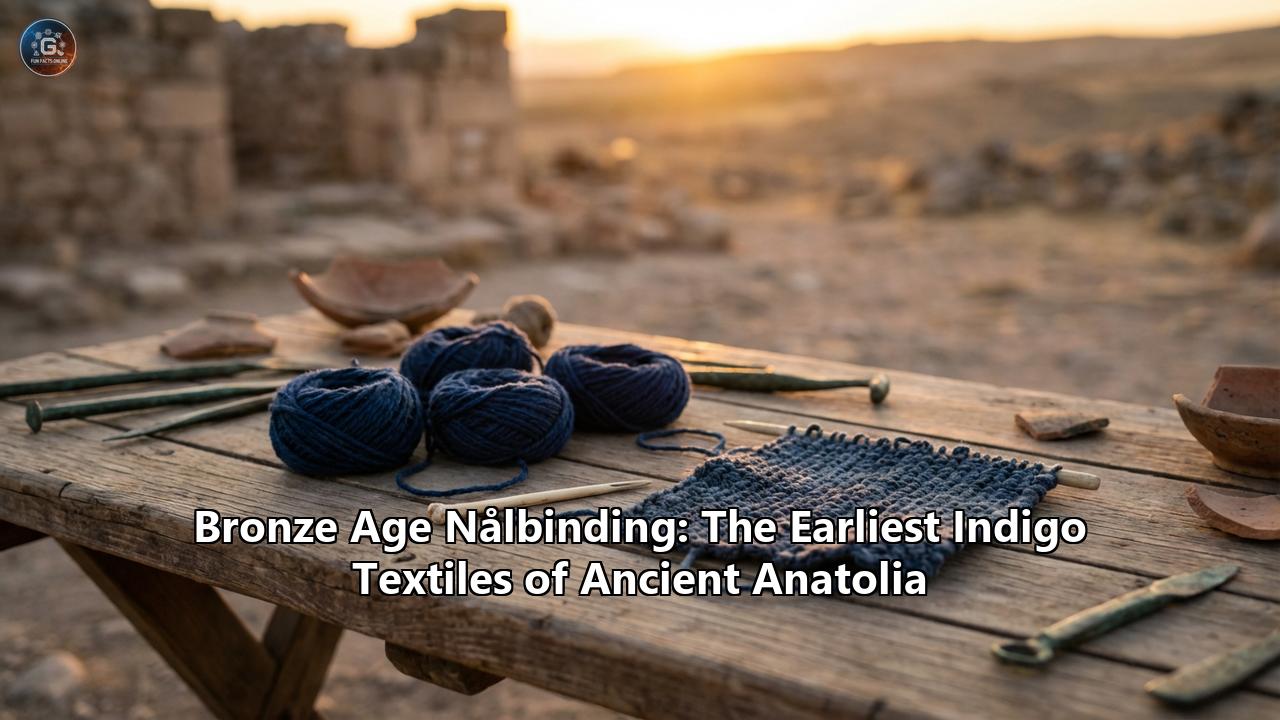
Beneath the sun-baked soils of western Anatolia, buried under millennia of earth and ash, lies a story of human ingenuity that has only recently come to light. It is a story not of monumental stone architecture or golden hoards, but of something far more fragile, intimate, and telling: a few charred scraps of fabric. Yet, these seemingly unassuming fragments are currently rewriting the history of ancient technology, chemistry, and international trade. Discovered at the sprawling archaeological site of Beycesultan Höyük, these textiles offer the earliest known evidence of the complex single-needle looping technique known as nålbinding in the Near East, as well as the oldest scientifically confirmed use of indigo dye in Bronze Age Anatolia.
To understand the profound significance of this discovery, we must journey back nearly four thousand years to a time when empires were rising, trade routes were spanning continents, and a master artisan sat in a sunlit courtyard, patiently coaxing a brilliant blue thread through a loop of hemp.
The Stage: Beycesultan Höyük and the Bronze Age World
Located in the fertile Çivril Plain of the Denizli Province in modern-day Türkiye, Beycesultan Höyük sits strategically in the bend of an old tributary of the Büyük Menderes (Maeander) River. Today, it appears as a massive, sweeping mound—a höyük—covering approximately 35 hectares, formed by centuries of human habitation built upon the ruins of the past. During the Middle and Late Bronze Age (spanning roughly 2000 to 1200 BC), this site was a bustling, cosmopolitan epicenter.
Beycesultan served as a vital nexus connecting the vibrant cultures of the Aegean Sea to the west, the powerful Hittite heartland in central Anatolia, and the sophisticated societies of the Mediterranean and Mesopotamia to the south and east. First systematically excavated in the 1950s by the legendary British archaeologist Seton Lloyd, the site yielded over 40 distinct cultural layers, tracing a continuous line of human occupation from the Late Chalcolithic era through to the twilight of the Bronze Age.
Lloyd’s most dramatic discovery was the "Burnt Palace," a monumental administrative complex dating to the early second millennium BC. The sheer scale of this palace, with its sprawling courtyards, grand reception halls, and complex storage facilities, rivaled the contemporaneous Warsama Palace at Kültepe (ancient Kanesh) and the Sarıkaya administrative building at Acemhöyük. It strongly indicated that Beycesultan was not merely a provincial town, but a powerful regional capital—perhaps the seat of a lost Anatolian kingdom.
However, despite its grandeur, Beycesultan harbored a tragic, albeit scientifically fortuitous, secret. Sometime in the Middle Bronze Age, a catastrophic fire swept through the settlement. The flames consumed the timber framing of the mudbrick walls, collapsed the heavy earthen roofs, and buried the inhabitants' worldly possessions in a suffocating layer of ash and debris. In a supreme stroke of archaeological irony, the very inferno that destroyed Beycesultan is what preserved its most delicate treasures.
The Miracle of Carbonization
In the world of Near Eastern archaeology, finding textiles is exceptionally rare. The soils of western Anatolia are inherently humid, and organic materials like wool, linen, and hemp typically decompose completely within a few centuries. Unless preserved in the hyper-arid deserts of Egypt, the frozen tombs of the Altai Mountains, or the anaerobic bogs of Northern Europe, ancient fabrics simply vanish, leaving an immense gap in our understanding of ancient daily life, fashion, and technology.
But fire changes the chemical structure of organic matter. When the buildings of Beycesultan burned, the rapid, oxygen-starved environment transformed organic materials into elemental carbon. This carbonization process effectively halted bacterial decay, locking the structural integrity of the textiles in place for nearly 3,900 years.
Systematic excavations at Beycesultan resumed in 2007 under a Turkish team, later led by Associate Professor Dr. Çiğdem Maner of Koç University. During the 2016 and 2018 excavation campaigns, archaeologists carefully brushing away the ash of the destroyed buildings encountered two remarkable carbonized fragments, later designated in scientific literature as Tx1 and Tx2.
Tx1 was discovered adhering to the floor of a courtyard-like space in Room 3 of Level 10, a layer corresponding to the Middle Bronze Age (radiocarbon dated between 1915 and 1745 BC). Tx2 was found slightly later, in Room 28 of Level 5b, dating to the Old Hittite period (approximately 1700 to 1595 BC). When these brittle, blackened scraps were sent to laboratories for advanced microscopic and chemical analysis, the results sent shockwaves through the archaeological community.
Unraveling Tx1: The Nålbinding Revolution
When researchers placed the older fragment, Tx1, beneath the powerful lenses of scanning electron microscopes (SEM) and polarized optical microscopes, they immediately realized they were not looking at a standard woven cloth. Traditional weaving, executed on a loom, involves interlacing a set of vertical longitudinal threads (the warp) with a set of horizontal threads (the weft). Tx1 exhibited no such grid-like structure.
Instead, the microscopic images revealed a complex topography of interlocking loops. The fabric had been constructed using a single length of yarn, manipulated with a single, flat, blunt needle. This technique is known by its Scandinavian name: nålbinding (literally "needle-binding").
Nålbinding is the ancient, evolutionary predecessor to both modern knitting and crochet, though it is fundamentally distinct from both. In knitting, a continuous strand of yarn is drawn through a row of active, "live" loops. If a knitted thread is cut or dropped, the entire fabric can unravel in an instant. Nålbinding, conversely, requires the artisan to pull the entire working length of the yarn—usually no more than a meter or two to prevent tangling—completely through the preceding loop, creating a secure knot. As the yarn runs out, a new length must be seamlessly spliced in, typically by fraying the ends and twisting them together with a drop of moisture.
The result is an incredibly dense, robust, and highly elastic textile that will not unravel even if punctured or torn. Because of its durability and form-fitting nature, nålbinding was historically favored for items requiring heavy wear, such as socks, mittens, and hats.
While fragments of nålbinding have been found in the Pre-Pottery Neolithic Levant (such as in the Nahal Hemar cave in Israel) and in later dynastic Egyptian contexts, Tx1 represents the absolute oldest evidence of the nålbinding technique ever discovered in Anatolia or the broader Near East. The discovery fundamentally alters our timeline of textile engineering in the region. It suggests that the artisans of Beycesultan were not simply weavers relying solely on warp-weighted looms; they were multi-disciplinary textile engineers, experimenting with and mastering complex looping techniques to create specialized, highly durable garments. The fact that this technique was being utilized in a grand, palatial context hints that nålbinding was not merely a rustic, household survival skill, but a refined craft recognized for its unique properties.
The Chemistry of Prestige: Cultivating the Blue
If the structure of Tx1 was surprising, its chemical makeup was nothing short of revolutionary. To understand the original nature of the blackened fibers, scientists employed High-Performance Liquid Chromatography with photodiode array detection (HPLC-PDA)—a highly sensitive analytical technique used to separate, identify, and quantify each component in a complex mixture.
The chromatographic analysis isolated a specific molecule locked within the ancient carbon: indigotin. Indigotin is the active chemical compound responsible for true indigo blue. Further analysis strongly suggested that the source of this indigotin was Isatis tinctoria, commonly known as woad, a flowering plant native to the steppe and Mediterranean zones of Anatolia.
Finding indigotin in a 3,900-year-old context makes Tx1 the earliest scientifically confirmed blue-dyed textile from Bronze Age Anatolia. But to truly grasp the weight of this discovery, one must understand the sheer, agonizing difficulty of dyeing with woad in the ancient world.
Unlike many natural plant dyes—where one can simply boil roots, leaves, or bark in water to extract the color (a direct dye)—indigo is a "vat dye." The blue pigment in the woad plant is not soluble in water. You cannot boil woad leaves and dye a piece of cloth blue. Instead, Bronze Age dyers had to engage in a highly sophisticated, multi-stage biochemical process that borders on alchemy.
First, the woad leaves had to be harvested, crushed, and shaped into balls, which were then left to ferment in a humid environment for weeks. This initial fermentation broke down the plant cell walls and converted the precursor chemicals (isatan B) into indoxyl. The fermented woad was then dried for storage.
When it was time to dye, the woad was pulverized and introduced into a "dye vat." Because the pigment remains insoluble in plain water, the dyers had to create an alkaline, oxygen-free (reducing) environment. In antiquity, this was typically achieved by using stale human urine or water filtered through hardwood ash, mixed with a natural reducing agent like bran or madder root to consume the oxygen during a second, heated fermentation.
Inside this putrid, highly alkaline vat, the chemical structure of the dye transformed into "indigo white" (leuco-indigo), a yellowish-green, water-soluble state. The ancient artisan would submerge the nålbound hemp fabric into this pungent vat, allowing the liquid to deeply penetrate the fibers.
The true magic happened when the fabric was pulled from the vat. As the yellowish-green cloth was exposed to the oxygen in the air, a rapid oxidation reaction occurred. Before the dyer's very eyes, the fabric would transition from green to a vibrant, brilliant, indelible blue.
The presence of indigotin on Tx1 proves that the artisans at Beycesultan possessed profound botanical, chemical, and technical knowledge. They understood pH levels, bacterial fermentation, and oxidation centuries before the dawn of modern chemistry. The execution of a successful indigo vat required precise temperature control and weeks of preparation, pointing to a highly specialized, dedicated industry rather than casual, domestic craftwork.
The Cultural Currency of Blue
Why go to such extraordinary lengths, enduring noxious smells and complex chemistry, just to color a piece of string? In the Bronze Age, color was not merely aesthetic; it was a deeply ingrained social language, a marker of status, power, and divine favor.
In the ancient Near East, true blue was incredibly rare. The natural world offers very few stable blue pigments. The ultimate symbol of blue in antiquity was lapis lazuli, a semi-precious stone imported at astronomical expense from the rugged mountains of Badakhshan in modern-day Afghanistan. Lapis lazuli was the color of the heavens, the flesh of the gods in Mesopotamian mythology, and the ultimate marker of royalty.
To wear clothing that mimicked the divine, lapis-like blue was to project an aura of immense wealth and elite status. Because the process of creating indigo-dyed fabric was so labor-intensive and chemically complex, the resulting garments were luxury commodities of the highest order.
We know this not just from the archaeology of Beycesultan, but from the extensive cuneiform archives of the era. During the Middle Bronze Age, Anatolia was intimately connected to Mesopotamia via the Old Assyrian Trade Network. Assyrian merchants from the city of Ashur traveled hundreds of miles on donkey caravans to establish karums (trading colonies) in Anatolia, the most famous being at Kültepe (Kanesh). The thousands of clay cuneiform tablets recovered from Kanesh document a thriving, highly sophisticated international market where textiles were the primary currency, exchanged for Anatolian silver and gold.
In these Akkadian and Sumerian texts, blue-dyed wool and garments are frequently highlighted as items of immense value. The Sumerian term for woad was šamZA.GIN.NA, and blue-dyed wool was referred to as uqnâtu (literally "lapis lazuli-colored"). Cuneiform ledgers reveal that it was fashionable among the Mesopotamian elite to wear a sunu—a refined headband or attached trim—made of dark blue yarn. Furthermore, texts from the later Hittite Empire strictly regulate the distribution of blue garments, reserving them for royal exchanges, diplomatic gifts, and the dressing of divine cult statues. Similar high-status blue textiles have been documented in the elite tombs of New Kingdom Egypt (such as the tomb of Tutankhamun) and in the vibrant frescoes of the Minoan palaces on Crete.
By successfully identifying indigo-dyed fabric at Beycesultan, researchers have physically anchored this site into the elite, international luxury economy of the Bronze Age. Even though no cuneiform tablets have yet been found at Beycesultan itself, the presence of Tx1 speaks volumes. It implies that the rulers and artisans of this western Anatolian center were not merely peripheral players; they were producing, consuming, and likely trading the highest-tier luxury goods in the ancient world. The "Burnt Palace" was almost certainly a center of haute couture for the Bronze Age elite.
Tx2 and the Anatomy of an Ancient Workshop
While the indigo-dyed, nålbound Tx1 fragment provides a glimpse into the luxury economy, the second fragment, Tx2, offers an equally fascinating window into the industrial organization of Bronze Age textile production.
Tx2 dates to between 1700 and 1595 BC, placing it in the era of the Old Hittite Kingdom. Unlike its older counterpart, Tx2 was not looped with a single needle. It features a "plain tabby weave," the most fundamental weaving structure where single weft threads alternate over and under single warp threads. While this might sound common to modern ears, plain tabby weaves are surprisingly rare in the Middle and Late Bronze Age contexts of Anatolia, Mesopotamia, and the Caucasus, making it a highly significant typological find.
But it is the context of Tx2’s discovery that truly brings the ancient world to life. Tx2 was unearthed in Room 28, a space that archaeologists have definitively identified as a dedicated, high-volume textile workshop.
When the excavators cleared the ash from Room 28, they found a stunning array of industrial tools frozen in time. Scattered across the floor were more than 40 spindle whorls of varying sizes and weights. Spindle whorls are the small, weighted disks attached to a drop spindle, used to maintain momentum while spinning raw fibers into yarn. The variation in their sizes indicates that the artisans were spinning threads of different thicknesses and tensions, likely producing everything from heavy utility cords to ultra-fine gossamer threads for luxury garments.
Alongside the whorls lay numerous weaving combs (used to pack the weft threads tightly together), bone needles, and heavy loom weights. Loom weights are the telltale sign of the warp-weighted loom, the primary weaving technology of the ancient Mediterranean. These heavy clay or stone disks were tied to the bottom of the vertical warp threads, pulling them taut so the weaver could pass the weft through. In Room 28, a large, disk-shaped stone weight was found resting directly on top of the Tx2 cloth fragment, vividly capturing the very moment the loom collapsed in the flames. Furthermore, postholes in the floor of the room explicitly mark the footprint of the massive wooden loom frames that once stood there.
The concentration of tools in Room 28 points to a highly organized, institutionalized mode of production. This was not a family weaving cloth for their own backs; this was an industrial-scale operation, likely state-sponsored or managed by the palace administration. In the ancient world, textile production was predominantly a female-driven industry. The workshops of the Near East were staffed by hundreds, sometimes thousands, of women—ranging from highly respected master weavers who commanded premium rations, to captive slaves tasked with the grueling, endless labor of spinning and grinding dyes. The artifacts of Room 28 allow us to almost hear the clatter of the loom weights, the hum of the spinning whorls, and the chatter of the women who drove the economic engine of Beycesultan.
Hemp: The Unexpected Fiber
One of the most surprising revelations to emerge from the microscopic analysis of both Tx1 and Tx2 was the nature of the fiber itself. When we think of ancient Near Eastern textiles, we predominantly think of two materials: animal wool, the staple of the Mesopotamian economy, and linen (made from flax), the quintessential fabric of ancient Egypt.
However, the high-resolution imaging and structural analyses of the Beycesultan textiles revealed that both the nålbound loops of Tx1 and the tabby weave of Tx2 were crafted from Cannabis sativa—hemp.
Hemp is a bast fiber, meaning it is extracted from the inner bark of the plant's stem. Harvesting and processing hemp requires a laborious process known as "retting," where the stalks are soaked in water for weeks to rot away the cellular tissues, followed by "scutching" (beating the stalks) and "hackling" (combing) to extract the long, strong, spinnable fibers.
The identification of hemp in Bronze Age Anatolia is a paradigm-shifting revelation. While hemp cultivation is known from later periods—and remains an agricultural staple in the Denizli region today—its use in the Middle and Late Bronze Age of western Anatolia was previously undocumented. The fact that Tx1 is a Z-twisted yarn of about 2.25 millimeters thick made of hemp, and that Tx2 might be the oldest known hemp-based tabby weave in Late Bronze Age Anatolia, completely rewrites our understanding of ancient agronomy.
It demonstrates that the farmers of the Çivril Plain were cultivating a highly diverse portfolio of crops. Hemp fibers are exceptionally strong, naturally resistant to mold, and highly durable, making them ideal for sails, ropes, and heavy-duty clothing. However, the fact that hemp was also chosen to be dyed with the incredibly expensive, prestige indigo dye implies that it was not viewed merely as a utilitarian, "poor man's" fiber. Instead, expertly spun and dyed hemp was highly valued, perhaps prized for its slight natural luster and its ability to hold the deep blue of the woad vat beautifully. The presence of hemp expands the known catalog of Bronze Age agricultural resources and highlights the adaptability and botanical expertise of Anatolian societies.
Scientific Alchemy: Reading the Past Through Modern Technology
The incredible narrative of the Beycesultan textiles would remain entirely unknown were it not for the breathtaking advancements in modern archaeological science. Fifty years ago, these blackened, brittle scraps would have yielded little more than their physical dimensions. Today, archaeology is as much a hard science as it is an historical discipline.
The successful study of Tx1 and Tx2, published in the prestigious journal Antiquity in 2024, relied on an interdisciplinary symphony of techniques. To determine the date, researchers utilized Accelerated Mass Spectrometry (AMS) radiocarbon dating. By measuring the radioactive decay of Carbon-14 isotopes trapped within the charred fibers, scientists could pinpoint the textiles' creation to narrow, specific windows in the second millennium BC, aligning perfectly with the stratigraphy established by the excavators.
To understand the construction, Scanning Electron Microscopy (SEM) and polarized optical microscopy were deployed. SEM blasts a sample with a focused beam of electrons, creating highly detailed, three-dimensional images of the microscopic topography. This allowed researchers to trace the exact path of the single yarn in the nålbinding loops and to identify the characteristic morphological features of bast fibers (like the nodes and striations specific to hemp) without destroying the fragile artifacts.
Finally, the chemical identification of the dye required high-performance liquid chromatography (HPLC). Because the dye molecules were degraded by fire and nearly four thousand years of burial, they were present in trace, microscopic amounts. The HPLC system dissolves a microscopic sample in a solvent and forces it through a specialized column under high pressure. Different chemical compounds travel through the column at different speeds. By analyzing the time it takes for a molecule to emerge, and cross-referencing it with its light-absorption signature via a photodiode array, chemists can conclusively match the ancient residue against modern chemical standards—in this case, pure indigotin.
This synthesis of field archaeology and cutting-edge laboratory chemistry represents a gold standard in modern historical research. It proves that the soil of Anatolia still holds countless secrets, waiting not just for the trowel, but for the microscope.
Re-centering the Map of Innovation
For generations, the narrative of ancient history has often been heavily weighted toward the river valleys of the Nile and the Tigris-Euphrates. Egypt and Mesopotamia were viewed as the undisputed engines of innovation, while regions like western Anatolia were sometimes relegated to the role of the periphery—conduits of trade, perhaps, but not the originators of high technology.
The discoveries at Beycesultan fundamentally disrupt this outdated paradigm. The evidence of complex nålbinding, the mastery of multi-stage chemical indigo dyeing, the massive scale of the textile workshops, and the sophisticated cultivation of hemp all prove that Bronze Age Anatolia was a vibrant epicenter of technological and scientific advancement in its own right.
The artisans of Beycesultan were not merely copying techniques imported from the east or the south; they were experimenting, innovating, and pushing the boundaries of what was possible with plant fibers and natural chemistry. They were full, active participants in an interconnected, globalized Bronze Age world. The "Burnt Palace" and its surrounding workshops supplied the luxury markets of the ancient Near East, converting the native flora of the Anatolian steppe into the lapis-colored status symbols demanded by kings, queens, and high priests from the Aegean to the Zagros mountains.
The Legacy of the Single Needle and the Blue Vat
When we look at the blackened, looping threads of the Beycesultan textiles today, we are looking at much more than dead organic matter. We are looking at a frozen moment of human cognition and creativity.
We can vividly imagine the artisan, some 3,900 years ago, sitting in the sunlit courtyard of Room 3. We can picture the repetitive, rhythmic motion of the flat bone needle pulling the spun hemp through the loops, slowly building a fabric of immense strength and flexibility. We can smell the sharp, ammonia-rich tang of the woad vat fermenting in the heat, and witness the seemingly magical moment when the pale, wet cloth struck the air and bloomed into a deep, brilliant blue.
The destruction of Beycesultan by fire was undoubtedly a tragedy for those who lived through it. The roaring flames that collapsed the loom in Room 28 marked the violent end of a thriving era. Yet, through the alchemical quirk of carbonization, the fire insured that the labor, the skill, and the genius of those nameless artisans would not be lost to the damp soils of time.
The earliest indigo and nålbinding textiles of Anatolia stand as a profound testament to the human desire not just to survive, but to create, to innovate, and to adorn the world in color. They remind us that the threads that connect us to our ancient past are stronger than we ever imagined—and occasionally, they are dyed a beautiful, brilliant blue.
Reference:
- http://www.anatolianarchaeology.net/bronze-age-breakthrough-in-anatolia-3900-year-old-indigo-textile-and-single-needle-knitting-unearthed-at-beycesultan/
- https://www.turkiyetoday.com/culture/ancient-anatolian-textiles-reveal-earliest-indigo-dyed-yarn-nalbinding-technique-3203072
- https://texfash.com/research/oldest-known-blue-dyed-fabric-in-bronze-age-anatolia-identified-at-ancient-settlement-study-finds
- https://arkeonews.net/4000-years-of-innovation-indigo-dyed-and-nalbinding-textile-discovered-at-beycesultan-hoyuk/
- https://www.cambridge.org/core/journals/antiquity/article/untwisting-beycesultan-hoyuk-the-earliest-evidence-for-nalbinding-and-indigodyed-textiles-in-anatolia/4A00AC3051C50B89F5907F25F03A4B5C
- https://www.eurekalert.org/news-releases/1117025