
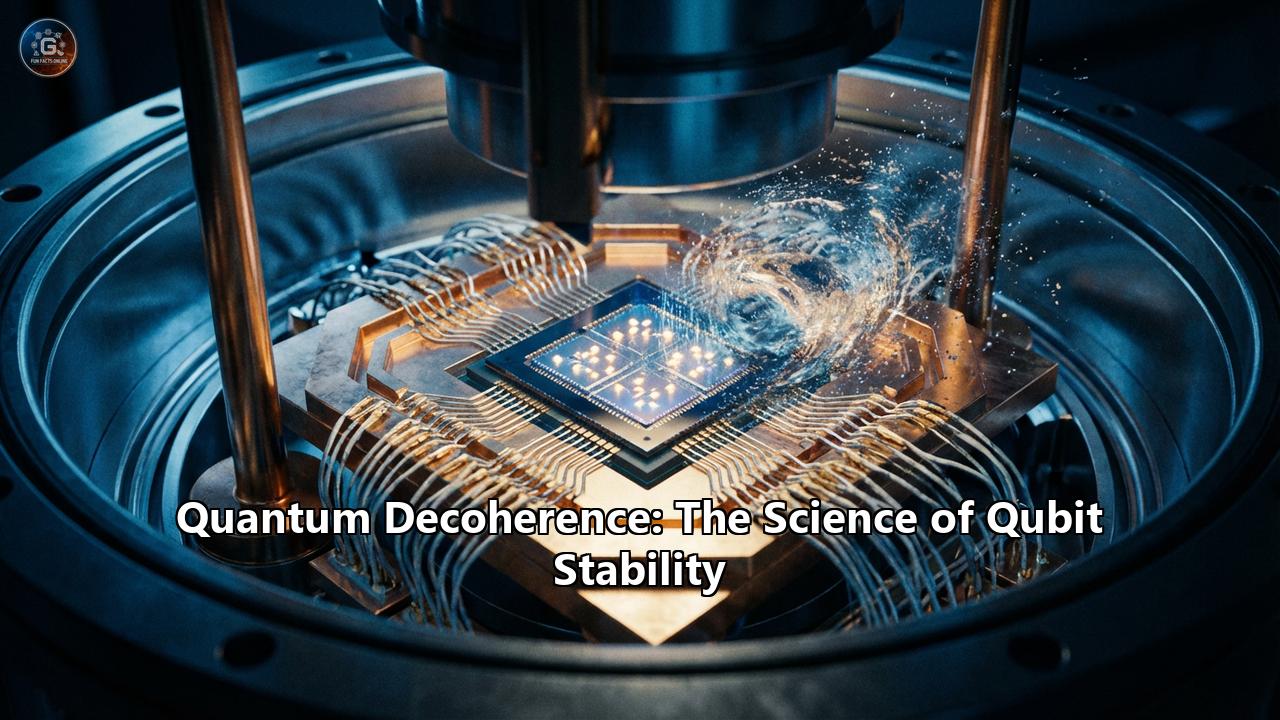
Imagine a symphony orchestra where every musician is blindfolded and wearing noise-canceling headphones. At the conductor’s initial downbeat, they all begin playing in perfect unison. For a few fleeting moments, the music is a flawless, complex masterpiece. But as the seconds tick by, without the ability to synchronize with one another or the environment, a violinist drifts out of tempo. A cellist misjudges a rest. The brass section falls behind. Within minutes, the intricate symphony dissolves into a chaotic, irrecoverable cacophony of noise.
In the realm of quantum mechanics, this descent from perfect harmony to random static is known as quantum decoherence.
For decades, the promise of quantum computing has tantalized scientists, promising to solve computational problems in minutes that would take classical supercomputers millennia. By leveraging the bizarre properties of quantum mechanics—namely superposition and entanglement—quantum computers process information in a fundamentally different way than the classical machines we use today. However, this immense power comes with a debilitating Achilles' heel: quantum information is incredibly fragile. The very states that give quantum bits (qubits) their processing power are highly susceptible to the slightest environmental disturbances.
Decoherence is the timer on the quantum bomb. It is the rate at which qubits lose their stored quantum information to the surrounding environment. If a qubit decoheres before a calculation is finished, the information is lost, and the output is nothing but randomized errors. Understanding, mitigating, and ultimately defeating quantum decoherence is not just a niche physics problem; it is the single greatest engineering challenge of the 21st century.
The Anatomy of a Qubit: Superposition, Entanglement, and Coherence
To understand why qubits fall apart, we must first understand how they hold together.
Classical computers operate on bits, which are binary. A bit is either a 0 or a 1, akin to a light switch that is either off or on. A qubit, however, operates on the principles of quantum mechanics. It can exist as a 0, a 1, or any linear combination of the two simultaneously—a state known as superposition. If a classical bit is a coin sitting flat on a table showing either heads or tails, a qubit in superposition is a coin spinning rapidly in the air.
Furthermore, qubits can be entangled. When two or more qubits are entangled, the state of one is intrinsically tied to the state of another, no matter how much physical distance separates them. Measuring one entangled qubit instantly collapses the state of its partner. This property allows quantum computers to perform highly complex, parallel calculations, processing vast probability spaces simultaneously.
The maintenance of these delicate states—superposition and entanglement—is called coherence. As long as a quantum system remains coherent, the "spinning coins" are synchronized, and the quantum computer can perform its algorithmic magic. But to maintain coherence, a quantum system must be perfectly isolated from the rest of the universe. The moment the quantum system interacts with the classical environment—whether through a stray photon, a microscopic fluctuation in temperature, or a faint magnetic field—the environment effectively "measures" the system. The spinning coin crashes to the table, forcing it to choose a definite state of 0 or 1. The quantum magic vanishes.
The Physics of Decoherence: The Collapse of the Wave Function
Quantum decoherence is the bridge between the bizarre quantum realm and the predictable classical world. It explains why macroscopic objects like chairs, apples, and humans do not exist in a superposition of states.
Mathematically, a quantum state is represented by a density matrix. The diagonal elements of this matrix represent the classical probabilities of the system (the likelihood of being in state 0 or state 1). The off-diagonal elements represent the quantum coherences—the interference patterns between the states that allow for quantum computation.
When a qubit interacts with its environment, the two become entangled. This entanglement causes the information about the qubit's state to leak into the surrounding environment. As this information leaks, the off-diagonal terms in the density matrix undergo an exponential decay, shrinking toward zero. The system loses its quantum interference properties and becomes a classical statistical mixture. The wave function has collapsed.
This loss of coherence is quantified by two primary timescales, colloquially known as the "Dual Villains" of quantum stability: $T_1$ and $T_2$.
$T_1$: Relaxation Time
$T_1$, or longitudinal relaxation time, measures the energy loss of a qubit. A qubit typically consists of a ground state (representing 0) and an excited state (representing 1). Like a ball precariously balanced at the top of a hill, a qubit in the excited state naturally wants to release its energy and roll down to the lowest possible energy state. If a qubit is prepared in the |1> state, $T_1$ is the average time it takes for it to spontaneously emit a photon or a phonon into the environment and decay back to the |0> state.
$T_2$: Dephasing Time
While $T_1$ deals with energy, $T_2$ deals with time and synchronization. $T_2$, or transverse relaxation time, measures how long a qubit can hold its superposition before its phase gets scrambled. Imagine two pendulum clocks swinging in perfect harmony. If a slight, random breeze hits one of the pendulums, its timing will shift. It hasn't lost energy (it is still swinging), but it is no longer synchronized with its partner. In a quantum computer, fluctuating magnetic or electrical fields cause the relative phase between the |0> and |1> states to drift randomly. $T_2$ is often the more restrictive bottleneck, as qubits generally lose their phase long before they lose their energy.
Visualized on a theoretical geometric model called the Bloch Sphere, the state of a qubit is a vector pointing from the center of the sphere to its surface. The poles represent classical 0 and 1, while the equator represents equal superpositions. $T_1$ relaxation pulls the vector out of the equator and forces it up toward the north pole (the ground state). $T_2$ dephasing acts like a blur, smearing the vector's precise direction around the equator until its phase information is entirely lost.
The Enemies at the Gate: What Causes Decoherence?
The classical environment is incredibly loud, and it attacks qubits from every conceivable angle. To achieve high coherence times, scientists must isolate qubits from an array of environmental hazards.
1. Thermal Fluctuations: Heat is essentially the kinetic vibration of atoms. Even at room temperature, these vibrations contain enough thermal energy to violently knock qubits out of their fragile states. This is why many quantum computers, particularly those using superconducting circuits, must be housed in dilution refrigerators and cooled to around 15 millikelvins—colder than the vacuum of deep space. 2. Electromagnetic Interference: Stray magnetic and electrical fields can easily scramble the phase of a qubit ($T_2$ dephasing). Even the Wi-Fi signals in a laboratory, the magnetic field of the Earth, or the electrical hum of the building's wiring can cause catastrophic errors. This necessitates extreme magnetic shielding. 3. Material Defects: The physical substrates upon which qubits are manufactured (often silicon or sapphire) are rarely perfect. Microscopic defects in the crystal lattice can act as "Two-Level Systems" (TLS). These defects behave like parasitic, microscopic sponges that absorb energy from the qubit, accelerating $T_1$ relaxation. 4. Control Line Noise: The ultimate paradox of quantum computing is that to use a qubit, you must communicate with it. Scientists use wires to send microwave pulses to manipulate the qubits. However, these very control lines act as highways for classical noise to travel down into the quantum processor. 5. Cosmic Rays and Background Radiation: In recent years, researchers discovered a stubborn limit to qubit stability. High-energy cosmic rays from deep space and trace amounts of ambient radioactivity in building materials occasionally strike the quantum chip. When they do, they shatter chemical bonds, releasing a cascade of phonons (vibrational energy) that sweeps across the chip, destroying the coherence of multiple qubits simultaneously.The Hardware Battlefield: Modalities of Qubits
Because different physical systems experience decoherence differently, the quantum computing industry is fractured into several competing "hardware modalities," each with its own strategies for maximizing coherence times.
- Superconducting Qubits: Used by industry giants like Google and IBM, these are printed onto microchips like traditional circuits. They rely on frictionless electrical currents operating at near absolute zero. They are incredibly fast, allowing for quick computation, but historically suffered from notoriously short coherence times—often decaying in less than 100 microseconds.
- Trapped Ions: Used by companies like IonQ and Quantinuum, these systems use lasers or microwaves to trap individual charged atoms (ions) in a vacuum chamber. Because they are isolated in a vacuum, they are highly shielded from environmental noise, resulting in inherently longer coherence times that can last for seconds. However, their gate operations (the time it takes to perform a calculation) are much slower than superconducting circuits.
- Neutral Atoms: Similar to trapped ions but using uncharged atoms held in place by highly focused lasers ("optical tweezers"). They offer excellent coherence and high scalability.
- Photonic Qubits: These use particles of light (photons) to carry quantum information. Because photons rarely interact with each other or their environment, they are highly resistant to decoherence and can operate at room temperature. The challenge lies in making them interact when necessary for computation.
- Topological Qubits: The holy grail of quantum hardware, championed by companies like Microsoft. Topological qubits encode information in the structural layout of quasiparticles. Because the information is stored globally rather than locally, a local environmental disturbance cannot flip the qubit. They are theoretically immune to most forms of decoherence, though practically realizing them remains a monumental physics challenge.
The 2025–2026 Stability Revolution: Record-Breaking Milestones
For years, the battle against decoherence yielded slow, incremental progress. However, the years 2025 and 2026 have been widely recognized by industry experts as the turning point for practical reality, unleashing a torrent of breakthroughs in qubit stability. We are now witnessing coherence times that were considered science fiction just half a decade ago.
Shattering the Transmon Millisecond Threshold
Superconducting "transmon" qubits are heavily favored by the industry due to their fast operation speeds and compatibility with existing semiconductor manufacturing techniques. Their primary disadvantage has always been their short shelf life. However, in July 2025, a team of physicists from Aalto University in Finland achieved a monumental milestone. They published a transmon qubit measurement with an echo coherence time that hit a maximum of 1 millisecond, with a median of 0.5 milliseconds. This drastically extended the window for error-free operations.
Just months later, in November 2025, researchers from Princeton University pushed the boundaries even further. They designed a novel transmon qubit architecture that achieved coherence times of up to 1.6 milliseconds—a staggering 15 times longer than the industry standard. Because these new highly stable qubits are fundamentally similar to those used by Google and IBM, they can easily slot into existing processor designs, bringing large-scale, fault-tolerant quantum systems significantly closer to reality.
The Galvanic Cat: An Hour of Stability
While a millisecond is a long time in the quantum world, Paris-based startup Alice & Bob completely rewrote the rulebook in September 2025. They announced the creation of the "Galvanic Cat" qubit, a specialized superconducting qubit that resists bit-flip errors for an astonishing 33 to 60 minutes. This is millions of times longer than typical superconducting qubits. While running quantum operations at a breakneck speed of 26.5 nanoseconds, the Galvanic Cat maintained a 94.2% fidelity. By solving the error problem at the source through intrinsic physics rather than relying purely on software correction, Alice & Bob dramatically simplified the hardware architecture required for future machines, targeting a fault-tolerant system of 100 logical qubits by 2030.
Microwave Control and Unprecedented Precision
In June 2025, physicists at the University of Oxford targeted the accuracy of the operations themselves. Using trapped calcium ions as qubits, they achieved the most accurate quantum logic operation ever recorded: an error rate of just 0.000015% (or one error in 6.7 million operations). Crucially, they achieved this by discarding the conventional use of bulky, unstable laser arrays. Instead, they controlled the quantum state using electronic microwave signals. This method is not only cheaper and more stable, but it was conducted at room temperature without the need for magnetic shielding, drastically lowering the barrier to scaling up quantum hardware.
Real-Time Fluctuation Tracking
Even highly stable qubits experience sudden, microscopic variations in performance. In February 2026, researchers at the Niels Bohr Institute (NBI) pioneered a breakthrough in how we measure decoherence. Previously, standard testing methods took up to a minute to measure average energy loss, completely masking rapid, real-time qubit fluctuations. Using fast FPGA-based hardware, the NBI team successfully tracked changes in delicate quantum states 100 times faster than previous methods. They can now instantly monitor the exact fraction of a second when a qubit shifts from a "good" state to a "bad" state, allowing for real-time calibration and adaptive control that can course-correct before the system entirely decoheres.
The Shield and the Sword: Quantum Error Correction (QEC)
While extending the natural coherence time of a physical qubit is essential, physics dictates that we can never isolate a system perfectly. To solve radical challenges in fields like materials science and medicine, quantum computers will eventually need to perform trillions of continuous operations. If a qubit lasts for 1 millisecond, but an algorithm takes 10 minutes to run, the system must actively fix errors faster than decoherence can cause them.
This brings us to the ultimate shield against decoherence: Quantum Error Correction (QEC).
In classical computing, error correction is simple: just copy the data. If you want to make sure a '1' doesn't accidentally flip to a '0', you encode it as '111'. If an error flips one bit so the system reads '101', the computer takes a majority vote and corrects it back to '111'.
Quantum mechanics forbids this approach. According to the No-Cloning Theorem, it is physically impossible to create an identical copy of an unknown quantum state. If you try to read a qubit to copy it, you collapse its superposition and destroy the data.
To bypass this, QEC relies on the power of entanglement. Instead of copying the data, QEC takes the fragile information of a single quantum state and entangles it across a vast web of multiple physical qubits to create one highly stable Logical Qubit. These secondary physical qubits, known as "ancilla qubits," act as sensors. By carefully measuring the parity (the relative relationships) of the ancilla qubits without directly looking at the core data, the computer can deduce if an error has occurred (like a bit-flip or a phase-flip) and apply a corrective microwave pulse before the logical qubit decoheres.
The year 2025 marked a definitive paradigm shift in this arena. Experts point to Google's "Willow" chip, unveiled in late 2024, as the moment QEC successfully made the leap from abstract theoretical physics to tangible hardware reality, proving that scaling the number of physical qubits could practically drive down logical error rates.
This triggered a "QEC code explosion" throughout 2025. Between January and October of that year alone, 120 new peer-reviewed papers on QEC codes were published, a massive jump from the previous year. Industry consensus solidified: QEC is no longer a futuristic goal; it is the beating heart of the quantum computing industry and the universal priority for utility-scale computation.
Companies like QuEra Computing laid down aggressive, achievable roadmaps based on QEC. For 2025, QuEra targeted a model with 30 logical error-corrected qubits supported by over 3,000 physical qubits, utilizing a technique called magic state distillation to allow for the execution of complex, non-Clifford gates with high fidelity. By 2026, QuEra's third-generation QEC model introduces 100 logical qubits backed by 10,000 physical qubits—a threshold capable of executing deep logical circuits that finally push quantum computation beyond the simulatability limits of classical supercomputers.
Algorithmic Lifelines and Dynamical Decoupling
Hardware stabilization and QEC are heavy, resource-intensive solutions. Consequently, researchers have also developed algorithmic techniques and pulse-control protocols to outsmart decoherence at the software and microwave-control level.
Dynamical Decoupling: This technique involves hitting the qubit with a continuous, precise sequence of microwave pulses, effectively flipping it back and forth. If a low-frequency environmental noise is slowly dragging the qubit out of phase, flipping the qubit halfway through the noise exposure causes the second half of the exposure to perfectly cancel out the first. It is the quantum equivalent of a swimmer swimming upstream for five minutes, and then turning around to swim downstream for five minutes to end up exactly where they started. Beating the Ramsey Limit: In April 2025, Dr. Eli Levenson-Falk’s group at USC published a landmark paper in Nature Communications demonstrating a coherence-stabilized technique that bypassed the traditional "Ramsey limit" of measurement. By applying continuous, slowly varying microwave control, the team manipulated the vector of the quantum state on the Bloch sphere, intentionally "dumping" the decoherence into trackable, stabilized directions. This not only enhanced the sensitivity of the qubits for quantum sensing but drastically sped up the calibration of superconducting devices, allowing processors to maintain high measurement fidelity over longer periods. Google's Quantum Echoes: Software and algorithmic design also play a vital role in managing noise. In 2025, Google announced the "Quantum Echoes algorithm". Earlier quantum algorithms were universally bottlenecked by limited stability. Quantum Echoes redefines how the computer treats algorithmic queries, utilizing stronger entanglement protocols interwoven with real-time error correction to keep the quantum states steady for significantly longer periods. This breakthrough provided verifiable evidence of quantum advantage over classical systems, showcasing that intelligent algorithmic design can effectively "hide" the computation from environmental noise.The Path Forward: From NISQ to Fault Tolerance
For the last decade, the industry has existed in the NISQ era: Noisy Intermediate-Scale Quantum computing. In the NISQ era, machines possess enough qubits to be interesting, but are too noisy (decoherence-prone) to execute deep, world-changing algorithms.
The convergence of the 2025/2026 milestones—Princeton's 1.6-millisecond transmons, Alice & Bob's hour-long bit-flip resilience, the deployment of active logical QEC, and real-time FPGA feedback loops—signals the definitive end of the NISQ era. We are now entering the era of Fault-Tolerant Quantum Computing (FTQC).
This transition is not merely an academic victory; it is triggering a massive geopolitical and commercial infrastructure race. Following these stabilization breakthroughs, sector investment surged by 50%. Governments recognize that stable, utility-scale quantum computing is a strategic imperative. In late 2025, the Canadian government launched the $92 million Canadian Quantum Champions Program, projecting that mature quantum technologies could contribute over 3% to their GDP by 2045.
The stakes are astronomically high. With systems bridging the gap toward trillions of error-free operations through real-time correction, the "encryption shock" timeline is accelerating. A sufficiently large, stable quantum computer running Shor's Algorithm will be capable of factoring prime numbers exponentially faster than a classical machine, effectively breaking RSA encryption. Industry analysts now project that data encrypted today could be decrypted by stable quantum systems as early as the early 2030s.
Yet, the constructive power of coherent qubits vastly outweighs the disruptive. When a quantum processor can reliably hold its coherence, it acts as a perfect simulator for nature. Materials science relies entirely on understanding how electrons behave and interact inside solids and molecules. With long-lived logical qubits, we will no longer have to discover new batteries, superconductors, or pharmaceuticals through trial and error. We will perfectly simulate their molecular interactions in a quantum environment, bypassing years of laboratory research.
Quantum decoherence—the once seemingly insurmountable barrier that caused wave functions to collapse and calculations to perish into noise—is finally being tamed. By marrying the exquisite isolation of advanced physics, the raw computational heavy-lifting of error correction algorithms, and the blinding speed of real-time control hardware, scientists have transformed the fragile quantum state from a fleeting anomaly into a stable, industrial powerhouse. The timer has been paused. The symphony of the quantum realm is finally playing in perfect, uninterrupted harmony.
Reference:
- https://singularityhub.com/2025/11/11/record-breaking-qubits-are-stable-for-15-times-longer-than-google-and-ibms-designs/
- https://www.spinquanta.com/news-detail/understanding-quantum-decoherence-the-ultimate-expert-guide
- https://www.newquantumera.com/podcast/
- https://voicehunt.news/emerging-technology/the-quantum-dawn-why-2025-was-the-turning-point-for-practical-reality
- https://www.eurekalert.org/news-releases/1089891
- https://www.forbes.com/sites/johnkoetsier/2025/09/25/massive-quantum-computing-breakthrough-long-lived-qubits/
- https://www.sci.news/physics/new-record-qubit-operation-accuracy-13974.html
- https://www.sciencedaily.com/releases/2026/02/260219040756.htm
- https://www.mdpi.com/2624-960X/6/4/39
- https://www.riverlane.com/blog/quantum-error-correction-our-2025-trends-and-2026-predictions
- https://www.hpcwire.com/off-the-wire/quera-unveils-ambitious-roadmap-for-error-corrected-quantum-computers-through-2026/
- https://www.quera.com/press-releases/quera-computing-releases-a-groundbreaking-roadmap-for-advanced-error-corrected-quantum-computers-pioneering-the-next-frontier-in-quantum-innovation-0
- https://trendsresearch.org/insight/googles-quantum-breakthrough-redefines-the-future-of-computation/
- https://www.orfonline.org/expert-speak/will-2025-mark-the-beginning-of-practically-useful-quantum-computers
- https://www.rbc.com/en/thought-leadership/explained/quantum-computing-explained/