
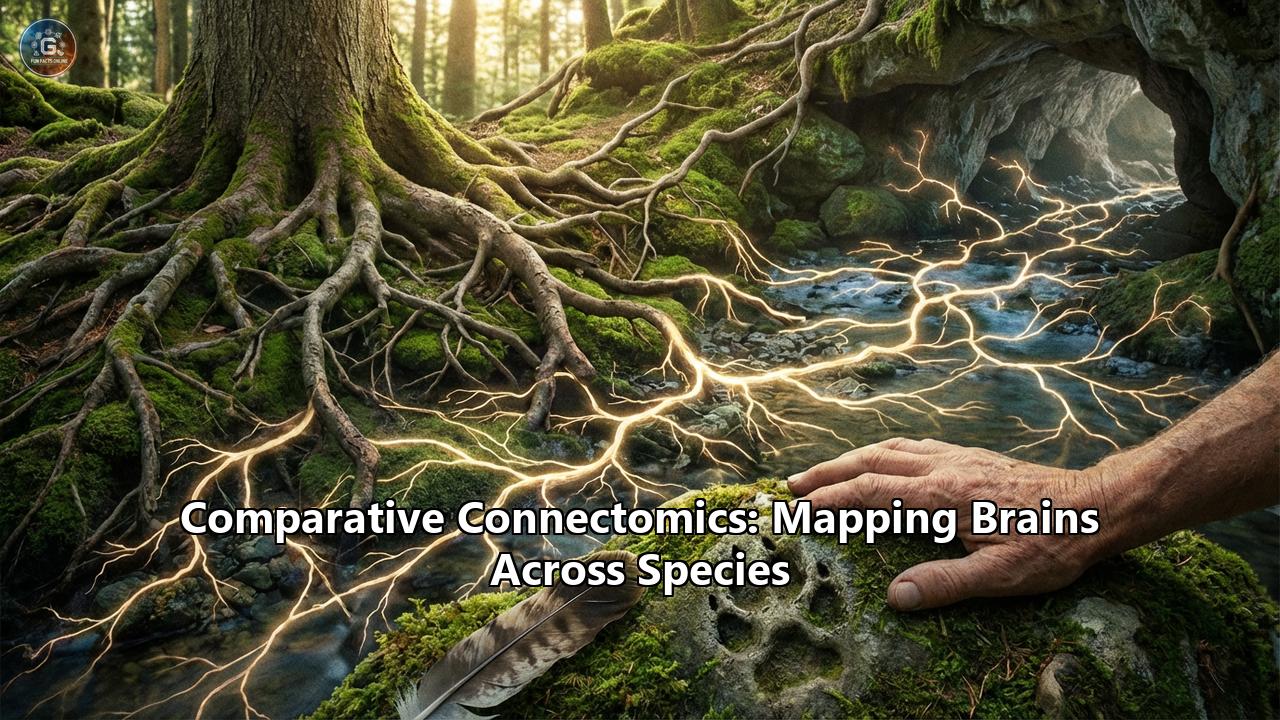
Imagine a map so detailed it traces not just every highway and street, but every sidewalk, garden path, and hallway in a megacity. Now, imagine this city is not made of concrete, but of living tissue, and the traffic isn't cars, but electric sparks of thought, memory, and emotion. This is the connectome—the comprehensive wiring diagram of a brain.
For decades, neuroscience operated like early explorers, naming continents (lobes) and mountain ranges (gyri) without knowing the paths that connected them. We knew where language happened, but not how the message traveled. Today, we have entered the era of Comparative Connectomics. By mapping and comparing the brain circuitry of different species—from the humble roundworm to the complex human—scientists are uncovering the universal laws of intelligence and the unique wiring errors that lead to disease.
This article is your definitive journey into the most ambitious biological cartography project in history. We will explore the cutting-edge technology slicing brains into nanometer-thin sheets, the "universal grammar" of neural circuits, and the startling discovery that the blueprint for decision-making is conserved from mice to men.
Part 1: The Cartographer’s Toolkit – How to Map a Mind
Mapping a connectome is not merely "scanning" a brain; it is a computational and physical feat that borders on science fiction. The challenge is scale: a neuron's axon can span centimeters, but the synapses connecting them are measured in nanometers. It is like mapping the entire Earth with a resolution accurate to a single marble.
1. The Nanoscale Knife: Serial Section Electron Microscopy (ssEM)
To map a connectome at the synaptic level—the "microscale"—researchers must physically slice the brain.
- The Process: A brain sample is stained with heavy metals (like osmium) to make cell membranes visible to electrons. It is then embedded in hard resin.
- The Slicing: Automated tape-collecting ultramicrotomes (ATUM) diamond-slice the brain into sections as thin as 30 nanometers (1/3000th the width of a human hair).
- The Imaging: Electron microscopes blast these slices with electron beams, generating terabytes of images.
- The Challenge: A cubic millimeter of mouse brain yields roughly two petabytes of data. Storing and processing this requires data centers that rival those of tech giants.
2. The Macroscale View: Diffusion Tensor Imaging (DTI)
For human brains, we cannot slice and dice. Instead, we use MRI-based techniques like DTI.
- How it Works: DTI tracks the movement of water molecules. In the brain, water flows easily along bundles of axons (white matter tracts) but is blocked from moving across them. By tracking this "anisotropic" flow, computers reconstruct the massive superhighways connecting brain regions.
- The Limitation: DTI is like a flight map; it shows you the routes between cities (London to New York), but it cannot tell you which house in London is calling which house in New York. It lacks synaptic resolution.
3. The AI Apprentice: Automated Segmentation
This is where the revolution lies. Ten years ago, tracing neurons was done by hand—undergrads sitting in dark rooms, coloring in cells. Today, Convolutional Neural Networks (CNNs) do the heavy lifting. AI algorithms trained on human-traced ground truth data can now segment neurons in 3D, identifying synapses and organelles with superhuman speed. This AI-human hybrid workflow was the key to the massive breakthroughs of 2024 and 2025.
Part 2: The Ladder of Life – Case Studies in Connectivity
Comparative connectomics is built on the idea that by looking at "simpler" brains, we can understand the fundamental blocks of our own.
*1. The Pioneer: Caenorhabditis elegans (The Roundworm)
- The Stats: 302 neurons, ~7,000 synapses.
- The Legacy: Completed in 1986 by Sydney Brenner, this was the "Moon Landing" of connectomics. It taught us that wiring is not random. The worm has a "small-world" network—neurons are grouped into local clusters with a few long-range connections, maximizing efficiency.
- The Insight: Even in this simple worm, the wiring diagram is consistent between individuals. It is a hard-coded biological machine.
2. The New Standard: Drosophila melanogaster (The Fruit Fly)
- The Breakthrough: In October 2024, a global consortium released the first complete connectome of an adult fruit fly brain.
- The Stats: ~140,000 neurons, >50 million synapses.
- Why It Matters: Unlike the worm, the fly displays complex behaviors: aggression, courtship, navigation, and learning.
- The "Compass" Circuit: Connectomics revealed a ring-shaped circuit in the fly's central complex that acts as an internal compass. As the fly turns, a bump of neural activity moves around the ring. This is a physical representation of an abstract concept (heading)—a literal "ghost in the machine" that we can now see.
3. The Mammalian Frontier: The Mouse
- Current Status: We are on the brink of the whole-brain mouse connectome. Recent releases have mapped the primary visual cortex in stunning detail.
- Key Finding: Mouse visual circuits are far more interconnected with "non-visual" areas than expected. The visual cortex doesn't just "see"; it receives motor predictions (what the mouse intends to do) to stabilize the image. This proves that perception is an active, predictive process, not a passive camera.
4. The Human: The Macroscale Mystery
- The Difference: The human connectome is characterized by modular hyper-specialization. While a mouse brain is highly integrated (everything talks to everything), the human brain is broken into distinct, specialized modules (language, faces, tools) connected by expensive, long-range white matter tracts.
Part 3: Conserved Principles – The "Universal Grammar" of Brains
When we compare these maps, three fundamental laws of neural architecture emerge. These are the rules evolution follows, regardless of species.
1. The Rich Club Phenomenon
In every brain mapped so far, there exists a "Rich Club"—a group of high-degree hub nodes that are more densely connected to each other than chance would predict.
- The Analogy: Think of the global air travel network. London, New York, and Tokyo are hubs. They don't just connect to small airports; they connect to each other.
- Function: This allows for rapid communication across the brain. If you see a tiger (Visual Cortex), the information zips to the Amygdala (Fear) and Motor Cortex (Run) via the Rich Club.
- Vulnerability: This is the Achilles' heel. In diseases like Alzheimer’s and Schizophrenia, the Rich Club nodes are often the first to fail, causing a catastrophic collapse of global integration.
2. Feed-Forward Motifs & Decision Making
A 2023 study revealed that the neural strategy for "history-dependent decision making" is conserved from mice to humans.
- The Mechanism: Circuits don't just react to current input; they maintain a "running average" of past choices to bias future ones. This is done via recurrent loops that sustain activity—a biological "short-term memory" slot.
- Implication: The algorithm for "making up your mind" is ancient. Evolution didn't reinvent the wheel for human free will; it just scaled up the mouse's decision loop.
3. The Superior Colliculus: The Ancient Visual Brain
While the neocortex (the thinking cap) varies wildly between species, the Superior Colliculus (SC)—the midbrain area controlling reflexive eye movements—is strikingly conserved. Genetic and connectomic analysis shows that the specific cell types and wiring in the SC are nearly identical in mice, tree shrews, and humans. This is our "lizard brain" visual system, operating perfectly under the hood of our newer, more plastic cortex.
Part 4: What Makes Us Human? The Evolutionary Trade-off
If the building blocks are the same, why do we write symphonies while chimps throw stones? Comparative connectomics reveals that the difference is in the architecture, not just the size.
1. The Corpus Callosum Trade-off
The Corpus Callosum (CC) is the bridge between the left and right hemispheres.
- The Finding: Relative to brain size, humans have a smaller Corpus Callosum than chimpanzees.
- The Theory: As the human brain ballooned in size, connecting every neuron to its partner in the opposite hemisphere became too "expensive" (slow transmission times, too much white matter volume).
- The Result: Lateralization. The hemispheres became more independent. This isolation allowed the left hemisphere to specialize in language and the right in spatial reasoning without interference. Our "genius" may be a result of this necessary disconnection.
2. The Cost of Wiring: Schizophrenia and Evolution
Recent comparisons show that the specific circuits that expanded most in humans (multimodal association areas) are the exact circuits that malfunction in Schizophrenia.
- The Hypothesis: Schizophrenia may be the "cost" of our complex connectivity. The genetic tweaks that allowed for long-range, high-bandwidth communication in humans created a system that is inherently unstable. We walk a fine line between genius and dysfunction that other primates do not.
Part 5: From Wetware to Hardware – Neuromorphic Computing
The maps we are building are not just for biologists; they are blueprints for the next generation of computers.
1. The Energy Crisis of AI
Current AI (like the LLMs behind ChatGPT) is power-hungry, burning megawatts of electricity. The human brain does more cognitive work on 20 watts (the power of a dim lightbulb).
- Why? Computers separate memory (RAM) and processing (CPU). Data wastes energy shuttling back and forth (the Von Neumann bottleneck). Brains compute in memory. The synapse is both the storage and the processor.
2. Silicon Brains: TrueNorth and Loihi
Inspired by connectomics, companies like IBM (TrueNorth) and Intel (Loihi) are building Neuromorphic Chips.
- Spiking Neural Networks (SNNs): unlike standard AI, which uses continuous math, these chips use "spikes" of electricity, just like neurons. If a "neuron" isn't firing, it consumes zero power.
- Event-Based Vision: Connectomics-inspired cameras don't capture frames; they capture changes (movement), allowing drones to dodge obstacles with the speed of a fly (a direct application of the fly brain map).
Part 6: The Ethics of the Connectome
As we approach the ability to map human brains, we face profound ethical questions.
- The Privacy of Thought: If a connectome contains the physical trace of memories and personality, is your map "you"? Who owns the copyright to a digitized brain?
- Animal Welfare: The "3 Rs" (Replacement, Reduction, Refinement) are crucial. While connectomics currently requires sacrificing animals, the goal is to create sufficiently accurate in silico models that future research can be done on the computer simulation, eventually reducing* animal use.
- The "Uploading" Fantasy: Comparative connectomics is the only scientific path toward "Mind Uploading." While centuries away, validating that a simulated worm behaves like a real worm is the first proof-of-concept that a biological mind can exist in code.
Conclusion: The Century of the Map
We are living in the "Magellan moment" of neuroscience. We have left the shore and are charting the open ocean of the mind. Comparative connectomics is revealing that the brain is not a magical black box, but a physical machine with conserved parts, logical wiring, and evolutionary trade-offs.
From the ancient, shared loops of the Superior Colliculus to the fragile, uniquely human bridges of our language centers, we are seeing—for the first time—the physical structure of the soul. As these maps grow from the fly to the mouse to the human, we will likely find the keys to curing mental illness, building conscious machines, and understanding the deepest mystery of all: how a lump of wet matter wakes up and wonders, "Who am I?"
Reference:
- https://pmc.ncbi.nlm.nih.gov/articles/PMC11785205/
- https://journals.plos.org/plosone/article?id=10.1371/journal.pone.0179624
- https://pmc.ncbi.nlm.nih.gov/articles/PMC2678549/
- https://scaleuplab.gatech.edu/neuromorphic-computing-advancing-brain-inspired-architectures-for-efficient-ai-and-cognitive-applications/
- https://pmc.ncbi.nlm.nih.gov/articles/PMC10424524/
- https://www.wellbeingintlstudiesrepository.org/cgi/viewcontent.cgi?params=/context/acwp_arte/article/1111/&path_info=Ethical_Issues_in_the_Use_of_Animals_in_Biomedical_and_Psychopharmocological_Research.pdf