
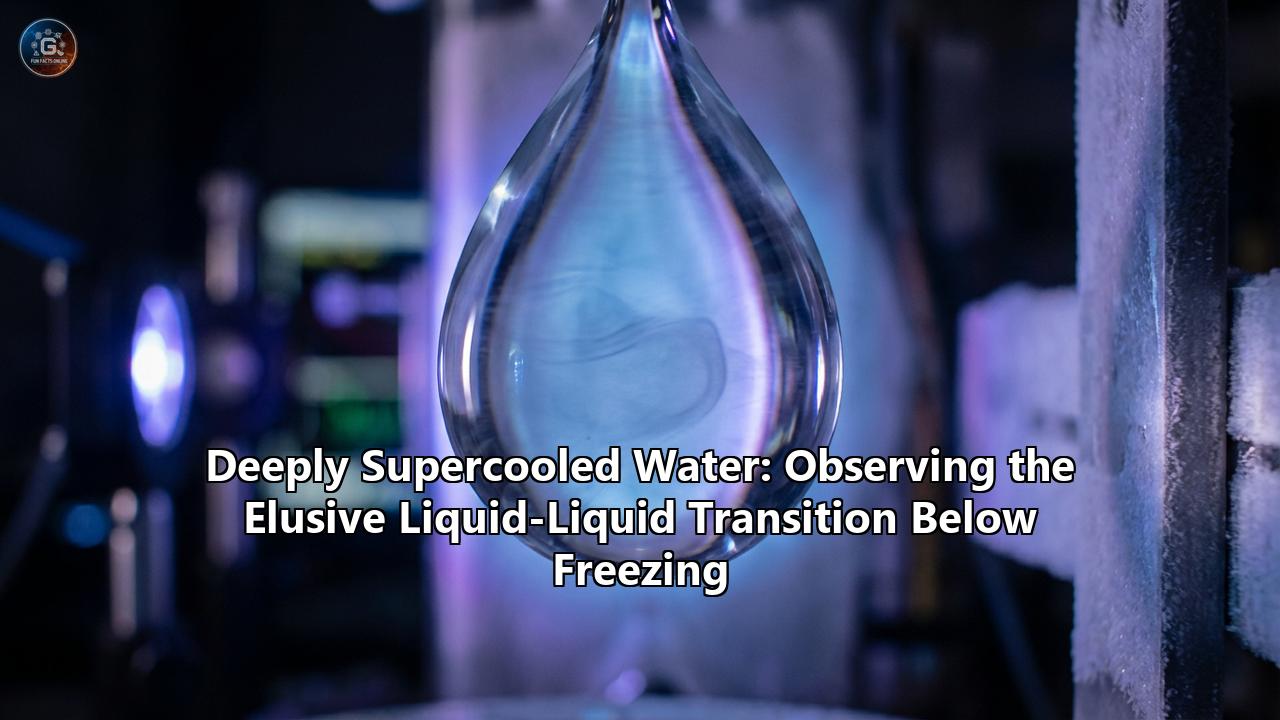
Water is the most familiar substance on Earth, yet it remains one of the most mysterious. We drink it, bathe in it, and are composed largely of it, but to physicists and chemists, $H_2O$ is a chemical eccentric—a substance that breaks almost every rule in the textbook. It expands when it freezes, becomes less viscous when compressed, and exhibits over 70 distinct "anomalies" that distinguish it from simple liquids like argon or benzene.
For decades, one specific mystery has haunted the scientific community, lurking in a temperature range known ominously as "No Man’s Land." This is the realm of deeply supercooled water—liquid water cooled far below its freezing point, down to temperatures where it theoretically shouldn't exist as a liquid at all. In this frigid, unstable zone, researchers have long hunted for a "holy grail" of chemical physics: a hypothetical transition where water splits into two distinct liquids, one dense and one light.
After thirty years of chasing ghosts in computer simulations and indirect experiments, the 2020s have ushered in a golden age of discovery. Through the use of X-ray free-electron lasers (XFELs) that act like atomic strobe lights, and ingenious "isochoric" chambers that defy standard thermodynamics, scientists have finally captured direct evidence of this elusive liquid-liquid transition.
This discovery does more than just solve a physics puzzle. It suggests that water is not one liquid, but two—a fluctuating mixture of high-density and low-density forms that fight for dominance depending on temperature and pressure. This duality may hold the key to understanding everything from how life survives in the deep ocean to the formation of clouds that regulate our climate, and even the detection of dark matter in the cosmos.
Part I: The Anomaly of Anomalies
To understand why deeply supercooled water is so significant, we must first appreciate how strange "normal" water is. In a typical liquid, as temperature drops, molecules move slower and pack closer together, increasing density until the substance freezes into a solid that is denser still. Water behaves normally until about 4°C (39°F). Then, it goes rogue. As it cools further toward 0°C, it begins to expand and become less dense. When it freezes, it expands violently, creating a lattice structure that allows ice to float—a quirk that prevents oceans from freezing solid and allows aquatic life to survive winter.
But what happens if you prevent the ice from forming?
The Supercooled StateWater freezes at 0°C only if there are "nucleation sites"—impurities like dust, bacteria, or rough surfaces where ice crystals can start growing. If you take ultra-pure water and cool it in a perfectly smooth container free of vibrations, it can remain liquid well below freezing. This is supercooled water.
In the 1970s, researchers Austen Angell and Robin Speedy pushed water to its limits. They found that as supercooled water gets colder, its anomalies go into overdrive. Its heat capacity skyrockets, and its compressibility increases sharply. It acts as if it is approaching a critical point—a mathematical singularity where physical properties blow up to infinity. However, just as they tried to cool it further to see what would happen, the water would inevitably "flash freeze" into ice. There was a hard limit, around -40°C, below which the liquid state seemed impossible to maintain for even a microsecond.
This unobservable region, roughly between -40°C (233 K) and -113°C (160 K), was dubbed "No Man’s Land." It is a zone where ice crystallization is so rapid that traditional instruments cannot measure the liquid's properties before it solidifies.
The Two-Liquid HypothesisIn 1992, a team at Boston University led by Peter Poole and Gene Stanley proposed a radical explanation for water's behavior. Using computer simulations (specifically the ST2 water model), they suggested that the "critical point" Angell and Speedy sensed was real, but it wasn't a transition between liquid and gas. It was a "liquid-liquid critical point" (LLCP).
Their hypothesis was stunning: below freezing, water wants to separate into two different liquids.
- Low-Density Liquid (LDL): A structured, open network where every water molecule forms four strong hydrogen bonds in a tetrahedral shape (a pyramid with a triangular base). This form is "ice-like" but still fluid.
- High-Density Liquid (HDL): A disordered, collapsed structure where molecules are jammed closer together, often with a "fifth neighbor" squeezing into the first coordination shell, breaking the perfect tetrahedral geometry.
In our daily life at room temperature, these two forms are indistinguishably mixed, rapidly fluctuating nanosecond by nanosecond. But in the deep freeze of No Man’s Land, the Poole-Stanley hypothesis predicted they would separate. Just as oil and vinegar separate in a vinaigrette, supercooled water would essentially "unmix" itself into two distinct fluids.
For nearly 30 years, this remained a controversial theory, supported by computer models but unproven in the real world. Critics argued that the "two liquids" were just artifacts of imperfect computer code or fleeting transient states, not true thermodynamic phases.
Part II: Piercing the Veil of No Man’s Land
Proving the existence of two waters required observing the liquid inside No Man’s Land before it could freeze. This is a race against time. At -100°C, water wants to become ice in microseconds. To see the liquid, you need a camera that is faster than the freezing process.
Enter the X-ray Free-Electron Laser (XFEL).
The "Atomic Camera"Facilities like the Linac Coherent Light Source (LCLS) at SLAC National Accelerator Laboratory in California and the PAL-XFEL in South Korea are miles-long particle accelerators that generate X-ray pulses a billion times brighter than the sun. These pulses are incredibly short—lasting only femtoseconds (quadrillionths of a second).
In 2020, two landmark experiments utilized these behemoths to finally peer into the forbidden zone.
Experiment 1: The Decompression Trick (Stockholm University/PAL-XFEL)A team led by Anders Nilsson at Stockholm University used a clever backdoor to enter No Man’s Land. They didn't start with liquid and cool it down; they started with high-pressure ice and melted it.
They took "High-Density Amorphous Ice" (HDA)—a glassy form of water created under immense pressure—and used an infrared laser to heat it instantly while simultaneously releasing the pressure. For a fleeting moment, the sample became liquid water at -70°C.
Before the water could realize it was supposed to be ice, the team hit it with femtosecond X-ray pulses from the PAL-XFEL. The X-rays scattered off the water molecules, creating diffraction patterns that revealed the atomic structure.
The results, published in Science in November 2020, were unambiguous. As the pressure dropped and the water expanded, the X-ray, "fingerprint" shifted dramatically. It didn't change smoothly. It jumped. The liquid transformed from a high-density, disordered structure (HDL) to a low-density, tetrahedral structure (LDL). The discontinuity was the smoking gun of a phase transition. They had caught water in the act of switching identities.
Experiment 2: The Laser Heater (PNNL/Science)Around the same time, Greg Kimmel and his team at Pacific Northwest National Laboratory (PNNL) used a different approach. They created a microscopic film of ice on a platinum wafer in a vacuum. By zap-heating the ice with a nanosecond laser, they melted it into a supercooled liquid for just a few nanoseconds before it refroze.
Using infrared spectroscopy, they watched the water molecules dance. They observed that at extremely low temperatures, the water settled into a structure that was distinctively "two-state." They could effectively see the signature of the Low-Density Liquid (LDL) winning the tug-of-war against the High-Density Liquid (HDL) as the temperature dropped. Their conclusion: water is indeed a "mixture of two structural motifs."
Part III: The Physics of the Transition
What exactly is happening at the molecular level during this transition? To visualize it, we have to look at hydrogen bonds—the "velcro" that holds water molecules together.
The Tetrahedral vs. The CollapsedIn the Low-Density Liquid (LDL), water behaves like a master architect. Each oxygen atom grabs two hydrogen atoms from its neighbors and offers its own two hydrogen atoms to others, forming a perfect tetrahedron. This creates an open, spacious 3D network with lots of empty space in the center of the cage-like structures. This "openness" is why ice is light. LDL is essentially "liquid ice"—it has the geometry of ice but the fluidity of water.
In the High-Density Liquid (HDL), the architecture collapses. The thermal energy or high pressure forces the molecules to jiggle out of their perfect alignment. The hydrogen bonds bend and distort. Crucially, a "fifth" water molecule often squeezes into the space that would be empty in the tetrahedral arrangement. This "interstitial" molecule increases the local density.
The Second Critical PointThe theory posits that if you could map water’s behavior on a graph of pressure vs. temperature, there is a line separating these two liquid phases. This line ends at a specific point—the "Second Critical Point" (estimated around -83°C and 1,000 atmospheres of pressure).
Beyond this point, the two liquids become indistinguishable (supercritical). But as you move away from it into the "No Man's Land," they separate. The fluctuations between these two states near the critical point are what cause water’s famous anomalies.
- Why does water expand when cooled? Because as it cools, the equilibrium shifts toward the spacious LDL form.
- Why does compressibility increase? Because near the critical point, the fluctuations between dense and light forms make the liquid "softer" and more responsive to pressure.
Part IV: The Skeptics’ Corner
Science is rarely a straight path to truth; it is a series of arguments. Despite the 2020 breakthroughs, a faction of the scientific community remains unconvinced.
The "Mixture" vs. "Continuum" DebateThe "Mixture Model" (two liquids) has gained the upper hand, but the "Continuum Model" proponents argue that water doesn't need two distinct phases to be weird. They believe water is a single liquid that simply undergoes continuous structural changes.
The Thermodynamic Challenge (2022)In 2022, Fumio Hirata published a paper titled "Does the second critical-point of water really exist in nature?" He argued that the simulation results supporting the Second Critical Point might violate the Gibbs Phase Rule, a fundamental theorem of thermodynamics. Hirata suggests that what looks like a "phase transition" in computer models might be an artifact of "finite size effects"—essentially, because the simulation box is small, it forces the water to behave in ways that bulk water in the real world wouldn't.
Furthermore, some skeptics argue that the XFEL experiments might be observing "rapid crystallization" rather than a liquid transition. Since the LDL structure is very similar to ice, distinguishing "tiny ice crystals" from "low-density liquid" is incredibly difficult. The Nilsson team argues their diffraction data clearly shows liquid-like disorder, not crystalline Bragg peaks, but the interpretation of data at the femtosecond limit is always a subject of intense peer review.
Part V: Cosmic and Practical Applications
While physicists argue over phase diagrams, engineers and biologists are already putting supercooled water to work. The ability to manipulate water in this state has sci-fi implications.
1. The Snowball Chamber: Hunting Dark MatterMatthew Szydagis at the University at Albany has turned supercooled water into a subatomic particle detector. His invention, the "Snowball Chamber," relies on the fact that supercooled water is metastable—it is desperate for an excuse to freeze.
In his lab, water is cooled to -20°C. It sits there, liquid and calm. But if a neutron strikes a water molecule, the collision deposits energy that triggers a "nucleation event." The water instantly flash-freezes, turning into a "snowball." The heat released (the exothermic spike) and the camera footage of the sudden white crystal provide the signal.
Szydagis proposes that this could be the ultimate Dark Matter Detector. WIMPs (Weakly Interacting Massive Particles), the leading candidate for dark matter, interact very weakly with normal matter. But a collision with a hydrogen nucleus in supercooled water might be just enough to trigger that phase change. Because water is rich in hydrogen (which has low atomic mass), it is particularly sensitive to low-mass dark matter particles that other heavy-metal detectors (like Xenon) might miss.
2. Biological Time Travel: Isochoric Organ PreservationPerhaps the most immediate impact of supercooled water research is in medicine. Currently, a donor heart or liver can only be kept on ice for a few hours (4-12 hours). This logistical nightmare leads to thousands of wasted organs every year.
Freezing organs destroys them because ice crystals act like microscopic daggers, puncturing cell membranes. But supercooling offers a third way: keeping the organ sub-zero without freezing.
Boris Rubinsky at UC Berkeley and teams at Harvard/Mass General have pioneered Isochoric (Constant Volume) Preservation. They place an organ in a rigid, sealed steel chamber filled with a preservation fluid. As the chamber is cooled, the water wants to freeze. But water expands when it freezes. In a rigid box of constant volume, it has no room to expand.
The laws of thermodynamics kick in: the pressure inside the box skyrockets (up to hundreds of atmospheres). This high pressure depresses the freezing point. The water remains liquid even at -5°C or -10°C.
- The Result: The organ’s metabolism is suppressed much more effectively than at 0°C, extending preservation time from hours to days.
- Recent Success: In experiments, rat and pig livers have been supercooled for 3 to 4 days and then successfully transplanted. If this scales to humans, it would create a global "organ bank," allowing perfect immunological matching and saving countless lives.
High in the atmosphere, clouds are often made of supercooled water droplets, not ice. These droplets can exist at -30°C. The ratio of supercooled water to ice in clouds is a critical variable in climate models.
- Supercooled water clouds reflect sunlight (cooling the Earth).
- Ice clouds trap heat (warming the Earth).
Understanding the specific conditions under which the "Two-Liquid" transition triggers freezing (the crossover from HDL to LDL) helps meteorologists predict when a cloud will glaciate. This improves the accuracy of climate change forecasts, as the "phase" of clouds is one of the largest uncertainties in current models.
Part VI: Conclusion
The study of deeply supercooled water is a testament to the fact that the frontier of science isn't always on Mars or inside a black hole. Sometimes, it is in a glass of water.
The observation of the liquid-liquid transition is a triumph of modern experimental physics. It vindicates the 30-year-old hypothesis that water is a "chameleon" liquid, shapeshifting between dense and open structures to navigate the thermal landscape. This duality is likely the secret sauce that makes water the solvent of life—its ability to fluctuate allows it to fold proteins, dissolve nutrients, and buffer thermal changes with unparalleled efficiency.
As we peer deeper into "No Man's Land," we are finding that the void is not empty. It is filled with a bizarre, two-faced fluid that holds the secrets of our universe, from the microscopic machinery of life to the invisible matter that binds the galaxies. The next time you drink a glass of ice water, remember: you are swallowing a mystery that science is just beginning to digest.
Reference:
- https://www.sciencedaily.com/releases/2019/04/190415082008.htm
- https://newatlas.com/supercooled-water-dark-matter-detector/59294/
- https://indico.global/event/647/contributions/16550/attachments/5332/8604/snowball_UCLA_MSZYDAGIS.pdf
- https://www.youtube.com/watch?v=UxflmcowiWg
- https://www.reddit.com/r/space/comments/bg24px/supercooled_water_in_snowball_chamber_might_be/
- https://physicsworld.com/a/second-critical-point-appears-in-two-models-of-water/
- https://arxiv.org/abs/2201.08556
- https://www.semanticscholar.org/paper/aa22dcd01e03929df3d7bdd0f87f69add005f7ad
- https://www.astronomy.com/science/new-snowball-chamber-may-help-scientists-finally-detect-dark-matter/
- https://pmc.ncbi.nlm.nih.gov/articles/PMC11052586/
- https://www.youtube.com/watch?v=6aNf2qnIk7o
- https://www.news-medical.net/news/20190910/Supercooling-helps-preserve-human-transplant-organs-longer.aspx
- https://www.researchgate.net/publication/378806332_Prototype_isochoric_preservation_device_for_large_organs
- https://www.sciencenews.org/article/supercooling-chemicals-tripled-shelf-life-donor-organs