
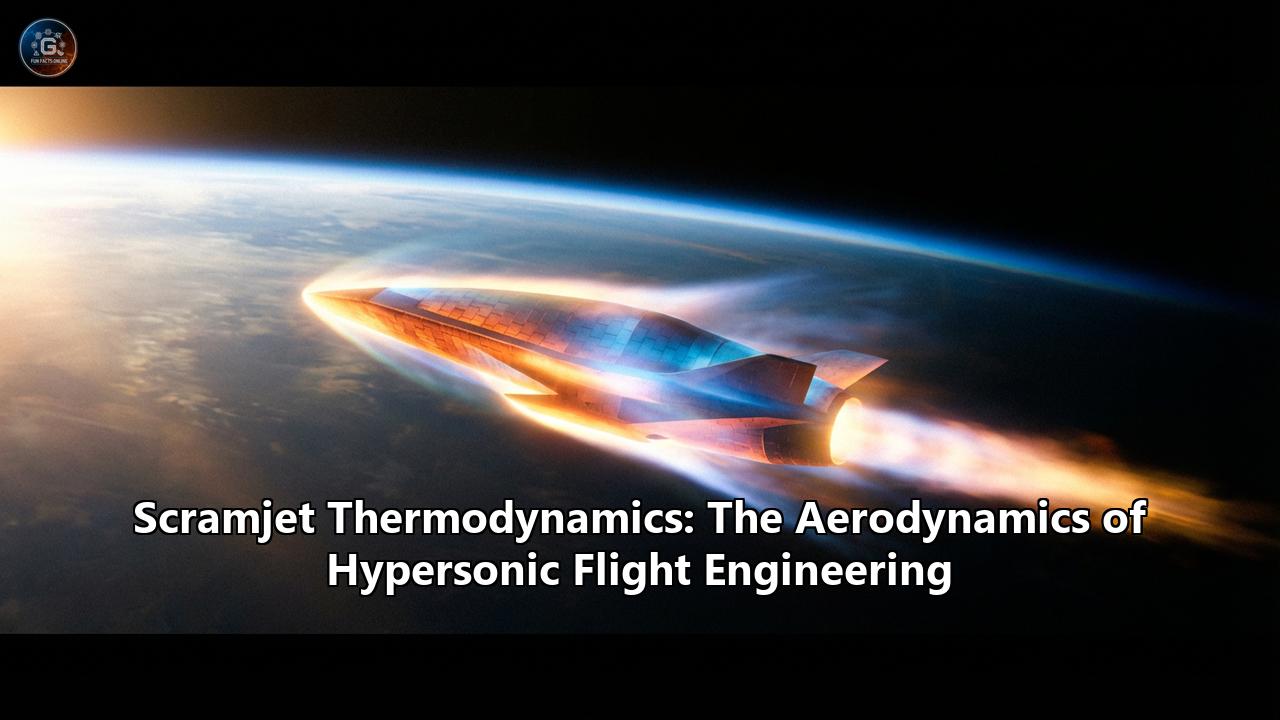
To understand the sheer magnitude of engineering required to sustain flight at hypersonic speeds—velocities exceeding Mach 5, or five times the speed of sound—one must discard almost everything familiar about conventional aviation. At these velocities, the atmosphere ceases to behave like a fluid medium to be slipped through and instead acts like a physical barrier of immense heat and pressure. The friction and shockwave compression generated by pushing through air at over 3,800 miles per hour strip molecules apart, generate plasma, and push the operational limits of known materials to their absolute breaking point. At the heart of this extreme frontier lies the scramjet (Supersonic Combustion Ramjet), an airbreathing engine with virtually no moving parts, yet one that stands as arguably the most complex thermodynamic and aerodynamic system ever devised by human engineers.
Unlike traditional turbojets or turbofans, which rely on rotating compressor blades to squeeze incoming air before mixing it with fuel, a scramjet relies entirely on the forward motion of the vehicle to ram air into its inlet. The entire vehicle acts as the engine; its forebody is responsible for air compression, while its aftbody serves as the expansion nozzle. However, the defining characteristic of the scramjet—and the source of its immense technical difficulty—is that the airflow through the entire engine, including the combustion chamber, remains supersonic.
Mastering scramjet propulsion is not merely a question of thrust; it is a delicate, chaotic ballet of extreme thermodynamics, shockwave management, aerothermoelasticity, and finite-rate chemical kinetics. The engineering challenges are monumental: igniting fuel in a supersonic airstream is akin to keeping a match lit in a hurricane, while the engine itself must be actively cooled using its own fuel to prevent it from vaporizing under the intense heat of hypersonic compression,.
The Aerothermodynamics of Hypersonic Compression
In a conventional jet engine, airflow is slowed to subsonic speeds before it enters the combustor. If one were to attempt this at Mach 5 or above (a configuration known as a ramjet), the kinetic energy of the incoming air would be converted into internal energy through compression, raising the stagnation temperature to catastrophic levels. Slowing Mach 6 airflow to subsonic velocities generates temperatures high enough to dissociate the diatomic molecules of oxygen and nitrogen in the air. When oxygen dissociates, it absorbs massive amounts of heat, severely diminishing the energy available to be released during combustion, thereby destroying the engine's thrust potential. Furthermore, the extreme pressure would physically rupture the engine casing.
To avoid this thermal bottleneck, the scramjet allows the air to pass through the engine at supersonic speeds. Compression is achieved not by a turbine, but through a meticulously designed geometry of shock waves. As the vehicle cuts through the atmosphere, the wedge-shaped forebody of the aircraft generates a series of oblique shock waves. When the supersonic flow passes through an oblique shock, its velocity decreases, and its static pressure and temperature increase—an process known as supersonic aerodynamic compression.
Engineers employ "waverider" configurations to optimize this phenomenon. A waverider is designed such that the shock wave generated by the vehicle's leading edge remains attached to the lower surface of the aircraft. This traps the high-pressure air beneath the vehicle, simultaneously feeding highly compressed air into the engine inlet and generating tremendous aerodynamic lift. Because the vehicle is effectively "riding" its own shock wave, the lift-to-drag ratio is significantly enhanced in a flight regime where wave drag normally dominates.
However, shock wave interactions inside the scramjet inlet and isolator are incredibly complex. The isolator, a constant-area duct sitting between the inlet and the combustor, contains a "shock train"—a series of reflecting oblique and normal shock waves that further compress the air and prevent the adverse pressure gradients of combustion from propagating forward and causing an "unstart" (a catastrophic condition where the shock system is violently expelled from the front of the engine). Managing corner effects, shock-expansion wave interactions, and swept oblique shock reflections requires advanced computational fluid dynamics (CFD) and sophisticated active flow control mechanisms. Recent innovations from institutions like the National University of Defense Technology involve utilizing plasma actuators and localized energy deposition to create "thermal bubbles," modifying the flow field ahead of the scramjet inlet to reduce wave drag and control shock structures dynamically.
The Millisecond Dilemma: Supersonic Combustion
Once the air has been compressed via the shock train, it enters the combustor at speeds exceeding 1,000 meters per second. This presents the most daunting hurdle in scramjet thermodynamics: residence time. The time it takes for a parcel of air to enter the combustor, mix with the injected fuel, ignite, and complete the chemical reaction is on the order of 1 millisecond (0.001 seconds). For perspective, the typical self-ignition time of hydrocarbon fuels is often longer than this (1 to 2 milliseconds), meaning the unburnt fuel-air mixture could easily be blown out the back of the engine before it produces any thrust.
To solve this, scramjet combustors are heavily reliant on advanced aerodynamic structures designed to induce micro-turbulence and localized subsonic pockets without severely disrupting the overall supersonic flow. The most prominent of these structures is the cavity flameholder. A wall cavity is a recessed area in the combustor wall that creates a shear layer and a recirculation zone. As fuel is injected, a portion of it becomes trapped in this low-pressure recirculation zone inside the cavity. The high temperatures of the surrounding air ignite this trapped mixture, creating a continuous, stable pool of hot radicals and intermediate reactive species. These burning radicals then bleed out into the supersonic core flow, effectively acting as a continuous pilot light that anchors the main flame.
The dynamics of combustion in these cavities are intensely studied. Advanced non-intrusive diagnostic techniques, such as Hydroxyl Tagging Velocimetry (HTV) and Line Raman Scattering, have been developed because inserting physical probes into a supersonic, high-enthalpy flow would either melt the probe or generate massive, disruptive shock waves. These laser diagnostics have revealed three distinct combustion modes in cavity-stabilized scramjets, depending on the equivalence ratio of the fuel: the cavity shear layer mode, the jet wake mode, and the newly defined jet front mode, where shockwaves provide reliable flow conditions to anchor the flame near the leading edge of the fuel jet. The combustion front is notoriously unstable, oscillating at high frequencies (100–600 Hz), as revealed by Proper Orthogonal Decomposition (POD) analysis of the flame's chemiluminescence.
An alternative to wall cavities is the strut-based injector. Struts are physical wedges placed in the middle of the supersonic flow. Fuel is injected through holes directly into the high-speed core of the airflow, generating strong trailing vortices that rapidly enhance molecular mixing,. A low-pressure region forms behind the strut, acting similarly to a cavity to anchor the flame. However, inserting a physical strut into the flow induces severe wave drag and total pressure loss, presenting a classic aerodynamic trade-off between mixing efficiency and drag penalties. Furthermore, large eddy simulations have shown that strut-wakes exhibit strong, inherent flame instabilities, with the flame front oscillating violently depending on the inflow parameters.
Thermodynamics of the Engine Cycle
From a thermodynamic perspective, the scramjet operates on an open continuous-flow cycle approximating the Brayton cycle, but heavily modified by the realities of compressible high-speed flow. The cycle consists of:
- Isentropic Compression (Forebody and Inlet shockwaves).
- Isobaric/Rayleigh Heat Addition (Combustion chamber).
- Isentropic Expansion (Aftbody nozzle).
Because heat is being added to a supersonic fluid, the scramjet must contend with Rayleigh flow physics. When heat is added to a supersonic gas, its Mach number decreases, while its static temperature and static pressure increase. If too much heat is added relative to the combustor area (a condition called thermal choking), the flow will decelerate to Mach 1 at the combustor exit, resulting in a normal shock wave moving upstream into the isolator and causing an engine unstart. Consequently, the combustor geometry must actively diverge (expand in cross-sectional area) to accommodate the volumetric expansion of the hot gases and maintain supersonic flow throughout the burning process.
The thermodynamic efficiency (propulsive efficiency and specific impulse) is highly sensitive to total pressure recovery. Every shock wave the air passes through increases entropy and decreases the total (stagnation) pressure of the system. If the mixing mechanisms (like struts or deep cavities) create too many strong shock waves, the total pressure loss will negate the energy gained from combustion, resulting in a system that produces net drag rather than net thrust. Therefore, scramjet engineers obsess over generating weak, highly angled oblique shocks rather than strong normal shocks to preserve the flow's available work potential.
Endothermic Fuels and Regenerative Cooling
The aerodynamics of hypersonic flight generate an inescapable thermodynamic nightmare: the heat barrier. As air enters the scramjet at Mach 5 to Mach 10, it undergoes rapid compression, pushing stagnation temperatures inside the engine past 2000°C. These temperatures far exceed the melting points of standard aerospace alloys like titanium and stainless steel. In fact, if a scramjet combustor were not actively cooled, it would vaporize itself within seconds of operation.
The solution to this extreme thermal load is a marvel of thermodynamic synergy known as regenerative cooling. Since it is impossible to carry heavy cooling fluids like water on a weight-sensitive hypersonic vehicle, the onboard aviation fuel itself is utilized as the primary coolant,. Before the fuel is injected into the combustor to burn, it is routed through an intricate network of microscopic cooling channels milled directly into the walls of the engine.
At speeds up to roughly Mach 3, the sensible heat capacity of the liquid fuel (its ability to absorb heat simply by getting hotter) is sufficient to cool the engine. However, at hypersonic speeds, the thermal load surpasses the sensible heat capacity. Here, the scramjet leverages the chemistry of endothermic fuels. Special hydrocarbon fuels (such as JP-7, JP-8+100, and JP-10) are pumped through the cooling channels where they absorb so much heat that they exceed their critical temperatures. Under the presence of catalytic coatings inside the cooling passages, the large hydrocarbon molecules undergo thermal cracking, or pyrolysis.
This pyrolytic reaction is highly endothermic—it absorbs a massive amount of thermodynamic energy to break the chemical bonds, effectively turning the fuel into a chemical heat sink. A standard hydrocarbon fuel might see a temperature increment of 700 to 800 Kelvin while traversing the cooling channels. By cracking into smaller, lighter molecules (like hydrogen, methane, and ethylene), the fuel accomplishes two vital tasks. First, it absorbs the lethal heat from the combustor walls, maintaining structural integrity. Second, the smaller, heated hydrocarbon products exiting the cooling jacket are injected into the combustor in a gaseous, highly reactive state, drastically reducing the ignition delay time and aiding the ultra-fast supersonic combustion process.
However, utilizing supercritical hydrocarbon fuels as a regenerative heat sink introduces its own severe limitations. When hydrocarbons are heated to these extreme temperatures, they tend to undergo secondary reactions that result in the deposition of solid carbon, known as coke, on the inner walls of the cooling channels. Coke is an excellent thermal insulator; if it accumulates, it blocks the transfer of heat from the engine wall into the fuel, causing localized hot spots that lead to structural failure and melting. Managing the "coking limit" of endothermic fuels remains one of the primary hurdles in sustained hypersonic flight.
Because of the coking limitations of hydrocarbons, cryogenic liquid hydrogen is frequently considered the holy grail of scramjet fuels. Hydrogen boasts an unmatched specific energy, incredibly fast reaction kinetics, and a colossal cooling capacity compared to hydrocarbons. However, hydrogen is incredibly un-dense, requiring massive, bulky fuel tanks that severely compromise the aerodynamic waverider profile of the vehicle. For atmospheric cruise missiles and future global transport, endothermic hydrocarbons remain the pragmatic, albeit challenging, choice,.
Advanced Materials and Structural Dynamics
Because the heat flux distribution across a scramjet engine is highly uneven, localized thermal stresses cause intense plastic deformation of metals. The engine structure comprises multiple layers, often lacking heavy thermal barrier coatings in favor of thin, highly conductive walls (like specialized stainless steel, 1Cr18Ni9Ti, or copper alloys) that can quickly pass heat into the cooling fuel.
For the leading edges of the waverider vehicle and the engine inlet cowls, where active fuel cooling is geometrically difficult to implement, engineers turn to advanced material sciences. Ultra-High-Temperature Ceramics (UHTCs) such as hafnium diboride and zirconium diboride, alongside Carbon-Carbon (C/C) composites, are utilized to withstand the brute force of plasma generation at the stagnation points.
Furthermore, because scramjet geometry must change to adapt to varying Mach numbers (optimizing shockwave angles), materials like shape memory alloys are being integrated into variable-geometry inlets. These allow for real-time optimization of airflow compression ratios without the need for heavy, complex hydraulic actuators that would melt in the hypersonic environment.
The Complexities of Flight Mechanics and Control Laws
The aerodynamics and thermodynamics of a scramjet do not exist in isolation from the vehicle's flight dynamics; they are intrinsically coupled. In a conventional aircraft, thrust is generated by an engine slung under the wing, and lift is generated by the wing. In a scramjet-powered waverider, the entire underbelly is the engine. The high-pressure airflow on the lower surface of the vehicle generates both upward lift and forward thrust. Consequently, any change in the fuel injection rate alters the shockwave pressure profile in the combustor and nozzle, which directly alters the lift and pitching moment of the entire aircraft.
This high degree of aero-propulsive coupling results in terrifyingly unstable flight mechanics. To manage this, researchers have developed comprehensive six-degree-of-freedom (6-DOF) aero-thermo-elastic models,. Vehicles like the conceptual "LOGAN" hypersonic waverider (a massive 31,000 kg design) require integrated control-oriented modeling that concurrently addresses rigid-body dynamics, structural flexing, and 1D scramjet thermodynamics in real-time.
Controlling a scramjet requires microsecond precision. For instance, to maintain a cruising speed of Mach 10, advanced Proportional-Integral-Derivative (PID) controllers must constantly track the Mach number error and modulate the fuel injection rate accordingly,. If the vehicle needs to decelerate, the controller cannot simply shut off the fuel, as doing so would cause the engine to unstart or freeze the thermal state of the vehicle; instead, it must preserve a carefully calculated residual fuel flow. During rapid maneuvers or acceleration, pitch and flight path angles must be simultaneously adjusted via elevons and aerodynamic surfaces to prevent the shifting shockwaves from choking the engine. Active sensor systems must detect flow instabilities in milliseconds, utilizing feedback loops to stabilize both the longitudinal and lateral-directional dynamics of the aircraft across varying altitudes and atmospheric densities,.
Ground Testing and the Verification Bottleneck
Bringing a scramjet from theoretical thermodynamics to the physical world requires replicating Mach 6+ conditions on the ground. Scramjet technology development is severely bottlenecked because testing in ground facilities is extraordinarily difficult and expensive. Producing continuous Mach 7 flow requires massive amounts of power and generates enough heat to melt most test facilities.
To overcome this, engineers utilize blowdown facilities and shock tunnels. A blowdown facility utilizes a high-pressure bottle field to force air through a heating element and a converging-diverging nozzle, simulating the enthalpy and velocity of hypersonic flight. Shock tunnels, such as Ludwieg tubes, utilize a diaphragm that bursts to send a shock wave through a high-pressure driver section, creating perfect Mach 10 to Mach 20 conditions—but only for a few milliseconds of quasi-steady-state flow. Because optical access to the internal flow paths of a scramjet is highly restricted, researchers are developing actively-cooled, miniature imaging systems capable of being embedded directly into the thermal environment to observe high-enthalpy flows and fuel mixing in real time.
The Future of Hypersonic Airbreathing Engineering
As computational fluid dynamics models become more refined and materials science inches closer to mastering the extreme heat fluxes of the hypersonic regime, the scramjet engine is evolving from a highly classified military curiosity into the foundation of future aerospace transportation. The modern push toward dual-mode scramjets—engines capable of transitioning seamlessly from subsonic-combustion ramjet mode at Mach 3 to supersonic-combustion scramjet mode at Mach 6—promises to bridge the gap between traditional runways and the edge of space.
Furthermore, bio-inspired aerodynamic designs are beginning to influence inlet geometry, utilizing nature's evolutionary fluid dynamics to minimize shock wave interactions and develop adaptive structures capable of responding instantly to changing thermal environments.
Scramjet engineering is a discipline governed by razor-thin margins. The margin between optimal compression and catastrophic unstart is a fraction of an angle in shock reflection. The margin between sustained combustion and flame blowout is measured in tenths of a millisecond. The margin between regenerative cooling and structural vaporization is bounded by the molecular cracking limit of hydrocarbon chains. Yet, by merging the extreme limits of thermodynamics with the elegant, shock-riding aerodynamics of waverider geometries, humanity is steadily unlocking the ability to cross continents in minutes and redefine the boundaries of atmospheric flight.
Reference:
- https://www.krayonnz.com/user/doubts/detail/62d00f1b6492ae005877c2cc/what-is-the-difference-between-ramjet-and-scramjet-in-thermodynamics
- https://eureka.patsnap.com/report-aerodynamic-lift-management-in-scramjets-during-extreme-maneuvers
- https://pmc.ncbi.nlm.nih.gov/articles/PMC8515821/
- https://ttctech.com/wp-content/uploads/2024/11/AIAA-2009-127-336-Critical-Review-Scramjet-Comb.pdf
- https://rsisinternational.org/journals/ijrsi/articles/combustion-optimization-of-a-scramjet-a-numerical-flow-investigation-approach/
- https://etd.auburn.edu/bitstream/handle/10415/8995/Ryan_Alles_Masters_Thesis.pdf?sequence=2&isAllowed=y
- https://www.scribd.com/document/876422468/Paper-Ramjets-and-Scramjets-Aerodynamics-A-Progress-Review
- https://eureka.patsnap.com/report-wave-drag-reduction-technologies-in-scramjet-engineering
- https://www.mdpi.com/2226-4310/9/12/826
- https://lab.vanderbilt.edu/combustion/research-overview/applications/scramjet-combustor-measurements/
- https://pubs.aip.org/aip/pof/article/37/12/125102/3373701/Flow-physics-of-supersonic-combustion-in-a-grooved
- https://www.researchgate.net/publication/268554773_Development_of_an_Aerodynamic_Database_for_a_Generic_Hypersonic_Air_Vehicle
- https://eureka.patsnap.com/report-bio-inspired-design-elements-in-scramjet-aerodynamics
- https://arc.aiaa.org/doi/10.2514/1.B35887
- https://pdfs.semanticscholar.org/b87e/562a1e7a02cebc055baa5081e013317b6683.pdf
- https://www.researchgate.net/publication/342676994_Modeling_and_Analysis_of_a_6-DOF_Flexible_Hypersonic_Flight_Vehicle
- https://www.researchgate.net/publication/397651015_SCRAMJET_ENGINE_CONTROL_LAW_FOR_A_HYPERSONIC_WAVERIDER_VEHICLE