
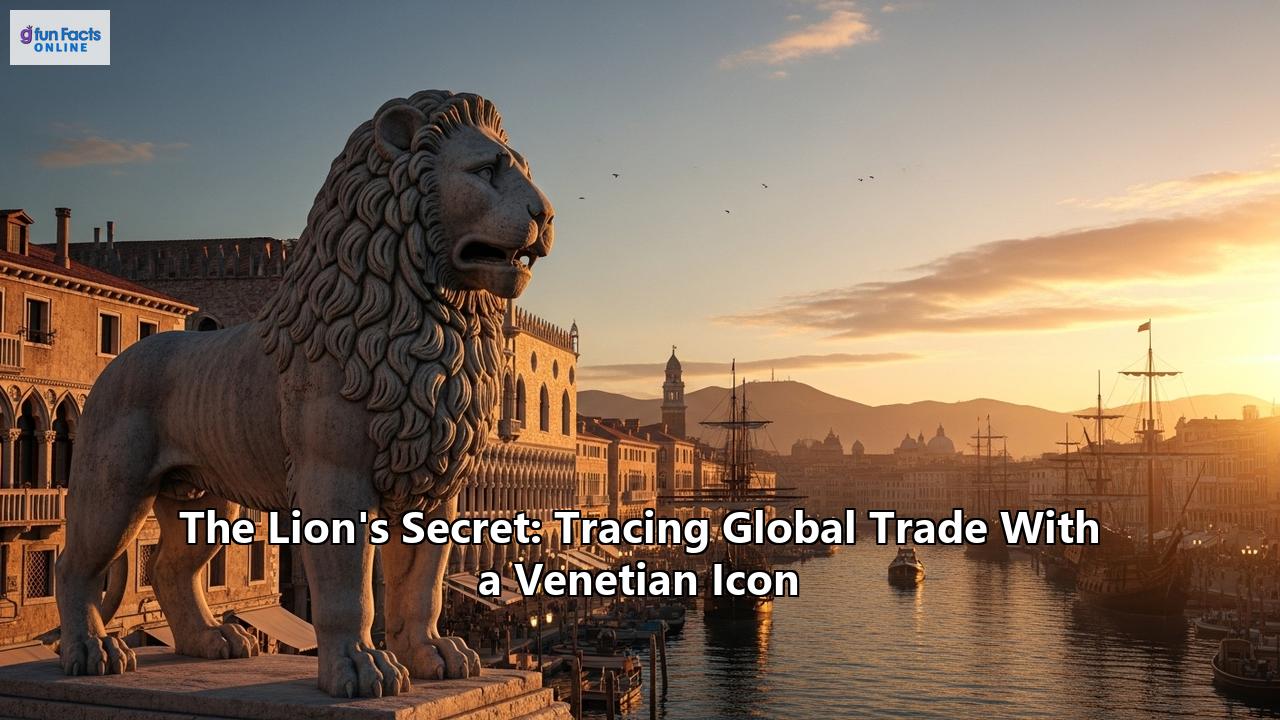
An emblem of power, a testament to faith, and a silent guardian of a global economic empire, the Lion of Saint Mark is an icon intrinsically woven into the fabric of Venice. More than just a symbol of the city's patron saint, this winged beast, in its myriad forms, tells a sprawling story of ambition, commerce, and cultural exchange that stretched from the heart of Europe to the farthest reaches of the known world. To trace the journey of this lion is to trace the arteries of global trade as they were first chartered by the audacious Republic of Venice, a city that, against all odds, rose from the salty marshes of a lagoon to become the fulcrum of international commerce for centuries.
The Genesis of a Symbol: From Sacred Text to State Emblem
The association of a lion with Saint Mark the Evangelist predates the Venetian Republic itself. Early Christian tradition, drawing from the prophetic visions of Ezekiel and the Book of Revelation, assigned symbolic creatures to the four Evangelists. Matthew was represented by a man, Luke by an ox, John by an eagle, and Mark by a winged lion. The lion was seen to embody the power of the Evangelist's word and the majesty of Christ's resurrection. A legend further cemented this connection: while traveling, Saint Mark was said to have taken refuge in a fisherman's hut in the Venetian lagoon where an angel in the form of a winged lion appeared to him, declaring, "Pax tibi Marce, evangelista meus. Hic requiescet corpus tuum" ("Peace be with you, Mark, my evangelist. Here your body will rest").
This prophecy would become a foundational myth for the burgeoning republic. In 828, two Venetian merchants, Buono da Malamocco and Rustico da Torcello, undertook a daring act of holy theft, smuggling the relics of Saint Mark from Alexandria, a city then under Muslim rule. They ingeniously hid the saint's body in a shipment of pork to repel inspection by the Muslim authorities. The arrival of these relics in Venice was a political and religious coup of immense proportions. It elevated the city's status, providing it with a patron saint of apostolic rank to rival Rome's Saint Peter. The winged lion, the symbol of this new protector, was enthusiastically adopted, becoming an expression of divine protection and the city's burgeoning power.
Initially a purely religious icon, the Lion of Saint Mark was officially co-opted as a symbol of the Venetian state by the 13th century. It first appeared on a Doge's seal in 1261 and soon proliferated across the city and its expanding territories, adorning flags, coins, official documents, and public buildings. The lion was no longer just a representation of the Evangelist; it was the logo of the Venetian Republic, a globally recognized brand of power, justice, and commercial might.
The Many Faces of the Lion: A Language of Power and Diplomacy
The genius of the Venetian lion as a symbol lay in its fluidity. Its depiction was not static; it changed to convey specific messages about the Republic's intentions and its relationship with the territories it controlled. This visual language was understood across the vast expanse of Venice's maritime empire.
The most common representation is the standing winged lion, often with one paw resting on an open book. This form is typically associated with Venetian territory around the Mediterranean, a clear statement of dominion over both land and sea. The inscription in the book, "Pax tibi Marce, evangelista meus," reinforced the idea of a just and peaceful Venetian rule, a message of enlightened governance to its subjects and allies. However, this message of peace was often backed by an implicit threat. In some depictions, the lion holds a sword, a clear symbol of Venetian justice and its readiness to defend its interests by force. A lion depicted with a closed book and a sword in its paws signaled that Venice was in a state of war.
Another significant form is the lion "in moleca," depicted frontally, emerging from the water with its wings encircling its head, resembling the claws of a crab ("moeca" in Venetian). This form is more intimately associated with the city of Venice itself, rising from the lagoon, and symbolized vigilance and the city's intrinsic connection to the sea. The "lion on the move," depicted walking with one paw raised, was a symbol of the Republic's expansion and influence, while the "rampant lion," in an attacking stance, was a clear message of military might.
The presence of these lions across the Mediterranean and beyond serves as a map of Venetian influence. From the port cities of the Adriatic to the islands of the Aegean, the Lion of Saint Mark was a constant reminder of who held the reins of power.
The Arteries of Commerce: Venice's Global Trade Network
At its zenith in the 15th century, the Republic of Venice was the undisputed master of Mediterranean commerce. It was a thalassocracy, a maritime empire whose power and wealth were derived not from vast landholdings, but from its control of the sea lanes. The city's unique geography, a collection of islands in a defensible lagoon, made it a natural fortress and a perfect hub for maritime trade. From this strategic position, Venetian merchants built a commercial empire that linked Europe with the markets of the Levant, Egypt, the Byzantine Empire, and, by extension, the fabled spice routes of Asia.
The earliest cornerstone of Venetian trade was salt. The abundant salt flats in the lagoon provided a valuable commodity that was in high demand for food preservation. Venice quickly established a monopoly on the salt trade, and the routes established to transport salt became the arteries for a much wider range of goods. Venetian merchants were soon trading in everything from humble necessities like grain and timber to the most coveted luxury goods of the age.
From the East, Venetian ships brought back spices like pepper, cloves, and cinnamon, which were worth their weight in gold in Europe. They also imported raw silk, cotton, precious stones, carpets, and exotic foodstuffs. In return, Venice exported finished goods to the East, including textiles, soap, paper, and, most notably, fine glass from the furnaces of Murano. This trade was not just with Christian nations; Venice maintained a pragmatic and often controversial trading relationship with the Islamic world, even when it defied papal prohibitions. The Venetian ambassador's sentiment that "being merchants, we cannot live without them" perfectly encapsulated the Republic's priorities.
The lifeblood of this empire flowed through a network of strategically located trading posts and colonies. These were not colonies in the modern sense of large-scale settlements, but rather a string of fortified ports and commercial enclaves that served the needs of Venetian merchants. In these outposts, the Lion of Saint Mark was prominently displayed, a constant assertion of Venetian authority.
The Lion's Roar Across the Seas: Venetian Outposts and Cultural Exchange
To follow the trail of the Lion of Saint Mark is to embark on a journey through the bustling ports and trading centers of the medieval and Renaissance world.
Dalmatia and the Adriatic: The eastern coast of the Adriatic, what is now Croatia, was one of the first areas to come under Venetian control. The Republic systematically established its dominance in the region to secure its trade routes and eliminate the threat of pirates. Cities like Zadar, Dubrovnik (Ragusa), and Korčula are still adorned with countless relief carvings of the Venetian lion on their city walls and gates. These lions, often depicted with their paws on the water, symbolized Venice's supremacy at sea. Crete and the Greek Islands: The island of Crete, or Candia as the Venetians called it, was a key Venetian colony for over four hundred years. The massive Koules Fortress at the entrance to the harbor of Heraklion is a powerful statement of Venetian military architecture, and it is here that one can find a badly eroded but still imposing marble relief of the Lion of Saint Mark. The lion here, sometimes depicted with both a book and a sword, was a reminder of Venice's dual role as a purveyor of peace and a wielder of military might. Other Greek islands, like Corfu, were also vital Venetian possessions. The fortress in the city of Corfu, still a dominant feature of the landscape, proudly displays the Lion of Saint Mark on its walls, a testament to the island's role as one of the "Eyes of the Republic." Cyprus: Venice took control of Cyprus in 1489, and the island became another crucial outpost in the eastern Mediterranean. The Sea Gate, or Porta del Mare, in Famagusta, completed in 1496, is a fine example of Italian Renaissance military architecture. Dominating the entrance is a large marble sculpture of the winged lion, holding the Gospel with the familiar Latin inscription. The presence of the lion here marked the easternmost extent of Venice's permanent territorial control and its strategic importance in the trade with the Levant. Venetian coins minted in Cyprus also prominently featured the Lion of Saint Mark, a portable symbol of Venetian power that circulated with every transaction. The Fondaci: Gateways to the East: In the great trading centers of the East, Venetian merchants established commercial enclaves known as fondaci. These were combination warehouses, inns, and markets where foreign merchants could live, store their goods, and conduct business. The Fondaco dei Tedeschi in Venice, the headquarters for German merchants, and the Fondaco dei Turchi, for Ottoman Turkish traders, were central hubs of international commerce. These buildings were tightly regulated by the Venetian state, with rules governing everything from the hours of operation to the prohibition of weapons.The architecture of the Venetian fondaci and many Venetian palaces shows a clear influence from the Islamic world, particularly from the caravanserais and Mamluk architecture of Egypt and Syria. The distinctive ogee arches, intricate stonework, and grand central courtyards of many Venetian buildings have their roots in the East. This architectural exchange was a two-way street; Venetian goods and artistic styles were highly prized in the Islamic world. Wealthy Ottomans and Mamluks collected Venetian glass and textiles, and the shared tastes in colors and patterns sometimes make it difficult to distinguish between a textile made in Venice and one made in Bursa. This cultural and artistic cross-pollination, facilitated by the very trade that the Lion of Saint Mark protected, is one of the most enduring legacies of the Venetian empire.
The Merchant's Life and the Innovations of Trade
The Venetian empire was built on the ambition and ingenuity of its merchant class. Unlike the landed aristocracies of feudal Europe, the Venetian nobility was a "nobility of money," an oligarchy of merchant families who controlled both the political and economic life of the city. The state itself was deeply involved in commerce, functioning almost like a modern corporation with the Doge as its CEO and the Great Council as its board of directors.
To manage the immense risks and complexities of long-distance trade, Venetian merchants developed a number of groundbreaking business and legal practices. One of the most important was the Colleganza, a form of limited partnership. In a Colleganza, a land-bound investor would provide the capital for a trading voyage, while a traveling agent would carry out the journey. Profits were then split according to a pre-arranged formula, allowing for the pooling of capital and the distribution of risk. This contractual innovation was a precursor to modern joint-stock companies and was a key factor in Venice's commercial success.
The Venetian state also played a crucial role in supporting and regulating trade. The Arsenal, a massive state-owned shipyard, was the largest industrial complex in the world for a time, capable of mass-producing galleys on an unprecedented scale. The state organized and dispatched trading convoys, known as mude, which sailed to specific destinations at set times of the year, protected by military warships. This system provided security for merchants and allowed for a regular and predictable flow of goods.
Venice also developed a sophisticated legal system to deal with commercial disputes. A special court, the Giudici del Forestier (Judges for Foreigners), was established to handle cases involving foreign merchants, ensuring that Venice remained an attractive and reliable place to do business. The city's maritime laws were among the most advanced in the world, covering everything from the chartering of ships to the rules of jettison (throwing cargo overboard in an emergency). This stable and predictable legal environment was a major competitive advantage for the Republic.
The life of a Venetian merchant, while potentially lucrative, was not without its hardships. A young man's training would often culminate in a business trip, a rite of passage that would expose him to the dangers and opportunities of the wider world. Life aboard a Venetian galley was crowded and often unsanitary. Passengers had to bring their own bedding and utensils, and slept in cramped quarters infested with fleas and lice. The ships carried live animals for food, and the noise and smells would have been a constant presence. Yet, for those who succeeded, the rewards were immense, and the tales of men like Marco Polo would inspire generations of explorers to come.
A New Chapter in the Lion's Tale: An Eastern Secret?
For centuries, the origin of the most famous Lion of Saint Mark, the majestic bronze statue that stands atop a granite column in the Piazzetta, has been a subject of debate. For many years, the prevailing theory was that it was a Hellenistic bronze, perhaps from the 4th century BC. However, a recent scientific study, announced in 2024, has turned this long-held belief on its head, suggesting a far more distant and unexpected origin for this most Venetian of icons.
A multidisciplinary team of researchers from the University of Padua and other institutions conducted a new analysis of the bronze, using advanced techniques to study the lead isotopes in the metal. This analysis acts like a "chemical fingerprint," allowing scientists to trace the origin of the copper ore used to make the statue. The results were startling: the metal used for the oldest parts of the statue came not from the Mediterranean or the Near East, but from mines in the lower Yangtze River basin in China.
This chemical evidence, combined with a fresh stylistic analysis, has led researchers to a new and radical hypothesis: the Lion of Venice may have begun its life as a zhènmùshòu, a type of mythological tomb guardian creature from China's Tang Dynasty (618-907 AD). These tomb guardians were often hybrid creatures with lion-like features, and the Venetian statue shares several stylistic similarities with them, including its bulbous nose and grinning mouth. The theory suggests that this Chinese statue, already ancient, somehow made its way to Venice, where it was repurposed and adapted to become the symbol of Saint Mark.
The exact circumstances of its arrival in Venice are unknown, but it is known that the statue was already in place by the time Marco Polo returned from his travels in 1295. One tantalizing possibility is that it was brought back by Marco's father, Nicolò, and his uncle, Maffeo, who had visited the court of Kublai Khan in the 1260s. It is also possible that it arrived earlier, through the complex and far-reaching trade networks that already connected Venice with the East.
This new theory, if it holds up to further scrutiny, adds a remarkable new layer to the story of the Venetian lion. It suggests that the global connections of the pre-modern world were even more extensive than previously imagined, and that Venice's role as a cultural and commercial crossroads was so profound that even its most cherished symbol might have a secret, hidden history that stretches all the way to China. It is a testament to the fact that the story of the Lion of Saint Mark is not just a story of Venice, but a story of the world.
The Lion in Twilight: Decline and Legacy
The 15th century was the zenith of Venetian power, but it also marked the beginning of a long and gradual decline. The very forces of global exploration and trade that Venice had helped to unleash would eventually bypass the city, shifting the economic center of gravity from the Mediterranean to the Atlantic.
The fall of Constantinople to the Ottoman Turks in 1453 was a major blow, though Venice's pragmatic merchants quickly established trading relationships with their new neighbors. A more decisive turning point came in 1499, when the Portuguese explorer Vasco da Gama successfully navigated a sea route to India by sailing around Africa's Cape of Good Hope. This monumental achievement broke the Venetian and Mamluk monopoly on the spice trade. Suddenly, European merchants could buy spices directly from the source, cutting out the Venetian middlemen who had for so long controlled the flow of these valuable goods.
The discovery of the Americas by Venice's old rival, Genoa, in the service of Spain, further accelerated the shift of trade to the Atlantic. Locked into the Mediterranean, Venice found itself on the periphery of a new global economy. While the Republic would remain a significant regional power for several more centuries, its days as the undisputed queen of global trade were over.
Today, the Lion of Saint Mark can be found far from the shores of the Mediterranean. It is the emblem of the Venice Film Festival's highest prize, the Golden Lion, a symbol of artistic excellence recognized around the world. It is also the logo of the insurance giant Assicurazioni Generali, a company with its roots in the Venetian tradition of maritime commerce.
The stone and bronze lions that still stand guard in Venice and across its former empire are more than just historical curiosities. They are the silent sentinels of a remarkable story, a story of a city that built a global trading network on a foundation of salt and audacity. They are the markers on a map of ambition, a testament to a time when the roar of the Venetian lion echoed across the known world, a symbol of power, prestige, and the enduring human quest for connection and commerce. Tracing the paw prints of this iconic beast reveals not just the secret of Venice's success, but the very blueprint of our interconnected world.
Reference:
- https://www.scmp.com/news/china/science/article/3281965/was-lion-venice-made-china-more-1000-years-ago-italian-scientists-have-evidence
- https://archaeologymag.com/2024/09/lion-of-st-marks-square-in-venice-is-chinese/
- https://news.artnet.com/art-world/bronze-venice-lion-from-china-2537486
- https://arte2000.it/en/blog-en/the-lion-of-saint-mark-in-venice-symbol-of-magnificence-and-power/
- https://en.wikipedia.org/wiki/Lion_of_Venice
- https://www.google.com/search?q=time+in+CN
- https://brill.com/display/book/edcoll/9789004428874/BP000016.xml
- https://www.weforum.org/stories/2016/05/3-career-lessons-from-venice-15th-century/
- https://imagesofvenice.com/the-lion-of-st-mark/
- https://ouclf.law.ox.ac.uk/conflicts-in-13th-century-maritime-law-a-comparison-between-five-european-ports/
- https://www.odysseytraveller.com/articles/venice-and-its-merchants/
- https://www.visitncy.com/discover/porta-del-mare/
- https://en.wikipedia.org/wiki/Lion_of_Saint_Mark
- https://brill.com/display/book/edcoll/9789004428874/BP000016.xml?language=en
- https://asianartnewspaper.com/venice-and-the-islamic-world/
- https://www.finestresullarte.info/en/works-and-artists/the-lion-of-st-mark-was-a-chinese-monster-what-are-the-implications-of-the-venetian-discovery
- https://larnakaregion.com/directory/product/winged-lion-venice-statue
- https://www.wheninvenice.com/the-venetian-lion-explained/
- https://islamicarchitecturebydxx.blogspot.com/2021/12/venice-and-islamic-world.html
- https://www.alamy.com/stock-photo/lion-symbol-dalmatia-croatia.html?sortBy=relevant
- https://www.alamy.com/stock-photo/relief-sculpture-venetian-winged-lion.html?sortBy=relevant
- https://www.youtube.com/watch?v=K4SQRTapYRk
- https://en.wikipedia.org/wiki/File:Lion_of_St._Mark,_Venetian_coin_from_Cyprus.svg
- https://www.globaltimes.cn/page/202410/1321333.shtml
- https://engineering.tiu.edu.iq/architecture/wp-content/uploads/2019/12/5-Caravansarais.pdf
- https://muslimheritage.com/architectural-links-between-east-and-west-in-early-modern-times/
- https://www.amymaroney.com/2021/10/30/life-on-a-venetian-galley/
- https://www.reddit.com/r/history/comments/5xfbh4/how_was_everyday_life_in_medieval_and_renaissance/
- https://journals.openedition.org/mefrim/1665?lang=en
- https://brill.com/display/book/9789004721692/BP000009.pdf
- https://arte2000.it/en/blog-en/what-is-the-famous-inscription-in-the-book-of-the-lion-of-san-marco/
