
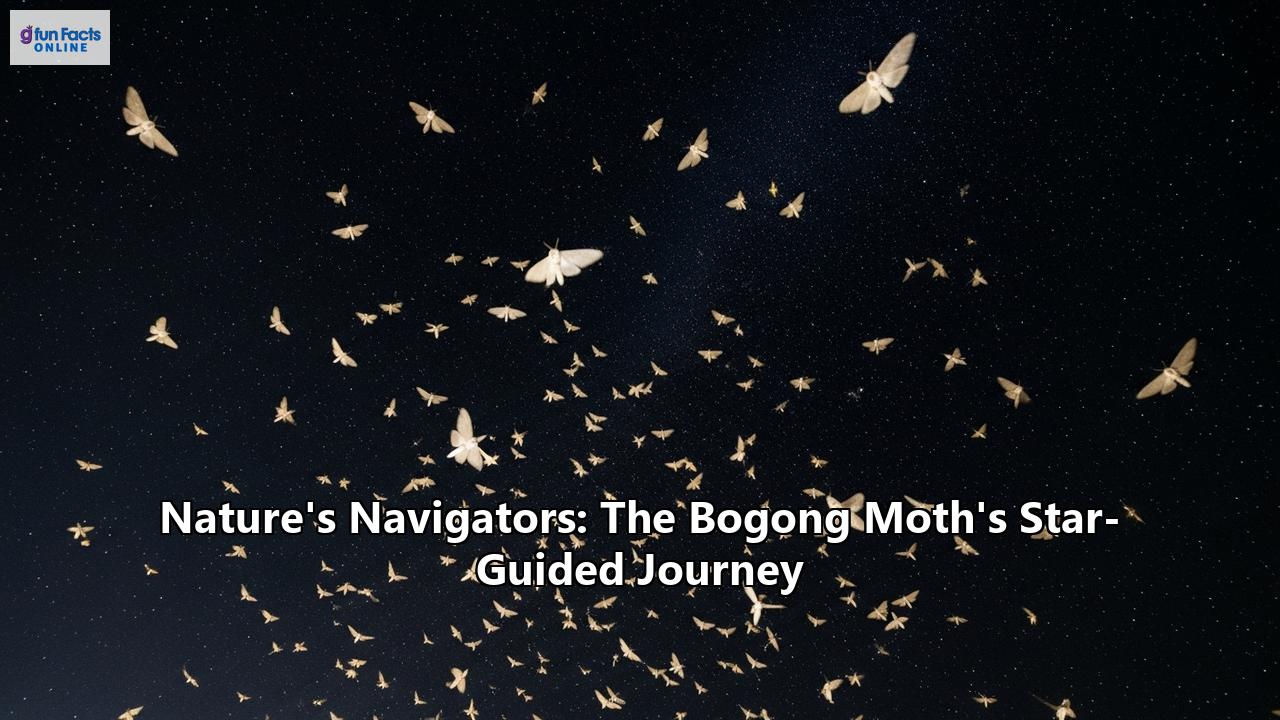
Nature's Navigators: The Bogong Moth's Star-Guided Journey
In the vast, star-dusted theater of the Australian night sky, a silent, epic journey unfolds each year. It is a mass aerial migration of billions of tiny, unassuming travelers, the Bogong moths (Agrotis infusa). These nocturnal navigators undertake a perilous round-trip journey of over 1,000 kilometers, a feat of endurance and precision that has long captivated scientists and held deep cultural significance for Indigenous Australians. Their destination: the cool, dark crevices of the Australian Alps, a summer refuge from the scorching heat of their breeding grounds. This incredible pilgrimage, guided by the celestial map of the stars and an innate magnetic sense, is a testament to the sophisticated navigational abilities packed within a brain no bigger than a grain of rice. But this ancient natural wonder is now under threat, with the very survival of these remarkable moths hanging in the balance.
The Great Moth Migration: A Tale of Two Journeys
The life of a Bogong moth is one of constant movement, a biannual odyssey that dictates its entire existence. This incredible migration is not a one-way trip but a return journey undertaken by the same individuals, a rare phenomenon in the insect world.
The Spring Exodus: A Flight for SurvivalAs spring awakens across the vast inland plains of southern Queensland and western and northwestern New South Wales, a new generation of Bogong moths emerges. These moths are born into a landscape that will soon become inhospitable. The tender, broad-leafed plants their larvae, known as cutworms, feast upon will wither under the harsh summer sun, replaced by grasses they cannot consume. This impending food scarcity and the rising temperatures are the primary triggers for their great southern migration, a genetically programmed instinct for survival.
Starting in early September, billions of these newly emerged adult moths take to the night skies, embarking on a journey that can span several weeks. They fly southwards, a river of fluttering wings under the cover of darkness, heading towards the high peaks of the Great Dividing Range, including the iconic Mount Bogong from which they derive their name. Their destination is a series of specific, cool, and dark caves and rock crevices in the Australian Alps, typically at elevations above 1,800 meters. This is a place they have never been before, a destination passed down not through experience but through an inherited celestial and magnetic map.
During their long journey, the moths are not idle travelers. They make pit stops to feed on the nectar of flowering plants like grevilleas and eucalypts, building up crucial fat reserves that will sustain them through the coming months of dormancy.
Aestivation: The Summer SlumberUpon reaching their alpine destination, a truly remarkable spectacle unfolds. The moths congregate in massive numbers, blanketing the walls of their chosen caves in a dense, shimmering carpet. Densities can reach an astonishing 17,000 moths per square meter. Here, they enter a state of dormancy known as aestivation, a summer equivalent of hibernation. Their metabolism slows, and they live off the fat reserves they diligently accumulated during their migration. This summer slumber allows them to escape the extreme heat and lack of food in their lowland breeding grounds.
The Autumn Return: A Final Homeward FlightAs summer wanes and the alpine air begins to cool in February and March, the Bogong moths stir from their dormancy. It is the same generation that arrived months earlier that now prepares for the second leg of their epic journey. They take to the skies once more, this time flying north, retracing their path back to the very plains where they were born.
Upon their return, their final life chapter unfolds. They mate, the females lay up to 2,000 eggs in the soil, and shortly after, their remarkable life cycle comes to an end. From these eggs, a new generation will hatch, and when spring arrives, they too will answer the ancient call to migrate south, guided by the same stars that led their parents.
Celestial Navigation: Reading the Starry Map
For centuries, the mystery of how these tiny insects navigate with such precision over vast distances has baffled researchers. The answer, it turns out, lies in the heavens above. Recent groundbreaking research has confirmed that Bogong moths are among the very few animals, and the first invertebrate, known to use the stars for long-distance navigation.
Scientific studies, utilizing sophisticated flight simulators, have revealed the moths' incredible ability to use the night sky as a compass. In controlled experiments, when presented with a simulated starry sky, the moths consistently flew in the correct migratory direction for that time of year – south in the spring and north in the autumn. Even more compellingly, when the researchers rotated the star patterns by 180 degrees, the moths promptly reversed their direction of flight. However, when the stars were scrambled into a random pattern, the moths became disoriented, proving they are not simply flying towards the brightest light but are reading specific celestial patterns.
It is believed that the moths use the Milky Way, the luminous band of stars that stretches across the southern sky, as a primary directional cue. The brightest part of the Milky Way is a constant and reliable feature in the southern celestial hemisphere, making it an excellent compass for their journey. Eric Warrant, a professor of zoology at Lund University who has led much of the research into Bogong moth navigation, explains that despite their small eyes, these moths likely see the Milky Way more distinctly than humans do.
The moths' brains, though minuscule, are incredibly sophisticated. Researchers have identified specialized neurons in a region of the moth's brain responsible for navigation that fire in response to the orientation of the stars. These "compass neurons" are tuned to fire most strongly when the moth is heading in its seasonally appropriate migratory direction. This discovery reveals a remarkable level of complexity in the neural processing of an insect.
The Magnetic Backup Plan
The Bogong moth's navigational toolkit is not limited to the stars. They possess a "sixth sense" – the ability to detect and use the Earth's magnetic field. This magnetic sense serves as a crucial backup system. On cloudy nights when the stars are obscured, the moths can switch to their internal magnetic compass to maintain their course.
Experiments have shown that when both visual cues (the stars) and the magnetic field are manipulated to conflict with each other, the moths become confused. This indicates that they rely on both systems, likely using the stars to calibrate their magnetic compass. This dual-compass system provides a robust and reliable navigational mechanism, allowing them to successfully complete their migration even under variable weather conditions.
The precise mechanism by which they sense the magnetic field is still under investigation, but it is thought to involve a light-sensitive protein called cryptochrome located in their eyes. This suggests that Bogong moths may, in a sense, "see" the Earth's magnetic field.
A Cultural Keystone Species
For thousands of years, the annual migration of the Bogong moth has been a significant event for the Indigenous peoples of the Australian Alps. The arrival of the moths in the mountains heralded a time of abundance and ceremony. Several Indigenous nations, including the Gunaikurnai, Taungurung, and Ngarigo peoples, would travel to the high country to harvest the moths.
The moths, rich in fat and protein, were a vital food source. They were cooked in the hot ashes of a fire, which would burn off their wings and scales, and then either eaten whole or ground into a paste to make "moth meat," which is said to have a nutty flavor.
These annual gatherings were not just about food; they were important social and cultural events. They provided an opportunity for different clans and nations to come together, to trade, to conduct ceremonies, and to strengthen social bonds. The mountains themselves were named in honor of these moths, with areas like the Bogong High Plains and Bogong Peaks bearing their name. The moth's name, "Bogong," is derived from the Dhudhuroa word "bugung," which describes the moth's brown coloration.
Ecological Importance and Mounting Threats
Beyond their cultural significance, Bogong moths are a vital part of the alpine ecosystem. Their annual arrival provides a massive influx of nutrients to a generally food-scarce environment. They are a crucial food source for a variety of alpine animals, including birds like ravens and currawongs, bats, and lizards.
Most notably, they are the primary food source for the critically endangered mountain pygmy possum (Burramys parvus). These tiny marsupials rely heavily on the fat-rich Bogong moths to build up their own reserves for their winter hibernation and to successfully raise their young. The precipitous decline in moth numbers in recent years has had a devastating impact on the mountain pygmy possum, pushing this unique species closer to extinction.
The once-abundant Bogong moth is now facing a crisis. Their populations have plummeted by an estimated 99.5%, leading to their listing as an endangered species on the IUCN Red List in December 2021. The threats they face are numerous and interconnected.
Climate Change and Drought: Increasingly severe and prolonged droughts in their breeding grounds, driven by climate change, are a major factor in their decline. The lack of rainfall means a lack of the specific plants their larvae need to survive, leading to widespread breeding failure. Pesticides: As agricultural pests in their larval stage, Bogong moths are often targeted with pesticides. Millions are killed each year in their breeding grounds. There is also concern that the moths may accumulate toxins like arsenic from the soil in their bodies, which they then transport to the fragile alpine ecosystems. Light Pollution: The moths' migration takes them over increasingly urbanized landscapes. Artificial lights from cities like Canberra, which lies directly on their flight path, can disrupt their navigation. The bright lights can act as a "light trap," disorienting the moths and drawing them off course, where they may perish from exhaustion or predation.The Path to Conservation
The plight of the Bogong moth has spurred a range of conservation efforts. Scientists are working to better understand the full extent of their migration and the specific impacts of various threats. Citizen science projects like "Moth Tracker" encourage the public to report sightings of Bogong moths, helping to map their migration routes and identify key habitats.
Efforts are also underway to reduce light pollution during the moths' migration periods, with calls to turn off unnecessary outdoor lights. Promoting the planting of native, nectar-producing flowers can provide vital food sources for the moths along their journey. Addressing the broader issues of climate change and pesticide use is also critical to the long-term survival of this iconic species.
A Journey's End?
The star-guided journey of the Bogong moth is a powerful reminder of the intricate and often invisible wonders of the natural world. It is a story of resilience, of ancient knowledge encoded in the stars and in the very DNA of a tiny insect. But it is also a story of vulnerability, a stark illustration of how human activities can disrupt these delicate natural rhythms.
The future of the Bogong moth, and the unique alpine ecosystem that depends on it, is uncertain. Protecting these remarkable navigators requires a concerted effort to safeguard their migratory pathways, their breeding grounds, and the dark, starry skies that have guided them for millennia. The silent, fluttering river of life that flows through the Australian night is a spectacle we cannot afford to lose. Its continuation depends on our willingness to look up, to understand, and to act before this incredible journey reaches its final, tragic end.
Reference:
- https://earthsky.org/space/australian-bogong-moths-navigate-using-starlight/
- https://www.jpost.com/science/article-858277
- https://www.space.com/astronomy/earth/this-australian-moth-may-be-the-1st-insect-ever-discovered-to-use-stars-for-long-distance-navigation
- https://en.as.com/latest_news/star-guided-journeys-scientists-reveal-moths-migrate-over-600-miles-using-celestial-navigation-n/
- https://www.vice.com/en/article/these-tiny-moths-use-the-stars-to-guide-them-hundreds-of-miles/
- https://astrobiology.com/2025/06/bogong-moths-use-stars-in-the-night-sky-to-navigate-hundreds-of-kilometers.html
- https://bioengineer.org/bogong-moths-navigate-night-using-stellar-compass/
- https://news.mongabay.com/short-article/bogong-moths-use-stars-and-the-milky-way-to-make-epic-migration/
- https://www.discovermagazine.com/planet-earth/these-moths-are-the-first-nocturnal-insect-with-a-magnetic-compass
- https://www.unisa.edu.au/media-centre/Releases/2025/stargazing-flight-how-bogong-moths-use--the-night-sky-to-navigate-hundreds-of-kilometres/
- https://scienceblog.com/moths-use-star-maps-like-ancient-sailors-to-cross-australia/
- https://www.icr.org/article/moths-sense-magnetic-field/
- https://cordis.europa.eu/project/id/741298