
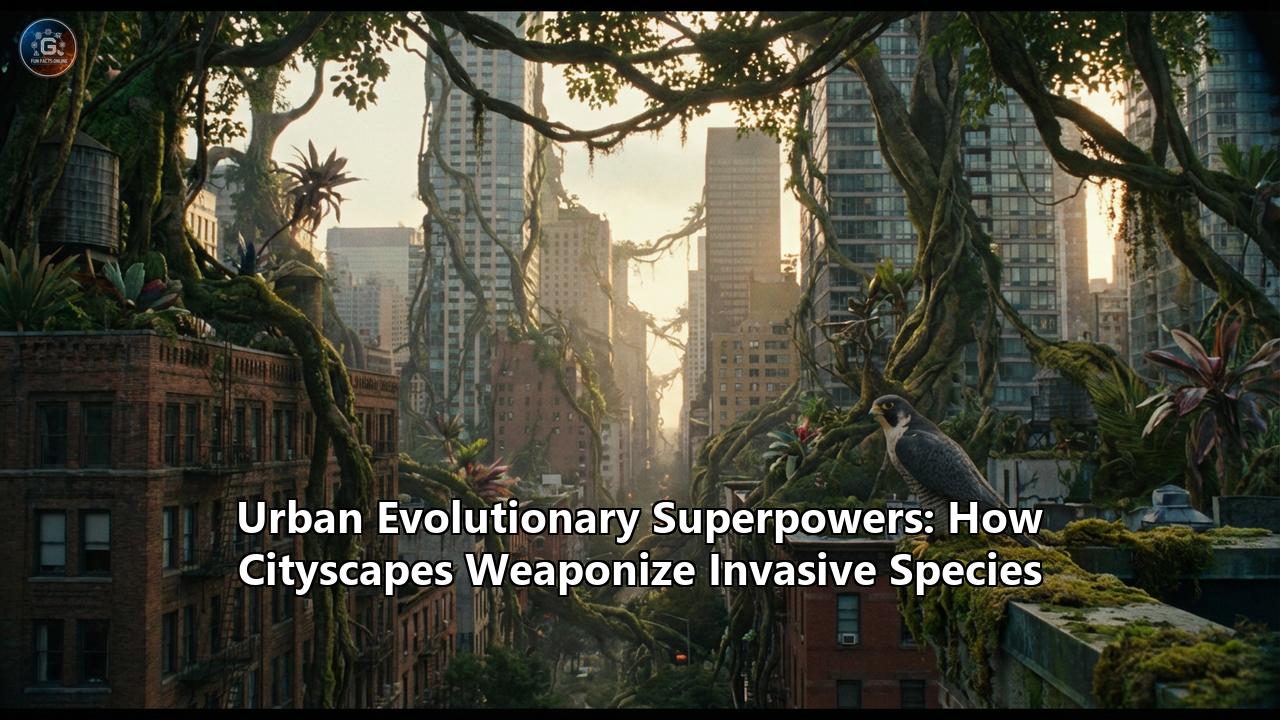
For centuries, we have viewed cities as the antithesis of nature—concrete wastelands where biology goes to die, suffocated by asphalt, smog, and artificial light. But modern evolutionary biology has uncovered a radically different reality. The city is not a biological desert; it is a hyper-speed evolutionary crucible. By radically altering the environment, humans have inadvertently constructed the most intense evolutionary training grounds on Earth.
Within these urban hothouses, species are subjected to extreme selective pressures: soaring temperatures, relentless chemical pollution, heavily fragmented habitats, and novel diets. To survive, animals and plants must adapt. But they aren't just adapting—they are evolving at a breakneck pace, acquiring biological "superpowers" in a matter of decades rather than millennia.
While this rapid urban evolution is a marvel of resilience, it harbors a darker ecological consequence. When non-native species are introduced to cities, these harsh urban pressures forge them into highly competitive, resilient, and aggressively dispersing organisms. Biologists call this the "Urban Bridgehead Hypothesis". Cities act as evolutionary boot camps. Once an invasive species survives the urban gauntlet, it emerges weaponized—perfectly adapted to conquer other cities across the globe, and uniquely equipped to outcompete native species when it spills over into natural environments.
Here is how cityscapes are actively weaponizing invasive species, granting them the evolutionary superpowers needed to dominate the modern world.
The Thermal Vanguard: Forged in the Urban Heat Island
One of the most defining characteristics of any global metropolis is the Urban Heat Island (UHI) effect. Asphalt, concrete, and steel absorb solar radiation during the day and radiate it back at night, making cities significantly hotter than their surrounding rural areas. In addition, human activities—from running air conditioners to driving cars—pump localized waste heat directly into the environment.
For small, cold-blooded creatures, a temperature shift of even a few degrees can be a matter of life or death. Enter the acorn ant (Temnothorax curvispinosus), a tiny insect that makes its home inside hollowed-out acorns. Unlike many other ants that can burrow deep underground to escape the heat, acorn ants live right on the surface, directly exposed to the baking urban microclimate.
When researchers collected acorn ants from the urban center of Cleveland, Ohio, and compared them to colonies in nearby rural forests, they discovered something astonishing: the urban ants had rapidly evolved a significantly higher tolerance to extreme heat. Because ant queens live for five to fifteen years, researchers calculated that this genetic adaptation occurred in no more than 20 generations—a blink of an eye in evolutionary time, representing roughly 100 years of urban exposure. Furthermore, urban ants demonstrated a higher resting metabolic rate and an evolved plasticity, meaning their bodies can adjust to sudden, rapid spikes in temperature much faster than their rural cousins.
While the acorn ant is native to North America, this exact mechanism is weaponizing invasive pests globally. When an invasive insect arrives in a warming city, the UHI effect forcefully selects for individuals with extreme heat tolerance. As global climate change raises baseline temperatures worldwide, these "urbanized" invaders are already pre-adapted to the warmer climates of the future. When they eventually migrate out of the city and into natural forests, they possess a massive thermal advantage over native species, which are left biologically lagging, unable to cope with the warming world.
The Concrete Acrobats: Morphological Shapeshifting
The physical architecture of a city—smooth glass windows, sheer concrete walls, and painted metal poles—bears little resemblance to the textured bark of forest trees. To navigate this slick, vertical world, urban invaders are physically shapeshifting, altering their morphology to master the concrete jungle.
The brown anole (Anolis sagrei), an invasive lizard native to Cuba and the Bahamas, has aggressively conquered the southern United States and parts of the Caribbean. In its native habitat, it scurries along the ground and low tree trunks. But in cities, it faces smooth, artificial surfaces and wide-open, dangerous expanses of pavement.
Evolutionary biologists studying brown anoles and their close relatives, the Puerto Rican crested anoles (Anolis cristatellus), found that city-dwelling lizards have evolved drastically different bodies from their forest-dwelling counterparts. Urban anoles have developed significantly longer limbs, granting them the explosive speed necessary to sprint across open gaps in fragmented urban spaces before being picked off by predators.
Even more remarkably, the city lizards have evolved specialized feet. Over just a few dozen generations, urban anoles developed larger toe pads with an increased number of lamellae (the microscopic, sticky scales that allow them to cling to surfaces). This morphological superpower allows them to scale smooth concrete, metal, and glass with ease. Genomic sequencing of these city lizards revealed that these aren't just phenotypic adjustments; the changes are hardcoded into 93 specific genes related to skin and limb development.
When these genetically upgraded, highly athletic lizards spread, they are an unstoppable force. The native green anole (Anolis carolinensis) of the American South has been utterly outcompeted by the invasive brown anole. Forced out of their lower-trunk habitats, native green anoles have had to retreat high into the tree canopies just to survive the invasion. The urban environment crafted a physically superior invader, and the native species paid the price.
The Fragmented Flyers: Supercharging Dispersal
Cities are essentially archipelagos of habitat. A park here, a garden there, separated by vast oceans of lethal roads, parking lots, and buildings. If an organism wants to find food or a mate, it must cross these perilous voids. This spatial fragmentation heavily selects for species with enhanced dispersal capabilities—essentially, the ability to travel farther and faster.
The cabbage white butterfly (Pieris rapae) is a notoriously invasive agricultural pest originally from Europe. It has successfully colonized cities worldwide. When researchers examined urban populations of the cabbage white, they found that the city butterflies had evolved significantly larger wingspans and stronger flight muscles compared to those living in continuous rural landscapes.
In the city, a butterfly with weak wings cannot make the long, exhausting flight from one flowerbed to the next; it dies without passing on its genes. Only the strongest flyers survive to reproduce.
This urban adaptation has devastating consequences for global agriculture. By forcing the cabbage white butterfly to become a long-distance flyer, cities have inadvertently created a super-disperser. When these large-winged urban butterflies make their way out to agricultural lands, their enhanced flight capabilities allow them to spread rapidly across vast fields, infesting crops at a rate much faster than their rural ancestors ever could. The city acted as an evolutionary slingshot, pulling the species back and launching it further into the wild.
The Strategic Seed-Droppers: Hijacking Plant Reproduction
It is not just animals that are being weaponized by urban landscapes; invasive and opportunistic plants are also rewriting their genetic code to conquer the concrete.
Consider the reproductive dilemma of a weed growing in a small patch of soil around a sidewalk tree. In a natural meadow, a plant benefits from casting its seeds to the wind, allowing its offspring to colonize distant lands. But on a city street, wind dispersal is a death sentence. A seed carried away by a gust of wind is statistically guaranteed to land on suffocating concrete or asphalt, where it will fail to germinate.
The hawksbeard (Crepis sancta), a small yellow flower in the dandelion family, found itself facing this exact urban dilemma in Montpellier, France. The plant naturally produces two types of seeds: light, fluffy seeds designed to ride the wind, and heavier, un-tufted seeds designed to drop straight down next to the mother plant.
Researchers discovered that within just 12 years—roughly 5 to 12 generations—the urban hawksbeard populations underwent rapid genetic evolution. The city plants drastically altered their seed ratio, producing significantly more of the heavy, dropping seeds and far fewer of the wind-riding seeds compared to their rural counterparts.
By evolving to drop their seeds straight down into the single patch of viable soil at the base of the tree, the urban hawksbeard guaranteed its local survival. This rapid evolution of reproductive strategy shows how quickly an invasive weed can lock down a newly conquered territory. Once a plant evolves to manipulate its own dispersal mechanics to suit human infrastructure, it becomes nearly impossible to eradicate, dominating urban green spaces and choking out native flora.
The Toxic Avengers: Chemical Immunity and Dietary Flexibility
Cities are chemically saturated environments. Pesticides, herbicides, heavy metals, road salt, and industrial runoff seep into the soil and water. For native species accustomed to pristine environments, this chemical cocktail is toxic. But for invasive species, it is just another evolutionary hurdle to clear.
Pests like rats, bedbugs, and cockroaches have famously developed near-total immunity to the chemical poisons we use to control them. But the phenomenon extends to wildlife as well. Invasive fish in polluted urban waterways have rapidly evolved resistance to industrial toxins like PCBs (polychlorinated biphenyls). They achieve this by mutating the genetic receptors that normally bind to the toxins, rendering the deadly chemicals harmless.
Furthermore, the urban diet is a radical departure from the natural food web. Cities are overflowing with human refuse—highly processed, calorie-dense, and rich in sugars and fats. Invasive species that can rapidly alter their metabolic pathways to digest human garbage gain a massive caloric advantage. Birds like pigeons, starlings, and house sparrows have adapted their digestive microbiomes to process complex human starches. When an invasive species is perfectly happy to eat discarded French fries, it no longer relies on the seasonal availability of wild seeds or insects. This decoupling from the natural food web allows their populations to explode to unnatural densities.
The Bridgehead Effect: A Global Network of Invaders
The true danger of urban evolution lies in the homogenization of the global environment. A city in North America shares more ecological similarities with a city in Europe or Asia than it does with the forest lying just five miles outside its own limits. Cities around the world feature the same concrete buildings, the same asphalt roads, the same heat island effects, the same light pollution, and the same chemical runoff.
This brings us to the ultimate weaponization of the invasive species: The Urban Bridgehead.
Historically, an invasive species transported from a jungle in Asia to a temperate forest in North America would likely die. The environmental shock would act as a natural filter, preventing the invasion. But globalization has changed the rules of the game. Today, an insect from Tokyo is accidentally loaded onto a cargo ship and unloaded in New York City. Because both locations are highly developed urban centers, the environmental filter is bypassed.
If that insect has already adapted to the heat, pollution, and fragmentation of Tokyo, it arrives in New York completely pre-adapted to its new home. The first city served as the evolutionary training ground; the second city serves as the bridgehead.
From this urban bridgehead, the invasive population establishes a massive, unassailable stronghold. As their numbers swell, the invaders inevitably spill out into the surrounding natural landscapes. And when they do, they are vastly superior to the native species. They have the thermal tolerance to survive climate change. They have the enhanced limbs and wings to disperse rapidly. They have the metabolic flexibility to eat anything, and the genetic resistance to survive chemical attacks.
A New Era of Conservation
For decades, conservation biology has operated on the assumption that nature is static and that preserving species means shielding them from human influence. But the reality of the Anthropocene is that human engineering is driving biological engineering.
The cityscapes we build are not separate from nature; they are the most intense evolutionary engines on the planet. By creating extreme environments, we are inadvertently running a global selective breeding program, favoring the boldest, fastest, most heat-tolerant, and most chemically resistant organisms.
If we are to protect global biodiversity, we must stop viewing cities merely as the staging grounds for ecological destruction, and start studying them as the epicenters of rapid evolution. Understanding how urban environments warp the DNA of invasive species is the first step toward mitigating their spread. Until we recognize the evolutionary superpowers we are handing to these urbanized invaders, we will continue to lose the battle against them, one concrete sidewalk at a time.
Reference:
- https://pubmed.ncbi.nlm.nih.gov/18316722/
- https://www.pnas.org/doi/10.1073/pnas.0708446105
- https://www.sciencedaily.com/releases/2017/03/170307130801.htm
- https://urbanevolution-litc.com/2021/06/11/urban-evolution-of-invasive-species-the-making-of-urbanized-invaders/
- https://pmc.ncbi.nlm.nih.gov/articles/PMC6007456/
- https://www.tomorrow.city/invasive-species-how-do-they-endanger-the-ecosystems-in-cities/
- https://www.oaklandzoo.org/animals/brown-anole-cuban-anole
- https://www.biorxiv.org/content/10.1101/2020.08.21.251025v1.full-text
- https://academic.oup.com/evolut/article/75/4/876/6728555
- https://urbanevolution-litc.com/2019/06/22/evolution-2019-a-test-for-transgenerational-plasticity-in-the-adaptive-divergence-of-acorn-ant-thermal-tolerance-across-an-urban-rural-temperature-cline/
- https://www.researchgate.net/publication/5534974_Rapid_evolution_of_seed_dispersal_in_an_urban_environment_in_the_weed_Crepis_sancta
- https://en.wikipedia.org/wiki/Brown_anole
- https://www.edge.org/conversation/jonathan_b_losos-urban-evolution
- https://www.popsci.com/environment/lizard-city-genetics/
- https://india.mongabay.com/2024/04/pricey-guests-urban-invasive-species-cost-the-world-billions-every-year/
- https://wildlife.org/qa-cities-are-evolutionary-incubators-for-invasive-species/
- https://www.sciencenews.org/article/city-life-changes-style-weed-seeds
- https://www.anthropocenemagazine.org/2020/06/city-species-are-evolving-and-conservation-plans-should-evolve-with-them/