
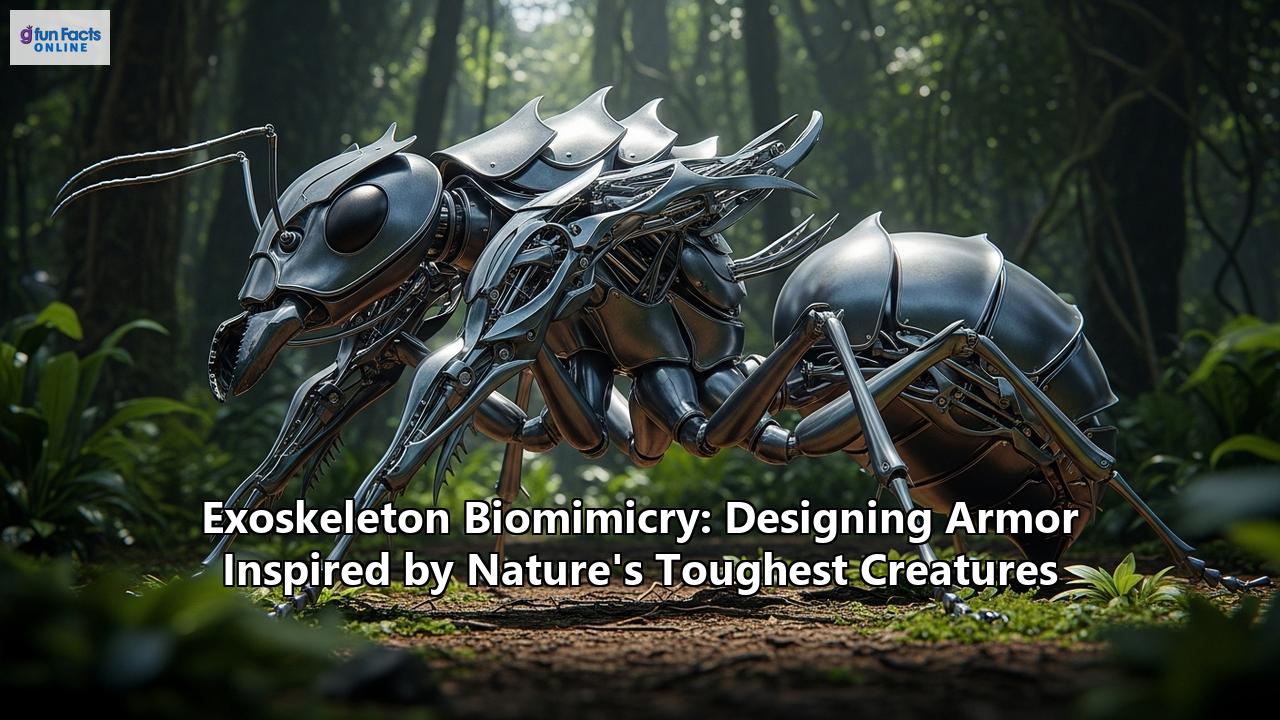
In a world constantly seeking stronger, lighter, and more resilient materials, nature has already perfected the art of self-defense. For millions of years, creatures great and small have evolved intricate and highly effective armor to protect themselves from predators and the harsh realities of their environments. Now, scientists and engineers are turning to these masters of natural protection for inspiration, heralding a new era of biomimicry in the design of advanced armor and exoskeletons. This approach, known as "Exoskeleton Biomimicry," involves studying the remarkable properties of nature's toughest creatures and translating those designs into revolutionary protective gear for humans.
The Nearly Indestructible Beetle: A Lesson in Crush Resistance
Imagine an insect so tough it can survive being run over by a car. This is the reality for the Diabolical Ironclad Beetle (Phloeodes diabolicus), a small, flightless insect native to the deserts of North America. This beetle can withstand forces up to 39,000 times its own body weight, the equivalent of a 200-pound person supporting the weight of about 40 M1 Abrams battle tanks. The secret to its incredible durability lies in the intricate structure of its exoskeleton.
Unlike flying beetles that have wing covers (elytra) that open, the Ironclad Beetle's elytra are fused together, forming a solid, protective shield. This shield is not a single, uniform piece. Instead, it features a series of interlocking, jigsaw-like sutures that run along its back. These connections are not rigid; they are made of layers of tissue held together by proteins. When subjected to immense pressure, these layers don't snap. Instead, they subtly give way and delaminate, absorbing impact energy and preventing catastrophic failure. This layered, interlocking design provides a "graceful failure," allowing the beetle to survive crushing forces that would obliterate other insects.
Researchers are already taking cues from this tiny tank. By 3D-printing materials that replicate the Ironclad Beetle's layered and interlocking architecture, they aim to create new types of body armor and even more durable components for buildings, bridges, and vehicles.
The Piranha-Proof Armor of the Arapaima
Deep in the Amazon River basin lives the arapaima, one of the world's largest freshwater fish. It shares its habitat with the notoriously sharp-toothed piranha, yet it thrives thanks to its incredibly tough and flexible scales. The arapaima's scales are a masterclass in composite armor design.
Each scale is composed of two distinct layers. The outer layer is hard and highly mineralized, designed to resist initial penetration from a piranha's bite. Beneath this hard exterior lies a much softer, more flexible inner layer made of collagen. This inner layer is not just a simple block of tissue; it's a "twisted plywood" or Bouligand-like structure, with layers of collagen fibers arranged in a spiraling pattern.
When a piranha bites down, the hard outer layer spreads the force of the impact. If the outer layer does crack, the underlying Bouligand structure of the collagen fibers prevents the crack from propagating, effectively containing the damage. This layered approach allows the arapaima's scales to be both incredibly tough and remarkably flexible, a combination that engineers strive for in modern armor systems. The design principle of combining a hard outer layer with a tough, energy-absorbing inner layer is a key takeaway for developing advanced, lightweight, and flexible body armor for soldiers and law enforcement.
The Iron-Clad Snail of the Deep Sea
In the extreme environment of deep-sea hydrothermal vents, where superheated, mineral-rich water spews from the ocean floor, lives a snail with a truly unique defense mechanism. The scaly-foot gastropod, or "iron-gilled snail," constructs its shell from iron sulfides, creating a natural suit of iron armor. It is the only known animal to utilize iron in this way.
The snail's shell is a three-layered marvel of natural engineering. The inner layer is made of a common shell material called aragonite. The middle layer is a thick, organic periostracum that acts as a shock absorber. But it's the outer layer that truly sets this snail apart. It is embedded with iron sulfide granules, creating an incredibly hard and durable exterior.
This iron-infused shell doesn't just block attacks; it's designed to fail in a controlled way. When a predator, like a crab, tries to crush the shell, the outer layer is designed to crack in a way that absorbs energy and prevents larger fractures from forming. The thick organic middle layer then dissipates the remaining energy from the blow, protecting the snail within. This sophisticated, multi-layered defense has caught the attention of military researchers, who see it as a blueprint for designing next-generation armor for soldiers and vehicles that can better withstand ballistic impacts.
The Shock-Absorbing Power of the Mantis Shrimp
The mantis shrimp is one of the most formidable predators in the ocean, possessing a club-like appendage that it can use to strike its prey with the speed of a .22 caliber bullet. The force of this impact is so great it can shatter crab shells and even crack aquarium glass. The question that has long fascinated scientists is how the mantis shrimp can deliver such a powerful blow without shattering its own club.
The answer lies in a complex, multi-layered structure. The club's surface is made of a very hard, ceramic-like material that can withstand intense impact. Beneath this impact surface are layers of chitin fibers arranged in a helicoidal, or spiral, structure, similar to the collagen in the arapaima's scales. This spiral arrangement is key to the club's resilience. When micro-cracks form as a result of an impact, they are forced to follow the twisting path of the fibers. This twisting dissipates a significant amount of energy and prevents the cracks from spreading and causing a catastrophic failure of the club.
This remarkable ability to absorb and dissipate energy has inspired researchers to develop new composite materials for everything from body armor to football helmets. The mantis shrimp's shock-absorbing mechanism could lead to the creation of materials that are significantly more resistant to impact, potentially saving lives in a variety of contexts.
The Flexible Armor of the Chiton
For many armor systems, there is a trade-off between protection and flexibility. Hard, rigid armor offers excellent protection but can restrict movement. Softer, more flexible armor allows for greater mobility but often at the cost of reduced protection. The chiton, a type of marine mollusk, offers a solution to this age-old dilemma.
Instead of a single, solid shell, the chiton's back is covered by eight overlapping mineralized plates. Surrounding these plates is a girdle of small, fish-like scales. This segmented design allows the chiton to be both highly protected and incredibly flexible, enabling it to cling to uneven rock surfaces.
When the chiton is at rest or moving, the plates and scales can slide over one another, allowing for a wide range of motion. However, when a predator attacks, the plates and scales lock together to form a rigid, protective barrier. This ability to transition between a flexible and a rigid state is a key feature that researchers are looking to replicate. Using 3D printing, scientists have created prototypes of armor inspired by the chiton's scales, with rigid "scales" mounted on a flexible substrate. This research could lead to the development of new types of body armor that offer the best of both worlds: robust protection for vital areas and enhanced flexibility for joints, creating a more effective and less cumbersome suit of armor.
From Nature's Blueprints to Human Exoskeletons
The lessons learned from these and other armored creatures are directly informing the design of the next generation of human augmentation. While early exoskeleton designs focused primarily on power and load-carrying capabilities, such as the Berkeley Lower Extremity Exoskeleton (BLEEX) and the Hybrid Assistive Limb (HAL-5), newer designs are increasingly incorporating biomimetic principles to enhance mobility, comfort, and protection.
For example, the adaptive, multi-modular design of a shrimp's shell has inspired the creation of a cable-driven elbow exoskeleton. This design aims to improve the adaptability and comfort of the exoskeleton for rehabilitation purposes. Similarly, the development of more flexible and form-fitting armor inspired by chitons and fish scales could be integrated into full-body exoskeletons to provide protection without sacrificing the wearer's range of motion.
As our understanding of the intricate structures and materials found in nature's toughest creatures continues to grow, so too will our ability to create revolutionary new forms of armor and exoskeletons. By learning from the blueprints perfected over millions of years of evolution, we are poised to develop protective systems that are not only stronger and lighter but also smarter and more adaptable than ever before. The future of armor is not just about new materials; it's about new ways of thinking, inspired by the enduring ingenuity of the natural world.
Reference:
- https://www.sciencenews.org/article/diabolical-ironclad-beetle-exoskeleton-armor-impossible-squish
- https://www.cbsnews.com/news/ironclad-beetle-indestructible-survive-run-over-by-car/
- https://journals.biologists.com/jeb/article/224/1/jeb235069/237142/The-mechanical-puzzle-of-crush-resistant-beetles
- https://www.snexplores.org/article/diabolical-ironclad-beetle-strong-exoskeleton-nearly-unsquishable
- https://today.ucsd.edu/story/piranha-proof-fish-scales-offer-inspiration-for-better-armor
- https://als.lbl.gov/the-molecular-ingenuity-of-a-unique-fish-scale/
- https://pubmed.ncbi.nlm.nih.gov/24816264/
- https://www.researchgate.net/figure/Protection-mechanisms-of-the-arapaimas-scales-against-the-penetration-of-a-tooth-a_fig11_262227731
- https://www.researchgate.net/figure/Hierarchical-structure-of-Arapaima-gigas-scales-a-The-scales-of-the-A-gigas-fish-act_fig2_257838780
- https://www.shapecut.com.au/tough-shell-to-crack-the-deep-sea-snail-made-of-iron/
- https://news.mit.edu/2010/snail-shell
- https://en.wikipedia.org/wiki/Scaly-foot_gastropod
- https://enviroliteracy.org/what-snail-has-an-iron-shell/
- https://news.ucr.edu/articles/2018/06/25/why-mantis-shrimp-dont-crack-under-pressure
- https://www.purdue.edu/research/features/stories/creature-feature-twisting-cracks-impart-superhero-toughness-to-animals/
- https://www.smithsonianmag.com/smart-news/mantis-shrimp-pack-a-punch-with-the-force-of-a-bullet-and-they-dont-get-hurt-heres-how-180986033/
- https://www.researchgate.net/figure/Impact-surface-of-the-dactyl-club-of-the-mantis-shrimp-a-Photograph-of-a-mantis-shrimp_fig1_343703777
- https://www.labmanager.com/chiton-mollusk-provides-model-for-new-armor-design-21323
- https://newatlas.com/materials/chiton-inspired-body-armor/
- https://www.imnovation-hub.com/science-and-technology/chiton-mollusk-innovative-bio-armour/
- https://news.vt.edu/articles/2019/12/chiton-mollusk-provides-model-for-new-armor-design.html
- https://geometrymatters.com/3d-printed-armor-inspired-by-mollusks/
- https://bleex.me.berkeley.edu/wp-content/uploads/hel-media/Publication/ICRA05-Design.pdf
- https://www.mdpi.com/2313-7673/10/5/271