
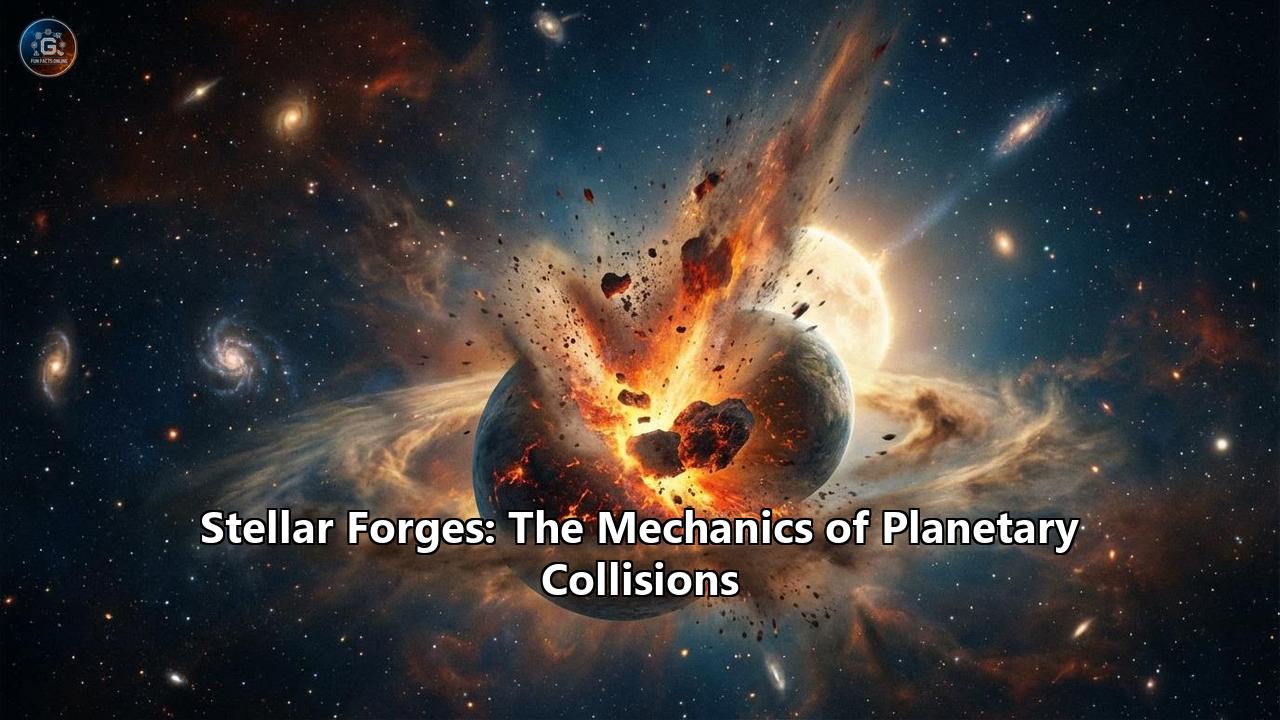
When we look up at the night sky, the universe appears as a tapestry of profound stillness. The stars are fixed, the planets trace their elegant, mathematically predictable orbits, and the cosmos seems defined by a serene, clockwork regularity. But this tranquility is a magnificent illusion. The history of planetary systems is not a story of gentle assembly; it is a saga of unimaginable violence. The solid ground beneath our feet, the water in our oceans, and the very existence of the Moon overhead are the direct results of cataclysmic events that shatter worlds and melt entire planets. These are the mechanics of planetary collisions—the stellar forges where the raw materials of the cosmos are hammered, melted, and recast into the habitable worlds we know today.
To understand planetary collisions is to understand the fundamental mechanics of creation in the universe. It is a story told in the language of kinetic energy, orbital dynamics, thermodynamics, and fluid mechanics. From the microscopic dust grains coalescing in the primordial nebula to the apocalyptic impacts of fully formed gas giants, the universe builds by destroying.
The Genesis of Chaos: The Protoplanetary Disk
The story of a planetary collision begins long before there are planets to collide. When a stellar nursery—a dense molecular cloud of gas and dust—collides with a shockwave from a nearby supernova, it collapses under its own gravity. At the center, a new star ignites. Surrounding this infant star is a spinning halo of leftover material: the protoplanetary disk.
Within this disk, the mechanics of collision begin at the microscopic level. Dust grains, coated in ice, collide gently, held together by electrostatic forces and the stickiness of their icy mantles. This is a quiet, constructive phase known as accretion. As these clumps grow from the size of pebbles to boulders, they cross a critical threshold. Once an object reaches a few kilometers across, it becomes a planetesimal, and a new force takes over: gravity.
Gravity fundamentally changes the nature of collisions. No longer are objects simply bumping into one another as they drift; they are actively pulling each other from their orbits. As planetesimals grow into protoplanets—bodies the size of the Moon or Mars—their gravitational reach extends. The protoplanetary disk transforms from a smooth highway of parallel orbits into a chaotic demolition derby. The mathematical reality of this phase is governed by the N-body problem. In a system with dozens of massive protoplanets, orbits are inherently unstable. Gravitational resonances pump up the eccentricities of these young worlds, causing their orbits to cross.
When orbits cross, the clock starts ticking toward a cosmic rendezvous. The relative velocities of these protoplanets can reach tens of kilometers per second. At these speeds, rock and iron no longer behave like solid objects; under the extreme pressures of an impact, they behave like fluids.
The Physics of the Crash: Collision Mechanics
When two planetary bodies find themselves on a collision course, the outcome is dictated by a strict set of physical parameters: the masses of the two bodies, their relative velocity at the time of impact, and the impact angle.
Velocity and the Energy of Annihilation
The speed of a collision is determined not just by how fast the planets are orbiting the star, but by their mutual gravitational attraction. As the two worlds approach, they accelerate toward each other, meaning the minimum impact velocity is always at least their mutual escape velocity. For Earth-sized planets, this is around 11 to 14 kilometers per second (roughly 25,000 to 31,000 miles per hour).
At these velocities, the kinetic energy involved is incomprehensible. The kinetic energy ($E_k$) is equal to one-half the mass times the velocity squared ($E_k = \frac{1}{2}mv^2$). Because the velocity is squared, even a slight increase in impact speed exponentially increases the violence of the event. A collision between two rocky planets releases millions of times more energy than the asteroid impact that wiped out the dinosaurs.
The Impact Parameter and Collision Taxonomies
The angle of impact is just as crucial as the speed. Astrophysicists measure this using the "impact parameter," which describes how far off-center the collision is. A parameter of 0 is a dead-center, head-on collision, while a parameter of 1 is a glancing blow that barely grazes the atmosphere. Depending on the impact parameter and velocity, planetary collisions fall into four main categories:
1. Perfect Merging: In a relatively slow, head-on collision, the two bodies smash together and fuse entirely. The kinetic energy is converted into intense heat, melting both planets into a single, larger, glowing sphere of magma. The heavier iron cores of both bodies sink to the center, combining into one massive core, while the lighter silicates form a deep magma ocean. 2. Partial Accretion: If the collision is slightly off-center or faster, the bodies will merge, but a significant portion of the impactor's mantle and crust will be blasted into space. Some of this material falls back to the new planet, some forms an orbiting debris ring, and some escapes the system entirely. 3. The Hit-and-Run: If the angle is steep (a grazing blow) and the velocity is high, the impactor might survive the encounter. It strikes the larger planet, gouges out a massive trench of crust and mantle, but retains enough momentum to escape the larger planet's gravity. The impactor continues on a new, highly altered orbit, often stripped of its outer rocky layers, leaving behind only a naked iron core. 4. Disruptive Shattering: In the most extreme scenarios, where the velocity is vastly higher than the escape velocity, the kinetic energy overwhelms the gravitational binding energy of both planets. The bodies do not merge; they completely obliterate one another, reducing two worlds to an expanding cloud of vaporized rock, shrapnel, and dust.Thermodynamics and State Changes: Vaporized Worlds
To truly envision a giant impact, one must abandon the everyday intuition of how solid objects behave. When a Mars-sized object strikes an Earth-sized planet, it does not crack like a billiard ball. The immense kinetic energy of the impact is converted almost instantaneously into heat and shockwaves.
At the moment of contact, a shockwave propagates outward from the point of impact at speeds exceeding the speed of sound in rock. The pressures behind this shock front reach millions of atmospheres. Under this pressure, the chemical bonds of silicate rocks snap. The rock does not merely melt; it vaporizes.
A massive plume of superheated rock vapor, expanding at supersonic speeds, explodes outward into the vacuum of space. Meanwhile, the solid crusts and mantles of both worlds are instantly liquefied. The target planet is engulfed in a global magma ocean that can be thousands of kilometers deep. Temperatures at the surface reach upward of 10,000 degrees Celsius—hotter than the surface of the Sun.
Within the interior, a dense choreography of fluid dynamics takes place. The iron core of the impacting planet, being denser than the surrounding silicate magma, does not vaporize as easily. Instead, it forms a massive blob of molten metal that plunges through the magma ocean of the target planet. As it sinks, it generates immense friction and secondary heat, eventually merging with the target's core. This process, known as core-mantle equilibration, determines the final chemical makeup of the surviving planet.
The Synestia: A New Cosmic Structure
For decades, the standard model of a giant impact involved a planet surrounded by a flat, Saturn-like ring of molten debris. But in 2017, planetary scientists Sarah Stewart and Simon Lock revolutionized our understanding of high-energy, high-angular-momentum collisions. They ran advanced thermodynamic simulations and discovered that when rapidly spinning, highly energetic planets collide, they do not form a simple planet-and-ring system. They form an entirely new astrophysical structure: a synestia.
The word synestia is derived from "syn-" (together) and Hestia, the Greek goddess of architecture and structures. A synestia is a huge, spinning, donut-shaped mass of hot, vaporized rock.
To understand a synestia, one must understand the corotation limit. In a solid, rotating planet, every point from the core to the equator rotates at the same angular velocity. If a planet spins too fast, the centrifugal force at the equator overcomes gravity, and material begins to fly off into space. In a highly energetic giant impact, the immense heat expands the volume of the planet, while the off-center strike injects massive amounts of angular momentum (spin).
The result is a structure that exceeds the corotation limit. The core of the synestia rotates like a traditional liquid planet, but as you move outward, the material transitions seamlessly into a thick, vaporized disk. There is no solid or liquid surface. Instead, it is a continuous, swirling cloud of vaporized rock. If you were to look at a synestia from the outside, it would resemble a glowing, incandescent red blood cell or a massive, fiery donut.
The weather inside a synestia is hellish beyond comprehension. The outer layers, known as the photosphere, radiate heat into the freezing vacuum of space. As the vaporized rock at the outer edges cools, it condenses into droplets of liquid magma. This creates a literal rain of molten rock. The "rock rain" falls inward toward the center of the synestia, continually cooling the structure.
A synestia is a transient phase. For an Earth-mass body, it might only last a century—a mere blink of an eye in cosmic time. As it bleeds heat into space, the vapor condenses, the structure shrinks, and the rotation slows. Eventually, it collapses back below the corotation limit, revealing a rapidly spinning, oblate, molten planet, perhaps surrounded by a traditional debris disk. Stewart and Lock postulate that almost all rocky planets, including Earth, spent a brief portion of their youth as a glowing, vaporous synestia.
The Giant Impact Hypothesis: Our Origin Story
The mechanics of planetary collisions are not just abstract astrophysics; they are our origin story. The Earth-Moon system is a profound anomaly in the inner solar system. Venus and Mercury have no moons; Mars has two captured asteroids. Earth, however, possesses a gravitationally dominant companion that regulates our tides, stabilizes our axial tilt, and illuminates our nights.
Since 1946, and gaining mainstream traction after the Apollo missions, the Giant Impact Hypothesis has been the prevailing explanation for the Moon's origin. The classical model, often called the Theia Impact, suggests that about 4.5 billion years ago, a Mars-sized protoplanet named Theia collided with the young proto-Earth. Theia was named after the Greek Titan who gave birth to Selene, the goddess of the Moon.
In the canonical model, Theia struck Earth with a glancing blow. The impact shattered Theia and blasted a massive amount of Earth's mantle into orbit. Over a few months to years, this orbiting debris ring coalesced under its own gravity to form the Moon.
This model elegantly explained the physical characteristics of the Earth-Moon system. The Moon has a tiny iron core because it was formed mostly from the lighter silicate mantles of Earth and Theia, while Theia's heavy iron core merged with Earth's. The impact also accounted for the unusually high angular momentum of the Earth-Moon system and the 23.5-degree axial tilt of the Earth, which gives us our seasons.
However, as analytical techniques improved in the 21st century, the classical model hit a crisis: the isotopic signature anomaly.
Isotopes are variants of chemical elements with different numbers of neutrons. In the solar system, different regions have distinct isotopic "fingerprints," particularly for elements like oxygen, titanium, and tungsten. If Theia were a wandering planet from another part of the solar system, the Moon (made largely of Theia's remains) should have a different isotopic signature than Earth. But when scientists analyzed the Apollo lunar rocks, they found that the Earth and the Moon are isotopic twins. Their oxygen isotope ratios are virtually identical.
How could a Mars-sized impactor create a Moon that looks exactly like Earth?
The introduction of the synestia model and high-energy impact paradigms provided the solution. If the impact was far more violent than the glancing blow of the classical model, it would have vaporized both proto-Earth and Theia entirely, mixing their constituent atoms in a chaotic, churning synestia. Within this continuous fluid and vapor structure, the isotopes of Earth and Theia would have thoroughly homogenized. As the synestia cooled, the Moon condensed from the outer vapor disk, while the Earth condensed in the center. Because they formed from the exact same well-mixed cloud of rock vapor, their isotopic signatures are identical.
Furthermore, recent research published in late 2025 by the Max Planck Institute for Solar System Research added another layer of clarity. By examining iron isotopes, researchers concluded that Theia was not an interloper from the outer solar system. Theia and Earth were planetary "neighbors" that formed in the same inner region of the protoplanetary disk, meaning their starting materials were already incredibly similar before the apocalyptic collision that brought them together.
Scars of the Solar System
Earth is not the only planet to bear the scars of the stellar forge. The architecture of our entire solar system is defined by the traumatic collisions of its youth.
Mercury's Missing Mantle: Mercury is an anomaly. It is essentially a giant iron core covered by a razor-thin veneer of rock. Its core makes up about 85% of its radius, a drastically higher proportion than Earth, Venus, or Mars. The prevailing theory is a textbook "hit-and-run" collision. Early in its history, a massive proto-Mercury was struck by another large body at a high velocity and steep angle. The impact did not destroy the planet, but it violently stripped away the lighter outer crust and mantle, leaving behind only the dense metallic heart of the world. Venus's Upside-Down Spin: All planets in the solar system orbit the Sun counter-clockwise (when viewed from the "top" of the solar system), and most spin on their axes in the same direction. Venus, however, rotates retrograde—backward. The sun rises in the west and sets in the east on Venus. Furthermore, it spins agonizingly slowly; a Venusian day is longer than a Venusian year. While atmospheric tidal friction plays a role, planetary dynamicists strongly suspect that a catastrophic giant impact early in Venus's formation stopped its original rotation and knocked it into its current, sluggish retrograde spin. The Toppling of Uranus: In the outer solar system, the ice giant Uranus orbits entirely on its side. Its axis of rotation is tilted at 98 degrees, meaning its poles point almost directly at the Sun during its orbit. It is highly unlikely that a planet formed in a protoplanetary disk with this orientation. Simulations indicate that an Earth-sized protoplanet, made of rock and ice, slammed into Uranus during the late stages of its formation, knocking the entire massive world onto its side and leaving it to roll like a barrel around the Sun. The Martian Dichotomy: Mars presents a striking topographical mystery. The southern hemisphere is heavily cratered, ancient, and highly elevated. The northern hemisphere, however, is a vast, smooth, low-lying basin known as the Borealis basin. Covering 40% of the planet, this topographical divide is believed to be the largest impact crater in the solar system, created when a Pluto-sized object struck the northern pole of Mars, liquefying the upper hemisphere and fundamentally altering the planet's geology forever.Witnessing the Forge: Exoplanetary Collisions
For a long time, planetary collisions were viewed as purely historical events—ghosts of the past deduced from orbital tilts and isotopic ratios. But as astronomical technology has leaped forward, we have entered an era where we can watch the stellar forge actively hammering out new worlds across the galaxy.
Detecting an exoplanetary collision is difficult. We cannot resolve the planets directly. Instead, astronomers look for the signatures of destruction: sudden spikes in infrared light (heat) and the obscuring clouds of debris.
When two exoplanets collide, the immense heat vaporizes rock and creates billions of tons of silicate dust. This dust absorbs the light of the host star and re-emits it as heat, which telescopes like the Spitzer Space Telescope or the James Webb Space Telescope (JWST) detect as an "infrared excess".
One of the most spectacular recent discoveries unfolded between 2021 and 2024 around a sun-like star called ASASSN-21qj, located 1,800 light-years away. Astronomers noticed the star suddenly spiked in infrared brightness—a glow that lasted for over 1,000 days. Two and a half years later, the visible light from the star suddenly dimmed. The timing and signatures provided a perfect narrative of a cosmic catastrophe: Two ice-rich, Neptune-sized planets had slammed into each other, completely liquefying into a single molten core surrounded by a synestia-like cloud of glowing, vaporized rock and water. The initial infrared spike was the heat of the collision itself. Years later, as the resulting debris cloud expanded and continued its orbit, it passed directly between the star and Earth, eclipsing the star and causing the visible light to dip. Astronomers were quite literally watching the cooling afterglow of a vaporized world.
In late 2025, astronomers using the Hubble Space Telescope and JWST observed similar violent phenomena around the nearby young star Fomalhaut. They witnessed not one, but two massive, expanding clouds of dust appearing over a 20-year span. These were the direct results of violent collisions between massive cometary or planetesimal bodies, objects dozens of kilometers across, smashing together as the Fomalhaut system continues its chaotic planet-building phase.
Even more recently, in March 2026, astronomers reported the extraordinary observation of the star Gaia20ehk, located 11,000 light-years away. Telescopes captured a series of flickering, visible-light dimming events perfectly mirrored by a massive surge in infrared heat. Data suggests this was a catastrophic collision between two major exoplanets orbiting at approximately the same distance from their star as Earth orbits the Sun. The expanding debris cloud around Gaia20ehk bears striking similarities to the impact that created our own Moon, offering astronomers an unprecedented real-time laboratory to study how Earth-Moon analogs are forged in the fires of destruction.
The Forge of Life: Destruction as a Catalyst for Habitability
It is tempting to view planetary collisions purely as destructive events—the ultimate apocalypse. However, in the grand calculus of the cosmos, destruction and creation are identical processes. The violence of the stellar forge is a strict prerequisite for habitability. Without the trauma of giant impacts, Earth might be a dead, stagnant rock.
The Delivery of Oceans: The inner solar system, close to the young Sun, was intensely hot during the planet-forming epoch. Earth coalesced inside the "frost line," meaning the raw materials that formed our planet were largely dry, volatile-depleted rocks. However, the chaotic gravitational dances of the giant planets (Jupiter and Saturn) sent icy comets and water-rich planetesimals plunging inward from the outer solar system. A barrage of collisions delivered the water that now fills our oceans, as well as the carbon, nitrogen, and complex organic molecules that serve as the building blocks of life. Recent perspectives on planetary formation suggest that while hybrid models of pebble accretion played a role, the profound impact of late-stage planetesimal collisions remains vital to understanding Earth's volatile inventory. The Tectonic Reset: A planet needs a churning, active interior to support long-term life. The heat generated by giant impacts—particularly the moon-forming impact—acted as a massive thermal battery for Earth. The energy deposited deep within the mantle and core by the sinking iron of Theia kept Earth's interior molten and vigorously convecting. This internal heat drives plate tectonics, the process that recycles carbon, regulates the global climate, and prevents the planet from locking into a runaway greenhouse or permanent ice age. The Magnetic Shield: Perhaps the most crucial gift of the giant impact was the genesis of a robust magnetic field. When Theia's core merged with Earth's, the immense influx of heat and metallic mass fundamentally altered the dynamics of our planet's center. The churning, convecting liquid iron in the outer core acts as a geodynamo. This dynamo generates the magnetosphere—an invisible shield extending far into space that deflects the lethal solar wind. Without the magnetic field, the solar wind would have stripped away Earth's atmosphere billions of years ago, leaving it as barren and irradiated as Mars. Mars, which likely avoided a massive late-stage core-merging impact, saw its core cool too rapidly, losing its magnetic shield and, consequently, its oceans.The violence of Earth's youth was not an impediment to life; it was the mechanism that engineered a biosphere. The synestia that vaporized our world effectively hit the "reset" button on its chemistry, leaving behind a rapidly rotating, thermally energized, magnetically shielded, and tidally locked planet equipped with a large moon to stabilize its seasons.
The Future: Will the Heavens Fall Again?
If the solar system was forged in violence, will it die in violence? To the naked eye, the current orbits of the planets seem fixed for eternity. But gravitationally speaking, the solar system is chaotic. The N-body problem cannot be perfectly solved for infinite time; slight gravitational perturbations compound over millions of years.
French astronomer Jacques Laskar has run supercomputer simulations of the solar system's orbital dynamics billions of years into the future. His results reveal a terrifying fragility. In about 1% of the simulations, the gravitational resonance between Jupiter and Mercury eventually causes Mercury's orbit to elongate. If Mercury's eccentricity is pumped high enough, its orbit will cross the path of Venus.
If Mercury and Venus collide, the impact will be a staggering display of cosmic power. Depending on the geometry of the crash, Mercury could be vaporized, or it could merge with Venus, creating a single, larger, super-Venus. More alarmingly, the gravitational chaos of a destabilized Mercury could ripple outward, altering the orbit of Mars. In an extremely rare but mathematically possible scenario, a destabilized Mars could be thrown into a direct collision course with Earth.
Even if the planets remain in their current lanes, a far greater collision looms on the horizon. In approximately 4.5 billion years, our entire galaxy, the Milky Way, will collide with the neighboring Andromeda galaxy. While the distances between individual stars are so vast that stellar collisions will be rare, the gravitational tidal forces will completely restructure the galactic architecture. Molecular clouds will smash together, igniting ferocious bursts of star formation, and the supermassive black holes at the centers of both galaxies will spiral toward a catastrophic merger.
Epilogue: Ashes to Earth
The mechanics of planetary collisions force us to reevaluate our place in the universe. We are accustomed to thinking of the ground beneath us as permanent and ancient. But the rocks of our mountains, the iron in our blood, and the calcium in our bones were once suspended in a swirling, glowing synestia—a ring of vaporized rock radiating into the void of space.
Planetary collisions teach us that stability is an illusion, a temporary pause in a universe defined by dynamic, violent transformation. The stellar forges do not rest. Right now, in distant corners of the Milky Way, protoplanets are accelerating toward one another, driven by the inescapable tug of gravity. They will meet in flashes of infrared brilliance, shattering crusts, vaporizing oceans, and mixing the fundamental elements of creation. Out of their destruction, new synestias will bloom, new moons will coalesce, and new worlds will be born, cooling in the dark, waiting for the first drop of water to fall.
Reference:
- https://www.ucdavis.edu/news/synestia-new-type-planetary-object
- https://news.agu.org/press-release/researchers-propose-new-type-of-planetary-object/
- https://www.sciencealert.com/a-new-type-of-planetary-object-has-been-proposed-and-it-could-be-the-reason-we-exist
- https://sjl499.github.io/Research/Synestias.html
- https://synestia.info/docs/01What_Are_Synestias.html
- https://en.wikipedia.org/wiki/Giant-impact_hypothesis
- https://www.universetoday.com/articles/new-research-suggest-earth-and-theia-were-neighbors-before-they-collided
- https://tanyamunshi.com/lifestyle/planet/why-the-moons-beginning-inspires-me-a-students-reflection-on-the-giant-impact-hypothesis/
- https://science.nasa.gov/universe/exoplanets/discovery-alert-glowing-cloud-points-to-a-cosmic-collision/
- https://www.sciencenews.org/article/exoplanet-collision-first-afterglow-infrared-light
- https://news.ucsb.edu/2025/022295/astronomers-discover-huge-dust-clouds-violent-collisions-around-nearby-star
- https://www.space.com/astronomy/exoplanets/completely-bonkers-astronomers-find-evidence-of-a-cataclysmic-collision-between-planets
- https://www.sciencedaily.com/releases/2026/03/260311213429.htm
- https://www.frontiersin.org/journals/astronomy-and-space-sciences/articles/10.3389/fspas.2026.1777086/full