
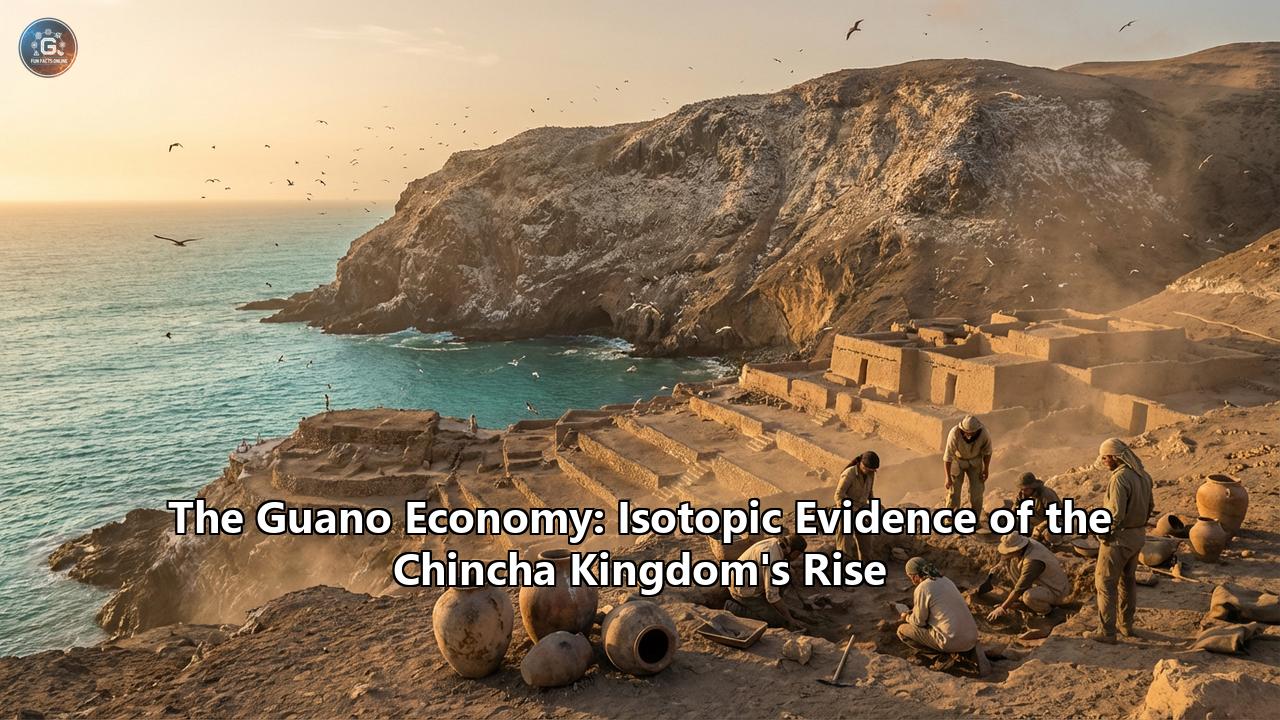
When we envision the spectacular wealth of ancient South American civilizations, our imaginations are instantly drawn to the gleaming artifacts housed in modern museums. We picture the intricate gold masks of the Chimú, the silver ornaments of the Moche, and the flawless ashlar masonry of the Inca. Yet, the foundation of true geopolitical power in the pre-Columbian Andes was not forged from precious metals. It was built upon something far less glamorous but infinitely more valuable to human survival: seabird excrement.
A groundbreaking multidisciplinary study published in the journal PLOS One in February 2026 has radically reshaped our understanding of early Andean statecraft. By conducting advanced stable isotope analyses on ancient agricultural remains, a coalition of researchers has provided the strongest evidence to date that the sociopolitical and economic expansion of Peru’s pre-Inca Chincha Kingdom was fueled by the systematic harvesting and application of seabird guano. Long before the industrialized chemical fertilizers of the modern era, Indigenous populations living in one of the world's most extreme desert environments engineered a thriving, surplus-driven economy powered entirely by bird droppings.
This revelation is more than an agricultural footnote; it is a profound testament to ancient ecological mastery. It explains how a coastal society managed to support tens of thousands of people, dominate regional trade, and ultimately negotiate terms of surrender with the mighty Inca Empire from a position of undeniable strength.
The Environmental Crucible of the Chincha Valley
To understand the magnitude of the Chincha Kingdom’s achievement, one must first understand the unforgiving geography they called home. The Chincha Valley is situated along the southern coast of modern-day Peru, a region dominated by a hyper-arid coastal desert. Trapped between the towering, rain-shadowing peaks of the Andes Mountains to the east and the Pacific Ocean to the west, this strip of land experiences almost no annual rainfall.
Agriculture in this environment is an exercise in defiance. Ancient farmers relied entirely on the seasonal meltwater rushing down from the Andean highlands, carefully managing river irrigation networks to breathe life into the barren sand. However, water alone cannot sustain intensive farming. The sandy soils of the Peruvian coast are exceptionally porous and naturally nutrient-poor. Without continuous replenishment, the soil is quickly exhausted, and crop failure is a mathematical certainty.
Yet, the very geographical features that made the land so hostile provided an extraordinary counterbalance in the ocean. Just off the coast flows the Humboldt Current, a cold, nutrient-rich upwelling that sweeps northward from Antarctica. This current creates one of the most productive marine ecosystems on the planet, teeming with phytoplankton, zooplankton, and massive schools of small fish like the Peruvian anchoveta. This explosive marine food web sets the stage for the creation of what 19th-century European and American merchants would later dub "white gold".
The Avian Architects of an Empire
Located a mere 25 kilometers (about 15 miles) offshore from the Chincha Valley lie the Chincha Islands—a cluster of rocky, barren outcrops. While inhospitable to humans, these islands have served for millennia as a sanctuary for millions of seabirds. Three species, in particular, are the undisputed champions of the guano ecosystem: the Guanay cormorant (Leucocarbo bougainvilliorum), the Peruvian booby (Sula variegata), and the Peruvian pelican (Pelecanus thagus).
Feasting endlessly on the bounty of the Humboldt Current, these birds return to the islands to nest, depositing staggering quantities of nutrient-dense waste. In most other climates, frequent rains would dissolve these droppings, washing the valuable nutrients back into the sea. But on the rainless Chincha Islands, the excrement simply bakes in the sun. Over centuries, it accumulates into towering, mountainous deposits.
Because the seabirds feed almost exclusively on marine life, their guano is uniquely saturated with nitrogen, phosphorus, and other essential minerals. Nitrogen is the critical engine of plant growth, and seabird guano boasts a nitrogen concentration that eclipses the manure of terrestrial livestock by orders of magnitude. It is, quite literally, the most potent natural fertilizer on Earth.
Unlocking the Past with Chemical Fingerprints
Historians and archaeologists have long theorized that the ancient inhabitants of the Chincha Valley must have utilized guano to sustain their large populations, but definitive archaeological proof was elusive. The organic nature of fertilizer means it quickly breaks down and vanishes from the archaeological record. To solve this mystery, researchers had to look at the microscopic, chemical level.
The 2026 PLOS One study brought together an international team of experts, led by researchers at the University of Sydney, the Smithsonian Institution’s National Museum of Natural History, Texas A&M University, and the University of California, Merced. The team turned to the Skeletal and Environmental Isotope Laboratory (SEIL) at UC Merced to prepare and analyze fragments of late pre-Hispanic maize (corn) cobs.
The researchers examined 35 ancient maize cobs recovered from 26 tombs across 14 cemeteries in the Chincha Valley. These artifacts spanned a vast timeline, from the late Formative period (around 200 BCE) all the way through the Colonial period (ending around 1825 CE). To establish a local chemical baseline, they also analyzed the collagen from the bones of 11 ancient seabirds, including pelicans, cormorants, and penguins, excavated from nearby archaeological sites.
The scientific key to this investigation was stable isotope analysis—specifically the measurement of nitrogen ($\delta^{15}N$), carbon ($\delta^{13}C$), and sulfur ($\delta^{34}S$) ratios.
In ecology, the isotope Nitrogen-15 ($\delta^{15}N$) acts as a dietary tracker. As energy moves up a food chain—from phytoplankton to small fish, to larger fish, and finally to apex predators like seabirds—the lighter Nitrogen-14 isotope is excreted, while the heavier Nitrogen-15 accumulates in the organism's tissues. Because marine food webs are highly complex and contain more trophic levels than terrestrial webs, marine apex predators possess exceptionally high levels of Nitrogen-15.
When seabird guano is applied to a farmer's field, the crops absorb these marine-derived nutrients through their root systems, permanently encoding the seabird's chemical signature into the plant's cellular structure.
The Staggering Results
When the UC Merced team ran the isotopic analyses, the numbers were definitive. In a natural, unfertilized environment, terrestrial crops typically exhibit nitrogen isotope values below +10‰. However, the maize recovered from the Chincha tombs told a radically different story.
Thirteen of the sampled maize cobs exhibited nitrogen values at or above +20‰, an astronomical level that no natural terrestrial process or standard livestock manure can produce. About half of the samples showed extremely high $\delta^{15}N$ values, with some peaking at a staggering +27.4‰. These readings perfectly match crops grown experimentally with seabird guano, as well as earlier archaeological findings from northern Chile.
The radiocarbon dating and isotopic patterns provided hard evidence that Indigenous communities in the Chincha Valley were systematically applying marine guano to their fields by at least 1250 CE. This agricultural innovation predated the arrival and dominance of the Inca Empire by more than a century.
The researchers also tested sulfur isotopes ($\delta^{34}S$) in hopes of finding another marine marker. While the sulfur levels were consistent with experimental data from guano-fertilized plants, they did not show the same explosive enrichment as the nitrogen. The scientists noted that the sandy Chincha soils are highly prone to leaching. The historical practice of heavily flooding fields via irrigation canals right after applying guano likely washed away much of the water-soluble sulfur before the maize plants could fully absorb it, making nitrogen the far more reliable indicator.
An Economy Built on "White Gold"
The systematic use of guano was not a marginal practice; it was the catalyst for massive socio-political transformation. By leveraging the nutrients from the ocean to fertilize the desert, the Chincha Kingdom sustained a densely packed population of over 30,000 tribute-paying citizens.
The logistics of this operation speak to a highly organized, complex society. Fisherfolk and laborers had to brave the open ocean, sailing 25 kilometers offshore on rudimentary balsa wood rafts to reach the rugged Chincha Islands. Once there, they mined the hardened, toxic deposits of excrement by hand and transported the heavy loads back to the mainland. The guano was then meticulously distributed to farmers and applied to the elaborate irrigation networks.
This hyper-productive agricultural system yielded a massive surplus of maize, which had cascading economic effects. Free from the constant threat of starvation, the Chincha people were able to diversify their labor force into specialized guilds of farmers, fisherfolk, and long-distance merchants. Surplus crops and excess fertilizer were loaded onto llama caravans and exported across the Andes, generating incredible wealth and transforming the Chincha Kingdom into a formidable economic superpower.
This deep ecological integration was immortalized in their culture. Archaeological artifacts from the Chincha Kingdom—including textiles, painted ceramics, architectural friezes, and carved wooden balance-beam scales—frequently feature intertwined motifs of seabirds, fish, and sprouting maize. These depictions were not mere artistic flourishes; they were a profound acknowledgment of the ecological loop that kept their civilization alive.
Diplomacy, Power, and the Inca Empire
The immense wealth and agricultural stability of the Chincha Kingdom made them an attractive partner—and an inevitable target—for the expanding Inca Empire. By the early 1400s, the Inca were rapidly absorbing neighboring societies across the Andes. Usually, civilizations that resisted were crushed by the overwhelming military might of the Inca war machine.
However, the Chincha Kingdom's integration into the Inca Empire was uniquely bloodless. Historical accounts describe it not as a military conquest, but as a peaceful capitulation and strategic negotiation. The Chincha held unparalleled leverage: they controlled the guano.
The Inca state was heavily reliant on maize, not just as a staple food, but as the primary ingredient for chicha, a fermented alcoholic beverage central to Inca religious ceremonies, political feasting, and the payment of the mita (state labor) system. Because the freezing, high-altitude environments of the Andean highlands severely limited large-scale maize cultivation, the Inca desperately needed the immense, guano-fueled agricultural output of the coastal valleys.
By maintaining control over the guano trade, the Chincha secured an elite, privileged status within the Inca political hierarchy. The sheer prestige of the Chincha leadership was documented by Spanish conquistador Pedro Pizarro. In 1532, when Francisco Pizarro’s forces ambushed and captured the Inca Emperor Atahualpa at the Battle of Cajamarca, Pedro Pizarro noted a striking detail: of all the thousands of nobles present, the Lord of Chincha was the only dignitary beside the Emperor himself permitted to be carried into the plaza on a royal litter. That physical elevation was the ultimate symbol of status, power, and wealth—all of it rooted in bird droppings.
Recognizing the existential importance of the guano supply, the Inca eventually implemented strict state control over the Chincha Islands. They established what may be some of the earliest and most severe environmental conservation laws in human history. Access to the islands was heavily restricted, particularly during the birds' breeding seasons, and harming or killing a guano-producing seabird was a criminal offense punishable by death.
Rewriting Archaeological Methodologies
Beyond the fascinating historical narrative, the 2026 PLOS One study has sent ripples through the methodology of modern archaeology. For decades, bioarchaeologists have used stable isotope analysis of human skeletal remains (such as bone collagen and hair) to reconstruct the paleodiets of ancient peoples.
Traditionally, a high Nitrogen-15 ($\delta^{15}N$) reading in human remains was interpreted as clear evidence of a heavily marine-based diet. If a skeleton had a massive nitrogen spike, researchers assumed that person spent their life eating fish, seals, and other oceanic resources.
However, the Chincha Valley findings introduce a massive complication. The researchers at UC Merced processed human hair from the Chincha archaeological sites and found the same elevated nitrogen isotopes. Because the Chincha heavily fertilized their maize with marine guano, the crops absorbed the marine chemical signature. When humans ate that maize, they absorbed the signature as well.
This means that ancient coastal populations might not have been eating nearly as much seafood as previously believed; they may have simply been eating massive quantities of guano-fertilized terrestrial crops. This revelation forces archaeologists worldwide to reevaluate dietary reconstructions in any region where marine fertilizers might have been utilized, highlighting the intricate, hidden ways that human ecosystems overlap.
Ancient Wisdom for a Modern Climate Crisis
The story of the Chincha Kingdom is more than a fascinating window into pre-Columbian politics; it is a highly relevant case study for the modern world.
In the 19th century, European and American powers "rediscovered" the fertilizing power of Peruvian guano. This sparked a global frenzy known as the Guano Age. Nations went to war over control of the islands, and the United States even passed the Guano Islands Act of 1856 to aggressively annex unclaimed, guano-rich islands across the Pacific. However, unlike the sustainable, culturally integrated practices of the Chincha and the strict conservation laws of the Inca, the 19th-century extraction was ruthlessly exploitative. Mining operations were highly toxic to the laborers, the bird populations were decimated, and the islands were rapidly stripped bare of a resource that took millennia to accumulate.
Today, global agriculture relies almost entirely on synthetic, petroleum-based fertilizers created via the Haber-Bosch process. While these chemical fertilizers have allowed the human population to boom, they have also severely degraded soil microbiomes, polluted global waterways with toxic runoff, and contributed massively to greenhouse gas emissions.
"The origins of fertilization are important because soil management allowing large-scale crop production would have been key to allowing population growth," noted Emily Milton, an environmental archaeologist at the Smithsonian and co-author of the study.
The ancient practices of the Chincha Kingdom demonstrate that it is entirely possible to sustain dense human populations, build complex economies, and manage large-scale agriculture by working with natural, localized ecological cycles rather than overriding them with synthetic chemicals. They looked at the inhospitable coastal desert, looked at the rocky islands covered in bird waste, and possessed the ingenuity to link the two together into an engine of incredible prosperity.
The isotopic legacy left behind in those 800-year-old maize cobs forces us to reconsider what we value. True wealth is not found in the gold that adorns the dead, but in the profound, ecological knowledge that sustains the living. The Chincha Kingdom proved that with deep environmental understanding, even the most barren desert can be transformed into an empire.
Reference:
- https://archaeologymag.com/2026/02/seabird-guano-fueled-rise-of-chincha-kingdom/
- https://www.eurekalert.org/news-releases/1117161
- https://journals.plos.org/plosone/article?id=10.1371/journal.pone.0341263
- https://arkeonews.net/how-seabird-guano-built-a-powerful-pre-inca-kingdom-in-peru-800-years-ago/
- https://www.vice.com/en/article/how-bird-poop-helped-make-ancient-peru-a-superpower/
- https://www.anthropology.net/p/bird-droppings-and-political-power
- https://bioengineer.org/seabird-guano-fertilized-perus-chincha-valley-by-1250-ce-boosting-pre-inca-societal-growth/
- https://repo.enc.edu/2026/02/11/the-ancient-peruvian-civilization-capitalized-on-the-harvesting-of-guano/
- https://www.thecooldown.com/outdoors/ancient-peru-agriculture-guano-fertilizer/
- https://www.forbes.com/sites/grrlscientist/2026/02/16/did-seabird-guano-shape-the-expansion-of-perus-pre-inca-society/
- https://www.theportugalnews.com/news/2026-02-21/seabird-fertiliser/974479
- https://latinamericanpost.com/science-technology/perus-ancient-guano-farms-offer-climate-lessons-for-today/