
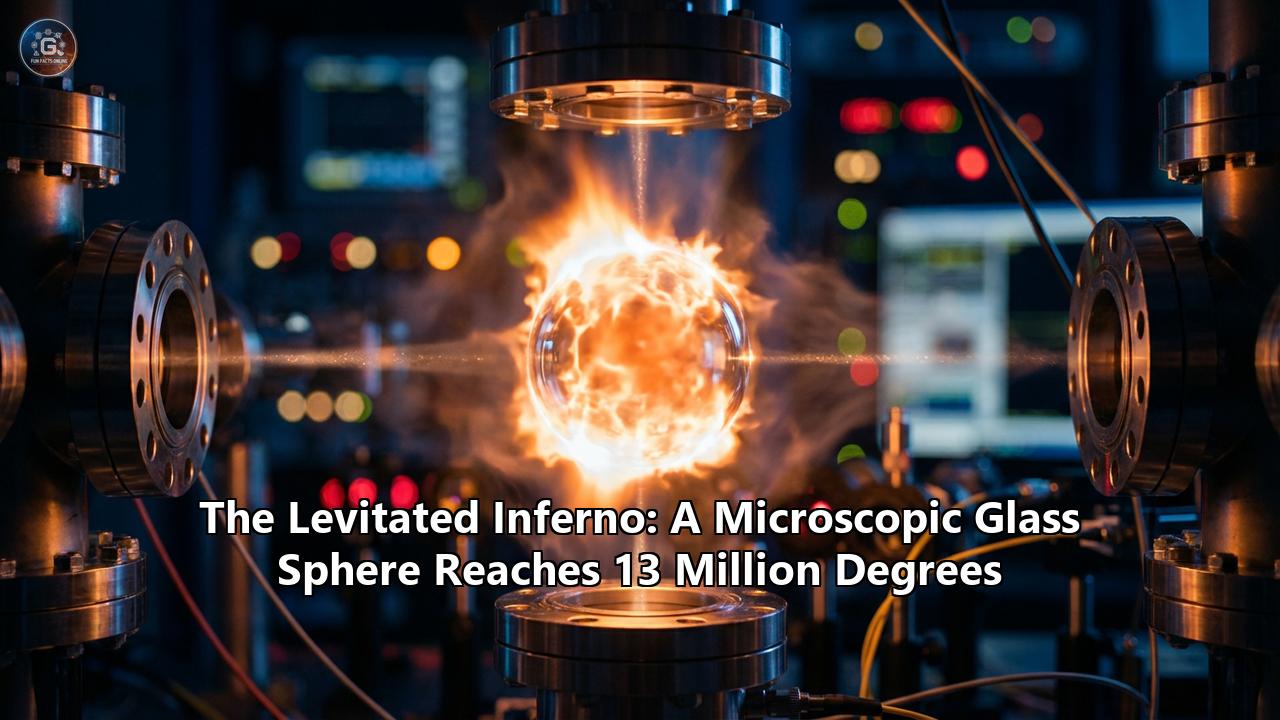
In the quiet, dust-free expanse of a high-vacuum chamber at King’s College London, a speck of glass invisible to the naked eye has just achieved the impossible. It has not melted, nor has it vaporized. It remains a solid, perfect sphere of silica, just five micrometers wide. Yet, according to the laws of physics, this tiny bead is currently experiencing an environment hotter than the center of the sun.
In October 2025, a team of physicists led by Dr. James Millen and doctoral researcher Molly Message shattered records and intuitions alike by creating the "hottest heat engine" ever observed. By suspending a microscopic glass sphere in an electric field and subjecting it to a precise, chaotic bombardment of noise, they drove the particle’s motion to an "effective temperature" of 13 million degrees Celsius.
This achievement is not just a triumph of temperature; it is a gateway into the bizarre and counterintuitive world of non-equilibrium thermodynamics. It offers a new lens through which to view the molecular machines that power our own bodies, potential avenues for quantum computing, and a deeper understanding of how the universe behaves when pushed to its absolute limits.
The Paradox of Heat: When Glass Doesn't Melt
To understand how a piece of glass can withstand temperatures that would vaporize steel, one must first dismantle the everyday concept of "heat."
In our macroscopic world, temperature is a measure of the average kinetic energy of the atoms shaking inside a material. If you heat a glass marble to 1,000°C, the silicon and oxygen atoms within it vibrate so violently that they break their chemical bonds, turning the solid into a liquid.
But in the realm of levitated optomechanics, physicists speak of two distinct temperatures.
- Internal Temperature: This is the thermal energy of the atoms inside the sphere. In the King's College experiment, the glass sphere stays at a comfortable room temperature (roughly 20°C).
- Center-of-Mass (CoM) Temperature: This measures how much energy the entire sphere has as it flies around its trap. If the sphere is perfectly still, its CoM temperature is near absolute zero. If it is thrashing violently back and forth, its CoM temperature skyrockets.
Dr. Millen’s team used an electric field to trap the charged glass sphere, levitating it in a vacuum so deep that air molecules were virtually non-existent. This isolation meant there was no air friction to slow the sphere down. They then injected a "noisy" voltage signal into the trap—essentially giving the sphere a random series of violent electrical kicks.
The sphere responded by jittering wildly, accumulating massive amounts of kinetic energy. If you were to calculate the temperature required to make a gas molecule move with that same chaotic energy, the answer would be 13 million degrees Celsius.
"It is moving as if you had put this object into a gas that was that hot," explains Dr. Millen. "It moves around like crazy."
Yet, because the sphere is floating in a vacuum, this "inferno" of motion cannot transfer its energy to the internal atoms of the glass. The two temperatures are decoupled. The sphere is a paradox: a room-temperature object living a 13-million-degree life.
The World’s Hottest Heat Engine
The significance of reaching 13 million degrees goes far beyond a flashy headline. The researchers used this high-energy state to build a microscopic heat engine.
A heat engine is any device that converts thermal energy into mechanical work. Your car engine is a heat engine; it takes heat from exploding gasoline and turns it into the rotation of wheels. The efficiency of any heat engine depends on the temperature difference between its "hot" source and its "cold" sink. The greater the difference, the more efficient the engine can theoretically be.
In this microscopic experiment, the "hot source" was the active electrical noise driving the particle to 13 million degrees. The "cold sink" was the inherent damping of the trap (or a "cooling" feedback loop). By cycling the particle between these states—expanding and compressing the trap, much like a piston in a car cylinder—the researchers created a functioning engine at the microscale.
Shattering the Carnot Limit?
Classic thermodynamics tells us that engines have a maximum theoretical efficiency, known as the Carnot limit. But at the microscopic scale, the rules begin to blur.
"Thermodynamics down at the microscale is really, really weird," says Dr. Millen. "I really think it's as unintuitive as something like quantum mechanics."
Because the engine consists of just a single particle, it is subject to the whims of statistical probability. In a car engine, trillions of gas molecules average out to produce predictable pressure. In the single-particle engine, random fluctuations can dominate.
The team observed moments where the engine achieved efficiencies that seemed impossible, and other moments where it ran in reverse—taking in heat and cooling down, or performing work without a clear input, effectively defying the Second Law of Thermodynamics for brief, fleeting instants. These violations don't break physics; they are predicted by fluctuation theorems, which state that while entropy must increase on average, small systems can occasionally "borrow" order from the universe, provided they pay it back later.
Why 5 Micrometers Matters
The choice of a 5-micrometer sphere (about 1/20th the width of a human hair) was deliberate. In the world of levitated physics, size dictates the regime.
- Nanospheres (100nm): These are small enough to be cooled to the quantum ground state. Researchers at ETH Zurich and the University of Vienna have successfully frozen the motion of these nanospheres to the point where they exhibit quantum wave-like properties.
- Microspheres (5µm): These are massive by comparison. They sit firmly in the classical world but are small enough to be highly sensitive to forces.
The 5-micrometer size allowed the King's College team to bridge the gap between atomic physics and biological machinery. This size scale is roughly the same as many biological cells and organelles.
"The researchers hope that their engine could help scientists study tiny, biological engines such as kinesin," reports Science News. Kinesin is a motor protein that "walks" along molecular tracks inside your cells, dragging cargo. It operates in a storm of thermal noise, constantly bombarded by water molecules. By simulating this chaotic environment at 13 million degrees, physicists can scale up the "noise" to better understand how biological motors retain high efficiency despite the storm.
The Technology Behind the Inferno
Creating this levitated inferno requires a symphony of lasers and electric fields.
1. The Paul Trap:Unlike optical tweezers which use light to hold a particle, this experiment utilized a Paul Trap (or quadrupole ion trap). This device uses oscillating electric fields to confine charged particles. It is the same technology used in mass spectrometers and trapped-ion quantum computers. The Paul Trap allows for much deeper "potential wells" than optical traps, enabling the sphere to hold the massive energy required for 13 million degrees without escaping.
2. Active Feedback:The "temperature" is artificial. It is created by a feedback loop. Sensors monitor the particle's position with nanometer precision. A computer calculates the exact "kick" needed to increase its energy and sends a voltage spike to the electrodes. This active feedback can be used to cool a particle (by kicking against its motion) or heat it (by kicking with its motion).
Dr. Millen's team simply turned the "heat" knob to eleven—and then kept turning until they hit 13 million.
3. The Vacuum:The experiment takes place in a high-vacuum chamber. At these pressures, the mean free path of a gas molecule is huge. The glass sphere might travel for seconds or minutes without hitting a single air molecule. This isolation is what preserves the energy. If air were let into the chamber, the air molecules would collide with the sphere, stealing its kinetic energy and instantly cooling the CoM motion (while likely heating the internal glass via friction, possibly destroying it).
From Heat to Quantum Gravity?
While the 13-million-degree engine is a triumph of classical thermodynamics, it sits adjacent to one of the Holy Grails of modern physics: Quantum Gravity.
Levitated spheres are currently the most promising candidates for testing whether gravity behaves like a quantum force. The logic is as follows:
- Levitate a massive object (like a glass nanosphere).
- Cool its motion to the quantum ground state (near absolute zero).
- Prepare it in a "superposition"—where it is in two places at once.
- Measure the gravitational field generated by this superposed mass.
If gravity is quantum, the gravitational field should also be in a superposition. If gravity is purely classical, it should not.
The "hot" experiments at King's College complement the "cold" experiments at ETH Zurich. To test gravity, we need massive particles (micrometers, not nanometers) to generate enough gravity to measure. But massive particles are harder to control. Learning to drive a 5-micrometer sphere to 13 million degrees and then control it with extreme precision provides the "handling skills" physicists need to eventually cool these massive giants down to the quantum regime.
The Future of the Levitated Inferno
The immediate applications of this research are fascinatingly diverse:
- Micro-Engines: We are approaching the limits of silicon computing. As transistors shrink, thermal noise becomes a major problem. Understanding how to build efficient engines that run on noise (like the 13-million-degree sphere) could lead to "thermodynamic computing" architectures that recycle heat into information.
- Sensing: A particle moving with such high energy is incredibly sensitive to external disturbances. It could be used as a sensor for dark matter or high-frequency gravitational waves, which would nudge the sphere in detectable ways.
- Material Science: Spinning these spheres at millions of rotations per second (another capability of levitated systems) creates centrifugal forces strong enough to test the ultimate tensile strength of materials, ripping them apart atom by atom to see how they fail.
Conclusion
The 13-million-degree glass sphere is a testament to our growing mastery over the microscopic world. We can now take a speck of dust, levitate it in a void, and command it to dance with the energy of a star or freeze with the stillness of a quantum wave.
It serves as a reminder that "temperature" is just a statistic—a way of describing chaos. And if we can control the chaos, we can build engines that power the next generation of nanotechnology, unravel the mysteries of biological life, and perhaps even unlock the quantum nature of reality itself. For now, however, it remains the hottest, weirdest, and most isolated object on Earth—a tiny, invisible inferno trapped in a box in London.
Reference:
- https://www.sciencenews.org/article/hottest-engine-levitated-glass
- https://www.gadgets360.com/science/news/microscopic-heat-engine-reaches-13-million-c-without-burning-9497017
- https://www.kcl.ac.uk/news/scientists-create-worlds-hottest-engine
- https://www.scribd.com/document/490342939/DepEd-EASE-Modules-Physics-Combined-1
- https://pubs.aip.org/aip/rsi/article-pdf/doi/10.1063/5.0095614/16567765/075109_1_online.pdf