
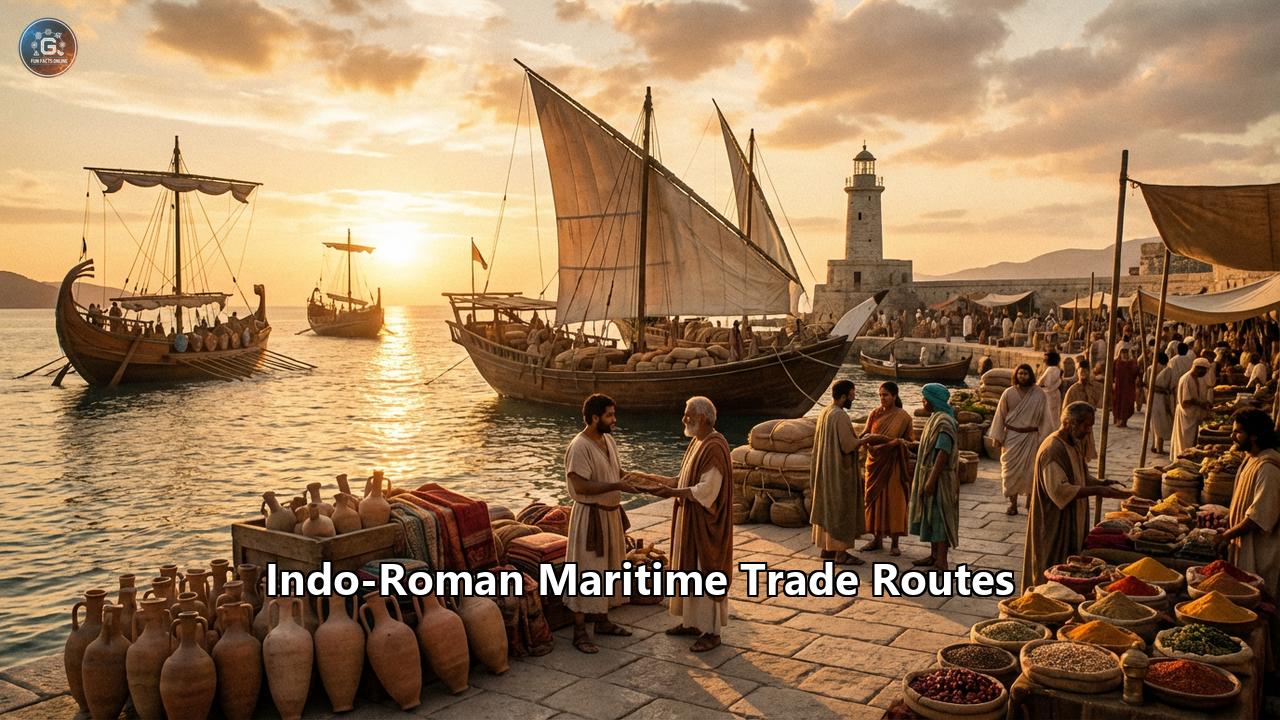
The open ocean has always been a barrier, a vast blue desert that swallows ships and men alike. But for a few glittering centuries at the turn of the Common Era, the Indian Ocean became something else entirely: a highway. It was a bridge of wind and water that connected the two greatest powers of the ancient world—the Roman Empire in the West and the sprawling, wealthy kingdoms of the Indian subcontinent in the East.
This was not a trade of simple necessity. It was a trade of excess, of opulence, and of an insatiable hunger for the exotic. It was a trade that drained the coffers of Rome, built the palaces of Tamil kings, and left behind a legacy of gold coins, broken pottery, and forgotten gods buried in the sands of Egypt and the mud of Kerala.
For centuries, this story was known only through the complaints of grumpy Roman moralists like Pliny the Elder, who lamented the vanity of Roman women and the "drain of gold" to the East. But today, thanks to spectacular archaeological discoveries—from a Buddha statue in a Roman temple in Egypt to a Roman emperor’s face carved into a ring found in an Indian village—we can reconstruct this lost world in vivid detail.
This is the story of the Indo-Roman maritime trade routes: a saga of brave sailors, monsoon winds, and the first true age of globalization.
Part I: The Discovery of the Wind
To understand how Rome and India touched hands across thousands of miles of ocean, we must first look to the wind.
For millennia, sailors hugged the coasts. To sail from the Red Sea to India meant a long, torturous crawl along the harsh coastlines of Arabia and Persia (the Gedrosian coast), risking pirate attacks and running out of fresh water. It was a journey that could take years.
Then came the discovery that changed the world. Greek and Roman sources credit a navigator named Hippalus with "discovering" the monsoon winds in the 1st century BCE. Of course, the sailors of Arabia and India had known these winds for centuries, if not millennia. They knew that in the summer, the violent Southwest Monsoon (the Hippalus wind to the Romans) blew steadily from the Horn of Africa straight toward the Malabar Coast of India. They knew that in the winter, the gentler Northeast Monsoon blew just as steadily back.
Hippalus—or perhaps the collective knowledge of Greek navigators learning from Arab pilots—unlocked the secret for the Mediterranean world. Suddenly, a ship didn't need to hug the coast. It could point its prow into the open ocean, catch the gale-force winds of July, and be blown across the Arabian Sea to India in a mere forty days.
It was a terrifying shortcut. The Southwest Monsoon is not a gentle breeze; it is a howling storm. Roman ships, built of heavy oak and held together with mortise-and-tenon joints, had to be strong enough to surf these massive swells. But the reward was worth the risk. A round trip that once took years could now be completed in under a year.
With the annexation of Egypt by Augustus in 30 BCE, the Roman Empire gained direct access to the Red Sea ports. The door to the East was kicked wide open. Strabo, the Greek geographer, tells us that before Augustus, hardly twenty ships a year ventured into the Indian Ocean. Under Roman rule, that number exploded to 120 ships annually from a single port.
The "Golden Highway" was open for business.
Part II: The Ships—Leviathans of the Ancient Seas
Imagine standing on the docks of Myos Hormos or Berenike on the Egyptian Red Sea coast in roughly 50 CE. The heat is oppressive, a shimmering wall of 40-degree Celsius air. But the harbor is alive with a babble of languages: Greek, Latin, Aramaic, Tamil, and Prakrit.
Dominated the skyline of the harbor are the Roman merchant ships, the corbitae. These were the supertankers of antiquity. Unlike the sleek, oar-driven war galleys (triremes) popular in movies, these were tubby, deep-bellied sailing ships designed for one thing: cargo capacity.
A large corbita could carry up to 1,000 tons of cargo, though 300 to 500 tons was more common. To put that in perspective, 500 tons is roughly the weight of 100 African elephants. These ships had a massive main mast carrying a square sail and a smaller "artemon" sail at the bow to help with steering. They were steered not by a rudder, but by two massive steering oars at the stern.
On the other side of the ocean, the Indian kings had their own impressive fleets. The Periplus of the Erythraean Sea, a sailor’s handbook written by an anonymous Greek-Egyptian merchant in the 1st century CE, describes the vessels of the Tamil country. There were the Sangara, massive double-canoes or catamarans made of hollowed-out logs joined together, perfect for navigating the shallow backwaters and estuaries of the Kerala coast. Then there were the Colandia, great ocean-going vessels that sailed from the Coromandel Coast to Southeast Asia (the fabled "Golden Chersonese"), carrying cargoes of immense value.
These ships were the lifeblood of the trade. They carried more than just goods; they carried people. A typical Roman merchantman heading to India would carry not just the captain and crew, but a small army of archers to fight off pirates, commercial agents representing the wealthy investors back in Alexandria, and perhaps even a few tourists or diplomats.
Part III: The Journey—Berenike to Muziris
Let us reconstruct a typical voyage in the mid-1st century CE.
The journey begins not at the sea, but on the Nile. Goods from Rome—glassware, wine, coral, and vast quantities of gold and silver coins—are shipped up the river to the city of Coptos. From there, a grueling 12-day caravan trek across the Eastern Desert brings the merchants to Berenike.
Recent excavations at Berenike by teams from the University of Delaware and the Polish Centre of Mediterranean Archaeology have revolutionized our understanding of this port. It wasn't just a dusty outpost; it was a cosmopolitan hub. Archaeologists have found peppercorns embedded in the mud floors, Indian-made cooking pots, and teak wood from Kerala ships repurposes as building materials.
In July, the fleet sets sail. The run down the Red Sea is dangerous, filled with coral reefs and contrary winds. They pass through the Bab el-Mandeb, the "Gate of Tears," and enter the Gulf of Aden. Here, at the port of Ocelis or Eudaemon Arabia (modern Aden), they take on fresh water and wait for the monsoon to be just right.
Then, the leap of faith. The ships turn their bows east, away from the comfort of land. The wind hits them like a hammer. For forty days and nights, the ship is driven relentlessly forward. The waves are high, the rain is constant, and the crew lives in a state of perpetual dampness.
Finally, the lookout spots the high peaks of the Western Ghats rising through the mist. They have reached Limyrike—the Malabar Coast.
The target is Muziris. Known today as the lost port (likely located at Pattanam near modern Kodungallur), Muziris was the "First Emporium of India." The Periplus describes it as a city "abounding in ships sent there with cargoes from Arabia, and by the Greeks."
When the Roman ships arrived, they couldn't dock directly at the city due to the shallow river mouth. Instead, they anchored offshore, and small Indian boats rowed out to meet them, ferrying the precious cargo into the bustling city.
Part IV: The Great Exchange—Pepper, Pearls, and Gold
What was all this effort for? What could possibly justify the immense cost and risk of such a voyage?
Imports to Rome (The Indian Exports):- Black Pepper: This was the black gold of antiquity. The Romans were obsessed with it. They put it in everything—meat, fish, fruit, even wine. A warehouse dedicated solely to pepper (the Horrea Piperataria) was built in the center of Rome. The Muziris Papyrus, a stunning document from the 2nd century CE, details the cargo of a single ship, the Hermapollon. It carried ivory, nard (an aromatic oil), and textiles, but the bulk of its value was in pepper. The tax alone on this single cargo was worth millions of sesterces—enough to pay a Roman legion for a year.
- Pearls: Pliny complains that Roman women wore pearls on their fingers, their ears, and even their sandals, "so that the sound of the pearls clashing together might announce their arrival." The best pearls came from the Gulf of Mannar, controlled by the Pandyan kings of Madurai.
- Gemstones: Beryls, diamonds, sapphires, and semi-precious stones like agate and carnelian flowed west. The Romans had an insatiable appetite for engraved gems (intaglios), and Indian artisans in the Deccan were masters of working these stones.
- Ivory & Tortoiseshell: Used for furniture inlays, combs, and luxury items.
- Exotic Animals: The Colosseum needed fodder. Tigers, leopards, and even elephants were shipped to Rome to be slaughtered in the games or kept as status symbols by emperors.
- Gold and Silver: This was the main export. India had little need for Roman finished goods, but it had an endless thirst for bullion. Thousands of Roman gold aurei and silver denarii have been found in hoards across South India. The Tamil kings were so fond of Roman coins that they often didn't melt them down; they simply defaced the emperor’s head (perhaps to show they didn't accept his sovereignty) and used them as high-value currency.
- Wine: The Tamil Sangam literature speaks fondly of the "cool, fragrant wine brought by the Yavanas (Westerners) in their good ships." Amphorae shards found at Pattanam show that Italian and Greek wines were consumed in great quantities by the Indian elite.
- Glass and Coral: Mediterranean red coral was prized in India, believed to have protective properties. Roman glass, technically superior to local varieties, was also in high demand.
- Yavana Women and Guards: In a fascinating cultural twist, Indian kings prized "Yavana" (Greek/Roman) bodyguards. These tall, imposing men in their strange armor were seen as the ultimate status symbol for a Tamil king.
Part V: The Muziris Papyrus—The Receipt that Changed History
For decades, historians debated the scale of this trade. Was it just a trickle of luxury goods for the super-rich? Or was it a major economic engine?
In the 1980s, a piece of papyrus languishing in a Vienna museum changed everything. Known as the Muziris Papyrus, it is a fragmentary loan contract for a maritime trade venture.
The document details a loan taken out by a merchant in Alexandria to finance a shipment from Muziris. It lists the cargo of the ship Hermapollon. The numbers are staggering. The cargo included:
- 60 boxes of nard (aromatic oil) from the Ganges.
- Over 4,000 pounds of ivory.
- Nearly 3,000 pounds of textiles.
- And a massive quantity of pepper.
The total value of the cargo was calculated at nearly 7 million sesterces. To put that in context, a Roman soldier earned about 900 sesterces a year. A wealthy senator needed a fortune of 1 million sesterces to qualify for his rank. The cargo of this one ship was worth the entire net worth of seven Roman senators.
And Strabo said 120 ships sailed a year.
The math implies that the Indo-Roman trade was not a side hustle; it was a cornerstone of the Roman imperial economy. The customs taxes collected at the Red Sea ports may have provided up to one-third of the Roman Empire's total military budget. It wasn't just trade; it was the fuel that kept the legions marching.
Part VI: Cultural Collisions—Buddhas in Egypt, Goddesses in Pompeii
Trade changes people. When you swap goods, you inevitably swap ideas, gods, and art.
The Berenike Buddha:In 2018 and 2022, excavations at Berenike yielded a bombshell: a beautiful marble statue of the Buddha, dated to the 2nd century CE. It is the first Buddha statue ever found west of Afghanistan. It was found in the forecourt of a temple to the Egyptian goddess Isis.
What does this mean? It means there was a settled community of Indian merchants living in Berenike. They were wealthy enough to commission high-quality sculpture (made of Turkish marble, carved locally) and confident enough to set up their own religious icons within the precincts of a Roman temple. They weren't just passing through; they were residents.
The Pompeii Lakshmi:Conversely, in 1938, archaeologists excavating the ruins of Pompeii (buried by the volcano in 79 CE) found a small ivory statuette. For years it was identified as the Indian goddess Lakshmi. Modern scholarship suggests it might be a Yakshi (a female nature spirit), likely carved in the Satavahana kingdom of the Deccan. That this delicate ivory figure traveled 4,000 miles to end up on the bedside table of a Pompeian noblewoman before Vesuvius erupted is a testament to the reach of this trade.
The Yavana Settlements:Tamil Sangam poetry is full of references to the Yavanas. They are described as "harsh-voiced" (perhaps because they didn't speak Tamil), living in their own quarters in the port cities. The poet Nakkirar describes the port of Muziris where "the beautiful ships of the Yavanas... come with gold and return with pepper."
Other poems describe Yavana mercenaries guarding the gates of Madurai, walking around with "whips hidden in their folds of dress," looking terrifying and impressive. There is even a mention of Yavana lamps (likely Roman oil lamps) that burned brightly in the night, a novelty to the Indians.
At the site of Pattanam (Muziris), archaeologists have found a brick structure that looks suspiciously like a Roman warehouse, along with a drain system that mirrors Roman technology. They also found a seal ring with the image of a sphinx—a symbol used by the Emperor Augustus himself.
Part VII: The Decline—Why the Golden Highway Closed
For three centuries, the trade boomed. But by the 3rd and 4th centuries CE, the lights began to flicker.
The decline wasn't sudden, but it was terminal. Several factors conspired to close the Golden Highway:
- The Crisis of the Third Century: Rome imploded. Civil wars, hyperinflation, and plague tore the empire apart. The wealthy elite who bought Indian pearls and pepper saw their fortunes vanish. The purchasing power of Rome collapsed, and with it, the demand for exotic luxuries.
- The Rise of the Sassanians: In Persia, the Parthian Empire was replaced by the aggressive Sassanian Empire. The Sassanians were not content to let Rome monopolize the Indian trade. They began to dominate the Persian Gulf routes and exerted pressure on the western Indian Ocean, disrupting the free flow of Roman ships.
- The Shift to Constantinople: When the Roman capital moved east to Constantinople, the trade routes shifted. The Red Sea route remained important, but the direct, massive fleets of the early empire faded. Trade became more indirect, filtered through Arab and Persian middlemen.
- The Collapse of Western Rome: By 476 CE, the Western Roman Empire was gone. The economic engine that drove the massive consumption of pepper and silk was broken.
The trade didn't stop completely—pepper still reached Europe in the Middle Ages, and Indian merchants still sailed the seas—but the era of direct, industrial-scale contact was over. The great ships rotted, the ports of Berenike and Muziris silted up, and the monsoon winds blew over an empty ocean.
Epilogue: The Legacy
Today, if you walk through the spice markets of Kochi in Kerala, the air still smells of ginger, cardamom, and pepper, just as it did 2,000 years ago. In the museums of Rome, you can see the ivory combs that once groomed the hair of Indian princesses.
The Indo-Roman trade was more than just a commercial exchange. It was proof that the ancient world was not a collection of isolated islands of civilization. It was a deeply interconnected web, where a financial crisis in Rome could bankrupt a merchant in Madurai, and a fashion trend in Alexandria could employ a gem-cutter in Gujarat.
It was the first time in human history that the West and the East looked each other in the eye, not as conquerors, but as customers. And for a brief, shining moment, the Indian Ocean was not a barrier, but a bridge.
Reference:
- https://www.chantrou.net/post/h-170-a-day-in-the-life-of-a-roman-sailor
- https://en.wikipedia.org/wiki/Indo-Roman_trade_relations
- https://www.heritagedaily.com/2023/02/evidence-of-indo-roman-relations/146284
- https://www.thecollector.com/indian-ocean-trade-ancient-rome/
- https://en.wikipedia.org/wiki/Ships_of_ancient_Rome
- https://archaeologicalpaths.com/news/discovery-of-buddha-statue-at-the-red-sea-city-of-berenike
- https://teajcs.com/wp-content/uploads/2022/11/004_TEAJCS-2022-Individual-art-Muziris-Papyrus-Issue-1.pdf
- https://global.oup.com/academic/product/the-indo-roman-pepper-trade-and-the-muziris-papyrus-9780198842347
- https://en.wikipedia.org/wiki/Indo-Roman_relations
- https://cycle.in/blogs/all/indian-heritage-the-indo-roman-trading-history
- https://www.cambridge.org/core/journals/journal-of-hellenic-studies/article/abs/f-de-romanis-the-indoroman-pepper-trade-and-the-muziris-papyrus-oxford-studies-on-the-roman-economy-oxford-oxford-university-press-2020-pp-xxiv-381-illustrations-facsimiles-maps-85-9780198842347/BFDFA1091A7D46299CCFD0937623093C
- https://books.google.com.hk/books/about/The_Indo_Roman_Pepper_Trade_and_the_Muzi.html?id=LK_gyQEACAAJ&redir_esc=y
- https://www.quora.com/I-recently-learned-that-the-Roman-Empire-traded-with-India-Was-there-ever-a-significant-Indian-community-living-in-Rome-Was-there-ever-a-significant-Roman-community-living-in-India
- https://www.reddit.com/r/AskHistorians/comments/18wfik/how_was_india_perceived_by_ancient_romans_is/
- https://en.wikipedia.org/wiki/Berenike_Buddha
- https://news.artnet.com/art-world/buddha-statue-discovered-egypt-2295035
- https://www.smithsonianmag.com/smart-news/buddha-statue-found-berenike-egypt-180982075/
- https://www.shankariasparliament.com/current-affairs/gs-i/ancient-red-sea-route
- https://www.reddit.com/r/AskHistorians/comments/wgt59c/ancient_mediterranean_piracy_was_largely_wiped/