
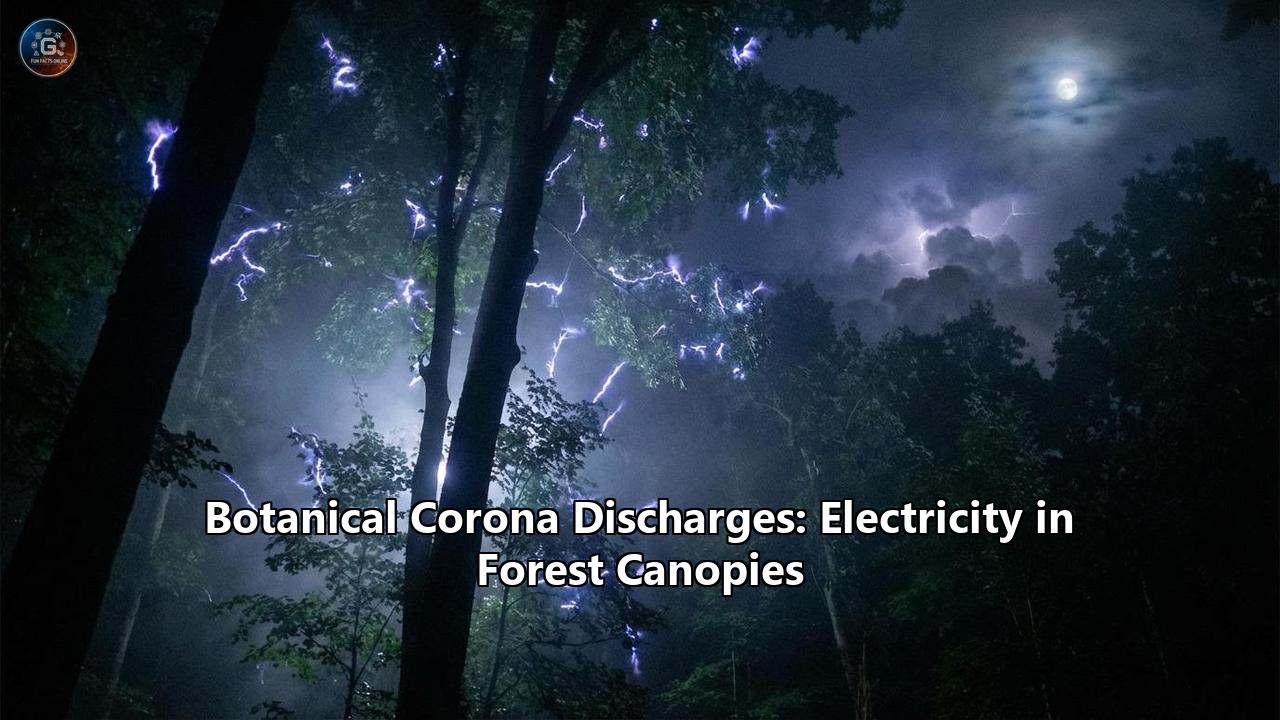
The moment a thunderstorm rolls over a dense forest, the human eye is naturally drawn to the violent, sky-splitting flashes of lightning and the deafening crack of thunder. For centuries, this spectacular display of raw atmospheric power has commanded our absolute attention. Lightning splits immense trunks, ignites widespread wildfires, and momentarily turns the darkest night into day. Yet, obscured by the torrential rain and the dramatic light shows, an entirely different, nearly invisible electrical phenomenon is quietly taking place across the canopy. Trillions of leaves, acting as microscopic lightning rods, are crackling with a cool, blue, and ultraviolet glow. This is the phenomenon of botanical corona discharge—a silent, sparking exchange between the earth and the sky that has profound implications for tree biology, atmospheric chemistry, and the global climate.
For decades, the idea that trees might glow with electricity during a storm was little more than a theoretical musing among physicists and meteorologists. However, thanks to recent breakthroughs in ultraviolet imaging technology and relentless fieldwork by atmospheric scientists, this hidden world has finally been brought into the light. Far from being a rare anomaly, it is now understood that forests experience thousands of subtle electrical flickers during a single storm. These discharges are reshaping the air we breathe, actively scrubbing greenhouse gases from the atmosphere, and subtly altering the physical structure of the trees themselves.
To fully comprehend the magnitude of botanical corona discharges, one must explore the intricate physics of atmospheric electricity, the deep-rooted biology of forest ecosystems, and the highly reactive chemical cauldrons that form above the treetops.
The Earth’s Invisible Electrical Circuit
To understand why a tree would spontaneously emit electricity, we must first look at the planet as a massive, continuously operating electrical circuit. The Earth's surface and the lower edge of the ionosphere (a layer of the upper atmosphere heavily ionized by solar radiation) form the two highly conductive plates of a giant spherical capacitor. The atmosphere between them acts as a dielectric—an insulator that prevents the electrical charge from freely flowing between the two plates.
In fair weather, the Earth carries a net negative charge, while the upper atmosphere carries a net positive charge. This creates a vertical "fair-weather electric field" of roughly 100 to 150 volts per meter near the ground. Because the human body is a relatively good conductor, and because we are electrically grounded when we stand on the earth, we do not feel this voltage; our bodies distort the field lines around us.
However, this relatively calm electrical state is violently upended by the arrival of a cumulonimbus cloud—a thunderstorm. Inside the turbulent environment of a thundercloud, powerful updrafts and downdrafts cause ice crystals, supercooled water droplets, and soft hail (graupel) to collide at high speeds. These collisions strip electrons from the rising ice crystals, passing them to the falling graupel. As a result, the top of the thundercloud becomes highly positively charged, while the lower base of the cloud develops a massive concentration of negative charge.
This intense negative charge at the cloud base violently repels the negative electrons in the ground below it, pushing them deep into the earth and leaving the surface profoundly positively charged. The electric field between the cloud and the ground skyrockets from a mere 100 volts per meter to tens of thousands of volts per meter. The atmosphere desperately wants to resolve this massive imbalance, but air is an excellent insulator. The charge must find the path of least resistance to bridge the gap.
Trees as Electrical Conduits and the Physics of the Corona
Enter the forest. A tree is essentially a giant, water-filled pillar heavily tethered to the ground by an expansive root system. Because the sap and water within the tree contain dissolved salts and minerals, the tree acts as a highly effective electrical conductor. As the massive positive charge builds up in the ground beneath the storm, it travels up through the tree's roots, up the trunk, and out into the branches, rushing toward the highest possible elevation.
If a tree were perfectly smooth and spherical, the electrical charge would distribute itself evenly across the surface. However, trees are complex geometric structures terminating in millions of sharply pointed tips—pine needles, jagged leaf margins, and tiny twigs. In the realm of electromagnetism, sharp points are critical. According to the laws of electrostatics, an electric field becomes immensely concentrated at sharply curved surfaces. The sharper the point, the more densely packed the electric field lines become.
When the electric field at the very tip of a leaf or pine needle becomes incredibly concentrated, it exceeds the dielectric strength of the surrounding air. The field becomes strong enough to literally rip electrons away from the surrounding nitrogen and oxygen molecules. This localized ionization of the air creates a conductive pocket of plasma.
As the electrons are accelerated by the electric field, they crash into other air molecules, knocking more electrons loose in a cascading effect known as a Townsend avalanche. As these excited electrons eventually recombine with molecules or drop back to their normal energy states, they release energy in the form of photons. This localized, glowing pocket of ionized gas is known as a corona discharge.
Unlike a lightning bolt, which is a massive, superheated channel of plasma that fully bridges the gap between the cloud and the ground, a corona discharge is incomplete. It is a slow, steady leak of electricity. The plasma is "cool," with temperatures only slightly above the surrounding air, meaning it does not instantly incinerate the material it touches.
The Maritime Predecessor: St. Elmo’s Fire
While the observation of corona discharges on tree canopies is a remarkably recent scientific triumph, the phenomenon itself has been observed by humans for centuries, albeit in a different context. Historically, this eerie glow was known to sailors as St. Elmo's Fire.
During severe maritime storms, sailors would frequently witness a ghostly, blue-violet flame dancing atop the sharp tips of their ship's masts and rigging. Because the glow produced no heat and did not consume the wood, it was often viewed with superstitious awe. It was named after St. Erasmus of Formia (St. Elmo), the patron saint of sailors, and was alternately considered a divine omen of protection or a harbinger of doom.
The physics governing St. Elmo's fire on a 19th-century galleon is entirely identical to the physics governing botanical corona discharges in a 21st-century forest. In both cases, grounded conductive structures with sharp points are subjected to the intense electric fields of an overhead storm, causing the air around the points to ionize and glow.
Yet, while St. Elmo's fire was relatively easy to spot on the isolated, towering masts of ships against the dark backdrop of the open ocean, observing the same phenomenon on trees proved incredibly difficult. Forests are complex, visually cluttered environments. Thunderstorms bring torrential rain, heavy cloud cover, and violent winds, making it dangerous and difficult to set up delicate optical equipment. Furthermore, the corona glow on a leaf is highly biased toward the ultraviolet spectrum, which is entirely invisible to the naked human eye. It would take a combination of serendipity, modern technology, and persistent scientific curiosity to finally bring the electric forest into view.
The Penn State Breakthroughs: From the Picnic Table to the Field
The journey to definitively proving and measuring botanical corona discharges in wild forests began with a simple, inquisitive conversation. A few years ago, Patrick McFarland, a meteorologist at Pennsylvania State University, was having lunch with his advisor, atmospheric scientist William Brune. As they sat at a picnic table, Brune looked up at the canopy of the tree above them and postulated a simple but profound question: Do those leaves glow during thunderstorms?
Driven by curiosity, the team immediately took a branch into their laboratory. They set up an experiment where the severed branch was connected to a positively charged plate to simulate the charged ground, while a high-voltage plate was suspended above it to simulate the negative charge of a thundercloud. When the room was plunged into total darkness, the results were unmistakable. Faint, ghostly blue and ultraviolet glows flickered at the sharp tips of the leaves and needles.
Proving that leaves could produce a corona in a highly controlled, dry laboratory was a significant step, but the true test was whether this phenomenon actually occurred in the wild, under the chaotic, wet, and windy conditions of a real thunderstorm. Water on the leaves, the constant swaying of branches in the wind, and the unpredictable nature of storm clouds presented massive variables.
To overcome these hurdles, the Penn State research team engineered a highly specialized mobile observatory. They outfitted a van with a multi-component instrument suite, the crown jewel of which was a 25-centimeter diameter telescope paired with a solar-blind ultraviolet camera. This camera was exquisitely sensitive to UV wavelengths between 255 and 273 nanometers, allowing it to see the specific spectrum of light emitted by nitrogen ionization while completely filtering out background light.
Over the course of several years, the team chased storms from Florida to Pennsylvania, hunting for the perfect conditions to point their specialized telescope at the treetops. The pursuit was grueling. Setting up delicate astronomical-grade equipment in the face of an oncoming squall line requires precision, speed, and a great deal of luck.
The definitive breakthrough came during a summer thunderstorm in Pembroke, North Carolina. As dark clouds completely obscured the sky, the researchers trained their UV telescope on the swaying branches of a sweetgum tree and a loblolly pine. For 90 minutes, the camera recorded something that had never before been definitively captured in the wild.
In the resulting footage, the trees appeared to be sparkling. The researchers identified 41 distinct bursts of corona discharge erupting from the sharp tips of the leaves. The sparks did not remain static; as the gale-force winds whipped the canopy, twisting and tilting the leaves, the electric field geometries rapidly shifted. The invisible glow hopped unpredictably from one leaf edge to another, flaring brightest when a leaf pointed most directly toward the sky. Some of the discharges flickered for just a fraction of a second, while others maintained their plasma state for up to three seconds.
The observation, published in the journal Geophysical Research Letters in early 2026, provided concrete, indisputable evidence. Entire swaths of forested land shimmer with invisible electricity during thunderstorms. It was no longer a theory; the canopy was actively bleeding electrical charge into the atmosphere.
The Atmospheric Detergent: Hydroxyl Radicals and Air Chemistry
While the visual discovery of sparkling trees is a stunning testament to the wonders of nature, the true importance of botanical corona discharges lies in what this electricity does to the air. The intense energy localized at the leaf tips acts as a microscopic chemical factory, radically altering the composition of the surrounding atmosphere.
The most critical byproduct of this botanical plasma is the generation of reactive oxygen species, primarily the hydroxyl radical (OH) and the hydroperoxyl radical (HO2).
The hydroxyl radical is a molecule composed of one oxygen atom and one hydrogen atom. Crucially, it possesses an unpaired electron, making it one of the most highly reactive chemical species in the atmosphere. Because it is so reactive, an OH radical typically survives for only a fraction of a second before it aggressively strips an atom from a neighboring molecule. In atmospheric science, OH is universally referred to as the "detergent of the atmosphere" because it initiates the chemical breakdown of numerous pollutants and greenhouse gases, most notably methane and carbon monoxide.
Under normal, fair-weather conditions, hydroxyl radicals are produced primarily by the interaction of ultraviolet sunlight with ozone and water vapor. However, during a thunderstorm, the heavy cloud cover blocks the sunlight, severely dampening this natural photochemical production.
A monumental 2022 study by Jena Jenkins, a postdoctoral scholar at Penn State, fundamentally shifted our understanding of this dynamic. Jenkins and her team demonstrated that the electrical breakdown of air during a corona discharge directly splits atmospheric water vapor (H2O) and oxygen, generating extreme, highly concentrated bursts of OH and HO2.
The laboratory measurements were staggering. The researchers found that the corona discharges generated on tree leaves could cause the localized levels of hydroxyl radicals to spike by 100 to 1,000 times their typical natural baseline. Because forests are naturally moist environments, and thunderstorms provide an abundance of humidity, the air directly above the canopy becomes incredibly rich with these atmospheric detergents.
However, this massive influx of chemical reactivity is a double-edged sword. While the hydroxyl radicals effectively scrub certain pollutants, they simultaneously interact with the vast quantities of volatile organic compounds (VOCs) naturally emitted by trees. Forests constantly exhale invisible chemical compounds—such as isoprene, pinene, and various terpenes—which give pine forests their characteristic scent.
When the extreme concentrations of corona-generated OH radicals collide with these forest-emitted VOCs, they rapidly oxidize them. This chain reaction of rapid oxidation leads to the formation of secondary chemical products, most notably tropospheric ozone (O3) and secondary organic aerosols (SOAs). Tropospheric ozone is a harsh respiratory irritant, and fine particulate matter can significantly impact local air quality, contributing to the hazy smog often seen settling over heavily forested mountain ranges.
Therefore, botanical corona discharges act as a massive, invisible catalyst. They jump-start highly complex chemical reactions in the dark, beneath the storm clouds, completely altering the local air quality and chemical profile of the forest long before the sun comes back out.
The Biological Toll: Scorched Cuticles and Tree Health
As scientists uncovered the vast atmospheric implications of botanical corona discharges, plant biologists began to ask an equally pressing question: How does the tree endure this? While the cool plasma of a corona is far weaker than the instantly vaporizing heat of a lightning bolt, it is still a concentrated stream of highly energetic electrons tearing through the air directly atop living biological tissue.
Through detailed laboratory analysis and microscopic examination of leaves subjected to high electric fields, researchers have discovered that corona discharges are not entirely harmless to the flora that host them. To determine the exact amount of energy transferring through the plant, scientists calibrated their ultraviolet brightness data to measure the physical electrical current. They found that roughly a millionth of an amp flows from a single tree branch during a typical corona flare.
While a microampere sounds minuscule, that entire current is concentrated at an incredibly sharp, microscopic point on the leaf's surface. When leaves were subjected to repeated simulated storms in the laboratory, microscopic scorching and physical tissue degradation were observed at the tips.
More alarmingly, the electrical discharge directly degrades the leaf's cuticle. The plant cuticle is a vital, waxy lipid layer that covers the epidermis of leaves, tree needles, and young shoots. Its primary evolutionary function is to prevent excessive water evaporation from the plant tissues and to serve as a physical barrier against pathogens, fungi, and ultraviolet radiation.
When the plasma of a corona discharge flares atop a leaf, the localized ionic bombardment and the highly reactive ozone generated right at the surface chemically attack and physically ablate this waxy coating. A single thunderstorm might only produce a microscopic blemish—a tiny, invisible scar at the very tip of a single pine needle. However, a mature forest tree may live for centuries and endure thousands of thunderstorms over its lifespan.
Repeated injury to the cuticles across millions of leaves could theoretically expand the surface area susceptible to uncontrolled water loss. In regions where intense thunderstorms are frequently followed by periods of extreme heat and drought, this microscopic canopy damage could compound the tree's water stress, forcing the plant to pull more water from the already depleted soil.
This revelation opens up entirely new avenues of evolutionary botany. Have certain tree species evolved specific leaf geometries to either mitigate or manage the buildup of electrical charge? Do the serrated edges of a sweetgum leaf or the clustered arrangements of pine needles serve an unrecognized electrical purpose, dissipating charge safely to prevent larger, more damaging localized breakdowns? The intersection of electrostatics and plant morphology is only just beginning to be explored.
Global Scale: The Invisible Engine
To fully appreciate the impact of botanical corona discharges, one must zoom out from the microscopic scorching of a single leaf to the macroscopic scale of the global biosphere. The Earth is a heavily forested planet, and it is also a highly stormy one.
At any given second, there are approximately 1,800 active thunderstorms raging across the globe. These storms are disproportionately concentrated over the great terrestrial landmasses, heavily overlapping with the world's most dense forest ecosystems, such as the Amazon basin, the Congo rainforest, the boreal forests of North America and Eurasia, and the temperate woodlands of the United States.
Researchers estimate that there are approximately two trillion individual trees situated in global regions where thunderstorms are a regular meteorological occurrence. When a massive mesoscale convective system (a vast complex of thunderstorms) sweeps across hundreds of miles of the Blue Ridge Mountains or the Amazon basin, it is not merely striking the ground with a few hundred lightning bolts. It is simultaneously inducing billions upon billions of individual corona discharges across an unbroken sea of canopy.
This means that botanical corona discharges are not a fringe anomaly; they are a continuous, globally operating mechanism. The sheer volume of hydroxyl radicals being generated by this process must now be factored into global climate models. For decades, atmospheric chemists have relied on models that calculate the scrubbing of methane and the generation of aerosols based primarily on sunlight-driven photochemistry. The realization that immense, dark swaths of storm-covered forests are actively churning out these exact same chemicals fundamentally rewrites our understanding of the atmosphere's self-cleaning capacity.
The Two-Way Street of Atmospheric Electricity
The relationship between the storm cloud and the forest is not merely a one-way street where the cloud tortures the trees with electric fields. Atmospheric physicists are increasingly realizing that the forest may actively feed back into the dynamics of the storm itself.
As the millions of sharp leaf tips continuously bleed negative ions (or positive ions, depending on the specific charge distribution of the passing cloud base) into the air, they create vast, invisible clouds of unipolar space charge just above the forest canopy. This means the air itself becomes heavily electrified.
During conditions like dense mist or fog, the highly charged aerosol particles created by the corona discharges become trapped near the surface. The liquid water droplets of the mist absorb the gaseous ions, significantly altering the conductivity of the lower atmosphere.
During a full-blown thunderstorm, the continuous upward draft of air—the very winds that feed the storm's power—can catch the charged particles emitted by the canopy and sweep them up into the storm cloud. This influx of electrical charge from the ground could potentially alter the charging mechanisms inside the cloud, subtly influencing where and when massive lightning strikes ultimately occur. In a very real sense, the shimmering forest canopy is deeply intertwined with the life cycle and electrical behavior of the thunderstorm above it.
The Future of the Electric Forest in a Changing Climate
The discovery of botanical corona discharges comes at a critical juncture in Earth's history. As anthropogenic climate change continues to warm the lower atmosphere, it alters the thermodynamic profile of the planet. Warmer air can hold significantly more moisture, and increased surface temperatures provide greater Convective Available Potential Energy (CAPE)—the primary fuel for thunderstorms.
Climatologists widely project that while the overall number of storms may shift regionally, the intensity and frequency of severe thunderstorms are likely to increase in many heavily forested parts of the world. More intense storms mean stronger electric fields, stronger updrafts, and larger areas of the canopy subjected to extreme electrical stress.
As a result, we can reasonably predict that the volume of botanical corona discharges occurring globally will also increase. This creates a highly complex, interconnected feedback loop that scientists are racing to model.
On one hand, an increase in corona discharges means an increase in the production of hydroxyl radicals, the atmospheric detergent. This could theoretically provide a slight buffering effect against climate change by accelerating the breakdown of atmospheric methane, a greenhouse gas roughly 80 times more potent than carbon dioxide in the short term.
On the other hand, the concurrent increase in tropospheric ozone and secondary organic aerosols could exacerbate local air pollution, leading to thicker smog and respiratory hazards for populations living downwind of major forest systems. Furthermore, the increased microscopic damage to the cuticles of leaves could compound the stresses already placed on forests by rising temperatures and prolonged droughts, potentially accelerating forest die-offs in vulnerable regions.
To untangle these complex variables, researchers are now looking to expand their field observations. Future studies aim to deploy autonomous, ruggedized ultraviolet sensors deep within the forest canopy, capable of continuously monitoring electrical discharges without the need for a team of scientists to manually track the storm in a specialized van. By pairing these UV observations with localized air quality sniffers and long-term tree health monitoring, the scientific community hopes to build a comprehensive map of the electric forest ecosystem.
Conclusion: A New Lens on the Natural World
The revelation that the trees outside our windows are sparking with invisible fire during a storm fundamentally alters the way we must view the natural world. It serves as a profound reminder that the environment is not a collection of isolated systems—the atmosphere, the biosphere, and the geosphere are inextricably linked in a continuous, dynamic, and often invisible dance.
For centuries, we looked up at the thunderclouds and marveled at the lightning, completely unaware that the vast green oceans of our forest canopies were silently answering back. The discovery of botanical corona discharges bridges the gap between the macro-scale violence of a storm and the micro-scale chemistry of a leaf.
As we continue to push the boundaries of atmospheric science, armed with solar-blind UV cameras and deep curiosity, we uncover an Earth that is far more alien, complex, and beautiful than we ever imagined. The next time the sky darkens, the wind howls, and the thunder shakes the ground, remember that the lightning is only half the story. Just out of sight, entirely invisible to your eyes, the forest is glowing.
Reference:
- https://www.earth.com/news/trees-release-invisible-electric-sparks-during-thunderstorms/
- https://www.sci.news/biology/thunderstorm-tree-coronae-14586.html
- https://www.researchgate.net/figure/Electric-field-below-the-tree-canopy-at-7-m-fine-curve-and-1-m-bold-curve-from-the_fig1_252115365
- https://nationaltoday.com/us/pa/state-college/news/2026/03/02/invisible-electric-sparks-discovered-emanating-from-trees-during-storms/
- https://www.psu.edu/news/research/story/electric-discharges-leaves-during-thunderstorms-may-impact-nearby-air-quality
- https://timesofindia.indiatimes.com/science/scientists-capture-trees-glowing-with-electricity-during-thunderstorms/articleshow/129501399.cms
- https://www.sciencenews.org/article/tree-sparkle-electricity-thunderstorms
- https://www.researchgate.net/publication/252115365_Electrical_and_chemical_consequences_of_point_discharges_in_a_forest_during_a_mist_and_a_thunderstorm